Most readers describe The Hierophant as "the religion card." That framing keeps people from understanding why it actually appears in modern readings. In a decade of reading with the Rider-Waite-Smith deck, I've drawn The Hierophant for clients who haven't set foot in a temple in twenty years — and the message was the same each time: there is a tradition or structure here you don't get to skip.
This guide covers what The Hierophant really means: the symbolism, upright and reversed readings, how it shows up in love, career, and spiritual questions, plus the questions clients keep bringing me (Yes/No, how it differs from The Emperor, and how Japanese reading culture handles this card differently from most Western interpretations).
Quick Answer
The Hierophant is Major Arcana card V, ruled by Taurus and the element of Earth. Upright, it represents tradition, mentorship, and structured wisdom — the moment to accept teaching rather than improvise. Reversed, it points to either dogma you've outgrown or rebellion that's costing you more than it's freeing. The card is less about religion and more about whether you're willing to be a beginner inside a system that already works.
Basic Information
| Attribute | Details |
|---|---|
| Card Name | The Hierophant |
| Number | V (5) |
| Arcana | Major Arcana |
| Element | Earth |
| Astrological Correspondence | Taurus |
| Yes / No | Yes — with the condition of doing the foundational work first |
| Upright Keywords | Tradition, mentorship, structured learning, shared values, institutional belonging |
| Reversed Keywords | Dogma, restriction, costly rebellion, hollow conformity, spiritual gatekeeping |
Card Imagery & Symbolism
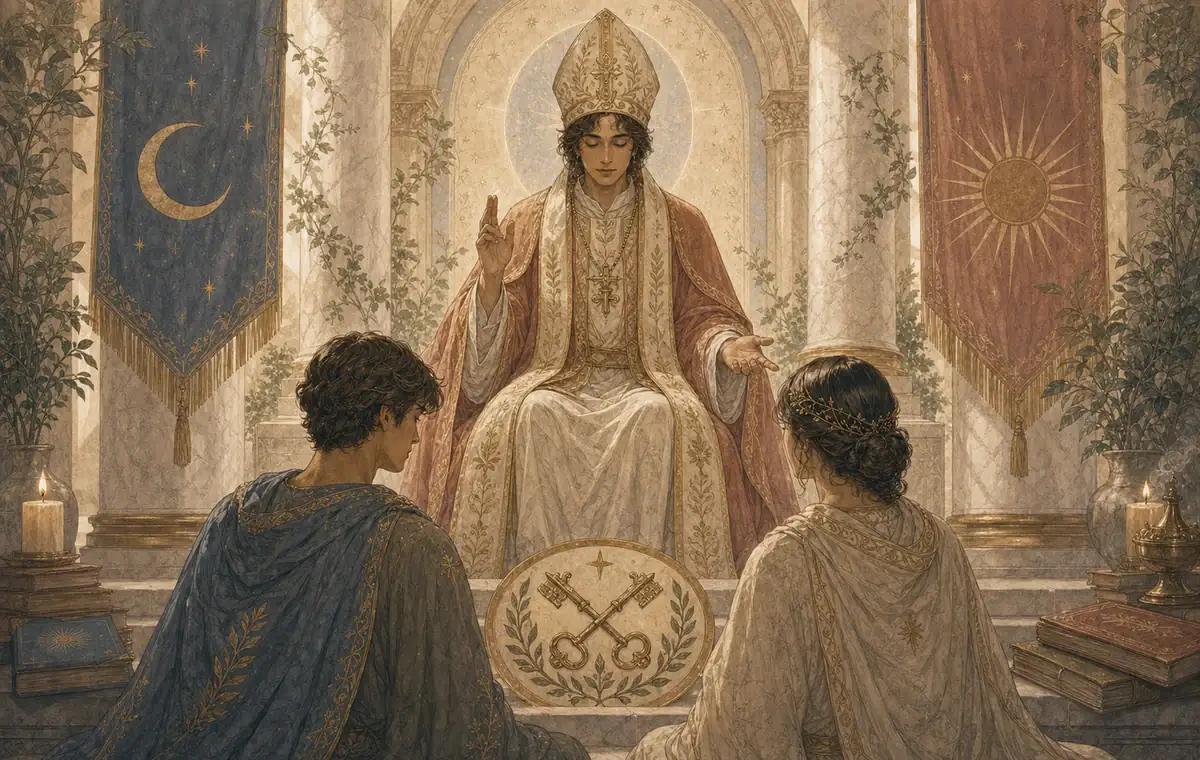
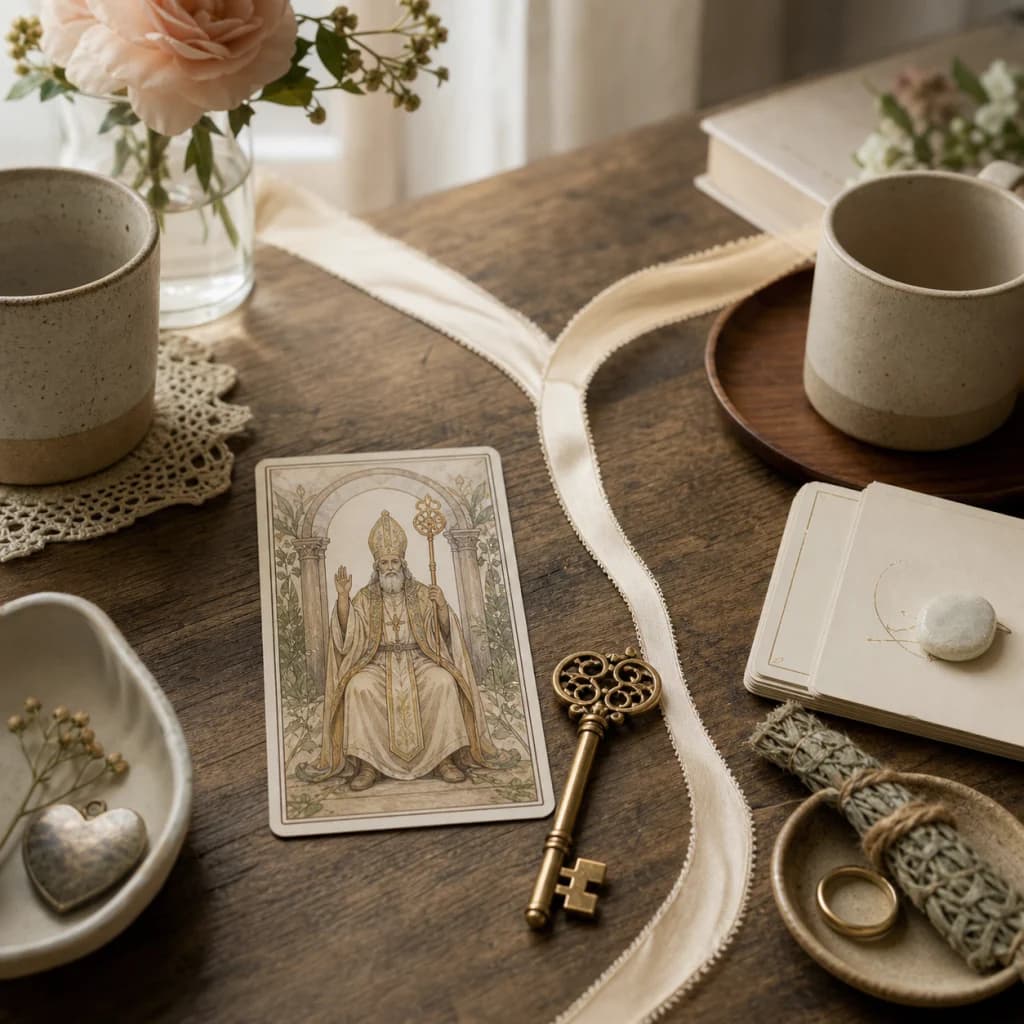
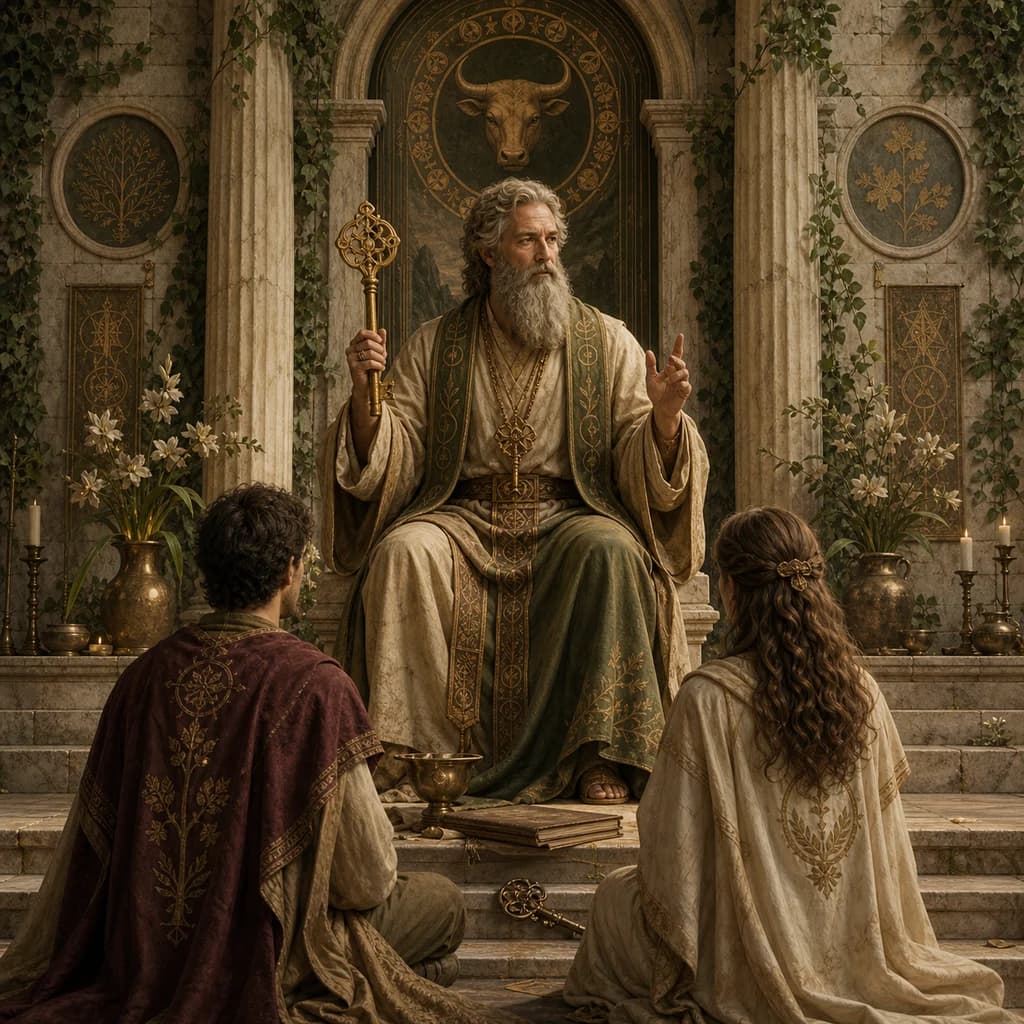
The figure on the card is a religious teacher seated between two pillars, blessing two kneeling initiates. Most articles call him "the Pope," but Pamela Colman Smith's choice was more specific: a hierophant is the priest who reveals sacred knowledge to those entering a mystery school. The role is teaching, not ruling.
The Two Pillars
The pillars echo The High Priestess's, but here they're solid stone — no veil between them. The hidden has become institutional. Where The High Priestess hands you intuition you can't explain, The Hierophant hands you a curriculum you can study.
The Triple Crown and Triple Cross
The three tiers of the crown and the three bars of the cross signal a system with multiple levels of mastery. You don't reach the top by skipping the bottom. This is the card's central practical message — there's an order to the learning.
The Crossed Keys
At his feet, two crossed keys lie unclaimed. They're the conscious and unconscious gates of knowledge, and they require a teacher to hand them over. The image is the opposite of the lone seeker's myth: this card says you do not have to figure everything out alone, and probably shouldn't try.
The Two Initiates
The two students kneeling before him wear robes patterned with roses (passion) and lilies (purity). Smith placed them deliberately — every student brings a different mix of motivation, and the teacher's job is not to flatten that but to channel it.
The Hierophant Upright Meaning
When this card appears upright, it points to a moment when working inside a structure — institutional, traditional, or mentorship-based — will serve you better than going it alone.
Core Upright Keywords
- Tradition — A system that has worked long enough to be worth learning
- Mentorship — Someone who has walked the path is offering to show you
- Structured Learning — Curriculum, certification, apprenticeship over self-teaching
- Shared Values — Belonging to a group whose ethics match yours
- Commitment — Marriage, vows, formal promises
In-Depth Upright Interpretation
The honest read on the upright Hierophant: you are being asked to be a beginner inside something that already exists. This is harder than it sounds. People who reach the point of pulling tarot cards are often the kind of people who built things from scratch, who don't trust institutions, who left organized religion or formal education for good reason. The Hierophant respects that history and asks anyway — is there a tradition here, with people who have done this before, that you could learn from instead of reinventing?
The first time this card came up for me in a major reading, I was deciding whether to study tarot formally with a teacher in Tokyo or keep working from books. I had been reading for six years already. I drew The Hierophant in three positions across two spreads. I took the apprenticeship. The first thing my teacher made me unlearn was half of what I thought I knew. The card was right.
This card often appears for people considering marriage, returning to school, formal therapy, religious return, or joining a professional association. In each case the read is the same: the structure is there because the path has been walked. Walking it in order will cost you less than improvising.
The Hierophant Reversed Meaning
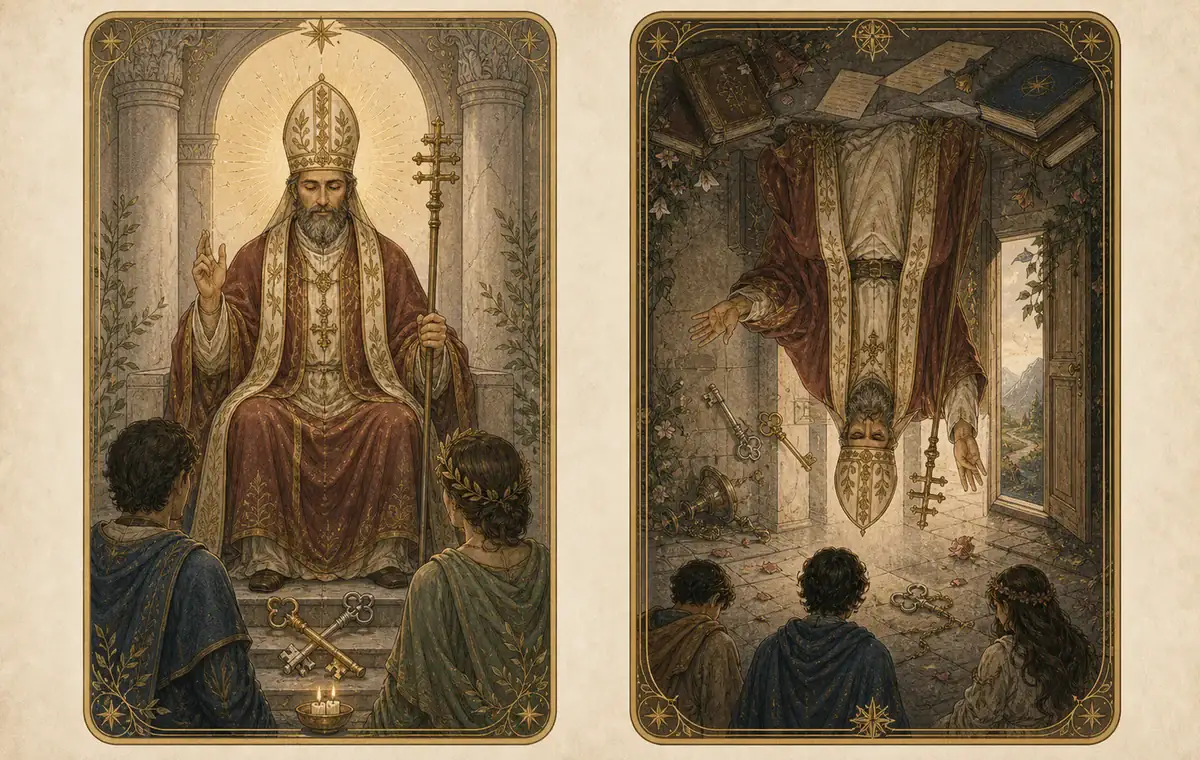
Reversed, the card has two distinct readings and they look opposite from the outside. You have to read the rest of the spread to know which is operating.
Core Reversed Keywords
- Dogma — A tradition that has stopped serving its original purpose
- Hollow Conformity — Following rules you no longer believe in
- Costly Rebellion — Breaking from a structure for reasons you haven't examined
- Gatekeeping — Authority used to exclude rather than transmit
- Personal Spirituality — Building your own framework after leaving an old one
In-Depth Reversed Interpretation
The first reading is "the system has stopped serving." A tradition, mentor, institution, or relationship that once gave you structure has become a constraint. You're following the form but the meaning has drained out. This is the read when the reversed Hierophant comes up around a stale marriage, a degree program you've outgrown, a religious practice that has become performative, or a mentor who's become controlling. The card is permission to leave consciously.
The second reading is "the rebellion is costing you." You're refusing structure for reasons that don't hold up under examination. You won't get the certification because "credentials are gatekeeping." You won't take the apprenticeship because "I'd rather figure it out myself." You won't commit because "labels are limiting." Sometimes these are legitimate; often they're fear wearing the costume of independence. The reversed Hierophant in this position is the card of pyrrhic freedom.
The difference between the two readings is honesty about cost. Leaving a tradition costs something. Refusing one costs something. The card asks you to know which you're paying for.
The Hierophant in Love & Relationships
Upright in a love reading, this is one of the most commitment-oriented cards in the deck. It signals formal partnership — engagement, marriage, moving in together, meeting families — not the chemistry stage. For couples, it points to a relationship maturing into something with vows and shared rituals. For singles, it indicates an upcoming meeting with someone whose values fit yours specifically because you both come from a similar tradition or want the same long-term structure.
Reversed, the most common reading is mismatched expectations about formal commitment. One person wants the ring; the other wants the connection without the ceremony. The second common read: a relationship you've stayed in because of family or religious expectation rather than because you still want it. The card asks for the conversation about whether the form still has meaning. If you're reading it to gauge a specific person's heart, see The Hierophant as someone's feelings for how this commitment-energy actually reads in love.
The Hierophant in Career & Education
This card shows up in career readings more than its reputation suggests. The upright reading is straightforward: advance through credentials, mentorship, and institutional belonging. Take the certification. Find the senior who will sponsor you. Stay long enough to inherit the role.
It particularly favors traditional professions — medicine, law, academia, religious vocations, established corporate ladders — but I've drawn it for entrepreneurs too, in moments when their next move was to join an industry association, take a formal course, or hire a coach who'd walked the same path. The card is not anti-entrepreneurship; it's anti-cowboy.
Reversed in career: time to leave the institution, OR time to stop pretending you'll succeed without learning the basics. Read the spread to know which.
The Hierophant vs. The Emperor: Two Authority Cards
These two get confused constantly. Both depict an enthroned male figure; both deal with authority and structure. The distinction matters in real readings.
The Emperor is the card of personal authority — the structure you build, the rules you set, the kingdom you defend. It's outward-facing. Aries energy: I make the order.
The Hierophant is the card of inherited authority — the structure you join, the tradition you submit to, the teaching you accept. It's relational. Taurus energy: I belong to an order that predates me.
When both appear in a spread, the question is usually about how to relate to a system you didn't build — whether to lead it (Emperor), serve it (Hierophant), or some negotiated combination.
The Hierophant Card Combinations
The Hierophant + The Lovers
The strongest marriage signal in the deck. The Lovers brings the conscious choice; The Hierophant brings the formal vow. In a love reading, this combination often indicates an engagement or wedding within the year.
The Hierophant + The Tower
Religious or institutional crisis. A tradition you've belonged to is about to break apart — leaving a faith, a marriage, a long career, a school. Often the right outcome but rarely a gentle one.
The Hierophant + The Hermit
Spiritual study. Both cards point to depth work; together they often indicate retreats, serious solo learning, or finding a teacher precisely because you've exhausted what self-study can give you.
The Hierophant + The Devil
The shadow side of structure. A tradition or relationship has become coercive. Often appears around controlling religious communities, controlling family expectations, or relationships maintained by guilt rather than choice.
The Hierophant + The Fool
The student question. You're being called into a tradition you have to enter as a complete beginner. The Fool's openness is necessary for the Hierophant's teaching to land. A favorable combination for taking on something genuinely new.
Numerology & Astrological Correspondences
The Meaning of Number 5
The Hierophant is V (5). Five is the number of instability, the threshold between the foundational fours and the integrative sixes. That's why this card sits where it does in the deck — after The Emperor's order and before The Lovers' choice. Five is the moment when the order you inherited starts asking what you'll do with it.
Astrological Correspondence: Taurus
Taurus is an earth sign ruled by Venus. The pairing tells you how this card prefers to work: slowly, sensually, through embodied repetition rather than dramatic conversion. Real Hierophant work — whether spiritual practice, mastery of a craft, or building a long marriage — is Taurean in pace. Years, not weekends.
Frequently Asked Questions
Is The Hierophant a Yes or No card?
Upright: lean toward Yes, but with a condition — yes after you've done the foundational work. For "Should I take the certification?" or "Will the marriage work?" the answer is yes if you're willing to follow through on what the commitment actually requires. Reversed: usually No, or "not in the form you've imagined" — the institutional path may not be the right one for this question.
Does The Hierophant always mean religion?
No, and treating it that way will lead you to miss most of its readings. The card is about any system with accumulated wisdom and a transmission method — therapy traditions, professional fields, martial arts lineages, academic disciplines, even long-running creative communities. Religion is one instance of a Hierophant structure, not its definition.
What if I'm not a "tradition" person — do I ignore this card?
Especially not then. The Hierophant most often appears for people whose first instinct is to do things their own way. When it shows up, the reading is usually pointing at a specific area where independence is costing you. The card respects independence; it just asks you to be honest about when independence becomes isolation.
How does the Japanese tarot tradition read The Hierophant?
In タロット占い, this card is often read through the lens of 「先生」 and 「師匠」 — the teacher-student relationship that runs through every traditional Japanese craft. Where Western readers sometimes treat the card with suspicion (anti-authority instincts run deep in modern English-language tarot), Japanese readers I've trained with tend to read it more neutrally: a system, a teacher, a method that has worked long enough to be worth studying. That framing has stayed with me, and I think it produces more accurate readings than the reflexive "tradition is suspect" approach.
Can The Hierophant indicate timing?
Taurus season runs from late April to late May, and some readers tie The Hierophant to that window. More reliable: this card almost always points to a longer timeframe than the question assumes. If you ask "when will this resolve?" and get The Hierophant, the answer is usually "longer than you want, in the rhythm the tradition requires."
What if I keep getting The Hierophant for the same question?
A repeating Hierophant is usually telling you that the structured path you're avoiding is still the right one. Three months of pulling the same card asking "should I leave?" while the card keeps saying "stay and finish the work" is the universe being patient with you. Either commit to the structure or commit consciously to leaving it. The card stops repeating once you've actually decided.
Closing
The Hierophant is the deck's most underrated card because modern readers project religious baggage onto it. Read clearly, it's the card of accepted apprenticeship — the moment you decide that someone else's hard-won knowledge is worth the cost of being a beginner again.
If you've drawn this card, the question to sit with is not "do I believe in tradition?" but "is there a path here someone has walked, and would learning it in order save me ten years of figuring it out alone?" Most of the time, the honest answer is yes.
Continue with the Major Arcana: read about The Emperor for the personal-authority counterpart to The Hierophant's inherited authority, or The Lovers for the next stage — making a conscious choice within (or against) the tradition you've absorbed.