The Sun is the card every reader is glad to draw, and that gladness sometimes covers up how much is actually happening in the image. "Joy, success, vitality" — true, all true, and so easy to say that the card stops being read. The Sun is not the deck's happy ending. It is a specific structural moment: the arrival of clarity after the night the Moon walked you through. The child on the horse is naked because he has nothing left to hide. The wall behind him is already crossed. The red flag he holds is the same red flag held by the figure of Death — a quiet, hard claim about the continuity of vitality across the deck's most opposing-feeling cards.
This guide reads The Sun the way the Rider-Waite-Smith image was drawn: the wall as something already passed (not something blocking), the red flag's structural echo with the Death card, the white horse as the same horse from Death now reversed in color, the 21 rays (= 21 Major Arcana), the four sunflowers facing the child rather than the sun, and the difference between The Sun and the other "light" cards — The Star and The Moon — that lead up to it.
Quick Answer
The Sun is Major Arcana card XIX, ruled by the Sun itself and corresponding to the sign Leo, with the element of Fire. Upright, it signals clarity, joy, vitality, success, the arrival of light after a difficult passage, and the integration of what the Moon's night revealed. Reversed, it suggests temporary self-doubt, delayed arrival of clarity, or overconfidence that hasn't earned the joy it's claiming. Yes/No: Yes, clearly and warmly.
Basic Information
| Attribute | Details |
|---|---|
| Card Name | The Sun |
| Number | XIX (19) |
| Arcana | Major Arcana |
| Element | Fire |
| Celestial Body | The Sun |
| Zodiac Affinity | Leo |
| Hebrew Letter | Resh (head, face) |
| Yes / No | Yes, clearly |
| Upright Keywords | Joy, clarity, vitality, success, freedom, innocence, integration |
| Reversed Keywords | Temporary self-doubt, delayed arrival, overconfidence, missed warmth |
Why The Sun Comes After The Moon
A short detour before the imagery, because the position is the whole point.
The Sun is XIX. The card before it is The Moon (test of doubt). The card before that is The Star (hope, orientation). The deck has built a careful arc: collapse (Tower) → hope (Star) → test (Moon) → arrival (Sun). The Sun is not where the journey starts. It is where the journey arrives. Reading The Sun as standalone joy — "you're happy now, congratulations" — misses what the position is doing.
This is why The Sun is the deck's most earned card. The joy it carries is post-collapse, post-doubt, post-walk-through-the-towers joy. The naked child on the horse is naked because the previous three cards stripped everything that was not essential. What's left is the version of yourself that survived the night.
I bring this up in every Sun reading because clients often discount The Sun when they're still in pain. They feel they don't deserve the card yet. The card is not asking permission. It is naming the structural availability of joy — whether the feeling has fully caught up or not.
Card Imagery & Symbolism
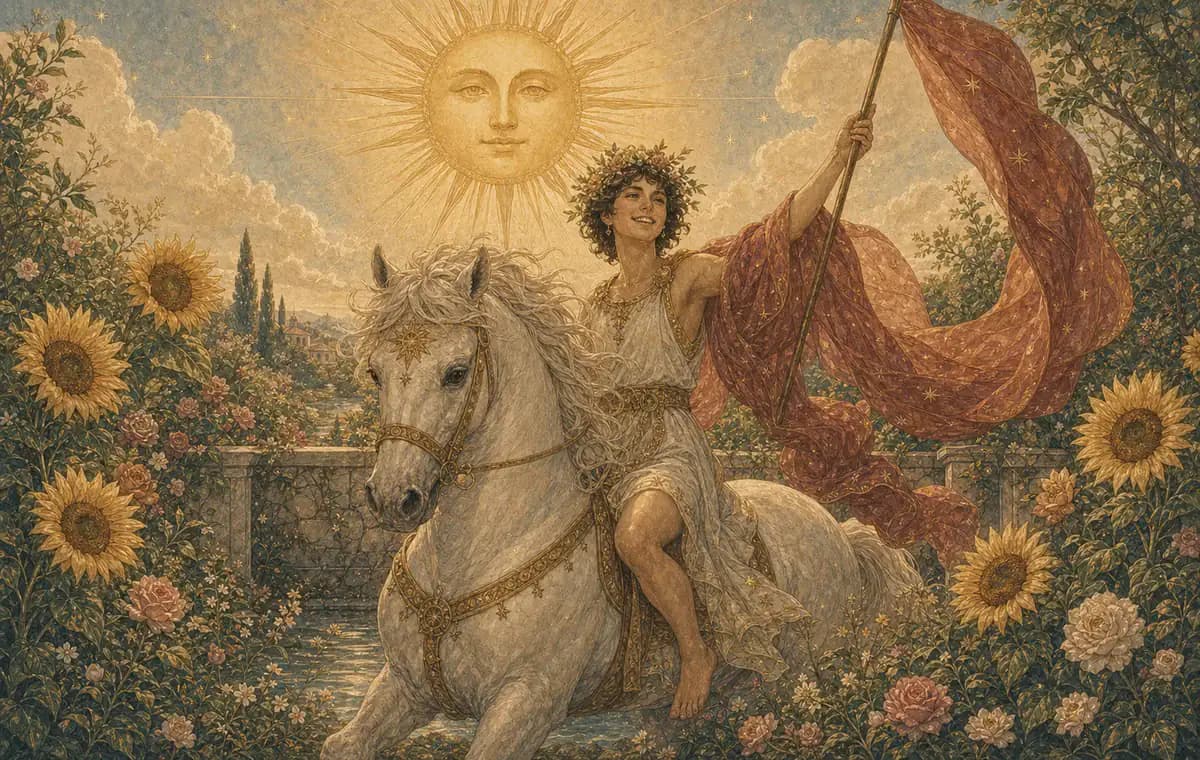
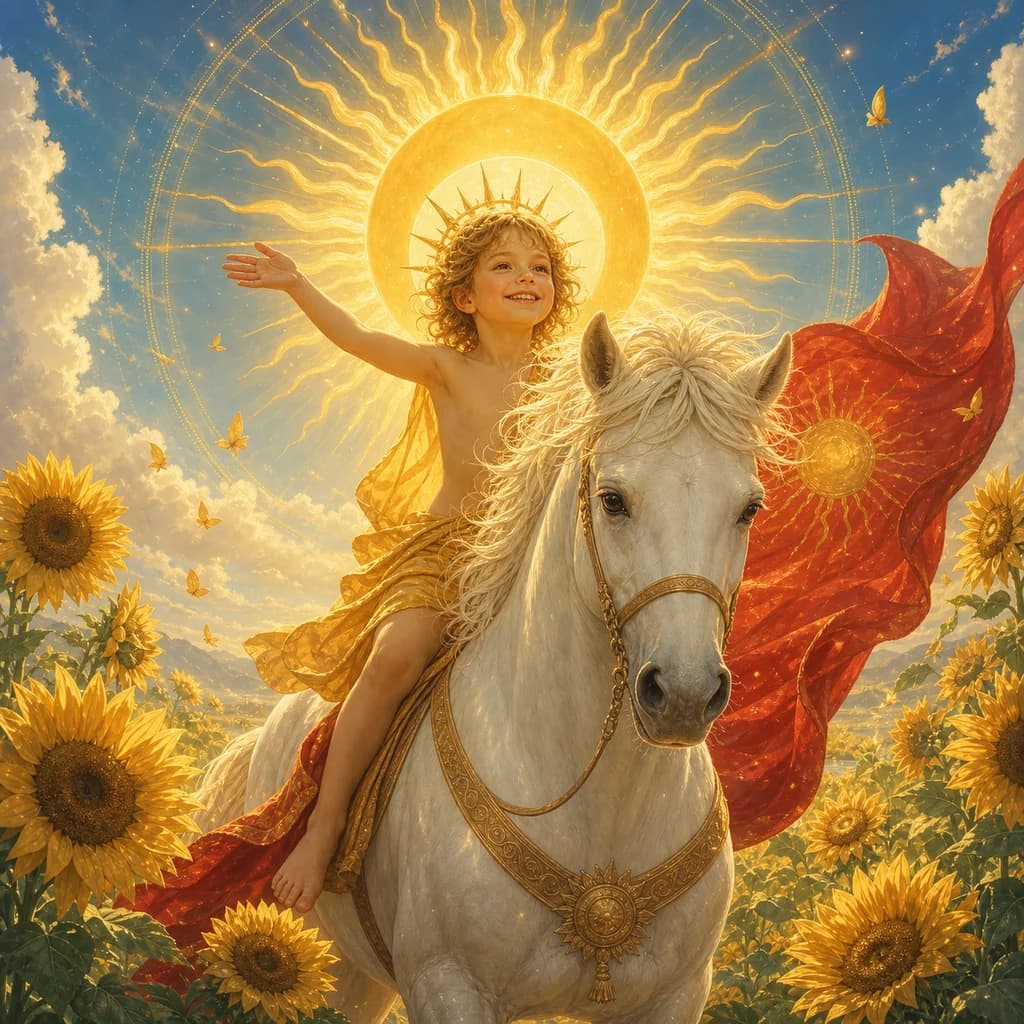
A great sun fills the sky, drawn with 21 alternating wavy and straight rays. Below it, four tall sunflowers grow above a low brick wall. In the foreground, a naked child sits on a calm white horse, holding a long red banner that streams behind him. The child wears a wreath with a red feather. The horse walks forward, calm and unbridled.
Every element of this image is doing structural work.
The Naked Child
A child, fully naked, sitting upright on a white horse without saddle or bridle. Nakedness in the Smith deck signals two things at once: vulnerability and the absence of anything to hide. The Sun's child has nothing to hide because the night has already taken everything that was performance. The child is also unselfconscious — he is not aware of being naked. This is the integration the previous cards were building toward: a state where you are simply yourself, in the world, without the armor of the curated self.
The White Horse (and Where You've Seen It Before)
The horse is white, calm, and bridleless. The reader who is paying attention will notice that this is the same horse the figure of Death rode on card XIII — except Death's horse was pale (sometimes read as bone-white, sometimes as ashen) and bore a different rider. The structural reading is that the horse is constant; what changes is who rides and why. Death's horse carried the figure of inevitable ending; The Sun's horse carries the integrated child. Same vehicle, opposite content.
This cross-reference is almost never made in popular guides. It is one of the most useful tools for reading The Sun in any spread that also contains Death — the two cards are paired by image, not just by theme.
The Red Flag
The child holds a red banner that streams in the wind. This banner is the same red banner that the figure of Death carries on card XIII — same crimson, same shape, same way of being held. The Sun and Death are visually rhymed at this level. The Death card's flag is the flag of the soul's continuity through transformation. The Sun's flag is the same flag in daylight. The banner has not changed. The light around it has.
This is the deck's quiet, hard claim: vitality runs through the deck continuously. Death does not interrupt it. The Sun does not invent it. The same flag flies in both.
The Wall, Already Crossed
Behind the child, a low brick wall runs across the foreground. Most articles read this wall as "limitations being overcome." More precisely: the wall is behind the child and the horse. They have already crossed it. The card is not depicting the moment of overcoming. It is depicting the state after. The Sun is what you find on the other side, in the open field of sunflowers, not the moment of breaking through.
This matters because clients drawing The Sun often think they still need to do the breakthrough work. The card is gently correcting that — the breakthrough is already behind you. What's left is to live in the light.
The Four Sunflowers (Facing the Child, Not the Sun)
Four large sunflowers grow behind the wall. The detail most articles miss is which way they face. Sunflowers normally turn toward the sun; in this image they are turned toward the child. The sun, in this card, is no longer external. The child has become a small sun, and the world responds. This is the integration the deck has been building toward: light that doesn't need to come from outside.
Four is also the number of structural completion (four elements, four suits of the Minor Arcana). The Sun is not just personal joy — it is joy that has organized into all four directions of life.
The 21 Rays
The sun in the image radiates 21 alternating rays — eleven wavy, ten straight (or eleven straight, ten wavy, depending on the printing). 21 = the number of Major Arcana cards excluding The Fool, who is unnumbered (0) and stands outside the count. The Sun is gathering the entire arc of the Major Arcana into one disc. This is why the card sits so close to the end of the deck — only Judgement and The World come after — it is the moment when all the lessons of the deck up to this point are integrated into a single luminous fact.
Leo and the Sun's Own Light
The Sun is the only card in the Major Arcana ruled directly by the celestial Sun. Most cards take a zodiac sign or a planet; The Sun takes the thing itself. The zodiac affinity is Leo — fixed fire, ruled by the Sun — which gives the card its specific quality: vitality that is not borrowed.
Leo-flavored Sun is generous, performative in the best sense (visible, willing to be seen), and unembarrassed about joy. This is the part of the card that is often underplayed in solemn readings. The Sun does not want you to be quietly happy. It wants you to be visibly happy, in a way that warms the people around you. The Leo dimension is the card's invitation to stop hiding the joy out of politeness.
In practice this matters when a client is recovering from a difficult period and feels guilty about feeling better. The Sun's Leo dimension explicitly disagrees with that guilt. Joy is not something to apologize for or to keep private. The card asks you to wear it.
Upright Meaning
Upright, The Sun is naming an arrival. The fog of The Moon is gone. The orientation of The Star has been proven. Whatever you were walking toward, you have reached. This is not a passive blessing — the card is also asking you to recognize the arrival and step into it. Clients often draw The Sun while still acting as though they were in the middle of a hard period. The card is correcting that mismatch.
Three things often accompany an upright Sun:
Visible clarity. What was uncertain becomes clear. Information that was hidden surfaces. Decisions that were paralyzed by ambiguity become obvious in retrospect.
Joy that doesn't require explanation. The integration the previous cards built toward starts to feel like ordinary happiness rather than effortful work. This is the part of the card that surprises clients who have been bracing for difficulty.
Visibility. You are seen. Your work is acknowledged. The child on the horse is in full daylight; The Sun does not let you keep your joy or your competence hidden.
A reading from earlier this spring: a Tokyo client came in unsure whether to leave the bedside of her elderly mother, who was in long-term hospice care. She drew The Sun and immediately said I cannot have this card right now. We sat with it for a while. The reading was not telling her to abandon her mother. It was naming the structural fact that her own life had been on hold for nearly two years and that the structural availability of joy was no longer something she could indefinitely defer. She started a small writing project that week, ten minutes a day, by her mother's bed. The Sun does not always arrive in dramatic forms. Sometimes it arrives as permission to begin again, in the corner of a hospice room.
The Sun Reversed Meaning
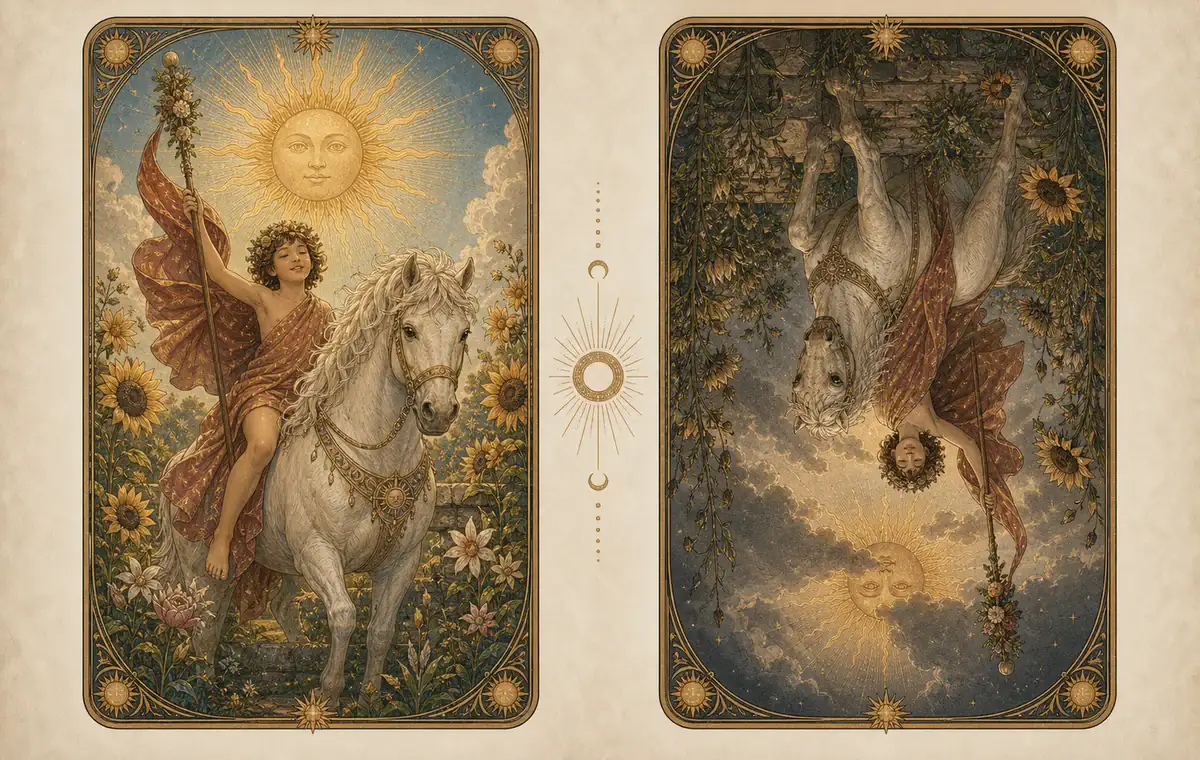
Reversed, The Sun has two honest readings.
Temporary clouding. The joy and clarity are structurally available, but a personal mood, a current setback, or a depressive period is blocking access. The reading is gentle: the light has not gone. You are not seeing it right now. Cards of fatigue or emotional weight (Four of Cups, Ten of Wands, the reversed Star) nearby usually point here.
Overclaimed joy. Less commonly, the reversed Sun signals a performed happiness that hasn't done the underlying work. The child is on the horse but the wall hasn't actually been crossed; the Moon's night has been skipped. This is the bypass version of the card, and it tends to collapse on contact with reality. Cards of avoidance or fantasy (Seven of Cups, reversed Hierophant) often surround it.
Distinguishing them matters because the first reading asks for patience and the second asks for return to honest work. They are different prescriptions.
The Sun vs. The Star vs. The Moon
Three cards of light, three completely different conditions:
The Star (XVII): night sky, calm water, hope as orientation. Light is direction.
The Moon (XVIII): night sky, restless water, doubt as testing. Light is ambiguity.
The Sun (XIX): daylight, open field, joy as arrival. Light is certainty.
Reading them as a sequence rather than three separate cards is the difference between using the deck as a vocabulary and using it as a structure. The Sun without the Moon walked through is unearned; the Star without the Sun on the way is incomplete; the Moon without the Star to precede it is just confusion. The arc matters.
Love and Relationships
The Sun in a relationship reading is the deck's most direct affirmation. If you are partnered, it signals a phase of warmth, visibility, and integration — the version of the relationship where neither person has to hide. Engagements, weddings, and the decision to publicly commit often surface under The Sun. If you pulled it asking about someone in particular, see how The Sun reads as someone's feelings for the warm, open-hearted version up close.
If you are single, The Sun in a love context usually signals a period when your visible self is more matched than your hidden self. The child on the horse is unbridled and unselfconscious — being met by someone real often happens when you have stopped curating yourself for an imagined match. The card does not predict a partner; it predicts the conditions under which a real one would be most likely to arrive.
A small honest note: The Sun can also intensify existing problems by shining light on them. A relationship with hidden issues will not stay hidden under this card. This is uncomfortable but not unkind — what becomes visible can be worked on. What stays hidden cannot.
Career and Money
Career Suns are arrivals: the promotion, the project that lands, the visibility you have been earning slowly. The card does not promise effortless success — the wall has already been crossed before the card's moment — but it does promise that the work behind you is being recognized.
Money Suns are stable, generative periods. Not necessarily windfalls (the deck has other cards for that), but the steady warmth of resources arriving in proportion to what's being done. The Sun is also the deck's clearest pregnancy card, both literally and as metaphor for new generative phases.
Card Combinations
- The Moon + The Sun: the night ends. The most consoling sequence in the upper deck.
- The Sun + Death: the structural pair via flag and horse. Vitality continuous through transformation.
- The Sun + The Empress: full abundance, often literal pregnancy or material generation.
- The Sun + The Fool: a new chapter beginning under integrated conditions. Joy not naïveté.
- The Sun + The World: completion with warmth. The arc nearly closed.
- The Sun + Three of Cups: communal joy made visible and public. The Sun's Leo dimension at its most generous.
- The Sun + Ten of Cups: doubled, uncomplicated joy. The Sun's daylight clarity meets the Ten's settled emotional fulfillment — happiness with nothing left to hide.
- The Sun + Six of Wands: victory in full daylight. Public recognition arriving with nothing to hide — the win is real and it is seen.
- The Sun + Ten of Swords: the promised dawn becoming full daylight. The Ten's one streak of light on the horizon grown into the Sun's whole sky — rock bottom genuinely behind you.
- The Sun + Queen of Wands: the card doubles the solar radiance of the Queen of Wands, who already pairs herself with the Sun. Visible, generous warmth at full strength.
Numerology and Astrology
XIX reduces to 1+9 = 10, which is The Wheel of Fortune. The link is operative. The Wheel sets the cycle; The Sun is the integrated point inside the cycle where you've made peace with the turning. Both cards are about being in right relation to time.
Astrologically, the Sun's direct rulership of the card gives it the deck's most stable signal. The Hebrew letter Resh means head or face — the part of you that is most visible, most expressive, most seen. The Sun is the card of the face the world finally gets to meet.
Frequently Asked Questions
Is The Sun always a positive card?
Effectively yes. The Sun's positivity has a specific shape — it is arrival after passage, not blessing without work — but it is consistently affirming. Even reversed, the card asks for patience or re-honesty rather than warning of harm.
What does The Sun mean in love?
Visible warmth and integration. If partnered, a phase where neither person has to hide and where public commitment often becomes possible. If single, conditions where your visible self matches your real self — the most likely state for a real partner to find you.
Why is the child on the horse naked?
Because the previous cards stripped away what was performance. The child has nothing to hide and is unselfconscious about being seen. Nakedness here is integration, not vulnerability.
What does the wall behind the child mean?
It has already been crossed. The Sun is not depicting the moment of breaking through limitations — it is depicting the state after. The breakthrough is behind you. What's left is to live in the open field.
What zodiac sign rules The Sun?
The Sun is ruled by the Sun itself (the only Major Arcana card so ruled). The zodiac affinity is Leo — fixed fire, ruled by the Sun. The card has its own light, not borrowed light.
Is The Sun a pregnancy card?
Yes, traditionally one of the strongest, particularly alongside The Empress, Ace of Cups, or Ace of Pentacles. It is also a card of generative new beginnings more broadly — pregnancy in the literal sense is one of several possible forms.
What should I do if I draw The Sun?
Recognize the arrival. Stop bracing for the difficulty that has already passed. Let yourself be visible — the child on the horse is not hiding, and the card is asking you not to either.
Closing
If The Sun drew today, locate what you have been treating as still difficult that has, in fact, already resolved. The wall behind the child is already crossed; you are doing the work of the previous cards in a body that has finished it. Step into the field. Let the sunflowers turn toward you. The deck has not given you this card by accident.