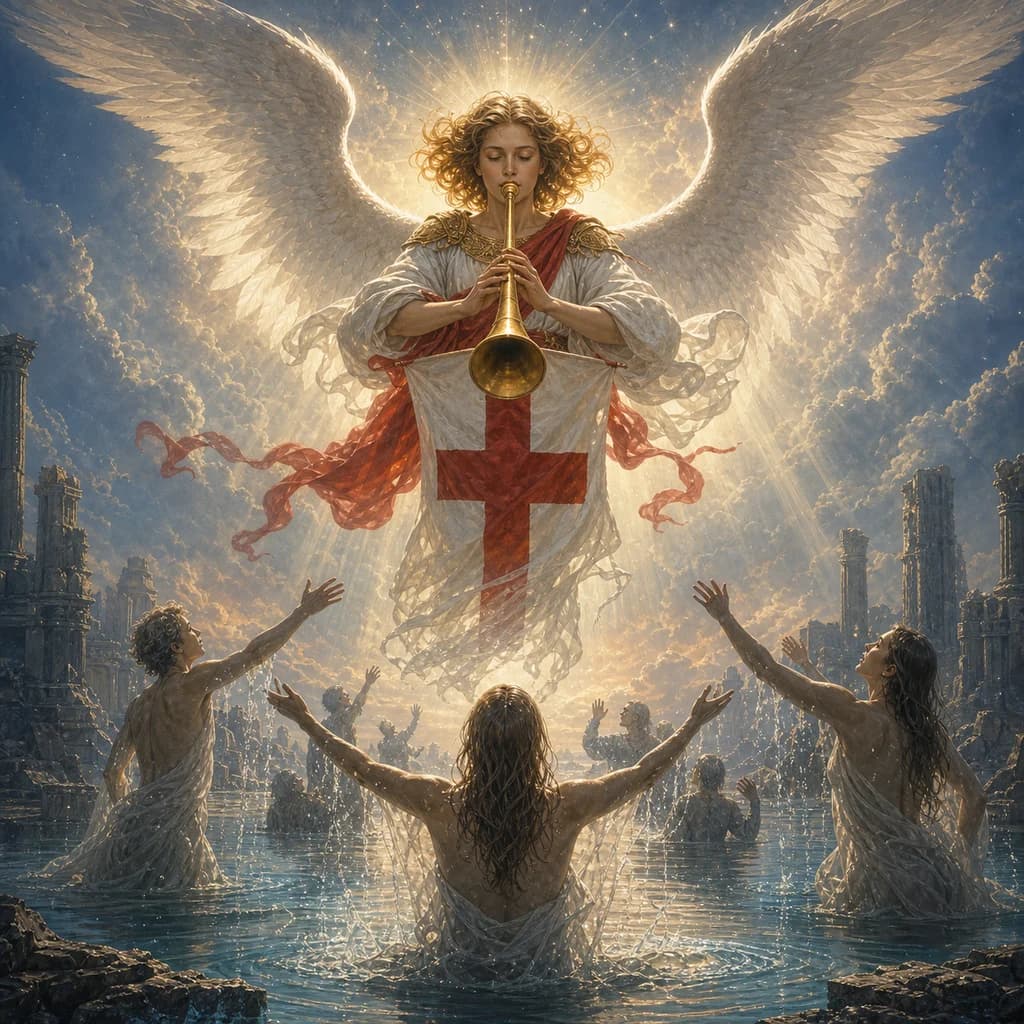
Judgement is the card most readers either soften too far ("just a calling, just a new chapter") or take too literally ("Last Judgement, end times, reckoning"). Both miss what the image is actually showing. Gabriel is in the clouds with a trumpet. The flag is the cross of St George. Three figures — a man, a woman, and a child — are rising from open coffins (not graves), arms spread, looking up. This is a precise scene with a specific theology embedded in it, and reading the card without naming the theology flattens the meaning.
This guide reads Judgement the way the Rider-Waite-Smith image is drawn: the St George flag and what it actually is (most articles call it generic), the figures rising from coffins (not graves — the distinction matters), the family of three echoing the figures in The Sun, the Pluto rulership most popular guides bury, and the difference between Judgement, Justice, and Death — three cards about reckoning that operate at completely different scales.
Quick Answer
Judgement is Major Arcana card XX, ruled by Pluto and the element of Fire. Upright, it signals an unmistakable inner calling, spiritual awakening, rebirth after a long buried period, the moment a long-resisted truth becomes undeniable, and the rising of what was dormant into active life. Reversed, it suggests refusal of the call, harsh self-judgement, or a still-incomplete reckoning. Yes/No: Yes, but the Yes is structural — it asks something of you.
Basic Information
| Attribute | Details |
|---|---|
| Card Name | Judgement (also Judgment / "The Aeon" in the Thoth deck) |
| Number | XX (20) |
| Arcana | Major Arcana |
| Element | Fire |
| Planetary Rulership | Pluto |
| Hebrew Letter | Shin (tooth, fire) |
| Yes / No | Yes, with conditions — the card asks something back |
| Upright Keywords | Calling, awakening, rebirth, reckoning, absolution, summons |
| Reversed Keywords | Refusing the call, self-judgement, incomplete reckoning, stuck in the coffin |
What Judgement is Actually Drawing From
A short detour before the imagery, because Judgement is one of the few cards that loses most of its weight if you don't name the source.
The image is built on Christian theology of resurrection — specifically the iconography of the Last Judgement, drawn from Revelation 20 and 1 Corinthians 15. The angel is the archangel Gabriel (in some readings Michael), whose trumpet blast is the call to rise. The flag he carries is the cross of St George — a red equal-armed cross on a white field, the same banner that flies on the Death card's pale standard. The figures rising from coffins are the resurrected dead, not "people receiving news."
This matters because it tells you what kind of call the card is depicting. It is not gentle. It is not optional. It is the trumpet that summons everything that has been buried — the parts of yourself that died, the projects abandoned, the truths shelved, the work refused — back into active life. The card's name in some decks ("Liberation" / "The Aeon") points at the same idea from a different theology: a moment when what was dormant is called by something larger than personal will, and the only honest response is to rise.
I bring this up in every Judgement reading. The card is not asking you to make a decision. It is naming the call. The decision is whether you're going to answer.
Card Imagery & Symbolism
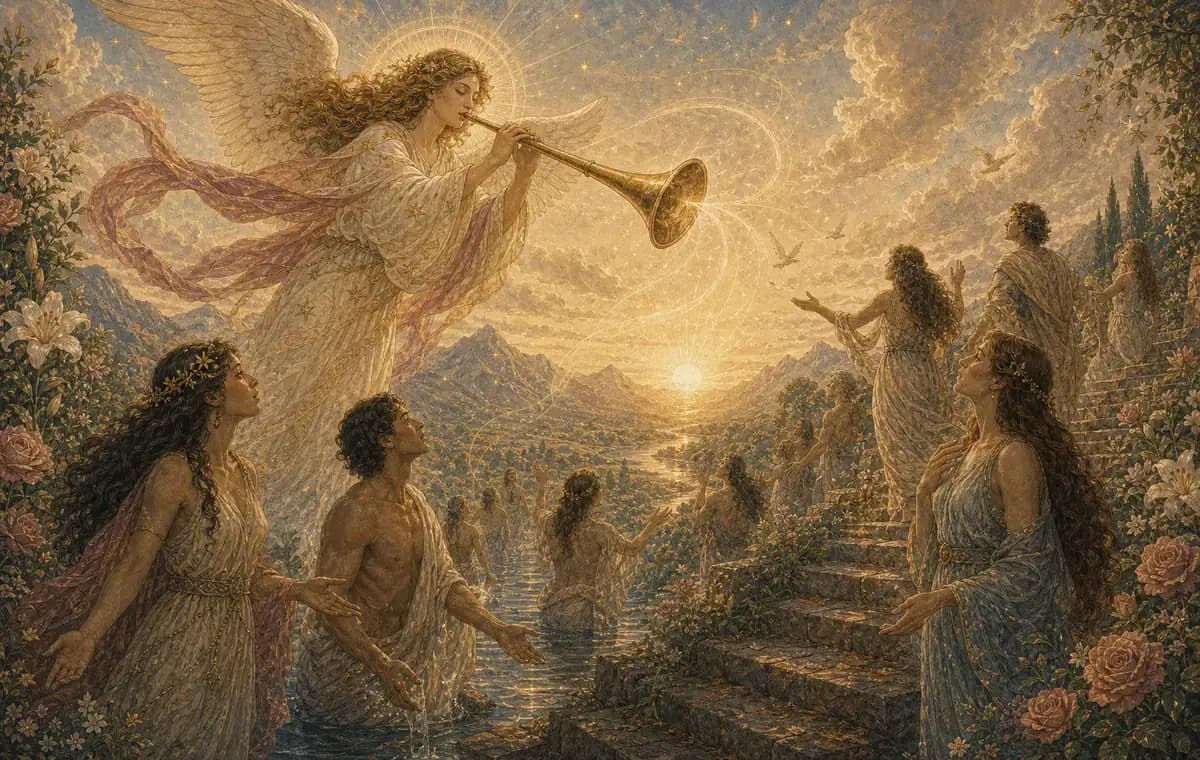
Above the scene, an angel — Gabriel — leans down from the clouds, holding a great trumpet to his lips. From the trumpet hangs a red equal-armed cross on a white square — the cross of St George. Below, three figures rise from open coffins floating on water (or set into earth, depending on edition): a grey-haired man, a woman, and a child between them. Their arms are spread wide, palms open, faces turned up toward the angel. Behind them, more figures rise in the distance from a row of coffins. Mountains close the horizon.
Read every element. Judgement is the deck's most theologically specific image.
The Trumpet
The trumpet is the instrument of the unmistakable call. In the iconographic tradition, you cannot mishear a trumpet blast; it does not ask for attention, it commands it. The card is naming the kind of inner calling that arrives this way: not a quiet intuition, not a vague pull, but a sound that everything else stops to register. Most people who draw Judgement have already heard the call. The card is naming it, not announcing it.
This is the part of the reading I press on with clients who say they "don't know what the call would even be." Usually they do. They have heard it and have been declining to name it.
The Cross of St George
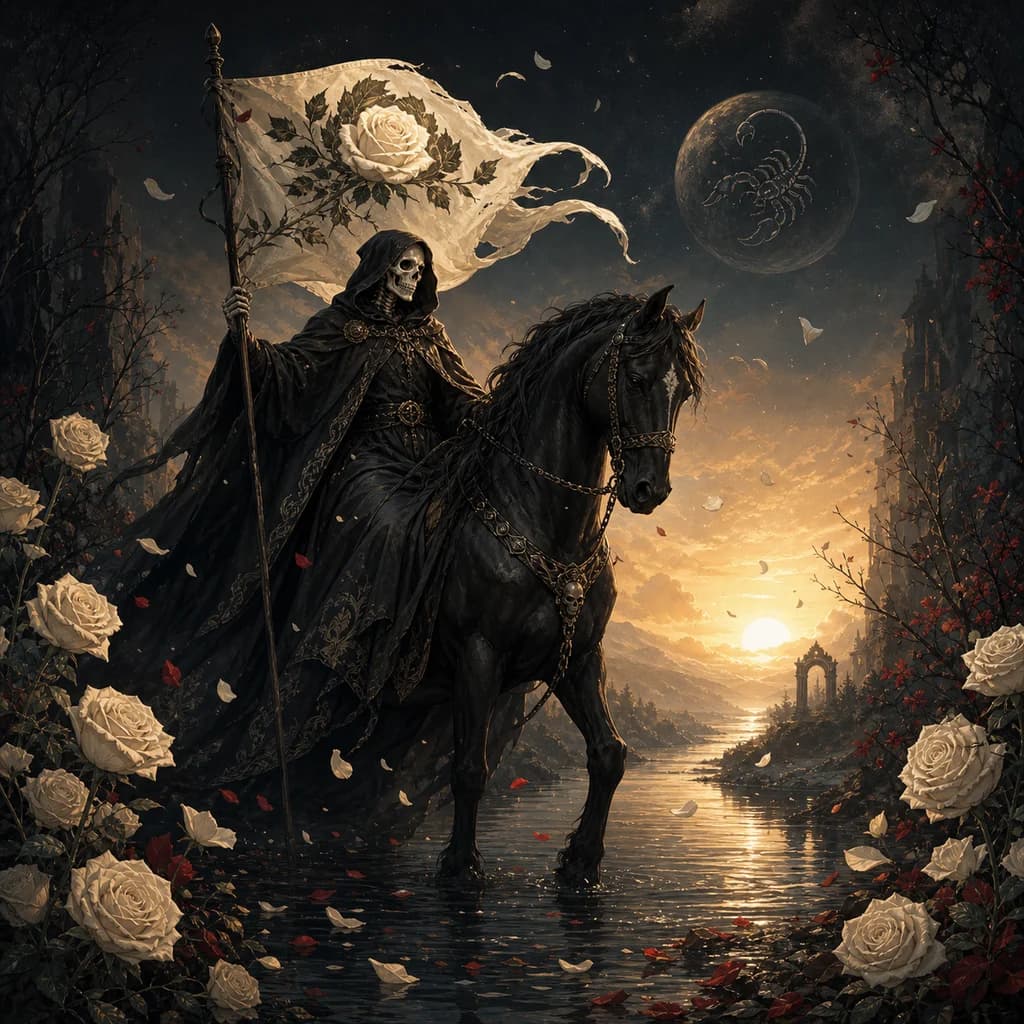
The flag on the trumpet is not a generic Christian banner. It is the cross of St George — red, equal-armed, on white. This is the same iconographic standard that flies on the Death card's banner. The two cards are explicitly visually linked by this flag. Death's flag was the banner of the soul's continuity through ending; Judgement's flag is the same banner raised in the call to rise.
The implication is structural: Judgement is what Death's transformation calls you to next. Death is the ending; Judgement is the summons that follows it. The same flag flies over both because the same continuous soul-thread runs through them.
Most popular guides do not name the flag specifically. Naming it is one of the most useful Judgement-reading moves available.
The Coffins (Not Graves)
A small but important precision: the figures in the foreground are rising from open coffins, not from graves dug into earth. (In some editions the coffins float on water; in others they are set in a snowy plain.) The difference matters. Graves imply burial in soil — natural decay. Coffins imply preservation — the body has been kept, intact, awaiting this moment. Whatever the call is summoning was not gone. It was preserved. The trumpet finds it intact.
This is the most quietly hopeful detail in the card. The work you abandoned, the truth you shelved, the part of yourself you treated as dead — it is not gone. It is in the coffin, intact, waiting to be called.
The Family of Three
A man, a woman, and a child stand in the foreground coffin, with the child between the two adults. The composition explicitly echoes the three figures in The Sun (which also depicts a child as the central figure of joy). It also echoes the holy family of Christian iconography. The structural reading: Judgement's resurrection is not solitary. The call summons the whole arrangement — the masculine, the feminine, and what the two together produced. Past work, past relationships, past creative outputs all rise together.
In practice this means Judgement readings rarely call for one thing. They call for a reorganization of how multiple buried things are going to live together going forward.
The Mountains in the Distance
Mountains close the horizon behind the figures. In the Smith deck, mountains usually mark the long territory still to be crossed — the work that is real but not done yet. Judgement's mountains are the deck's quiet acknowledgement that answering the call is not the end of the journey. It is the moment of being summoned. The walk that follows is The World's work, on the next card.
Pluto and the Depth of the Call
Pluto rules Judgement. Pluto is the slow, deep, transformative planet — the ruler of what is buried, what is hidden, what is undergoing irreversible change at the level of soul rather than personality. Pluto in astrology takes decades to move through a sign; its effects accumulate quietly and surface as inevitabilities.
This is the rulership most popular guides skip. It is the key to reading Judgement accurately. The call the card depicts is not a sudden divine intervention. It has been building underneath for years. The trumpet is the moment it surfaces, but the work has been happening in the underworld of the psyche for a long time. By the time you draw Judgement, the rising is already inevitable — your only choice is whether to answer with awareness or be dragged up unconsciously.
I have read for clients who described the Judgement period as feeling like "everything I've been trying to ignore for a decade has all decided to come up in the same month." That is exactly the card's Pluto-flavored physics. The call gathers what's been accumulating.
Upright Meaning
Upright, Judgement is naming the moment a long-buried call becomes undeniable. Something — a vocation, a truth, a relationship, an artistic project, a confession, a body of work — is rising from the coffin you stored it in, and the trumpet has sounded. You can no longer pretend you haven't heard it.
The card is not asking you to decide whether to answer. The decision is between honest answering and unconscious dragging. Both end up at the same place; one is dignified, the other isn't.
Three forms of the call most commonly surface under Judgement:
The vocational call. The work you abandoned, often years ago, asking to be picked up. Writing, music, a profession, a craft, a body of research. The card frequently appears in the weeks before clients return to something they had treated as permanently set aside.
The relational call. The conversation never had, the reconciliation never attempted, the apology never offered, the boundary never named. Judgement summons the relational unfinished business and asks for an answer.
The spiritual call. The deeper question that has been held at arm's length — about purpose, about belief, about what one is actually for. The card's traditional Christian framing reads here even for non-religious clients, because the structure is the same: something larger than the personal will is summoning, and the personal will is being asked to align.
A reading from autumn last year: a Tokyo client came in after the sudden death of an estranged uncle. She drew Judgement. She told me she had been "thinking about writing again" — past tense for almost seven years. The trumpet, in her case, had been audible the whole time; the death had simply turned up the volume. She wrote her first short story in two months. Judgement does not always arrive as a clear instruction. It often arrives as a death in the family that turns out to be also a death of the excuse for not writing.
Judgement Reversed Meaning
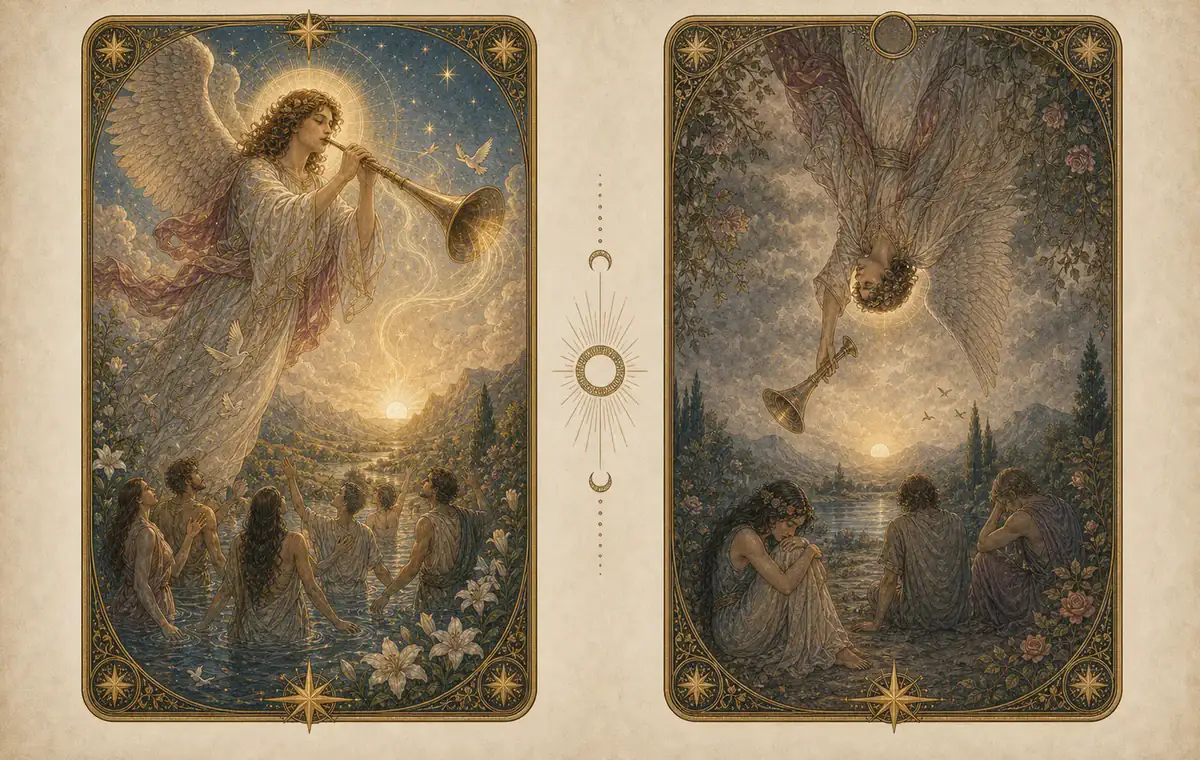
Reversed, Judgement has two honest readings.
Refusing the call. The trumpet has sounded and you are pretending not to hear. The cost is real: refused Judgement readings tend to ossify into long stretches of low-grade dissatisfaction that has no clear source. The card asks you to name what you are declining to answer.
Self-judgement. Less commonly discussed: the harsh inner critic acting as if it were the angel. You are judging yourself for not having answered the call sooner, or for not being worthy of it, or for not yet knowing what the call is. The card reversed can ask you to distinguish between the trumpet (which is summoning) and the inner critic (which is shaming). They are not the same voice. The trumpet calls you forward; the critic calls you guilty.
Distinguishing them depends on tone. If the inner voice is asking to rise, that's Judgement upright trying to come through despite the reversal. If the voice is asking to be punished, that's the inner critic, and the card is naming the substitution.
Judgement vs. Justice vs. Death
Three cards about reckoning, operating at completely different scales:
Judgement (XX): the spiritual call from beyond personal will. Intuitive, vocational, transpersonal. The question is not "what did you do" but "what are you for."
Justice (XI): the logical evaluation of action against principle. Personal, ethical, contractual. The question is "what did you do, and what is the proportional response."
Death (XIII): the structural ending that requires no judgement. Impersonal, transformative. The question is not asked; the change happens.
Reading any of them as interchangeable is the most common error in interpreting "reckoning" cards. Justice is courtroom. Death is autumn. Judgement is the trumpet from the sky. They answer different questions and ask different things back.
Love and Relationships
Judgement in a relationship reading is rarely about a small adjustment. It is about a call to honesty that the relationship has been postponing — the conversation that has been waiting in the coffin for years. Forgiveness, confession, the naming of long-unspoken patterns, the offering of an overdue apology. The card asks you to stop waiting for the right time and to rise to the conversation.
If you are single, Judgement often points to a pattern — a recurring relational shape you have been avoiding examining — that is finally rising for review. This is not punitive. It is the precondition for choosing differently next time.
The hardest Judgement love readings are the ones where the call is to release a relationship that has been over for a long time but has been kept in the coffin out of inertia. The trumpet doesn't always summon back. Sometimes it summons forward, which means leaving.
Career and Money
Career Judgements are vocational. The job that fits the personality but not the calling; the role that pays but does not animate; the career that has been satisfactory and is no longer enough. The card asks whether what you are doing is the answer to a call or merely a continuation of momentum.
Money Judgements are often less dramatic. They are about long-postponed financial truths — debts not faced, accounts not opened, conversations with partners or family about money that have been waiting in the coffin. The call here is simply: open it.
Card Combinations
- Judgement + Death: the call answered by the ending that frees you to answer it. The structural pair.
- Judgement + The Sun: the call answered, the joy that follows. One of the deck's most affirming sequences.
- Judgement + The Hermit: the inward listening that lets you hear the call. Often a reading about preparing to answer.
- Judgement + Eight of Cups: leaving what no longer fits the call. The most concrete form of "rising."
- Judgement + The Fool: the new beginning that is not naïveté but answer. The Fool with a reason.
- Judgement + The World: nearly the final arc. Call, answer, completion.
Numerology and Astrology
XX reduces to 2+0 = 2, which is The High Priestess. The link is operative. The High Priestess is the inner knowing held silently; Judgement is the same knowing summoned into action. Both cards are about truths that exist before words. Judgement is the moment those truths are called by name.
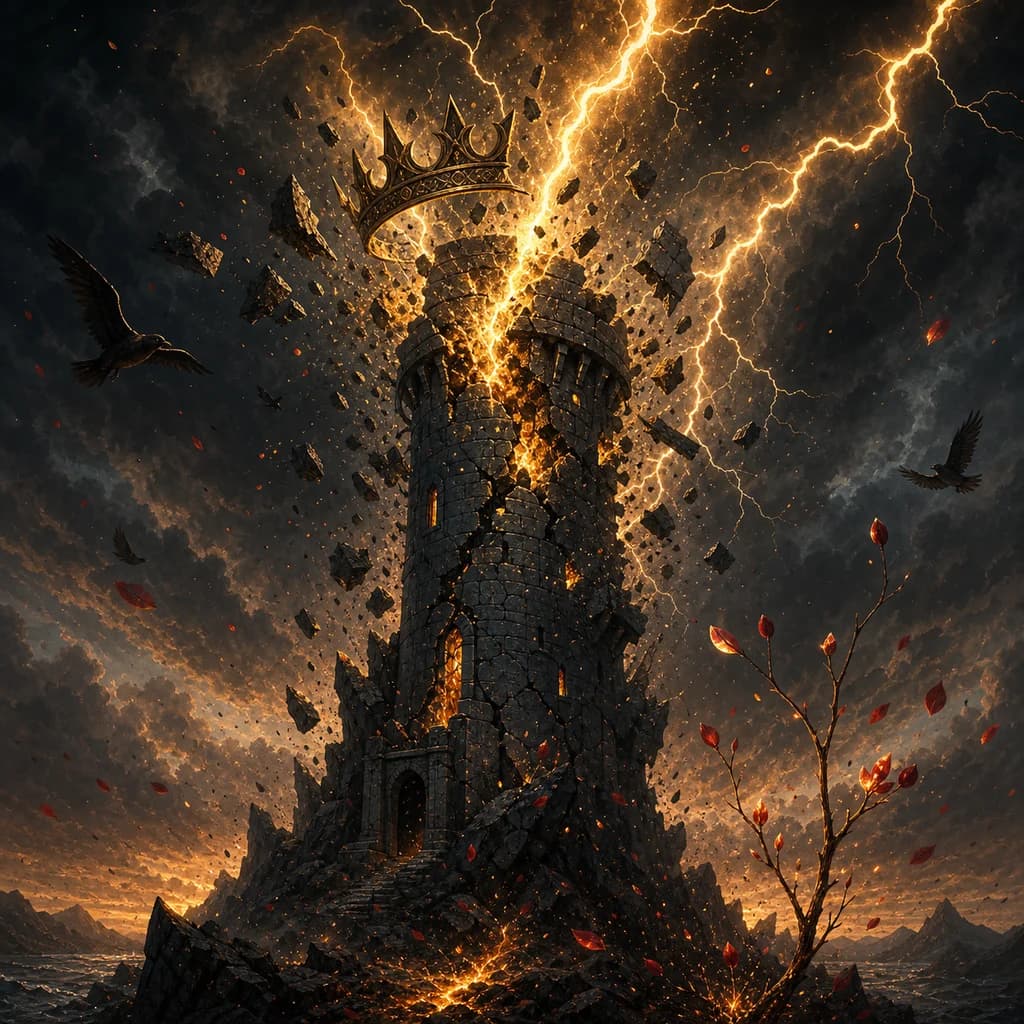
Astrologically, Pluto's rulership gives the card its specific depth. The Hebrew letter Shin means tooth — and by metaphor, fire — the consuming, transformative element that does not negotiate. Judgement's fire is not the destructive fire of The Tower but the awakening fire of the call. Same element, different work.
Frequently Asked Questions
Is Judgement a positive card?
Yes, structurally, though "positive" is the wrong word. Judgement is demanding. It names a calling that asks something of you. Clients who answer it tend to describe Judgement as one of the most meaningful cards they have drawn. Clients who refuse it tend to find the card haunting.
What does Judgement mean in a love reading?
A call to honesty the relationship has been postponing. The overdue conversation, the unspoken pattern, the apology never given, the boundary never named. Sometimes it summons toward reconciliation, sometimes toward release. Always toward honesty.
Is Judgement about religious judgement?
The imagery is built on Christian Last Judgement iconography, but the card's working meaning is not religious in the punitive sense. The "judgement" the card depicts is the moment of being summoned by something larger than personal will. The trumpet calls; you rise; you answer. It is calling, not condemnation.
Why are the figures rising from coffins, not graves?
Because coffins preserve, while graves return the body to soil. The card is claiming that what is being called is not decayed or gone — it is intact, preserved, waiting. Whatever you have shelved is still available to be answered.
What zodiac sign or planet rules Judgement?
Pluto — the slow, deep, transformative ruler of what is buried. The Pluto rulership is the key to reading the card: the call you hear has been building underground for years, and the trumpet is the moment it surfaces.
What's the difference between Judgement and The World?
Judgement is the call; The World, where the answered call walks to completion, is what closes the arc. Judgement (XX) and The World (XXI) sit next to each other for a reason — answering the call is what eventually walks you to completion, but they are different cards. Judgement asks; The World answers.
What should I do if I draw Judgement?
Name what is rising. You almost certainly already know. The card's most consistent guidance is to stop pretending the trumpet hasn't sounded. Answering doesn't have to be dramatic — it can start with one act, one conversation, one returned hour of work. But the answer is yours to make.
Closing
If Judgement drew today, name the thing you have been treating as buried. The card's quiet hopeful claim is that it is not buried; it is in a coffin, preserved, waiting for you. The trumpet has been audible for a while. Today the card is naming the sound. Rise — not because you must, but because the only honest alternative is to be dragged up later by something less kind.