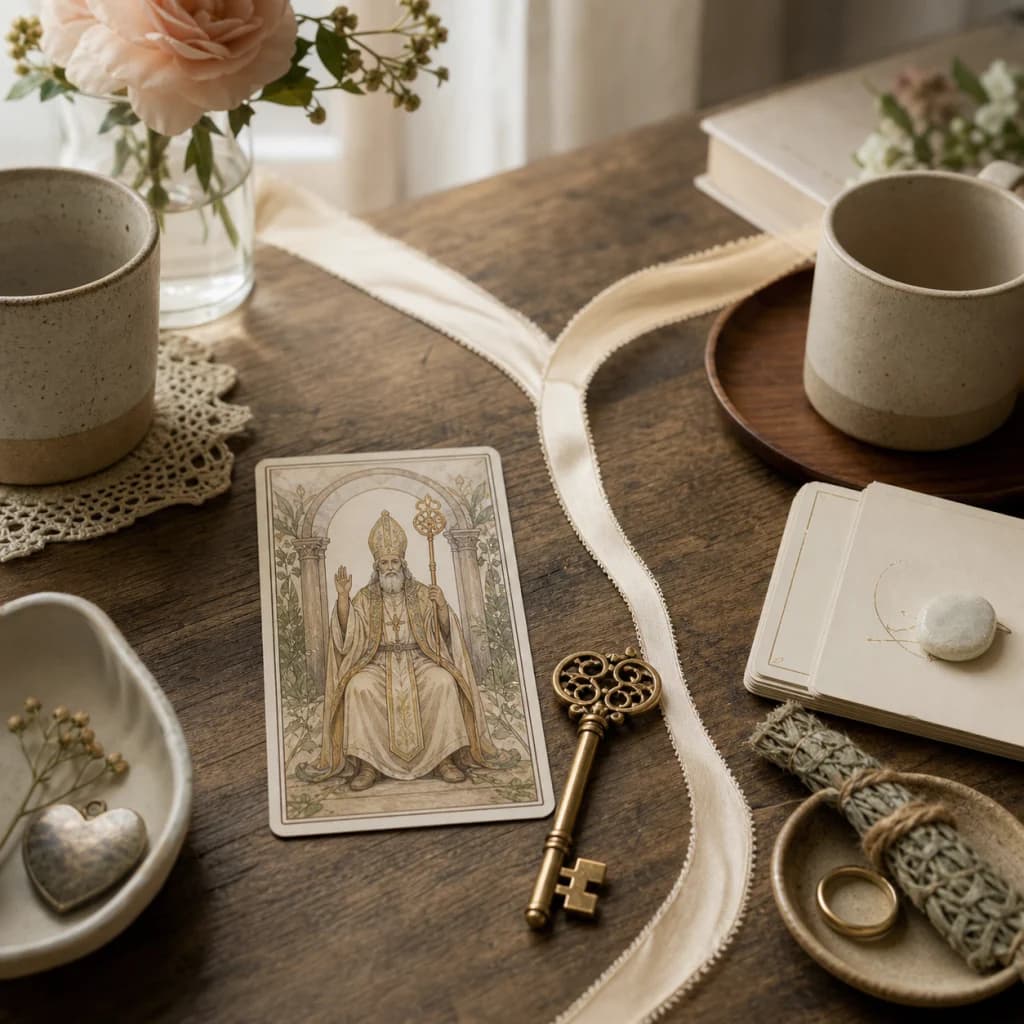
A client came to me last winter, here in Tokyo, asking why her boyfriend of two years had suddenly started talking about meeting her parents, moving in, "doing things properly" — and why all of it left her feeling oddly unseen. She pulled one card for how he felt. The Hierophant. People hear "the marriage card" and relax. She didn't, and she was right not to. After more than a decade reading the Rider-Waite-Smith deck, I've learned that The Hierophant as feelings is one of the most reassuring cards in the deck and one of the easiest to misread — because it can describe a man who has chosen you, or a man who has chosen the proper next step and you happen to be standing in the right place.
Here's what The Hierophant as feelings actually means, upright and reversed, and the one question that decides everything.
Quick Answer
Upright, The Hierophant as feelings points to stable, serious, committed love — someone who sees you as a long-term, marriage-shaped partner and feels safe, certain, and aligned with you. It's devotion through commitment and shared values rather than fireworks; he doesn't just feel, he pledges. Reversed, that same structure either chafes or breaks: rebellion against the expected path, feeling trapped by convention, or a connection that's stalled in situationship limbo because the "rules" no longer fit.
The Hierophant Upright as Feelings
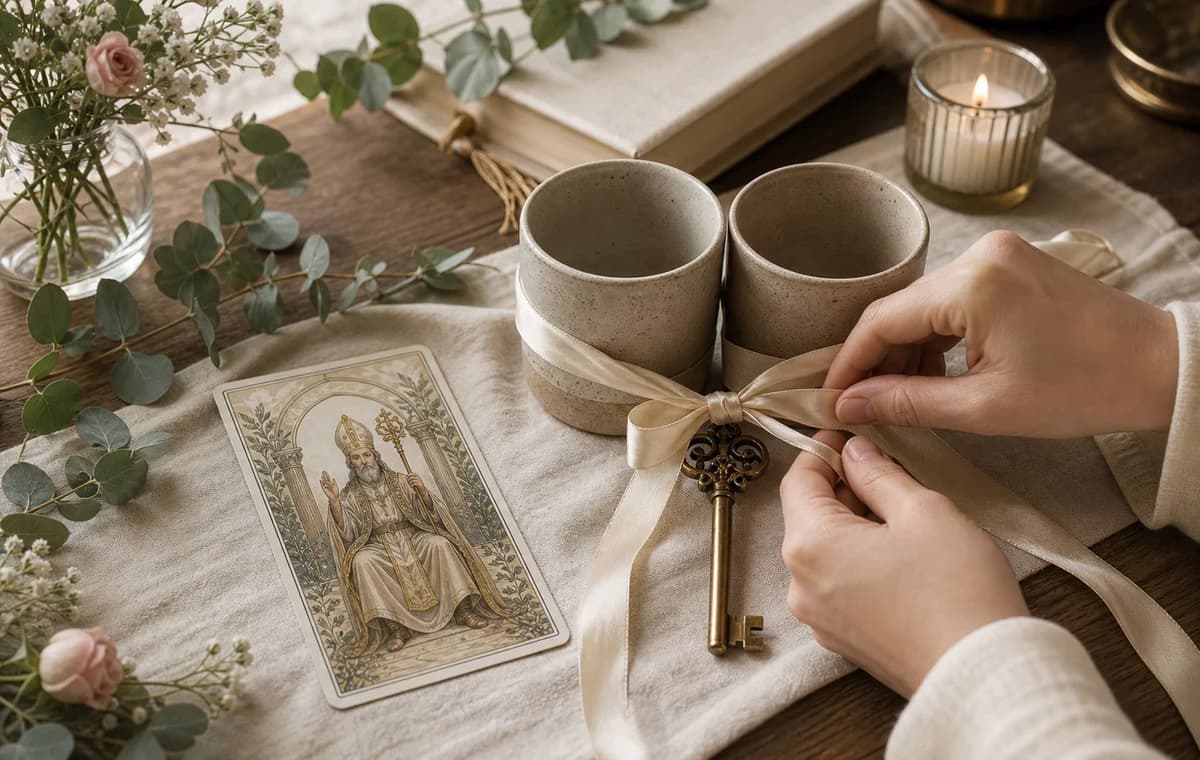
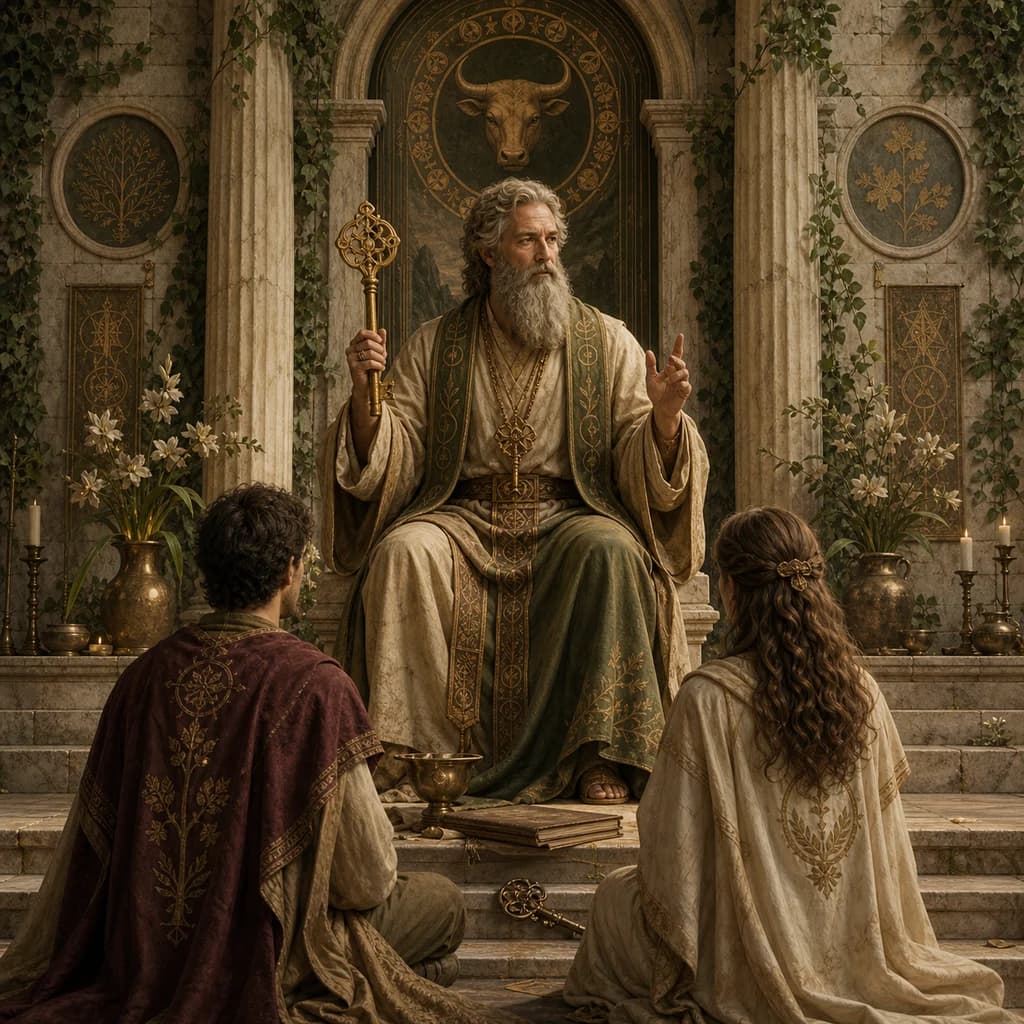
When The Hierophant comes up for someone's feelings, picture a man who has already filed you under "future," not "maybe." This isn't the flickering heat of a new crush. It's something steadier and more deliberate — he feels safe with you, certain about you, and his instinct is to formalize it. To make it real, named, committed. Among the major arcana, this is the one people call the marriage card, and the nickname earns itself: the feeling here wants a container.
There's a quality of alignment to it. He doesn't just like you; he feels you fit — your values, your direction, the kind of life you'd build. He's emotionally controlled rather than swept away, which can read as cool to someone waiting for a grand gesture. It isn't coolness. It's a man who treats love as something you commit to, not something that merely happens to you.
One more thing I'd add that the textbooks flatten. The Hierophant often carries a protective, almost mentoring warmth — he feels steadied by you, like being near you keeps him pointed at the right things.
When you're single or it's new
For something new, the upright Hierophant is unusually serious. He's not interested in a fling — he's the type who keeps things respectful, or pursues you properly with the long game in view. He's already wondering whether you're someone he could build with. Slow, but not lukewarm. The seriousness is the feeling.
In an established relationship
For a couple, The Hierophant marks devotion that wants to become official — engagement, marriage, moving in, blending families, naming the thing out loud. He feels committed and bound to you, and he draws security from the structure itself. To him, the commitment isn't a cage; it's the proof.
The Hierophant Reversed as Feelings
Reversed, the structure that felt safe upright starts to pinch. The most common reading is rebellion against the expected path: he feels something real but resists the script that's supposed to come with it — doesn't want the conventional milestones, the timeline, the version of love "the world says he should" give you. Sometimes that's healthy refusal of a mold that never fit. Sometimes it's a man who wants you on his terms only.
The other reversed reading is suffocation. He feels trapped — by expectations, by family pressure, by a relationship that's become more rulebook than romance — and the feeling has gone flat and dutiful underneath the obligation. And reversed Hierophant is a classic situationship card: feeling stuck in an undefined in-between, where neither of you will name it.
Reversed rarely means he feels nothing. It means the form is broken — too rigid, or refused outright.
From a crush
Reversed Hierophant from a crush usually means real interest tangled up with resistance to convention. He might like you but balk at "doing it the normal way" — wary of labels, of moving at the expected pace, of what people would expect of him. Read it as a yellow light, not a red one: the feeling can be genuine while the willingness to formalize it isn't there yet.
From an ex, or during no contact
Here the reversal often points to an ex who couldn't make the structure work — the timing, the family, the expectations, the "shoulds" that crushed the spontaneity out of it. During no contact, it can show someone reassessing the rules he was living by, sometimes circling back to whether the two of you could do it differently this time. Genuine feeling is frequently still there; what failed was the framework around it.
Does He Want You, or Want the Next Right Step?
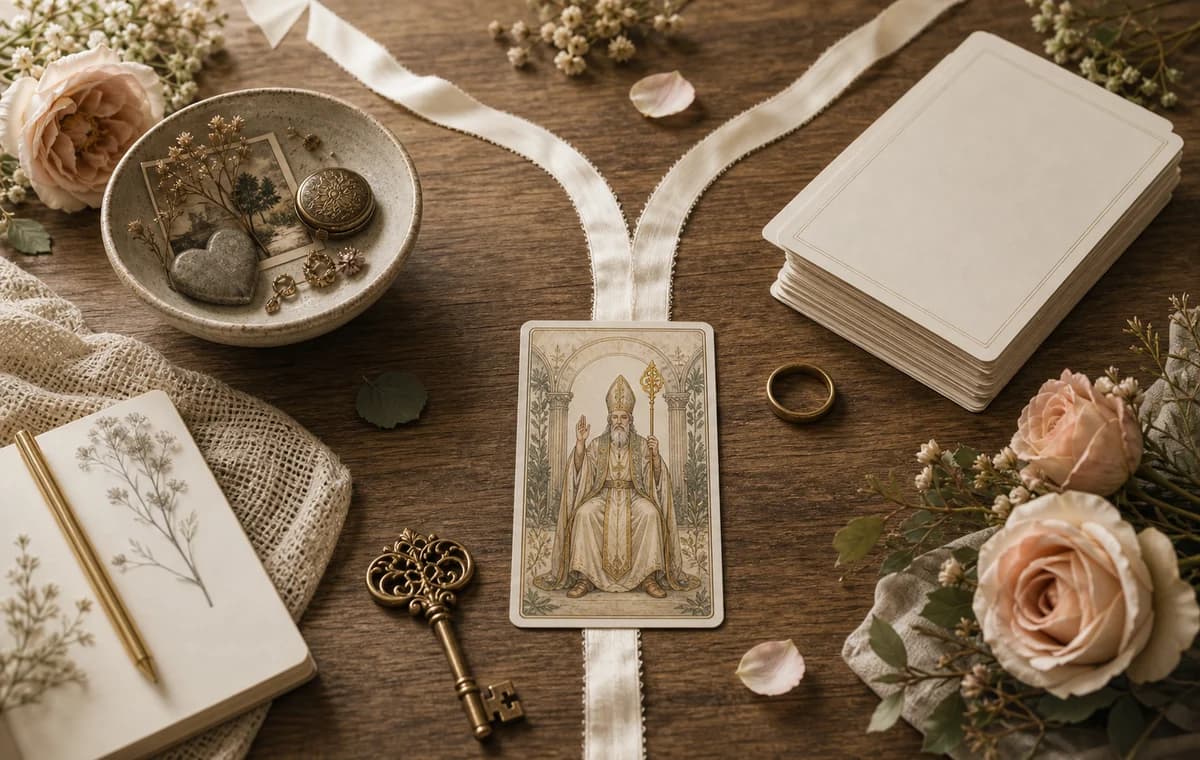
This is the question The Hierophant actually puts to you, and every guide I've read names it without answering it. The card is so tied to marriage, milestones, and "doing it properly" that it can describe two completely different men wearing the same calm, committed face: the one who chose you and wants to build it official — and the one who wants the structure, the proper next step, the life-stage box ticked, and you happen to fit the slot. Love that chose you, versus love by the rulebook. So how do you tell them apart?
Stop listening to the milestones and watch where the specificity is. A man who chose you talks about you — your quirks, your particular mind, the future as something the two of you invent together. A man who chose the step talks about the step: the timeline, what's expected, what people do at this age, how it's "time." Test it sideways. Ask what he'd want if you threw out the conventional script entirely — eloped, stayed unmarried, did it backwards. The one who wants you gets curious. The one who wants the structure gets uneasy, because the structure was the point. Upright, the form is how he expresses a love already aimed at you. Reversed — or upright but hollow — the form has quietly become a substitute for it. Real Hierophant love uses the ritual to hold something; rulebook love uses you to complete the ritual.
The Hierophant vs The Emperor as Feelings
These two authority cards get swapped constantly, and the difference is the whole reading. The Emperor protects through personal power — I will build walls and keep you safe myself. The Hierophant protects through shared belief — we'll follow the same path and it will hold us. The Emperor's love is a fortress he guards alone; the Hierophant's is a vow you both kneel to. If the Emperor is the provider — closer to the steady, build-you-a-life energy of King of Pentacles as feelings — the Hierophant wants to belong with you, inside something larger than either of you. Both are committed. One builds the house; the other builds the marriage that lives in it.
How the Japanese Tarot Tradition Reads This
In Japanese タロット占い, The Hierophant (教皇, kyōkō) is often read through 「絆」(kizuna) — a bond that ties two people together, the kind that's forged and then honored rather than felt and then forgotten. A teacher of mine framed the upright Hierophant in love as 「誠実」(seijitsu) — sincerity, faithfulness, a person whose word and conduct line up. I find that more useful than the Western "traditional," which can sound stuffy. It isn't about being old-fashioned. It's about a feeling that intends to keep its promises — kizuna over ときめき, the bond over the flutter. When this card describes how someone feels, that intent to stay bound is the gift it's naming. The shadow, of course, is 形だけ (katachi dake) — "form only," the vow with the feeling drained out — which is exactly the reversed reading.
Frequently Asked Questions
Does The Hierophant as feelings mean they love me?
Usually yes, and in a serious, committed way — this is the marriage card, pointing to someone who sees you as a long-term partner and feels safe and aligned with you. The one caveat: confirm the feeling is romantic and aimed at you specifically, not just a fondness for the idea of settling down. Watch whether he talks about you or about the milestones.
Does the reversed Hierophant mean they don't care?
Usually not. Reversed more often means real feeling colliding with the structure around it — rebellion against convention, feeling trapped by expectations, or a situationship neither of you will name. The form is broken, not the feeling. The thing to watch is whether he wants to do it differently or simply doesn't want to do it.
What does The Hierophant say about my crush?
Upright, your crush takes you seriously and is inclined to pursue you properly, with commitment in mind rather than a fling. Reversed, the interest may be real but tangled with reluctance about labels or the expected pace. Either way, this is rarely a casual card — the feeling, if it's there, tends to be the lasting kind.
Will an ex come back if I draw The Hierophant?
Upright, it's hopeful — it can show an ex who still values the bond and may want to do it properly this time, often pointing back toward commitment. Reversed, genuine feeling may remain, but the old framework failed; reunion depends on whether you can build it on different terms. It's a yes-leaning card for reconciliation more than a guarantee.
Is The Hierophant a yes for love questions?
Generally yes — it favors commitment, stability, and lasting bonds, which is about as solid a yes as the deck offers for serious love. Reversed it softens to "yes, but the conventional version isn't working," pointing to a structure that needs rethinking rather than a flat no.
Closing
If you drew The Hierophant for how someone feels, you're most likely looking at love that wants to commit — to name it, formalize it, make it last. That's one of the steadiest answers the cards give. Before you celebrate the marriage card, though, do one small thing: notice whether he talks more about you or about the next step. The first is love that chose you. The second is love looking for somewhere to put itself. Ask him what he'd want with none of the rules attached, and listen to which way he leans.
Want this card beyond the feelings question? Read the full The Hierophant meaning, compare Ten of Cups as feelings for the settled-family love this card reaches toward, or plan a full reading with our love tarot spread guide.