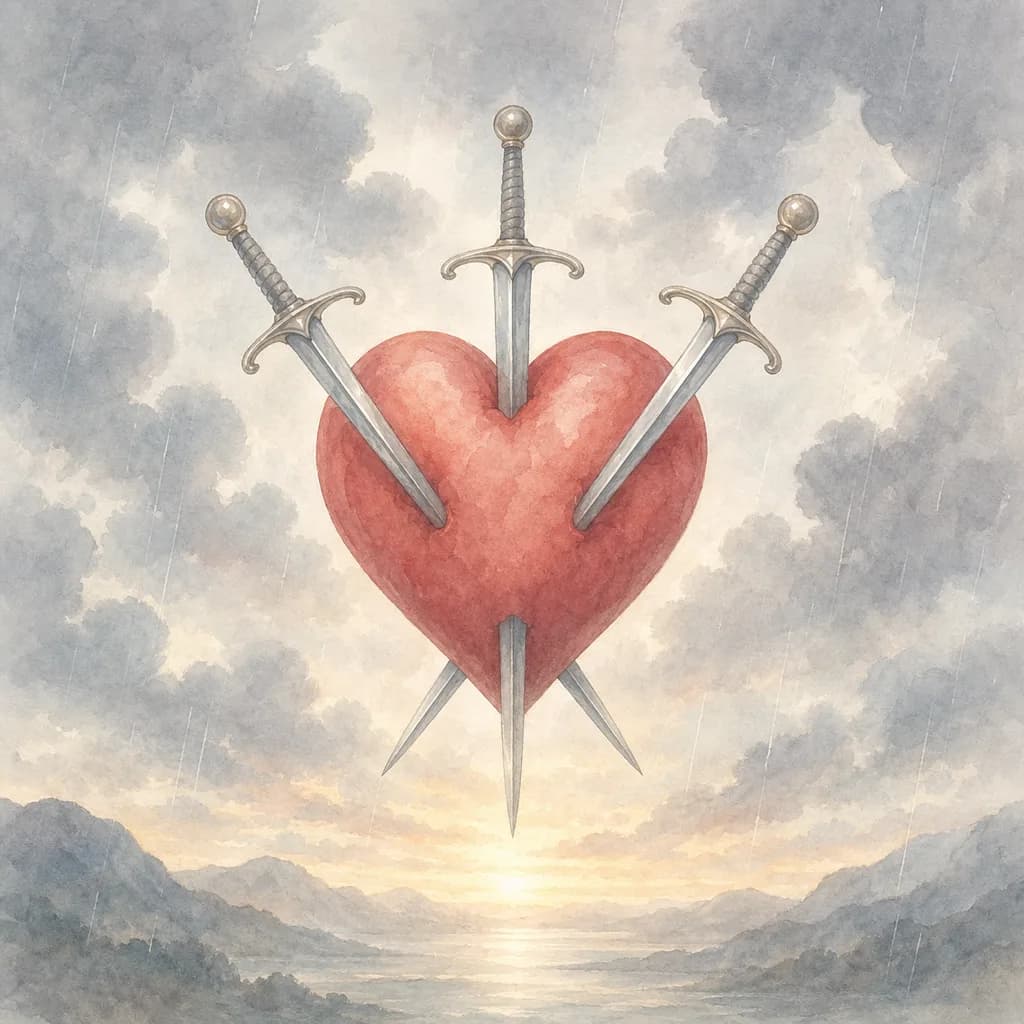
The Three of Swords is the card no one wants to draw and the one I most often see clients flinch at — the literal heart pierced by three blades, gray clouds, rain. It has perhaps the bluntest imagery in the deck, and when it appears in a feelings reading the message is, on its face, hard: this person is in pain about you, around you, or because of you. In ten years of readings in Tokyo I have watched many people brace themselves over this card and ask, very quietly, does this mean they don't love me anymore?
The answer I have grown into is: almost never. Three of Swords confirms presence, not absence. Indifference doesn't bleed. The pain in this card is what's left in someone's chest after something mattered enough to leave a mark — which is its own kind of difficult answer, and also, if you can hold it, its own kind of clarifying one.
Below: Three of Swords as feelings, upright and reversed, for crushes, exes, established couples — and the read most guides skip, which is what the size of someone's heartbreak reveals about the size of what they had invested.
Quick Answer
Upright, the Three of Swords as feelings means real heartbreak — grief, hurt, or sorrow connected to you or to a third party in the situation. The person is bleeding emotionally, not numb. Reversed, it tilts toward two possibilities depending on context: healing in progress and a slow release of the pain, or grief that has been pushed down and is leaking out sideways as avoidance and coldness. Almost never does this card describe indifference. The presence of pain is itself the evidence of how much there was to lose.
Three of Swords Upright as Feelings

Look at the card: a heart in the air, three blades through it, storm clouds raining behind. There is no sugarcoating what's being depicted. When the Three of Swords describes someone's feelings, those feelings are sharp, present, and recent enough to still be bleeding. This is the most acute heartbreak card in the deck. The person is experiencing something that has cut: an event, a realization, a confrontation with truth they had been avoiding. The pain is not background. It is the foreground. Unlike the Tower as feelings, where the shock is the sudden collapse of the whole structure, the Three of Swords is the precise, targeted wound to the heart itself — grief that knows exactly where it was cut.
But notice what the card is not depicting. There is no figure walking away (that is the Eight of Cups). There is no figure curled in despair beneath the swords (the Nine of Swords as feelings is the dread and the heartbreak already landed, the 3 a.m. aftermath; the Three is the cut still happening). The heart is suspended — still in the air, still pierced, still bleeding. Three of Swords describes the active, unfinished moment of being cut, not the long fall afterward and not the final closure. That detail matters in a feelings reading: this person is still in the middle of it. Their pain is current and ongoing, which means it is also, quietly, still alive — and what is alive can still change.
Singles, or in a New Connection
For a new connection, the Three of Swords often means the person you're asking about is carrying unhealed wounds from a previous chapter — and you are meeting them in the middle of that. They may be drawn to you and unable to fully show up at the same time. This is not rejection of you; it is the simple fact that someone bleeding from an older wound cannot reliably pour into a new cup. Read it as a timing question, not a verdict on the connection.
In an Established Relationship
For couples, the Three of Swords as feelings is one of the most important draws to read honestly. Your partner is hurt — by something specific, often something they have not fully said. It may be a recent betrayal real or perceived, an old wound newly opened, or the slow accumulation of small things that have suddenly added up to a cut. The pain is real, but the card insists that you not collapse it into "they hate me." It is telling you a wound is open. The work is naming it before it scars closed in silence.
Three of Swords Reversed as Feelings

Reversed, the swords begin to slip out. Most often the card describes someone who is genuinely starting to heal — the acute bleeding is past, they are processing, forgiveness becomes thinkable, and the connection (or the memory of it) is being slowly metabolized into something they can carry without constant pain. This is the gentler version of the reversal, and it usually points to a real opening: not all the way to "fine," but somewhere along the road toward it.
The second version is harder. Sometimes the reversal describes grief that has been pushed down — feelings the person is refusing to look at, behaving cold or avoidant on the surface while quietly carrying the same wound underneath. This version of the reversed Three of Swords is often what I see in clients asking about an ex who has gone unnervingly silent. The silence is rarely indifference. It is more often pain that has been stuffed into a closet and the door held shut hard.
A Crush
For a crush, the reversed Three of Swords usually points to someone carrying unhealed pain into the dynamic with you. Upright it would have been "they are actively heartbroken about something"; reversed it tilts more toward "they have buried it and the burial is affecting how they can show up." Either version asks for patience over pressure. You cannot rush someone whose chest is still full of swords they have not yet looked at.
An Ex, or No-Contact Period
This is where the Three of Swords is most often misread, so I will be direct. For an ex who has gone silent, who blocked you, who is acting cold — the reversed Three of Swords very frequently means they are still bleeding and have decided that silence is the only way they can survive looking at you. The behavior reads as indifference. The internal state is closer to the opposite. Whether that opens any door for reconnection depends on what each of you does with the wound. But please do not read the coldness as proof they never felt anything. Three of Swords would not appear at all if they hadn't.
What the Pain Confirms That Indifference Never Can

Here is the read most competitor guides skip, and the one I think the Three of Swords most needs you to hear. Heartbreak is not the opposite of love. It is one of its more reliable signatures. The Eight of Cups walks away. The Hermit chooses solitude. The Four of Pentacles withdraws and grips what little remains. None of those cards depict bleeding, because none of those states require something to have been opened in the first place. Three of Swords requires an opening. It is the proof of the opening.
I sometimes phrase it this way for clients in pain about an ex: the size of the wound is the size of what they let you become. People do not grieve relationships they were not in. They do not bleed over connections they had already sealed off. If the Three of Swords is describing your ex's feelings, what it is telling you — underneath the brutality of the imagery — is that there was, in fact, something there. Whatever else they may have done, however much they may now be avoiding contact, however cold the surface looks, the card is confirming an interior they cannot fully pave over.
That is not a promise that they will come back. That is not a license to ignore the real reasons the relationship ended, which were probably also real. But it is a different thing than indifference, and a different thing than "they never cared." If you came to this card afraid of one of those readings, take a breath. The card you drew is not that card. Three of Swords means the heart was reached. What you do with that information — whether you grieve, whether you reach out, whether you let yourself heal alongside them — is the next question. But you can let the fear that it never mattered, finally, go.
Three of Swords vs Ten of Cups as Feelings
These two cards sit at opposite ends of the same emotional spectrum, and reading them in relation to each other reveals something useful about both. The Ten of Cups as feelings describes someone who has built a future around you — calmly, settled, rainbow in view. The Three of Swords is what it feels like when that picture, or any picture, has been torn. The grief in the Three is sized to whatever Ten of Cups they had been imagining; the more elaborate the future they had pictured with you, the deeper this card hurts when it appears. Read together, the two cards form a kind of confession: only someone who had been picturing the Ten can feel the full force of the Three. Indifference can't bleed because it never built.
How Japanese Tarot Tradition Reads This Card
In Japanese タロット占い, the Three of Swords (ソードの3) is most often read through 「失恋(しつれん)」— the specific word for the heartbreak of losing love. What I value about the Japanese framing is that it treats 「失恋」 as its own emotional event with its own arc — not a failure, not a verdict on either person, but a real and named experience that has stages. My teacher used to pair it with 「胸が痛む(むねがいたむ)」— literally "the chest aches" — to keep the body close to the reading. The Three of Swords is not abstract sorrow; it is the felt, located ache that says something here mattered enough to hurt. In Japanese readings I'll often add the gentler 「癒し(いやし)」 — healing — when the card appears reversed, to point toward the road out without rushing the person off the road they are still on.
Frequently Asked Questions
Does the Three of Swords mean they don't love me anymore?
Almost never. The card describes pain, and pain in this deck specifically requires an open heart to be possible. The presence of Three of Swords is itself confirmation that something significant was felt. What it is reporting is that whatever was felt is currently in a sharp and hurting place — not that it was never there.
What does the Three of Swords reversed mean for feelings?
Two possibilities. The gentler version is healing in progress — the acute pain easing, forgiveness becoming thinkable, the wound metabolizing. The harder version is suppressed grief — feelings pushed down and showing up as avoidance, silence, or coldness. Context and surrounding cards usually tell you which.
What does the Three of Swords mean if my crush draws it?
Usually that they are carrying old wounds into the present — pain from a previous chapter is affecting how they can show up with you. This is rarely about you; it is about timing. Patience tends to read this card better than pursuit.
My ex got Three of Swords — does this mean they still feel something?
Yes, very likely. Especially reversed and in a context of silence or distance, this card commonly describes pain that has been buried, not pain that no longer exists. Cold behavior plus Three of Swords is one of the most consistent indicators that the surface and the interior are not telling the same story.
Is the Three of Swords ever a positive card in a feelings reading?
Not in the sense of "feel-good." But it can be quietly clarifying, in two ways. First, it confirms that something was real enough to leave a mark — which can settle a particular kind of anxiety. Second, it depicts grief in its active, unfinished phase — meaning it is not a final closure but a moving state, and what is moving can still change.
Closing
If you drew the Three of Swords for someone's feelings, sit with the harder part of the reading first — yes, there is pain; yes, something is currently hurt; yes, the picture is not what you wanted it to be. Then take the second read the card offers, which has rescued more of my clients than any reassurance ever has: this pain is the evidence that something was real. The heart in this card is suspended, not yet fallen, and what is suspended can still be reached. Let yourself grieve what needs grieving. Then, in your own time, decide what you want to do with the information that you mattered enough to leave a mark.
To see what the love picture looks like when it has not been pierced, compare the Ten of Cups as feelings, or use our love tarot spread guide for a fuller reading.