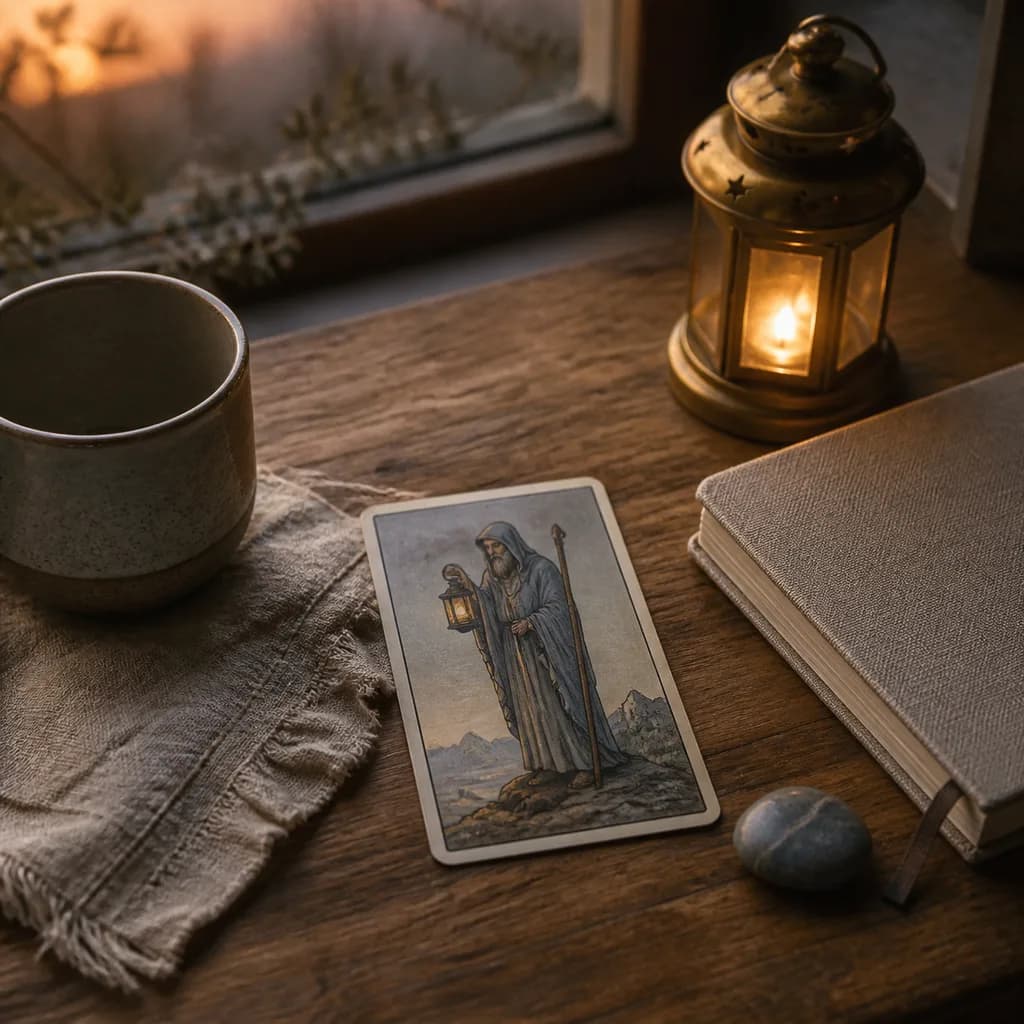
The first thing to know about The Hermit is that it's not the card of loneliness. Beginners read the image — an old man alone on a mountaintop — and assume the message is isolation. After more than a decade reading the Rider-Waite-Smith deck, I can tell you the opposite is closer to true. The Hermit shows up when a client is surrounded — by opinions, by noise, by other people's expectations — and the card is telling them to step out, not in.
This guide covers what The Hermit actually means in a reading, including the Seal of Solomon hiding in the lantern (a detail most articles skip), upright and reversed interpretations, how to read it for love, career, and timing, the questions clients ask me most often, and how it differs from the Four of Swords — the other Major-Arcana-adjacent "withdrawal" card it gets confused with.
Quick Answer
The Hermit is Major Arcana card IX, ruled by Virgo and the element of Earth. Upright, it means deliberate solitude in order to hear yourself think — a chosen retreat, not an enforced one. Reversed, it points to either isolation that has stopped serving you, or refusing the solitude the moment is asking for. The card's instruction is consistent: the answer is not out there, and you've spent enough time looking.
Basic Information
| Attribute | Details |
|---|---|
| Card Name | The Hermit |
| Number | IX (9) |
| Arcana | Major Arcana |
| Element | Earth |
| Astrological Correspondence | Virgo |
| Yes / No | Maybe / Wait (rarely a clean Yes or No) |
| Upright Keywords | Solitude, introspection, inner guidance, wisdom, retreat, soul-searching |
| Reversed Keywords | Isolation, withdrawal, refusing solitude, loneliness, paralysis |
Card Imagery & Symbolism

The Lantern and the Seal of Solomon
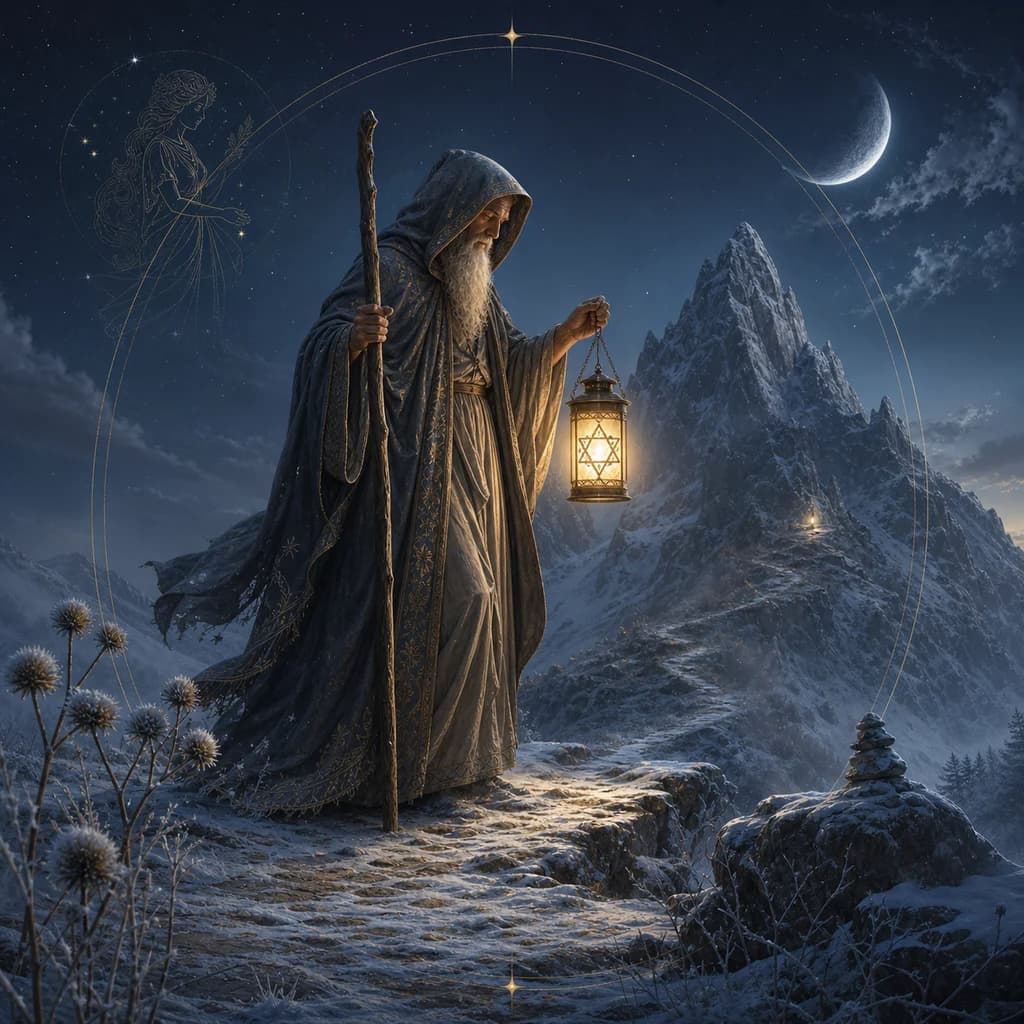
Most guides will tell you the lantern contains the Seal of Solomon — and that's correct. What most guides don't go further on is what kind of light that makes it.
The six-pointed star inside the lantern is two interlocking triangles: fire pointing up, water pointing down. It's not raw intuition (that's The Moon) and it's not solar reason (that's The Sun). It's integrated knowledge — wisdom that comes from holding both sides of yourself at once. When this card appears in a reading, the work isn't "follow your gut" and it isn't "be logical." It's "go somewhere quiet enough that both can speak."
The Staff
The Hermit leans on a staff. Same staff as The Magician's wand, same staff as The Fool's walking stick — they're all the elemental tool of fire and willpower, just held at different stages of the journey. The Fool's stick is light and casual. The Magician's wand is raised in command. The Hermit's staff supports him. He's tired. He has used his will. Now he walks slowly.
The Mountain Peak
The Hermit doesn't stand at the base or in the foothills. He stands on the summit. The implication, which Waite was explicit about, is that this is the figure who has already done the climbing other Major Arcana cards depict. The Lovers' mountain, the Strength card's mountain — they all lead here. The Hermit is what you become after climbing.
The Gray Cloak
His robe is gray. Not white (initiation, like The Magician), not red (action, like The Empress). Gray is the color of integration — the meeting point of black and white, dark and light. The Hermit isn't pure anything anymore. He's the figure who has held opposites long enough that they've blended.
The Hermit Upright Meaning
Upright Hermit is the card of chosen withdrawal — pulling back not because life pushed you out, but because you've decided you need quiet to know what's true.
Core Upright Keywords
- Deliberate Solitude — Time alone as an active practice, not an accident
- Inner Guidance — Trusting the answer that comes when no one else is talking
- Patience with the Process — Letting clarity arrive on its own schedule
- Wisdom from Experience — Knowledge that's been tested, not just read
- Spiritual Retreat — A period set aside for inner work
In-Depth Upright Interpretation
When The Hermit appears upright, the reading is usually one of two things. Either you've been moving too fast and the card is asking you to stop, or you've been listening to too many voices and the card is asking you to choose one — yours.
A client in Tokyo drew The Hermit twice in three weeks while trying to decide between two job offers. She had asked seven friends and three family members for advice. By the second reading I told her something I rarely say so directly: stop asking. Sit with the question for one weekend alone, without your phone. The card was not telling her which job to take. It was telling her she already knew, and the noise of consulting everyone was the thing keeping her from hearing it. She picked the offer she'd been leaning toward all along.
In Japanese タロット占い this card is sometimes translated as 「隠者」 with the specific cultural connotation of 修行 — disciplined spiritual practice in retreat. That nuance is closer to the original meaning than the English "hermit," which carries a faint suggestion of antisocial withdrawal. The Hermit isn't anti-social. He's practiced.
The card is also a strong indicator of a teacher figure — someone you're either becoming or about to meet. If the rest of the spread points outward, watch for a mentor. If it points inward, you're being asked to become one to yourself.
The Hermit Reversed Meaning
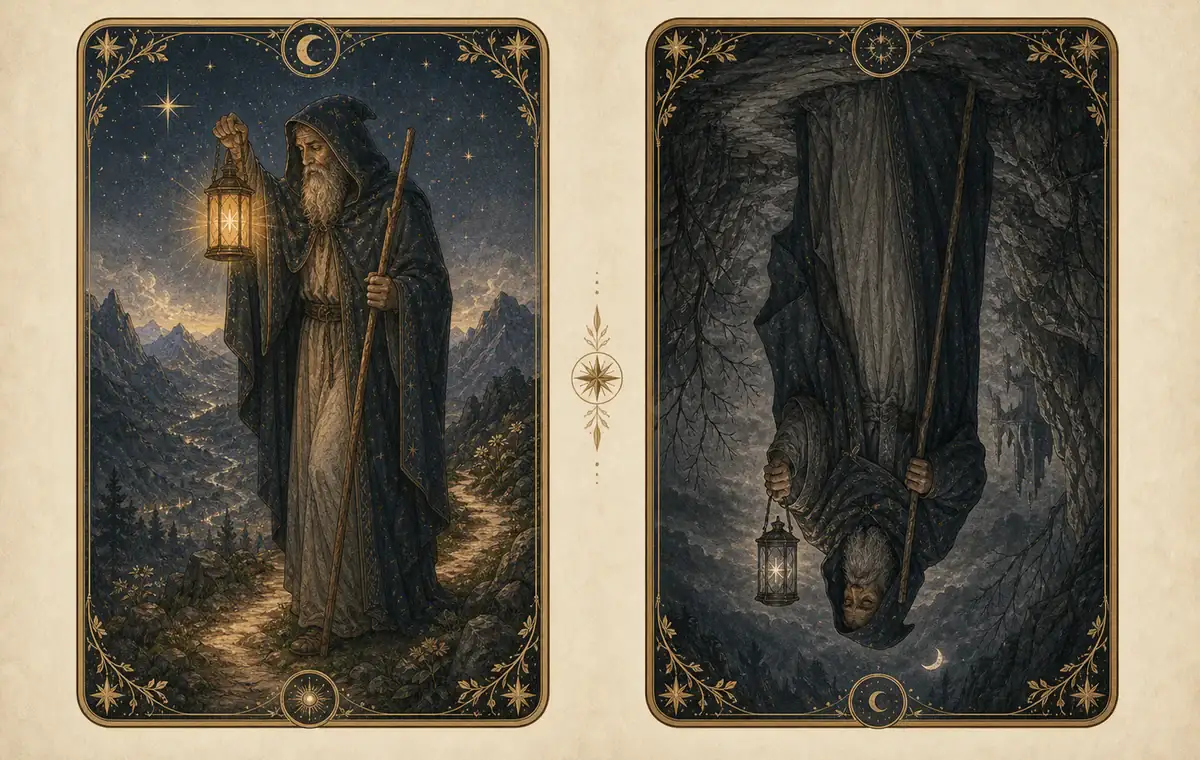
Reversed Hermit is one of the cards where you must read the direction of the flip carefully — because withdrawal and refusal to withdraw look like opposite problems, and both can show up here.
Core Reversed Keywords
- Isolation — Solitude that has curdled into avoidance
- Refusing Retreat — Staying busy to avoid hearing yourself
- Loneliness — Aloneness without the integration that should follow
- Spiritual Burnout — Exhausted from too much inner work without rest
- Paralysis — Inability to come back from the mountaintop
In-Depth Reversed Interpretation
The first reading is too much withdrawal. Someone has been alone long enough that the solitude has stopped producing insight and started producing rumination. They're not integrating; they're looping. Reversed Hermit here is the card asking them to come down off the mountain and rejoin the world. Wisdom that doesn't get tested in contact with others eventually rots.
The second reading is refusing the retreat the moment is asking for. This is the opposite — someone who is over-scheduled, over-consulted, and constantly checking their phone, refusing to be alone because being alone would force them to hear the question they don't want to answer. Reversed Hermit here reads as avoidance dressed up as productivity.
I see the second pattern more often than the first. Tokyo clients in particular tend to fill every hour with obligation, and reversed Hermit usually shows up after months of that. The card is asking them to cancel something.
The Hermit in Love & Relationships
The Hermit is not typically a "love card," and that's exactly why its appearance in love readings is worth taking seriously.
Upright in a love reading, The Hermit signals that the next move in your relationship — or in the search for one — comes from inside, not outside. For singles, this is the card telling you to stop swiping for a stretch and figure out what you actually want before you keep auditioning candidates. For people in relationships, it can signal a healthy period of inward focus by one or both partners — sometimes a sabbatical, a creative project, or a quieter rhythm. This isn't distance. It's depth.
Reversed in love is more complicated. It often signals one partner who has emotionally withdrawn and won't come out — present in the room but not in the relationship. It can also mean the opposite: someone in a relationship who is using the relationship to avoid being alone with themselves. The card asks: are you in this connection because you chose it, or because you couldn't bear the silence of being uncoupled? If you've pulled this card to read where another person stands, see the Hermit as someone's feelings for what that quiet usually means.
The Hermit in Career & Spiritual Path
In a career reading, The Hermit upright often means the next career move requires withdrawal before action. Maybe that's a sabbatical, maybe a single day spent not opening your laptop, maybe a longer pause to retrain. The card is not a promotion card. It's the card of the period that comes before the right move becomes visible.
This is the card I see most often before someone leaves a job they thought they loved. Not because the job is bad — because the version of them who picked it has changed, and they need quiet to find out who they are now.
Reversed in career suggests either burnout from over-isolation (the freelancer who hasn't talked to a colleague in six months and can no longer tell if their work is good) or burnout from over-stimulation (the manager whose calendar has no white space and who hasn't had an original thought since last quarter).
For spiritual practice, upright Hermit is unambiguous — go deeper, but go alone for a while. Stop reading new books. Sit with what you already know.
The Hermit in Timing Questions
Timing is The Hermit's weakest area, and most readers misread it. Because the card is so closely associated with Virgo, some guides assign it Virgo season (late August to late September). I find that unreliable.
What's more useful: The Hermit signals that the timing of the thing you're asking about is not yet and not external. The clock the card is running on is internal — the answer arrives when you're ready, not when the calendar turns. If you draw The Hermit asking when something will happen, the honest reading is: it will happen after you stop trying to make it happen.
The Hermit vs. Four of Swords: What's the Difference?
These two cards both depict withdrawal and are commonly confused. The distinction is important.
The Four of Swords is rest after battle. It's recovery, sleep, recuperation — necessary but reactive. The figure on the card is lying down because they've been depleted. The withdrawal is not chosen for its own sake; it's needed because something exhausted them.
The Hermit is solitude chosen for the sake of the solitude itself. The figure is upright, walking, climbing — withdrawal as active practice. Nothing has depleted The Hermit. He has chosen the mountain because the mountain is where the work happens.
If the Four of Swords is recovery, The Hermit is retreat. The first heals what's been spent. The second goes looking for what hasn't yet been found.
When both appear in a spread you're usually looking at someone who needs the Four's rest before they can do the Hermit's work. You can't introspect productively while exhausted.
The Hermit Card Combinations
The Hermit + The High Priestess
Two cards of inner knowing. Together they signal a period of strong intuitive guidance — the kind of clarity that only arrives when you've been quiet long enough to hear it. Often appears before a major life decision that the client already knows the answer to but hasn't said aloud.
The Hermit + The Star
Hope after retreat. The Hermit's solitude has produced something — a renewed sense of purpose, a creative vision, a healing. The Star is what comes after the Hermit's mountain when the work has been done well.
The Hermit + Three of Swords
A combination I see in grief readings. The Hermit's solitude here is processing a loss. Not avoidance, not denial — the necessary time alone that grief requires. Don't push the client to "get back out there" if this combination appears. They're doing the work.
The Hermit + The Lovers
A choice that requires solitude to make. The Lovers asks for a values-aligned decision; The Hermit says the values won't be visible until you've spent time alone with the question. Common in spreads about whether to commit to someone or something.
The Hermit + Eight of Cups
Departure as deliberate retreat. The Eight of Cups is the act of walking away from what no longer fits; The Hermit is the solitude that walk leads into. Together they read as a clean, chosen exit followed by the quiet that lets you understand why you left.
The Hermit + The World
The completion of an inner cycle. The Hermit's lantern has illuminated what the journey was for, and The World confirms it. Often appears at the end of a long therapeutic, creative, or spiritual process.
Numerology & Astrological Correspondences
The Meaning of Number 9
The Hermit is numbered IX. In numerology, nine is the number of completion before transition — the last single digit, the final stage before the system resets at ten. Nine carries the weight of everything that came before it. That's why The Hermit feels older than the cards around him; he's the figure who has lived through the previous eight cards and is integrating them.
Nine is also the number associated with universal love and wisdom, which sounds abstract but lands precisely in this card. The Hermit's solitude is in service of something larger — the wisdom he gathers alone is for others.
Astrological Correspondence: Virgo
Virgo is the mutable earth sign, ruled by Mercury. Earth gives Virgo its groundedness, its slowness, its attention to detail. Mutable means adaptive. Mercury rules thought. Combine these and you get the energy of the card precisely — patient, observational, mentally active in a quiet way, devoted to refining and discerning.
Virgo's shadow is over-analysis, and that's exactly what reversed Hermit can look like: someone who has thought so long about a question they've stopped being able to act on it.
Frequently Asked Questions
Is The Hermit a Yes or No card?
Neither, mostly. The Hermit is one of the worst cards in the deck for direct Yes/No questions because its whole nature is "the question you're asking is the wrong one." If pressed, I read it as "wait" — not now, not no, just not yet. Ask again after you've sat with the question alone.
Does The Hermit mean I'll be alone forever?
No. This is one of the most common beginner misreads. The Hermit is temporary solitude, not permanent isolation. The figure is climbing; he is not buried. If you've drawn this card asking about love, the reading is usually that the solitude will produce the clarity that the next relationship requires — not that there won't be one.
How does the Japanese tarot tradition read The Hermit?
In タロット占い this card is often translated as 「隠者」 but interpreted closer to 修行者 — a person on a disciplined spiritual path. The connotation of structured retreat (think of a Buddhist or Shinto practitioner doing a period of seclusion) is much stronger than the English "hermit." Japanese readers tend to read this card as actively productive solitude rather than passive withdrawal.
What if The Hermit shows up in a love reading?
It's not bad news. It usually means the next chapter of your love life requires inner work first — figuring out what you actually want, processing a past relationship, or deciding whether you're ready to date again. The card is not saying you'll be alone. It's saying alone is the doorway.
Can The Hermit indicate a specific person?
Yes — typically an older mentor figure, a teacher, a therapist, or a wise friend whose role in your life is to help you find your own answers rather than give you theirs. Astrologically, it can describe a Virgo or anyone with strong mutable-earth energy.
I keep drawing The Hermit. What does that mean?
A repeating Hermit is almost always a sign you're still asking the world for an answer you can only find alone. Cancel one thing on your calendar. Spend that time with no phone. The card usually stops repeating after you've actually done that — not after you've planned to.
Closing
The Hermit is not the card of being left alone. It's the card of choosing aloneness because aloneness is where the next thing gets made. Solitude in this card is not a punishment or a problem to be solved. It's a craft.
If you've drawn The Hermit, the question isn't "how do I get back out there?" It's "what would I hear if I were quiet for one whole day?" Try it before you do anything the card seems to be pointing toward. The lantern is already lit. You just have to walk far enough up the mountain to see it.
Continue exploring the Major Arcana: read about Strength for the temperament that precedes The Hermit's retreat, or The High Priestess for the intuition the Hermit's lantern was designed to illuminate.