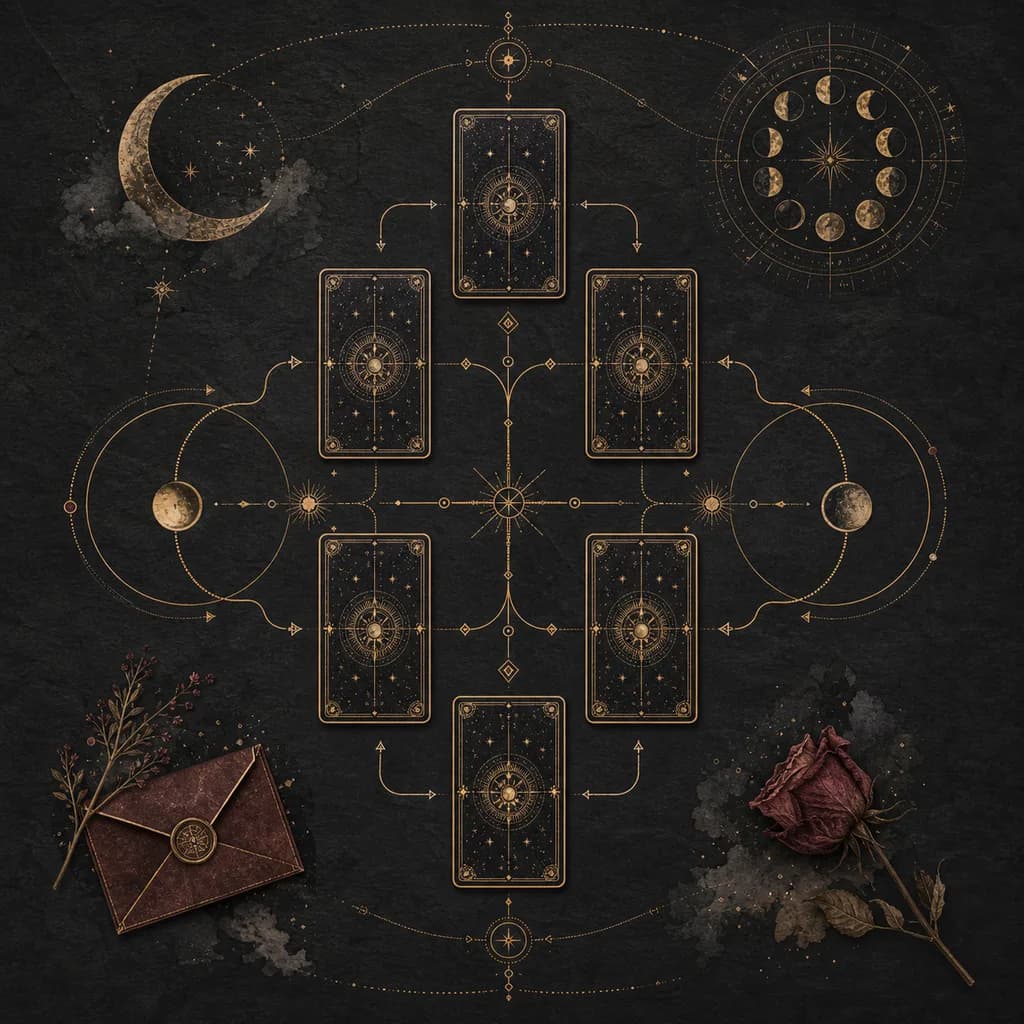
Most love tarot guides do the same thing: they list fifteen spreads, give each one a paragraph, and leave you to figure out which to use for your actual question. This guide does the opposite. Six spreads, picked because each one answers a question the others don't, plus a clear decision tree so you know which to reach for.
But the bigger reason to read this guide instead of another one is what most love-tarot articles skip entirely: the honest part. Tarot doesn't read another person's mind. It reads a dynamic. There are questions you should not ask the cards about an ex or a third party, not because it's "bad luck" but because asking them puts you in a worse mental state than you were in before. We'll cover all of that — what the cards can do well in love readings, what they can't do at all, and the ethical line that separates the two.
If you're sitting with a tarot deck right now and a question about someone you love, this is the guide.
Table of Contents
- Before You Pull a Single Card
- What Love Tarot Can and Can't Tell You
- Which Spread for Which Question (Decision Tree)
- Spread 1 — The One-Card Daily Love Pull
- Spread 2 — Three-Card You / Them / The Connection
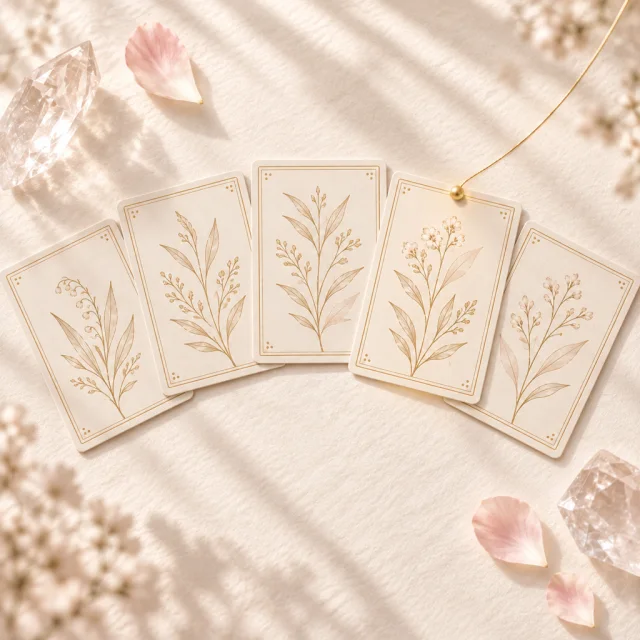
- Spread 3 — Five-Card Relationship Deep Dive
- Spread 4 — The Singles Spread
- Spread 5 — The Ex / Reconciliation Spread
- Spread 6 — The Soulmate Spread
- Reading Love Cards: Suits, Court Cards, and the Cards to Watch
- When Not to Do a Love Reading
- Frequently Asked Questions
Before You Pull a Single Card
Two things to get straight before you shuffle.
First: love readings are the most-misused category in tarot. People reach for them when they're upset, when they want reassurance, when they're hoping the cards will say something they already decided they want to hear. The cards will say something — but a reading done from that state isn't a reading, it's a confirmation-seeking ritual. If you can't honestly tell yourself you want the truth even if it's the answer you don't want, wait.
Second: the question has to be about you, or about the dynamic — not about the other person's mind. "Does he secretly love me?" is not a question tarot can answer in any honest sense. "What is the dynamic between us right now?" is. "Why am I drawn to this person?" is. "What is my part in this pattern?" is. The shift sounds subtle. It's not. It's the difference between a useful reading and a fantasy.
If both of those land, shuffle.
What Love Tarot Can and Can't Tell You
Honest list, because the honest list is more useful than the long one.
Tarot can:
- Show you the pattern you're carrying into the situation
- Show you the dynamic between two people (the relational field, not the inner monologue of one)
- Surface what you've half-noticed and haven't said out loud
- Name an obstacle that's been invisible to you
- Suggest a leverage point — something you can actually do or stop doing
- Highlight what you genuinely already know but are avoiding
Tarot can't (or shouldn't try to):
- Tell you what someone else is thinking, feeling, or doing in private
- Predict whether your ex is sleeping with someone new
- Date-stamp when you'll meet your future partner
- Confirm that a specific person is your soulmate
- Override another person's free will or "make" someone return
Every guide will tell you "tarot isn't fortune-telling." Almost no guide will then refuse to print the spread that asks "what is he doing with her right now?" This one will. The cards will give you an image if you ask, but the image is your own projection, not information. Asking a question that requires reading someone else's private inner life from the outside is the single biggest source of bad love readings. It's a trap. Don't ask.
Which Spread for Which Question (Decision Tree)

A decision tree, since the spreads below are tools and the wrong tool produces a confused reading.
- "What's the energy of my love life today?" → One-Card Daily Pull
- "There's someone specific I have feelings for — what's between us?" → Three-Card You / Them / The Connection
- "I'm in a relationship and want to understand it more deeply." → Five-Card Relationship Deep Dive
- "I'm single. Why isn't love landing?" → Singles Spread
- "My ex and I — is reconciliation possible / what's actually going on?" → Ex / Reconciliation Spread (after reading the ethical section first)
- "I want to understand soulmate-level connection." → Soulmate Spread
If the question doesn't fit any of these cleanly, the question may need narrowing before you pull. Vague questions get vague answers.
Spread 1 — The One-Card Daily Love Pull
The smallest love spread there is, and the one with the highest return on time invested.
One card. Pulled in the morning. Frame: "What energy am I bringing into love today?"
Why this works: the daily pull builds card vocabulary specifically inside the love domain. After two weeks, the difference between how the Four of Cups feels on an emotionally closed day vs. how the Two of Cups feels on an open day is in your body. That's the foundation under every bigger spread. You can't read a five-card love spread well if you can't read a single card well.
Best for: building skill, daily self-awareness, anyone in a relationship who wants to track emotional weather.
Not for: making decisions. A one-card pull is a check-in, not a council.
Spread 2 — Three-Card You / Them / The Connection
The single most useful spread when there's a specific person in your life and you don't yet know what's there.
Layout:
- Card 1 (left) — You in this connection. Your honest position, not the version you'd describe to a friend.
- Card 2 (right) — Them in this connection. How they're showing up energetically — not what they're privately thinking.
- Card 3 (center, below or between) — The dynamic between you. Not the outcome. The shape of the thing itself.
How to read it:
- Look at Cards 1 and 2 side by side first. Are the suits compatible? Is one card guarded (Swords, reversed) and the other open (Cups)? That mismatch is the reading.
- Then look at Card 3. The connection card often picks up an energy that's not visible in either Card 1 or Card 2 alone — relationships have a third entity that belongs to neither person.
- Notice what Card 3 is not. If your card is Two of Cups, it's a balanced reciprocal energy. If it's Knight of Cups, the connection is driven by one of you doing all the moving.
What this spread refuses to give you: a future card. This is intentional. Predicting the future of a connection treats the other person as a passive object whose behavior you can know. Read the dynamic, and let the future unfold from what you each choose to do with that information.
Spread 3 — Five-Card Relationship Deep Dive

For people already in a relationship who want more than a check-in.
Layout (you can lay it out any way that makes sense to you; positions matter, geometry doesn't):
- Card 1 — You in the relationship right now. Your current state, not your usual state.
- Card 2 — Your partner in the relationship right now. Their current energy.
- Card 3 — The strength of the relationship. What's actually working. What's load-bearing.
- Card 4 — The challenge. The friction point — often the one neither of you has named yet.
- Card 5 — The advice / leverage point. A specific shift one or both of you could make.
How to read it well:
- Compare Cards 1 and 2 first, the same way as the three-card spread.
- Then read Cards 3 and 4 as a pair. The strength is often the thing that, taken too far, becomes the challenge. A relationship built on independence (Card 3 = Hermit) can flip into disconnection (Card 4 = Five of Cups) when one or both pull too far back. The challenge is usually a strength under stress.
- Read Card 5 last. The advice card is almost always pointed at you, not your partner. You can only move your own piece on the board.
Best for: relationships at a transition point — getting more serious, considering moving in, considering kids, going through a slow patch.
Spread 4 — The Singles Spread
For when you're single and the question is "what's going on with my love life, why is nothing landing." The trap with singles spreads is they often slip into "when will I meet someone." That question is unanswerable and unhelpful. The version below points inward, where the actual leverage is.
Layout (5 cards):
- Card 1 — What you're radiating in love right now. Often unconscious. Often the most surprising card in the spread.
- Card 2 — What you actually want. Not what you're "supposed to" want. Not the relationship your friends keep telling you to find. What you'd want if no one were watching.
- Card 3 — The block. The pattern, fear, or belief keeping love from landing. Usually a holdover from earlier relationships.
- Card 4 — The shift. What needs to change for the radiating to match the wanting.
- Card 5 — The opening. Where in your life love is actually likely to enter, given who you currently are. This is not a "when" card — it's a where.
How to read: Cards 1 and 2 are usually mismatched. That mismatch is most of the problem. You're radiating one frequency and wanting another. Card 3 names why. Card 4 is the move. Card 5 is the door you actually have.
What this spread won't tell you: a date, a name, a description. If it did, it would be lying.
Spread 5 — The Ex / Reconciliation Spread
This is the spread most readers Google in their lowest moment. So a longer note before the layout.
Before you pull this spread, read this
There's a specific class of question this spread is designed not to answer:
- "Is my ex with someone new?"
- "Is my ex thinking about me right now?"
- "What is the third party like?"
- "Will the new person leave them?"
Don't ask any of these. Not because tarot is too sacred for it — because asking these questions makes you worse, not better, regardless of the answer the cards give. If the cards say "yes there's someone new," you suffer. If the cards say "no," you have new uncertainty to obsess over. There's no version of asking these questions that improves your life, and the cards in those positions tend to be projection-bait — your own fear in card form.
The spread below is for the question that's actually worth asking: what's the genuine state of this thing, and what would a return — if it happened — actually require.
Layout (5 cards)
- Card 1 — The honest current energy between you. Not the energy you had at peak, not the energy at the breakup — what's actually there now, including the gaps.
- Card 2 — Your own state. Where you are now in this. Important: this card usually tells you whether you're ready for what you're asking for.
- Card 3 — The block to reconciliation. What would actually have to move or change. Often it's a structural thing (timing, distance, an unresolved hurt), sometimes it's a pattern that broke the relationship the first time and hasn't been addressed.
- Card 4 — Advice. What's yours to do or not do.
- Card 5 — The realistic possibility. Not "yes" or "no." A read on whether the conditions for return exist or don't, right now.
How to read it honestly
Read Card 2 (your own state) first. Before you look at any card about them. If Card 2 shows you're emotionally raw, the rest of the spread won't sit right — you're not in the state to hear the answer. Put it down, come back in a week.
If Card 5 shows the possibility is low or absent, sit with what Card 4 is telling you to do. Sometimes the most loving advice is "stop pulling on a closed door."
If a court card you don't recognize appears in Card 3, don't leap to "third party." Court cards in obstacle positions are more often a quality — pride, immaturity, unprocessed anger — than a literal person. Read the card before reading the gossip.
Spread 6 — The Soulmate Spread
The soulmate concept is loaded. Different people mean radically different things by it — a fated lifelong partner, a karmic connection that teaches you a lesson, a twin flame in some traditions. This spread is agnostic. It's designed to clarify the quality of soulmate-level connection you're calling in, not to confirm whether a specific named person is the one.
Layout (5 cards):
- Card 1 — What "soulmate" means for you in this season. Different people need different soul connections at different times. This card names what yours would actually look like.
- Card 2 — What you'd need to be ready for it. The self-work piece.
- Card 3 — The first sign you'd recognize. Not a description of the person — a description of the feeling you'd notice early.
- Card 4 — The pattern to release. What old shape is taking up the space a soulmate connection would need.
- Card 5 — The next step. What's yours to do or to stop doing.
What this spread refuses to be: a "is X the one" reading. If you have a specific person in mind, use the three-card connection spread or the relationship deep dive. The soulmate spread is for the energy, not the identification.
Reading Love Cards: Suits, Court Cards, and the Cards to Watch
A few patterns that come up in almost every love reading:
Suit weather:
- Cups dominant — emotional truth, sometimes overwhelm. The reading is about feeling, not strategy.
- Pentacles dominant — commitment, stability, sometimes inertia. The reading is about the structure under the feeling.
- Wands dominant — passion, momentum, sometimes burn-out or impulsivity. The reading is about energy.
- Swords dominant — communication, mind, sometimes anxiety or sharpness. The reading is about what's being said or not said.
- Mostly Major Arcana — the situation has soul-level weight. Don't try to read it as a quick decision.
Court cards in love readings:
- Pages — beginnings, immaturity, sometimes a younger or less experienced energy
- Knights — pursuit, movement, but also unbalanced energy (one person doing all the chasing)
- Queens — emotional sovereignty, the ability to hold one's own
- Kings — established authority, sometimes stuck patterns
When a court card lands in a "the other person" position, it's often qualitative (a kind of energy they're embodying right now) rather than literal (a specific person who looks like that).
Cards that show up in love readings and what they actually mean:
- The Lovers — values-aligned choice, not "guaranteed romance." Often it's asking which love.
- Two of Cups — true reciprocal connection between equals.
- Ace of Cups — new emotional opening. Not necessarily romantic — sometimes the opening is in you.
- Ten of Cups — earned, settled happiness. Often a long-game card.
- Knight of Cups — romance offered, but check how grounded it is.
- Three of Swords — heartbreak, yes, but more usefully: a wound that needs naming, not avoiding.
- The Tower in a love spread — sudden change in the relational structure. Sometimes the structure was already broken and the Tower is letting you see it.
When Not to Do a Love Reading
Honest list:
- Right after a fight. You'll pull the cards looking for ammunition or vindication. Either way, you won't hear the reading.
- In the first 48 hours after a breakup. The emotional system is in shock. Whatever the cards show will be filtered through that shock.
- When you've already done one today on the same question. The second reading is almost always worse than the first. The cards aren't getting clearer; you're shuffling your unprocessed feelings.
- When the question is really about controlling someone else. "Will he come back" sometimes hides "how do I get him to come back." The cards can answer the first; they can't answer the second.
- When you're hoping the cards will give you permission to keep ignoring something. They won't.
The cards aren't going anywhere. A reading done from a steady state, even one day later, will give you something the panicked midnight reading can't.
Frequently Asked Questions
What's the best tarot spread for love?
There isn't one best spread — there's a best spread for your specific question. Use the decision tree above. A three-card you/them/connection spread covers the most common case ("there's a specific person, what's between us"); a five-card deep dive covers established relationships; the singles spread covers "why isn't love landing"; the ex spread covers reconciliation questions. Pick by question, not by spread.
Can tarot tell me if someone is my soulmate?
Tarot can clarify what soulmate-level connection would look like for you and what's currently blocking it. It can't confirm or deny that a specific named person is "the one." Anyone — reader or app — telling you otherwise is overselling. Soulmate confirmation isn't a thing tarot does honestly.
Can tarot tell me what my ex is feeling?
Not reliably. Tarot reads the dynamic — the relational field that includes both of you — far better than it reads one person's inner life from the outside. A card in "their state" position tells you about the energy they're putting into the relationship, not the secret content of their thoughts. If the question you want answered is "what is he privately thinking," the honest answer is: ask him, or accept you don't know.
Will tarot tell me when I'll meet my future partner?
No. Date predictions for relationship events are the single most-failed type of tarot reading. The cards can show you the energy of who you'd attract from your current state, and the patterns that have to shift before that meeting becomes likely. A specific date or month, no.
Is it OK to do tarot readings about a third party?
Not as the main subject of the reading. A reading about your ex's new partner — what they're like, whether they'll stay together, etc. — is a reading about a person who didn't consent and a situation you can't influence. Even setting consent aside, those readings rarely make the asker feel better. If a third party is genuinely affecting your situation, read the situation (the ex spread above), not the third party themselves.
How often should I do love readings?
The daily one-card pull is fine. For larger spreads on the same question, weekly or longer between readings is better. If you find yourself returning to the same question multiple times a week, the issue isn't that the cards weren't clear — it's that the answer isn't one you've accepted yet.
What if I keep getting "bad" cards in love readings?
First, no card is automatically bad. The Tower in a love reading often means the relational structure was already cracked and the cards are letting you see it — that's information you can use. Second, if you've genuinely been getting consistent difficult cards across multiple sessions, the cards are probably telling you something you don't want to hear. Sit with what they're naming. If it keeps being the same theme, that theme is probably the real reading.
Can I read tarot for my partner?
Yes, with their consent. Reading the relationship dynamic with your partner present can be powerful — pull cards together, talk about what each position brings up. Reading about your partner without their knowledge tends to drift into surveillance and projection. The first is intimate; the second isn't.
Conclusion
Love tarot is not crystal-ball work. It's a structured way to look at the relational situation you're actually in — your part in it, the dynamic between two people, the pattern that keeps repeating, the leverage point you actually have. Done well, it reduces confusion. Done poorly — usually because the question was really "tell me what I want to hear" or "tell me what someone else is secretly thinking" — it adds to confusion and stays there.
Pick the spread that matches your question. Read your own card first when you're asking about another person. Refuse the questions that hurt you no matter how the cards answer them. And remember the line that should be over every love spread you'll ever do: the cards read the dynamic, not the other person's mind.
Want to go further on the layout side? Read our Three-Card Tarot Spread Guide and Celtic Cross Tarot Spread Guide. New to tarot? Start with the Tarot Beginner's Guide. Want to pull a love spread right now? Our AI tarot tool can guide you through any of the six spreads above.