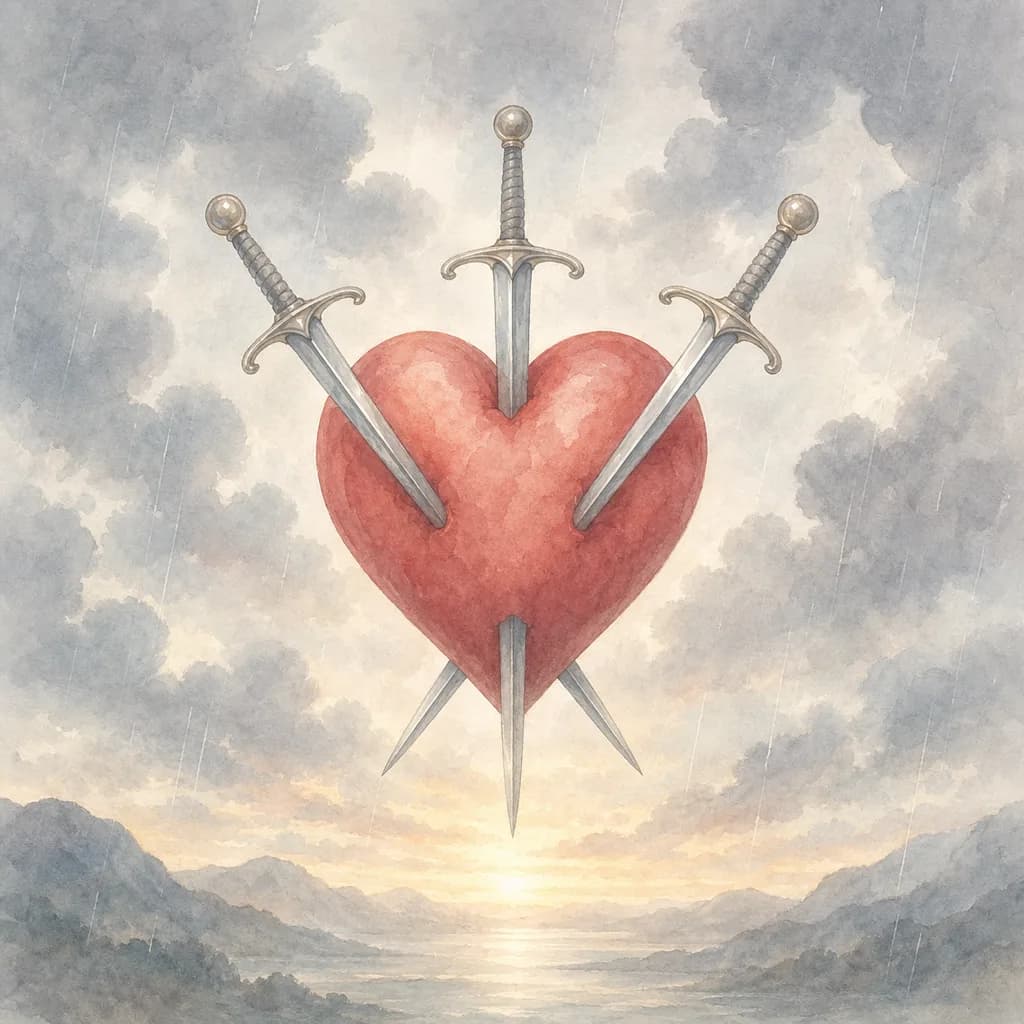
Three swords go through a single heart, and most guides stop reading the image right there. They count the blades, note the rain, pronounce the word "heartbreak," and move on. What almost no one points out is that the three swords are arranged with care — evenly spaced, crossing at clean angles. The heart is pierced cleanly, with order, and once you notice that, the Three of Swords stops being only the card of pain. It becomes the card of the truth that hurts because it is so accurate.
After more than a decade reading the Rider-Waite-Smith deck in Tokyo, the Three of Swords is the card I most often watch clients try to soften before they have actually looked at it. This guide goes past "you're going to get hurt" — into the symbolism, the upright and reversed meanings, the life areas where the card shifts the reading, and the question the whole image is built around: is the cut the injury, or the truth-telling?
Quick Answer
The Three of Swords means heartbreak, grief, and the sharp pain that comes when a hard truth finally lands. As a Swords card — the suit of the mind — the hurt it describes is the specific ache of seeing something clearly that you would rather not have seen: a betrayal, a painful realization, a separation, words that cut. Reversed, it points to healing already underway, or to grief pushed down and leaking out as avoidance. For Yes/No, upright leans No ("not without pain first") and reversed toward a cautious Yes as the worst passes.
Basic Information
| Attribute | Details |
|---|---|
| Card Name | Three of Swords |
| Suit | Swords |
| Arcana | Minor Arcana |
| Element | Air (the mind, thought, communication) |
| Astrological Correspondence | Saturn in Libra |
| Yes / No | No (upright); cautious Yes (reversed, as healing begins) |
| Upright Keywords | Heartbreak, grief, sorrow, betrayal, painful truth, separation, rejection |
| Reversed Keywords | Healing, forgiveness, recovery, releasing pain — or repressed grief, negative self-talk |
Card Imagery & Symbolism
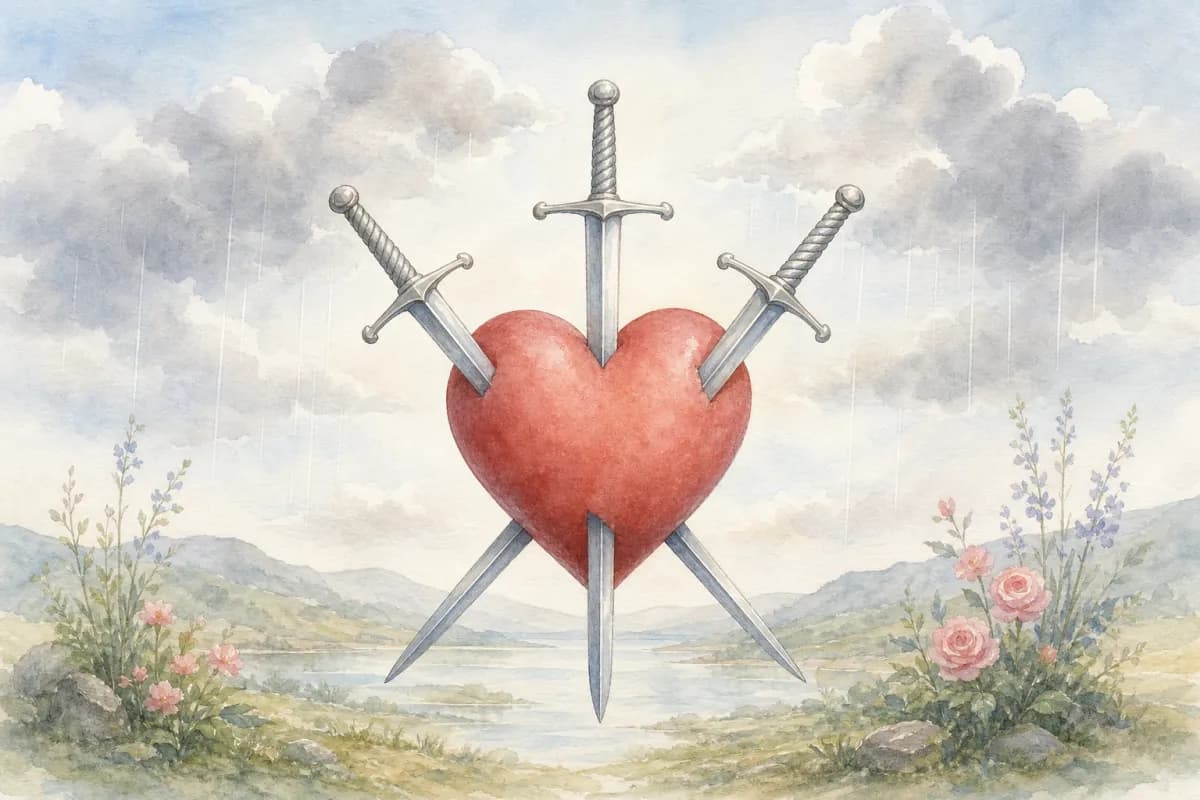
Three of Swords has the most stripped-down image in the deck. A red heart hangs in the center; three swords pass through it; behind, gray clouds and steady rain. No throne, no landscape, no human figure to stand in for you. Most of the seventy-eight cards give you a person to identify with; this one gives you only the wound and weather.
Why There's No Person
The missing figure is deliberate. The card shows the pain from the inside, where there is no observer — only the heart and the thing that went through it. No one is managing the situation or being brave about it; there is just the fact of it. The card asks you to look at the wound before you reach for the story that will make it bearable.
The Heart Held in the Air
The heart is suspended, not lying broken on the ground. It is exposed, upright, still recognizably a heart — pierced but intact in form. The Three of Swords depicts the moment of being cut while it is still happening: the heart still hangs there, still doing its work, three blades and all. The pain is active and present tense, which also means it is not yet finished.
Three Blades, Cleanly Arranged
Here is the symbol almost every competing guide skips: look at how the swords sit. They are spaced and angled with a kind of order — one straight down the middle, two crossing on the diagonals. Swords are the suit of Air, the suit of the mind, of logic and language and the clean line of a thought. These are deliberate incisions, the work of a mind doing something coldly methodical to itself.
That changes the reading. The Three of Swords carries the pain of accuracy — the moment a truth is articulated so clearly it cuts. Three things named that you cannot now un-know. The cruelest sentence in a breakup tends to be the most accurate one, and that sharp clarity is what the card is drawing.
The Storm Clouds and the Rain
The Swords cards almost always carry weather. Here the clouds are dark and the rain is heavy — the swirl of grieving thoughts, the replaying, the "if only." But rain has a second reading I always offer clients: it falls, and then it stops. These are passing clouds, the weather of a single storm, due to break.
Three of Swords Upright Meaning
Upright, the Three of Swords is the deck's most direct card of grief, and there is no soft synonym for what it shows. The reading that actually helps a client is that this card describes pain with a source. Something specific happened; a truth surfaced; the hurt has an address.
Core Upright Keywords
- Heartbreak — acute emotional pain, usually love-related
- Painful truth — a clarity that wounds because it is accurate
- Betrayal — trust broken, often by someone close
- Sorrow and grief — the honest weather of loss
- Separation — a parting, chosen or imposed
- Rejection — being turned away or left
In-Depth Upright Interpretation
When the Three of Swords comes up, my first question to a client is "what did you find out?" This card almost always sits next to a revelation: the text message you weren't supposed to see, the sentence in an argument you both knew was true the moment it landed, the slow dawning that the thing you'd been defending was already gone. As long as the hurt stays a fog of "everything's wrong," it cannot begin to heal — you cannot tend a wound you won't locate.
A client in her thirties drew this card asking about a friendship gone cold, wanting me to say she was imagining the distance. The card said otherwise, and so did she once we slowed down: months earlier her friend had said something dismissive about her work, and she had laughed it off and never addressed it. The Three of Swords was pointing at the sword already in place — the one she had decided to be too mature to feel. Naming it was the whole reading.
Still, this is not a forecast of doom. It tells you one thing has cut and asks you to feel it honestly, holding the truth and the wound in the same image.
Three of Swords Reversed Meaning
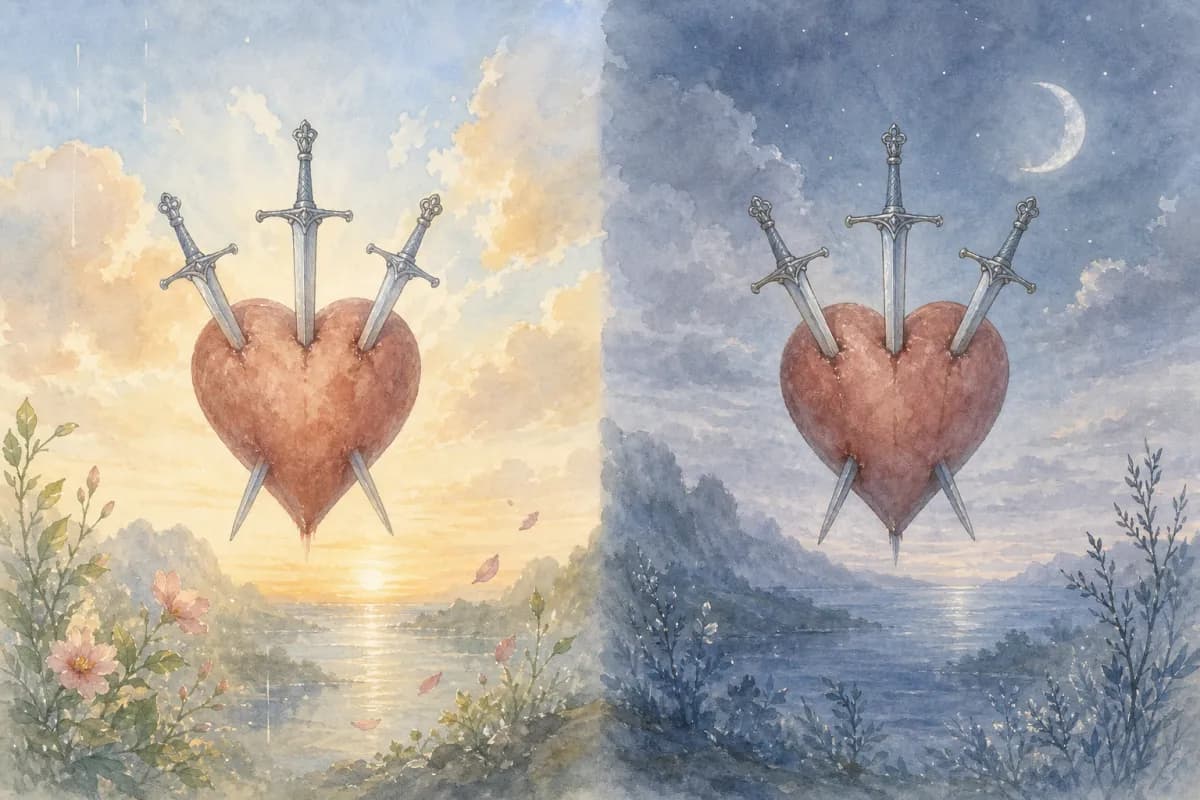
First, the question the playbook makes me answer: is reversed Three of Swords negative? Usually, no — this is one of the genuinely encouraging reversals in the deck. The upright card is so heavy that turning it over most often lightens the reading; the swords begin to slide out. But there is a shadow version, and confusing the two is the most common reversal mistake I see.
Core Reversed Keywords
- Healing — the acute pain easing, the wound beginning to close
- Forgiveness — of others or yourself; the grip loosening
- Recovery — reentering life after a hard chapter
- Repressed grief — the shadow reading: pain pushed down, leaking sideways
- Negative self-talk — the blades turned inward
In-Depth Reversed Interpretation
The first and most common reading is recovery. The storm has crested. The client is past the sharpest bleeding and into the slower, duller work of mending. Forgiveness becomes thinkable. The reversed Three of Swords often shows up the moment someone realizes they went a whole day without the wound being the first thing they thought about.
The second reading is harder: repression. The swords have not come out; they have been pushed down out of sight, and the person carries the same wound while insisting they are over it — grief stuffed in a drawer held shut. It ferments into resentment, numbness, a brittle coldness. When a client calls themselves "totally fine" about something that clearly cut deep, I take the "fine" as the symptom.
The third reading turns the blades inward — self-criticism. Here someone has become their own three swords, replaying the "I should have known," reopening the wound daily with harsh internal narration. The card asks whose voice is actually holding the knife. Often it is no longer the person who first hurt you; it is you, long after they have stopped.
How do I tell recovery from repression live? I listen for whether the client can describe the original wound plainly. Healing people say what happened in a level voice — it still hurts, but it has a shape; repressing people change the subject or jump to "but it's fine now." The Star or Six of Swords nearby pushes toward real healing; The Moon or Eight of Cups pushes toward something buried.
Is the Cut the Injury, or the Truth-Telling?
This is the blind spot in nearly every Three of Swords guide I have read, and the most useful thing the card teaches. Most articles read the three swords as pure damage, something to recover from. That is only half of what the suit is saying.
Swords are the suit of the mind, and the mind's job is to tell the truth. Across the suit the blades clarify: the Ace cuts through confusion to a single clear realization; the Two blindfolds itself to avoid a choice; the Three is where the avoided truth finally reaches the heart. The pain here is the surgical pain of finally seeing clearly — and clarity, when it arrives late and all at once, hurts as much as it was overdue. The cut and the comprehension are the same motion.
This reframes the card. The question to bring to a Three of Swords is "what did this make me see?" The breakup that cut you told you, unambiguously, what that relationship actually was; the betrayal ended a year of suspecting and never quite knowing. The blades are accurate, and the accuracy is the whole reason they hurt.
I am not claiming pain is secretly good — that is the kind of empty reassurance I distrust. The point is sharper than comfort: the Three of Swords is the deck's instrument of clarity, and clarity arrives with an edge. The clients who recover fastest stop fighting the diagnosis.
Three of Swords in Love & Relationships
This is the position people dread, and the dread is not unfounded — in love, the Three of Swords usually does describe heartbreak. But the specific shape matters, and lumping it under "bad news" wastes the reading.
For couples, the upright card most often points to a wound already present and probably already known: a betrayal real or perceived, words that cannot be unsaid, a painful truth one of you has been avoiding. Plenty of relationships survive the Three of Swords when the sword gets named and tended before it festers — the card is asking for the honest conversation that has been getting postponed.
The "three" also raises a question I always check: is there a third party? Sometimes the swords point to outside interference — an affair, a meddling figure, a love triangle — but I have seen this badly overdiagnosed. The third sword is just as often a thing as a person: a demanding job, a family pressure, an old grief one partner carries in. Before reading this card as infidelity, look at the neighbors. The Devil or the Seven of Swords — the suit's card of quiet deception — strengthens the betrayal reading; without them, the "third" is usually circumstance.
For singles, the upright Three of Swords usually describes old wounds still affecting how you connect — grief from a previous chapter that hasn't been let out. Reversed in love, the picture brightens toward healing after a breakup, forgiveness, and the slow return of openness. For what this card means when you've asked how someone feels about you, the Three of Swords as feelings page covers that lane.
Three of Swords in Mental Health & Grief
I read this position more often than the old guides suggest, because the Three of Swords is, at root, about the mind and the heart in conflict — the territory of grief and emotional pain in general, romantic loss included but never the whole of it. Upright here, the card describes real sorrow that needs space to be felt: bereavement, depression, the heavy stretch after any significant loss. The most useful thing it says is don't intellectualize this yet. The mind's instinct in pain is to start managing it; the Three of Swords asks you to feel the thing before you file it. Reversed here is usually a good sign — the worst has passed, you are mending — though the repression and self-criticism shadows live especially in this position, so an "I'm fine" delivered too quickly is worth distrusting.
Three of Swords in Career & Decisions
In work readings, upright Three of Swords points to disappointment with a clear cause: a job loss, a project that fell through, a conflict that stung, feedback that landed hard because it was true. The Saturn-in-Libra signature shows cleanly here — the workplace hurt that arrives through other people, with a sense of injustice. Reversed in career is recovery: the air clearing after conflict, the moment you stop replaying what went wrong and start rebuilding.
Three of Swords Card Combinations
Three of Swords + The Tower
A painful truth meeting a sudden collapse. Where the Three of Swords is the clarifying cut, The Tower is the structure falling all at once. Together they describe a heartbreak that arrives by shock — the revelation and the rupture in the same instant.
Three of Swords + The Star
One of the most hopeful pairings the card can land in. The Star is the calm after the storm — the rain in the Three of Swords clearing to open sky. When a grieving client draws this combination, I read it as permission to begin hoping again: the cut was real, and so is the recovery on its way.
Three of Swords + Six of Swords
Grief moving into transition. The Six of Swords is the boat leaving troubled water for calmer shores, so the heartbreak becomes a journey the client is actively carrying themselves away from.
Three of Swords + The Moon
The repression flag. The Moon is illusion, things unsaid, the murk under the surface. Paired with the Three of Swords, especially reversed, it strengthens the buried-grief reading — pain pushed down and now distorting how the person sees everything. When it appears about someone going cold and silent, I slow the reading right down; the calm is not peace.
Three of Swords + Queen of Swords
What comes after the wound. The Queen of Swords is the figure who has already grieved this exact cut and grown clear-eyed because of it — the widow's clarity on the far side of the heartbreak. Drawn together, they read as pain that is teaching you discernment rather than just hurting you.
Three of Swords + Ace of Cups
Heartbreak giving way to a new feeling. The Ace of Cups is the fresh emotional beginning, the cup offered full. After the Three of Swords it reads as the heart reopening — proof the pierced heart did not stay pierced, a good omen for love after loss.
Numerology & Astrological Correspondences
Threes in tarot are where a thing first takes shape beyond the pair. The Two of Swords is the held standoff — two blades crossed, a decision avoided, eyes blindfolded. The Three is what happens when that suspended tension resolves into something concrete: the avoided truth breaks through, and now there is a heart, a wound, an actual event in the world rather than a balance held in the mind.
Astrologically the Three of Swords is assigned to Saturn in Libra (the Golden Dawn attribution), and the fit is exact. Saturn is the planet of hard lessons and sobering truth; Libra is the sign of relationships and balance. Saturn in Libra is the difficult lesson that arrives through a relationship — the heartbreak that teaches, the fairness that comes late and at a cost. Saturn never softens its lessons, but it does make them permanent. That is the quiet promise inside the card — the cut also makes sure you never again mistake this particular illusion for the truth.
In Japanese タロット占い the Three of Swords (ソードの3) is read through 「失恋」(shitsuren), the heartbreak of lost love, but my teacher always coupled it with 「気づき」(kizuki) — the moment of realization. That pairing captures the card better than English usually does: the loss, and the seeing that comes with it.
Frequently Asked Questions
Is the Three of Swords a yes or no card?
Upright, it leans No — more accurately, "not without pain along the way." The card carries heartbreak and hard truth, so a yes would likely lead through difficult terrain. Reversed, it shifts toward a cautious Yes, especially for questions about recovery or whether the pain will ease.
What does the Three of Swords mean in a love reading?
Usually heartbreak with a specific source — a betrayal, a painful truth surfacing, a separation, words that cut. For couples it points to a wound that needs naming, and many relationships survive it. For singles it often means old grief is still shaping how you connect. Reversed, it brightens toward healing and sometimes reconciliation.
Does the Three of Swords always mean a breakup?
No. It means heartbreak or painful truth, which can happen inside a relationship that survives. Many couples move through this card by having the honest conversation it points to. Read it as a wound to tend; the surrounding cards tell you whether the relationship is ending or being forced into honesty.
Does the Three of Swords mean infidelity or a third party?
Sometimes, but it is overdiagnosed. The "three" can indicate outside interference, including an affair — but the third element is just as often a circumstance (work, family pressure, old grief). Look for The Devil or the Seven of Swords nearby before reading it as cheating; without supporting cards, don't leap to that conclusion.
What does the Three of Swords reversed mean?
Most often healing: the acute pain easing, forgiveness becoming possible, recovery underway. The shadow versions are repressed grief (pain pushed down, leaking out as coldness) and self-criticism (the blades turned inward as harsh self-talk). Whether the client can describe the original hurt plainly usually tells you which one you're facing.
Is the Three of Swords ever a positive card?
Not pleasant, but often clarifying. It delivers a truth along with the wound, and that truth ends a period of confusion or denial. Reversed, it is genuinely hopeful — one of the better "the worst has passed" cards in the suit.
What does the Three of Swords mean for health?
Traditionally it carries a heart-and-grief association — sometimes literal cardiac matters, more often the toll of stress, sorrow, or depression on the body. I treat it as a prompt to take emotional pain seriously as a physical reality. Tarot does not diagnose; if a health question is real, see a doctor.
Closing
The Three of Swords is the deck's most honest card about pain, and honesty is why it frightens people. Everything in the image is temporary except the truth it delivers.
If you've drawn it, here is the one concrete thing to do before deciding what it means: name the sword. Say, out loud or on paper, the specific thing that hurt — the actual sentence, the actual event, the truth that landed. The card's gift is that it shows you where the blade went in. Then let the rain do what rain does.
Continue exploring the Swords: read the Three of Swords as feelings for what this card means when you've asked how someone feels about you, or plan a fuller reading with our love tarot spread guide.