The Devil is the card most readers either soften too much ("it's not really evil") or harden too much ("addiction, toxicity, run"). Both readings miss the structural fact at the center of the card: the chains around the figures' necks are loose. They could walk out at any moment and they are choosing not to. The Devil is not a card about being trapped. It is a card about how we participate in our own trapping — and what it costs to admit it.
This guide reads The Devil the way the Rider-Waite-Smith image was drawn: as the dark mirror of The Lovers, with the same composition and a different physics. It covers the imagery in detail (including the inverted pentagram and the chain mechanics most articles only glance at), the Capricorn correspondence that almost no popular guide develops, the upright and reversed meanings, and how The Devil differs from The Tower and from The Lovers — the two cards it sits between thematically.
Quick Answer
The Devil is Major Arcana card XV, ruled by Capricorn and the element of Earth. Upright, it signals attachment, addiction, the shadow self, materialism, and bondage that is self-imposed — the chains are loose. Reversed, it suggests awareness of the bondage, release from an addiction or compulsion, or, less hopefully, exchanging one chain for another. Yes/No: leans No, but with the warning that the No is yours to make, not the situation's.
Basic Information
| Attribute | Details |
|---|---|
| Card Name | The Devil |
| Number | XV (15) |
| Arcana | Major Arcana |
| Element | Earth |
| Zodiac Correspondence | Capricorn |
| Hebrew Letter | Ayin (eye) |
| Yes / No | Generally No; tends to confirm a pattern you already suspect |
| Upright Keywords | Attachment, addiction, shadow, bondage, materialism, lust, hidden agreement |
| Reversed Keywords | Awareness, release, breaking free, detachment, sometimes substitution of one chain for another |
The Devil as the Mirror of The Lovers
Before the imagery, the structural fact most readers skip:
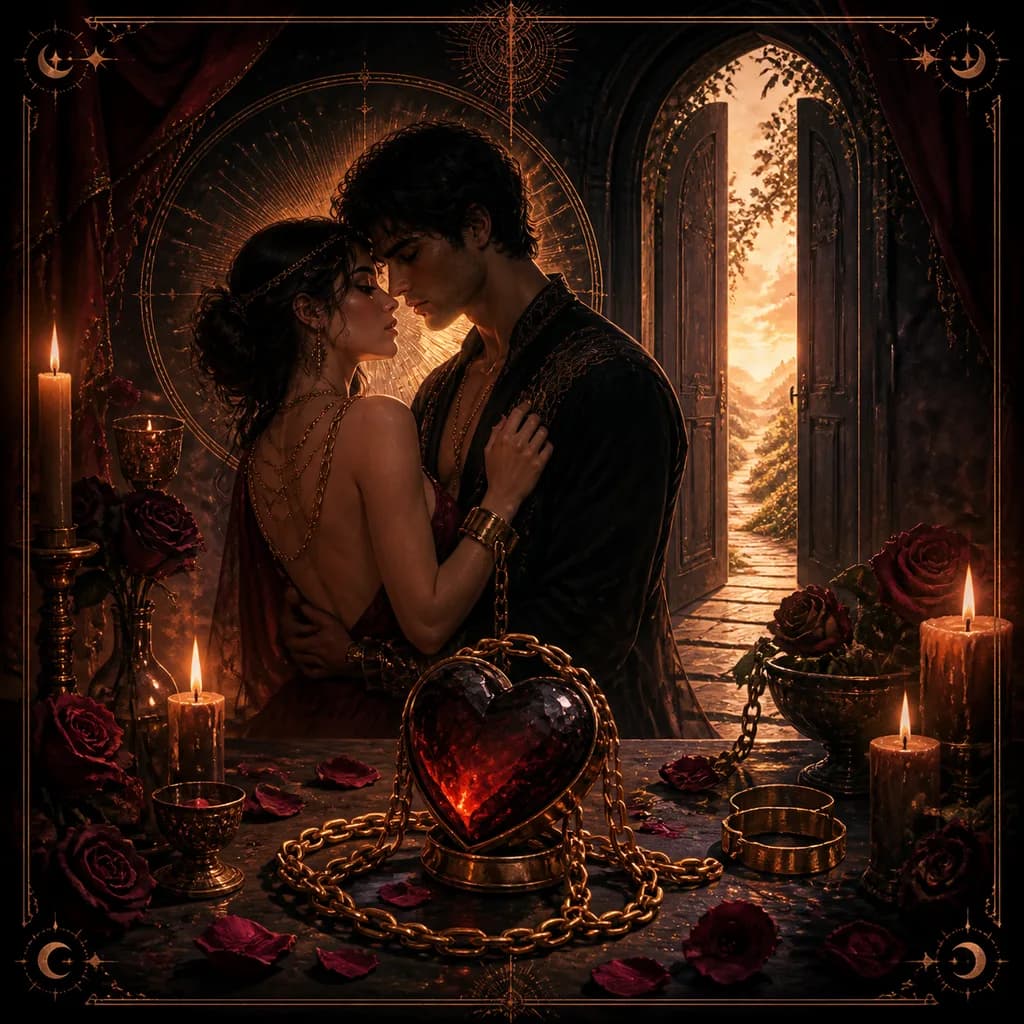
The Devil (XV) and The Lovers (VI) are drawn with the same composition. A naked man on the left, a naked woman on the right, a winged figure above them. In The Lovers, the winged figure is the angel Raphael blessing the union from light. In The Devil, the winged figure is Baphomet, looking down from a black background. Same bodies, same positions, same geometry — different overseer, different physics.
This is intentional. The Devil is what The Lovers becomes when you swap the conscious choice (Raphael's blessing) for the unconscious bargain (Baphomet's gaze). The card is asking: where in your life have you taken the form of love or partnership without the substance? Where is the structure of The Lovers running on Devil energy?
I bring this up in readings whenever The Devil appears next to anything relational, because the comparison usually does the work the words can't.
Card Imagery & Symbolism
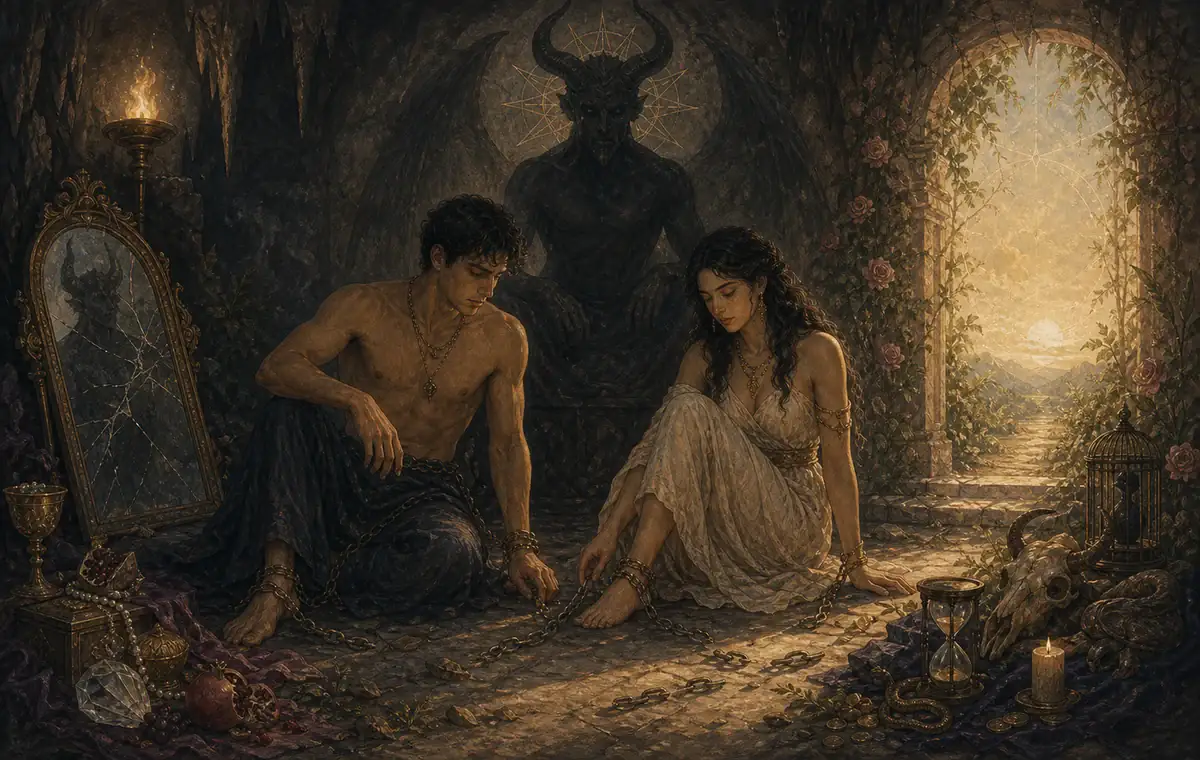
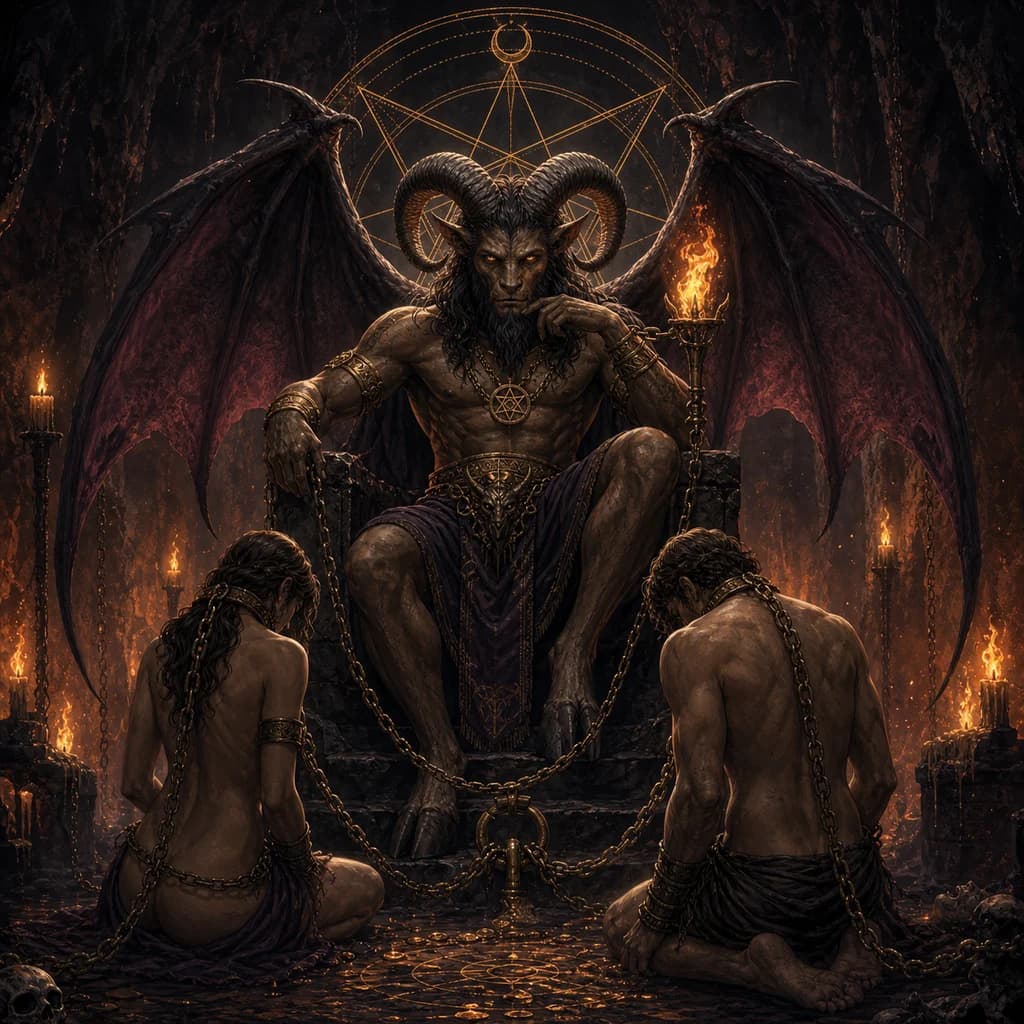
Baphomet sits on a black half-podium, half-cube. Above his head, an inverted pentagram. His right hand is raised in a gesture that mimics the Hierophant's blessing — but the hand is empty and the fingers are wrong. His left hand holds a downward torch. Below him, chained to a ring at the base of the cube, stand a naked man and a naked woman. Both have small horns and tails. The chains around their necks are visibly loose.
Read every element. The card is precise.
The Loose Chains
This is the single most important detail on the card and the one most articles mention without explaining. The chains around the figures' necks do not fit. They could be lifted off at any time. The figures stay because they have agreed to stay — usually without knowing they agreed.
That's the entire engine of the card. The Devil's bondage runs on consent that was never named as consent. The drink you said yes to once and then never said no to. The relationship you stayed in because leaving felt embarrassing. The job whose worst feature you stopped noticing six months in. The chain is loose. The collar is the part you forgot to take off.
The Inverted Pentagram
A five-pointed star with one point down and two up — the opposite of how it appears on Pamela Colman Smith's other cards. The pentagram inverted means matter ruling spirit. The four lower elements pressing down on the higher element. In divination this is not "evil" in the horror-movie sense; it is the prioritization of the physical, immediate, and tangible over the long, abstract, and aspirational. Earth ruling air. Body ruling mind.
This is consistent with Capricorn, which we'll get to in a minute.
The Torch Pointing Down
Baphomet's left hand holds a torch flame-down, into the floor. In The Magician, the wand is raised; energy goes up. Here it goes down. Light is being aimed at the ground — at what is already in front of you, at the immediate and material — and away from the sky. Pleasure now. Consequences later.
The Small Horns and Tails
The man and the woman have begun to take on the form of their captor. This is not a moralizing detail. It is a clinical one. The longer you live in a Devil configuration, the more your nervous system adapts to it. You start to look like the thing you're chained to. This is why "just leave" rarely works — by the time you'd need to leave, the chain has shaped you.
Capricorn and the Ambition Underneath
Capricorn is the under-discussed key to The Devil. Capricorn is cardinal earth — the sign of long-term structure, ambition, reputation, the climb. The Devil rules Capricorn in the same way that the Devil sits on a cube of stone: the most material, structural part of the zodiac is also where attachment to material structure becomes a trap.
This reframes the card. The Devil is not just about substances and sex (the popular shorthand). It's about ambition that has eaten its operator. The career you cannot leave because of what it has cost you to get there. The status you cannot let go of because your sense of self is welded to it. The mortgage that defines what "success" gets to mean. Capricorn-flavored Devil is the most respectable form of bondage in the deck, which is why it's also the hardest to see.
When I read The Devil for clients in their thirties and forties, this is usually where it lands — not in obvious addictions, but in the slow, prestigious version.
Upright Meaning
Upright, The Devil is naming a configuration in your life that has become structural. Something — a habit, a relationship, an identity, a substance, a financial setup, an ambition — has stopped being something you choose and started being something that chooses for you. The card is not asking you to leave it. It is asking you to see that the chain is loose.
That seeing is, in itself, the work the card requires. The Devil does not respond to willpower. It responds to recognition. The moment you can name the bargain you made without realizing you made it, the configuration starts to loosen. Most clients I read for don't act on Devil readings immediately. They act six weeks later, after the recognition has had time to settle. That delay is the card's actual mechanism.
A reading I had two years ago: a Tokyo client kept drawing The Devil across three sessions about her relationship. She was eighteen months into what she described as "almost dating" — they shared an apartment, slept together, had no exclusivity, and she was free to leave whenever. I asked her what staying gave her. She thought about it and said: the apartment is in his name and I don't want to apartment-hunt. The chain was the lease. Once she named it, she gave herself six weeks. She moved out the following month. The Devil does not always mean what the imagery makes it sound like it means.
The Devil Reversed Meaning
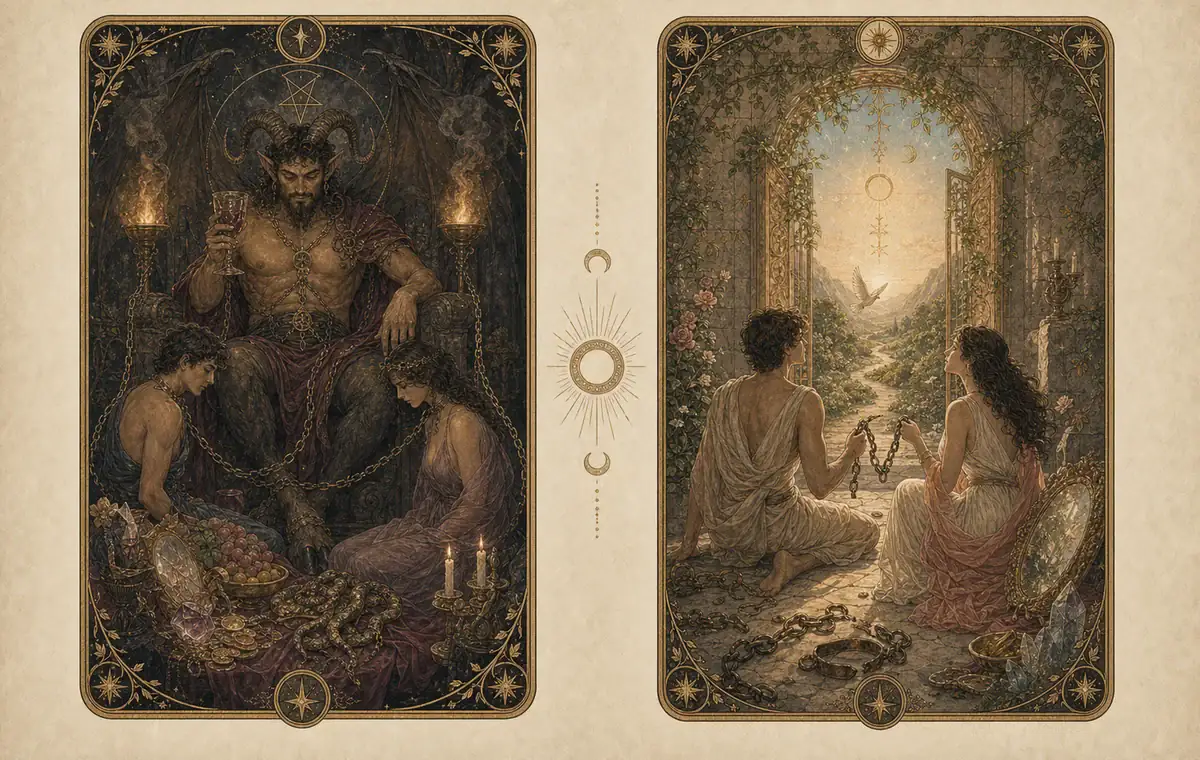
Reversed, The Devil most often signals awareness — the moment you become conscious of the chain and start the process of taking it off. This is genuinely good news in a reading, and it's why the Devil reversed as breaking free of the chain is one of the cards that reads better upside down — but it is rarely as clean as "you're free now."
The honest reversed reading has two flavors:
Reversed as release. You are coming out of a Devil configuration — ending the addiction, leaving the relationship, walking away from the role that had stopped fitting. The collar is in your hand. The work of figuring out who you are without it is still ahead of you. This is the version most articles describe.
Reversed as substitution. Less often discussed: you have not actually broken free, you have traded one chain for another. The drinker who became the workaholic. The toxic relationship that ended into a rebound with the same shape. The job you left for a job that looks different and feels identical. The card reversed can warn that the awareness has not yet translated into structural change — you have just rearranged the bondage.
In practice I read reversed Devils carefully and ask follow-up questions. "What changed and what stayed the same?" usually reveals which version is operating.
The Devil vs. The Tower vs. The Lovers
Three cards sit close to each other thematically and get confused. A short comparison:
The Devil (XV): bondage that is self-imposed and loose. The figures can leave. They don't. The configuration is stable until someone names it. Time horizon: long.
The Tower (XVI): bondage that breaks involuntarily. The configuration ends whether the figures consent or not — the lightning hits and the structure falls. Time horizon: instant.
The Lovers (VI): union under conscious blessing. The same composition as The Devil with the consent made explicit and the bond chosen freely.
The sequence XV → XVI is intentional. The Devil names what is bound. The Tower destroys what The Devil named, if you don't unbind it yourself. Many readers describe The Tower as "the bill The Devil quietly ran up." I don't go that hard on the framing in a session, but the structural relationship is real.
Love and Relationships
The Devil in a relationship reading is rarely about lust in the dramatic sense. Lust is named in the card, but the working meaning is closer to binding without naming the bind. The relationship has agreements neither person made on purpose — about money, about sex, about who carries what, about what the other person is allowed to need. The chains are loose, both people know they could leave, neither does.
If you are single and draw The Devil for a love question, it usually points to a pattern in attraction — the type you keep choosing, the type that keeps choosing back, the configuration that reasserts itself across different partners. The card is asking you to look at the configuration, not the person.
If you're partnered, The Devil rarely means end it. It means name what neither of you has named. Sometimes that conversation reveals the bond was real and the silence was the only problem. Sometimes it reveals the bond was the silence.
Career and Money
Career Devils are the Capricorn-flavored ones I described above. A position, title, or salary that has become a cage with a prestige finish. The signs are recognizable: you describe the job in language that is mostly defensive ("the benefits are good"), your weekends are about recovery rather than living, you have a clear sense of what you would do instead and a list of reasons it isn't possible yet.
Money Devils are usually about lifestyle creep that has hardened into commitment. The car payment, the rent, the subscriptions, the trips that have become non-negotiable. The Devil here is not telling you to live cheaply. It is asking which of those costs you'd choose if you were starting from zero. The ones you wouldn't are the loose chains.
Shadow Work
The Devil is the deck's most direct invitation to look at your shadow — the parts of yourself you've disowned, projected, or paved over. Carl Jung's framing is useful here: the shadow is not the evil part of you, it is the un-integrated part. The things you've decided are not allowed to be true about you. The qualities you can only see when someone else exhibits them and irritates you.
A practical shadow exercise for a Devil reading: list three people whose behavior you find unforgivable. For each, write the thing they do. Then ask where, in a very small or denied form, you do the same thing. The Devil's chain often turns out to be the energy you've refused to admit you have, which then runs the show from underneath.
This is uncomfortable work. The card does not require you to do it. It requires you to know it is available.
Card Combinations
The Devil's combinations are where the card gets specific.
- The Devil + The Lovers: a relationship operating with Devil dynamics inside a Lovers structure. The form is partnership; the energy is bondage. Usually the silent-agreement reading.
- The Devil + The Tower: the breaking of a bond that you didn't break yourself. Often shows up after long stalling.
- The Devil + Three of Swords: heartbreak inside a bond you can't yet leave. The pain is acknowledged; the chain is not.
- The Devil + Eight of Cups: a slow walking-away. The release version of the reversed reading, in upright form.
- The Devil + Six of Pentacles: generosity with a hook in it. The strings-attached side of the Six of Pentacles — help that quietly binds the person receiving it, or keeps you indebted to the one giving.
- The Devil + Seven of Pentacles: staying chained by what you've already sunk into it. The sunk-cost patience of the Seven of Pentacles turned into a reason not to leave a situation that stopped paying off.
- The Devil + The Star: the long climb out of a Devil configuration. Recovery, in the literal sense.
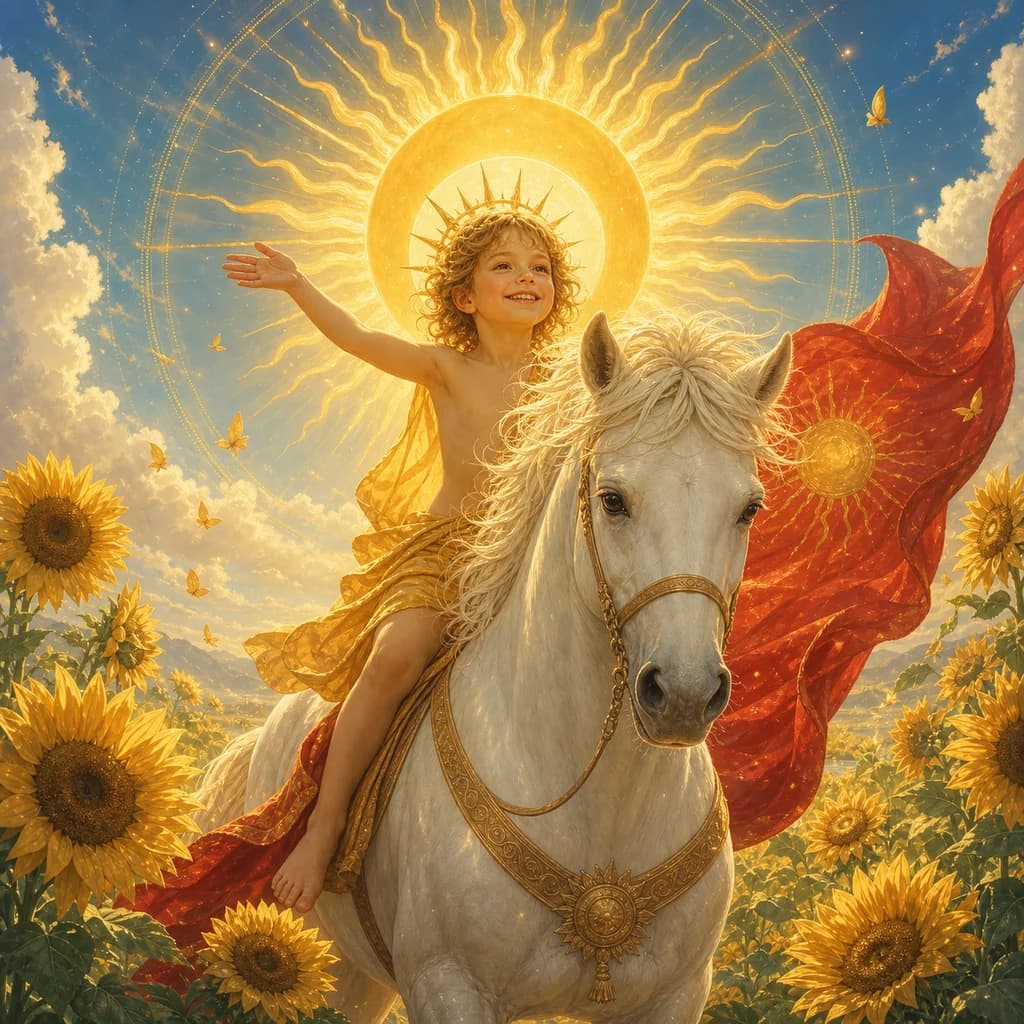
- The Devil + The Sun: rare and worth attention. Usually points to a configuration that looks healthy and isn't, or to a release into genuine joy after a long bondage.
Numerology and Astrology
XV reduces to 1+5 = 6, which is The Lovers. This is not coincidence; it is the deck's structural rhyme. The Devil and The Lovers are the same number under different conditions.
Astrologically, Capricorn — ruled by Saturn — gives The Devil its sober, structural quality. Saturnian themes run through the card: long timelines, material consequences, the cost of what we've built. The Hebrew letter Ayin means eye, which fits: the Devil is the part of consciousness that sees only what is materially in front of it. Eye without imagination. Body without horizon.
Frequently Asked Questions
Is The Devil card always a bad omen?
No. It names a configuration, and configurations can be changed. In many readings The Devil is the most useful card to draw — it tells you exactly what to look at. The work it asks for is uncomfortable, not bad.
What does The Devil mean in a love reading?
Most often, a relationship with agreements neither person has named — about money, sex, dependency, or freedom. The chains are loose; both people could leave; neither does. The card is asking what the silent agreement actually is.
Does The Devil mean addiction?
Sometimes literally, more often structurally. The card uses substance addiction as its clearest example, but it operates the same way around relationships, jobs, identity, and ambition. Anywhere consent has frozen into pattern.
Is The Devil reversed always positive?
No. Reversed Devil can mean genuine release, or it can mean you've swapped one chain for another. The careful reader asks what changed and what stayed the same.
Why is The Devil card next to The Lovers in meaning?
Because they are drawn with the same composition. The Devil is The Lovers with the conscious blessing replaced by an unconscious bargain. Reading them together is one of the deck's most useful exercises.
Can The Devil indicate a positive sexual relationship?
It can. Lust and embodiment are part of the card's vocabulary. The Devil in a sexual context usually flags intensity and earthly pleasure — which is not the same as bondage, unless the relationship is the bondage.
What zodiac sign rules The Devil?
Capricorn — cardinal earth, ruled by Saturn. The under-discussed key to the card. Capricorn-flavored Devils are about ambition and structure, not just substances.
Closing
If The Devil drew today, do this: pick the loosest chain you currently wear. Not the heaviest, not the most painful — the loosest. The one you could lift off in fifteen seconds if you decided to. Then ask why you haven't. The answer is the card's actual reading. Don't try to act on it this week. Sit with it for six. The Devil works on a delay; that delay is the part the imagery never tells you about.
For related reading see The Lovers and Death.