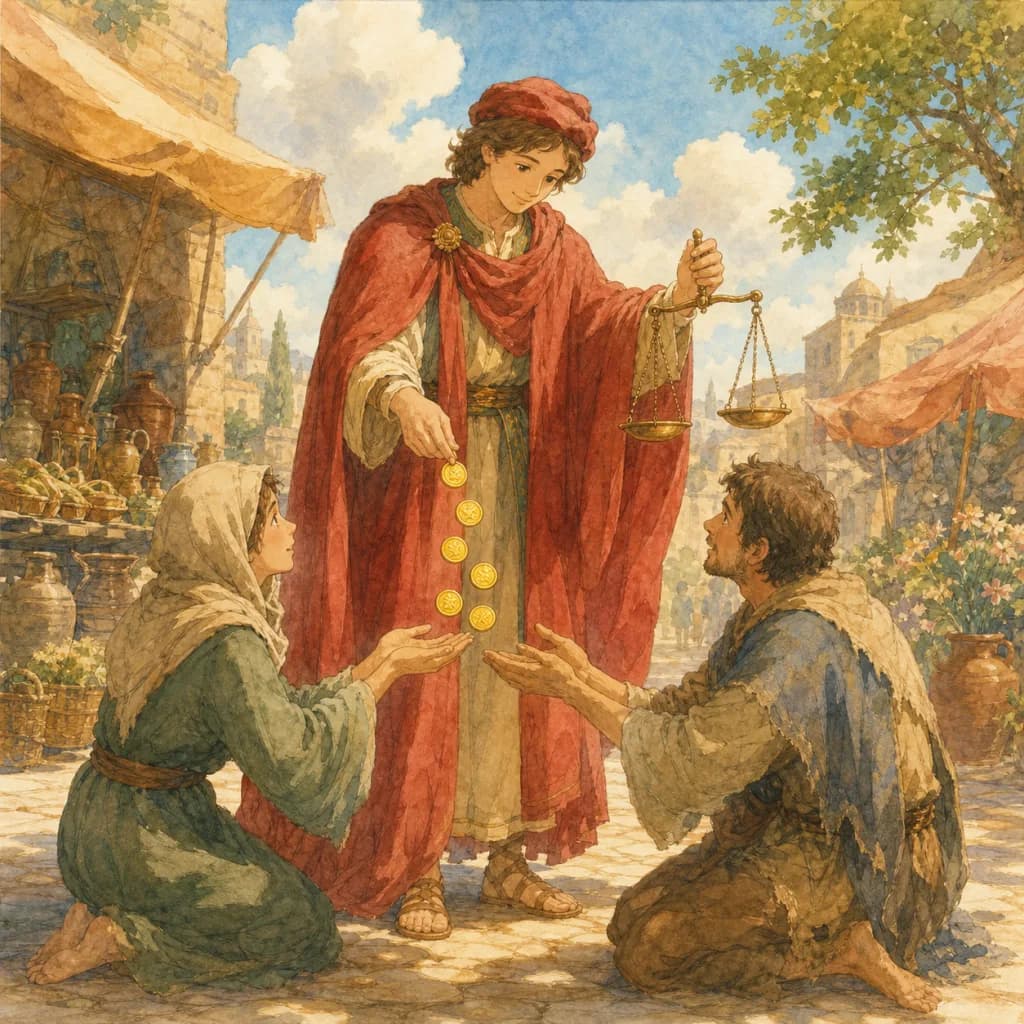
A man in a red robe drops coins into the open hands of two people kneeling in the dirt. Everyone reads this as generosity, and they stop there. Look again at what his other hand is doing: he is holding a merchant's balance-scale, weighing. The Six of Pentacles meaning lives in that detail almost nobody lingers on. The giver is measuring before he gives, and he is the only one in the picture who gets to hold the instrument that decides how much.
Most guides will call this the charity card and move on. That is true the way "a contract is a piece of paper" is true.
Quick Answer
Upright, the Six of Pentacles means generosity, charity, and the flow of giving and receiving — resources moving from those who have to those who need, ideally with fairness. It also asks which role you are in right now: the one who gives or the one who receives. Reversed, it warns of strings attached, debt, one-sided help, or giving in order to be seen, where the exchange looks generous but the power underneath is lopsided. As a Yes/No card it is a soft yes, conditional on the terms being fair.
Basic Information
| Card Name | Six of Pentacles |
| Suit | Pentacles |
| Arcana | Minor Arcana |
| Element | Earth |
| Astrological Correspondence | Moon in Taurus |
| Yes / No | Yes, if the terms are fair |
| Upright Keywords | generosity, charity, giving and receiving, fairness, shared resources |
| Reversed Keywords | strings attached, power imbalance, debt, giving to be seen, one-sided help |
Card Imagery & Symbolism
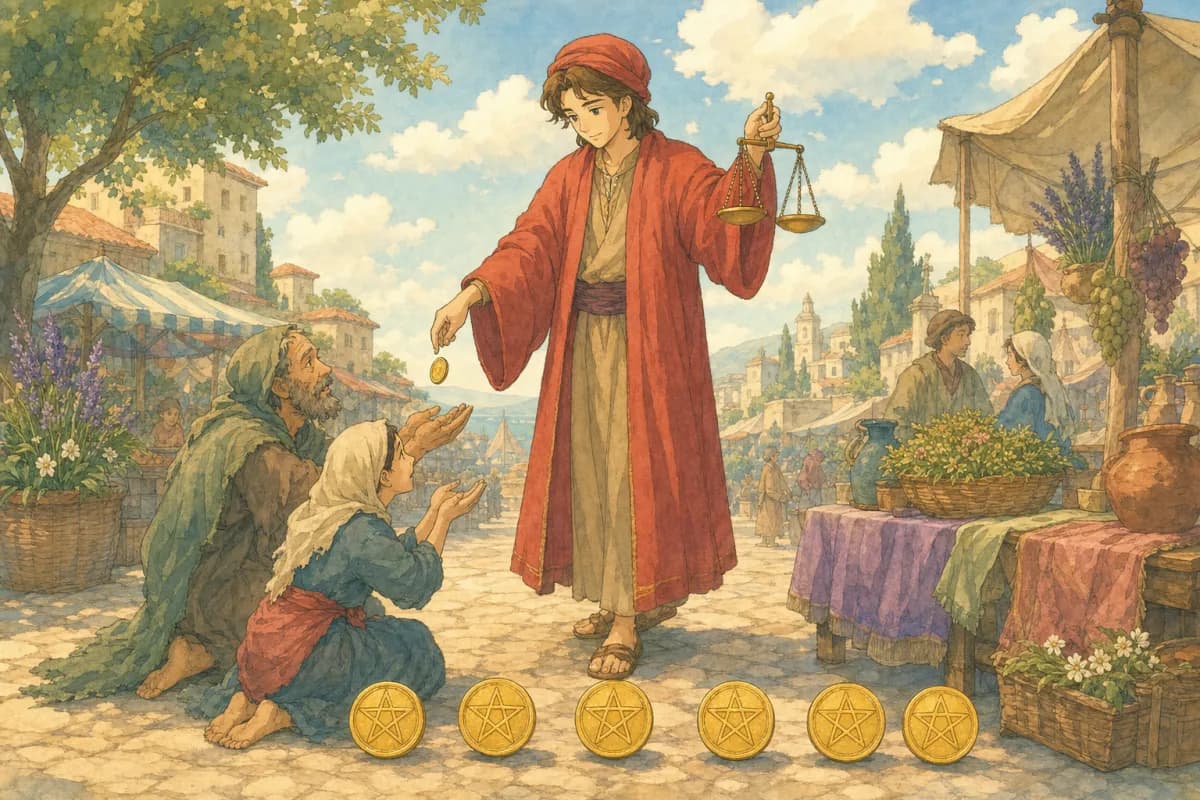
Pull up the Rider-Waite-Smith card and the scene reads instantly: a well-dressed merchant, two figures kneeling at his feet, coins passing between them. It looks like a closed case. The interesting material is in how Pamela Colman Smith staged the power in the frame — who stands, who kneels, and what each hand is doing.
The Scale Is in His Hand, Not on a Stand
Look at where the balance sits. In the Justice card the scale hangs in mid-air, an impartial cosmic measure mounted on a pillar. Here it rests in the merchant's own grip, and he holds it level himself. That single staging choice changes everything: here, one mortal person decides what is fair and then enacts his own verdict, no cosmic authority overhead. Most guides treat the scale as a symbol of equality; really it marks who holds the authority to define equality. I will come back to this, because it is the whole card.
Two Beggars, and One Gets More
There are two kneeling figures, and they are not interchangeable. Watch the coins: in Smith's drawing the merchant is dropping money into the hands of one of them while the other waits, looking up. The giver is splitting his resources unevenly, picking who gets coins and who keeps waiting. Generosity in this card is selective. People tend to imagine a flat, automatic distribution, yet the image shows a deliberate choice. Someone is deciding who deserves and who keeps waiting, and that decision is happening inside what looks like pure kindness.
The Robe and the Standing Posture
The merchant wears a rich red robe and stands upright; the beggars are barefoot, ragged, on the ground. Smith made the status gap unmissable. This matters because the card is often read as a warm, equal exchange, while the image insists on the gap. The vertical distance between standing and kneeling is the actual subject. This is a transfer of resources across a gap in power, with one party above and one below — and that is exactly why it carries both its grace and its danger.
Six of Pentacles Upright Meaning
Core keywords: generosity, charity, giving and receiving, fairness, shared resources, support.
Upright, the Six of Pentacles is resources in motion. Money, time, knowledge, attention — something of value is flowing from a place of plenty to a place of need, and the flow is, for now, healthy. After the cold and exclusion of the Five of Pentacles, where two figures trudge past a lit window in the snow, the Six is the door finally opening. Help arrives. The card often shows up when someone is about to receive support they had stopped expecting, or when they are in a stable enough position to give it.
The card asks a blunt question that the prettier interpretations skip: which one are you? The merchant or the kneeling figure? You can be either in any given reading, and the advice flips depending on the answer. If you are the giver, the card affirms the impulse and quietly asks whether your giving is clean. If you are the receiver, it tells you to take the help without shame, because the wheel turns and you will be standing on the other side of it before long.
That cyclical reading is the genuinely useful part. Today's merchant was yesterday's beggar and will be again. The card frames generosity as a position you rotate through, a role that passes from hand to hand. Charity from the secure to the desperate is one frame of a longer loop. The person handing out coins now once knelt in that dirt.
In a practical spread, the upright Six is one of the more reassuring Pentacles. It says the material situation is being held by something larger than you alone — a community, a mentor, a partner, a turn of luck. You are not carrying it by yourself.
Six of Pentacles Reversed Meaning
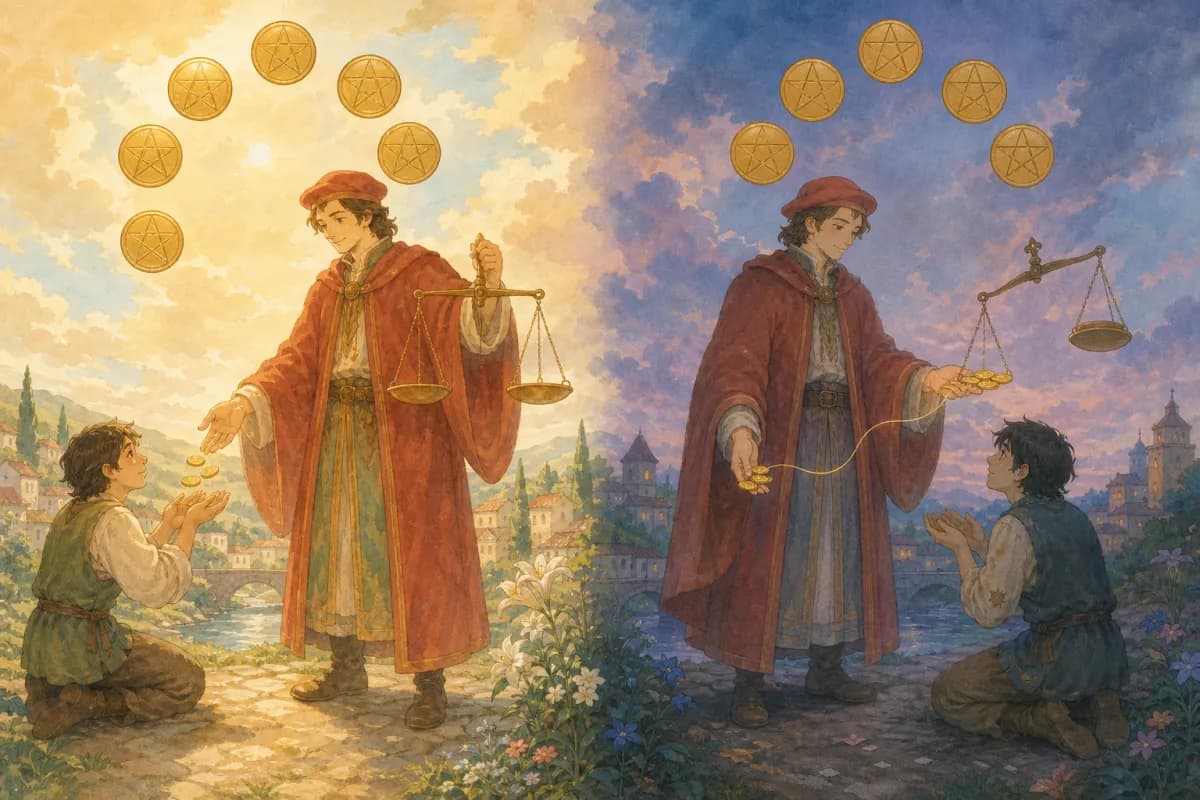
Reversed usually signals a wobble in the exchange, and I push back when a client flinches at it as if disaster were guaranteed. The image inverts into imbalance, the same scene with the fairness drained out of it. Most of the time the story is simple lopsidedness, the exchange tilted so far it stops being fair.
The most common reversed read is strings attached. The coins still change hands, but now there is a price written in invisible ink: a favor owed, a loyalty demanded, a quiet expectation that the receiver will stay grateful and stay below. The gift becomes a leash.
Then there is giving to be seen. The merchant is generous in public, and the generosity is performance — the donation that needs an audience, the help offered loudly so everyone notices who offered it. The act is real, and the motive sits with the giver's image while the receiver's need becomes a backdrop.
A third reading is one-sided help and debt. You lend and are not repaid. You pour care into someone who never pours back. Or you are the one accumulating debts, financial or emotional, that you cannot settle. The flow that ran both ways upright has frozen into a single direction.
The deepest reversed meaning is power imbalance itself — when the relationship has hardened around who gives and who receives, and the role has become a cage. Sorting which of these you are looking at is the work. The fix for strings attached is to refuse the terms; the fix for giving to be seen is honesty about why you give; the fix for one-sided help is to stop the bleed. The card points at the imbalance and leaves the diagnosis to you.
Whose hand holds the scale? The quiet power inside every act of giving.
Here is the question most write-ups skip. They note the scale and tag it "fairness, equality, Justice," then leave the obvious follow-up hanging: who is holding it?
Go back to the image. The scale hangs from the merchant's own fist, with no pillar to anchor it to anything impartial. He is the one who weighs, and he is the one who pours. In a single gesture he is appraiser, judge, and benefactor. The two people on the ground have no scale of their own. They cannot weigh his offer. They can only hold out their hands and accept what he has already decided their need is worth.
This is the part of the Six of Pentacles that gets sentimentalized into oblivion. Giving is an exercise of power. Every act of generosity contains a quiet asymmetry: the giver chooses the amount, the timing, the recipient, and the terms. To give is to occupy the standing position and hold the instrument of measure. The card is honest about this in a way most readings are too polite to be.
I sat with a client in Nakameguro who pulled this card upright about her family. She had read every meaning online and arrived certain it was the warm, generous card — her parents had paid off a debt for her, and the websites told her this was the support card, no shadow. What the scale flagged, and what she eventually said out loud, was that the money had bought a vote in her life. The help was real. So was the leash. The card held both at once. It kept the kindness intact and still pointed her toward the hand on the scale. For three years early in my practice I misread this card the same flattened way the search results do, as plain charity, and I missed this in reading after reading.
Reading the card this way turns giving into a responsibility. Generosity done well means knowing you hold the scale and choosing to set the lever down: giving without billing the receiver in gratitude, without buying influence, without needing to be seen doing it. The upright card at its best is a merchant who could attach strings and lets the gift go free. The reversed card is the same merchant discovering how much those strings are worth.
So when this card appears, push past the easy question of whether someone is being generous. The real one is sharper: who holds the scale here, and what are they doing with the fact that they hold it?
Money & Resources
This is the Six of Pentacles' native ground. In a financial spread, upright, it points to support arriving or available — a loan that comes through, a bonus, a benefactor, money flowing toward you from someone who has more of it. It can also flag that you are the one in a position to give, and that doing so now is right.
The practical caution lives in the terms. Before you accept the money or extend it, read the scale. What does this exchange actually cost? A loan from a bank costs interest you can name. A loan from a person sometimes costs things nobody writes down. Accept the help if you want it. Just know the price before you take the coins, so the support stays support and does not curdle into obligation.
Reversed in money matters, watch for debt hardening, repayment that never comes, or financial help that arrives with conditions you only feel later.
Love & Relationships
In relationships the Six of Pentacles is a reciprocity card, and it is one of the more useful ones for diagnosing a quiet imbalance. Look at the labor that is not financial — emotional support, planning, remembering, initiating, repairing after fights. Is it flowing both ways? Or is one of you reliably the merchant and the other reliably on the ground?
Upright, the card describes a relationship where care moves in both directions and the roles rotate. You hold each other up in turn. One person is low this month and the other carries; next season it reverses, and neither keeps score.
Reversed is where it gets sharp. It points to a partnership where one person does most of the giving and the other most of the taking, and the gap has stopped feeling temporary. The taker is often just comfortable kneeling, hands out, having settled into the role, while the giver keeps deciding how much warmth to portion out. If this card lands reversed in your love reading, the question to sit with is whether you would still want the relationship if the scale were handed to the other person for a while.
Six of Pentacles Card Combinations
- Six of Pentacles + Justice — the scale meets its mounted, impartial twin. This pairing pulls the giving into the realm of consequence: what you put out is being weighed and will come back measured. Strong for legal matters, settlements, or any situation where fairness is literally on the table. Whatever you decide to give or withhold here, expect it returned in kind.
- Six of Pentacles + Five of Pentacles — the full before-and-after. The Five is the cold outside the window; the Six is the door opening. Together they tell a story of hardship resolving into help. If the Five sits in the past position and the Six in the future, the deck is promising the lean stretch ends with someone reaching out.
- Six of Pentacles + The Devil — the strings-attached reading lit up in neon. Generosity that binds. This is the gift you cannot really refuse and cannot really pay off, the help that quietly becomes leverage. Read it as a warning to find the chain inside the kindness before you accept.
- Six of Pentacles + Ten of Pentacles — giving that builds something lasting. Resources shared now turning into generational stability, family wealth, an inheritance, a foundation. The flow in the Six matures into the established abundance of the Ten. A genuinely hopeful pairing for long-term security built on support given and received.
- Six of Pentacles + The Star — help offered freely, with no hook in it. The Star is generosity poured out the way water pours from her jugs, asking nothing back. Next to the Six it describes giving at its cleanest: open-handed, hopeful, unconcerned with credit. The merchant who never reaches for the scale as a lever.
- Six of Pentacles reversed + Seven of Swords — generosity used as cover. The reversed Six's hidden agenda meets the Seven's quiet deception. Watch for someone whose visible giving is masking what they are actually taking, or charity offered as a distraction from a less honest move.
Numerology & Astrological Correspondences
The number six in the Pentacles sequence is the breath of relief after the crisis of the five — the suit's swing from scarcity back toward balance, harmony restored once resources start moving between people. Its astrological signature is the Moon in Taurus, where the Moon's instinct to nurture meets Taurus's grounded relationship to material resources, producing a generosity you can touch: you do not just wish someone well, you hand them something they can hold. In Japanese タロット占い (tarō uranai, tarot divination), I read this card through 施し (hodokoshi) — the act of giving alms — but I always pair it with the older idea that 施し carries a duty on the giver not to wound the receiver's dignity. That duty is the whole upright lesson: hold the scale, and do not let the person on the ground feel the weight of it.
Frequently Asked Questions
Is the Six of Pentacles a yes or no card?
It leans yes, but a conditional one. The card affirms that support, generosity, and the flow of resources are available — so for questions about whether help will come or whether to give, the answer tends toward yes. The condition is fairness: it is a strong yes when the terms are clean and a much weaker one when strings are attached.
Is the Six of Pentacles a good card to pull?
Generally, yes. Upright it signals that you are either receiving needed support or in a secure enough position to offer it, both of which are good places to stand. The only caution is to check the terms of the exchange, since the same card can describe generous help and help that quietly costs you.
What does the Six of Pentacles mean in a love reading?
It points to the balance of giving and receiving between you and a partner — emotional care, effort, attention, and resources. Upright, it describes a relationship where support flows both ways and the roles rotate fairly. Reversed, it warns that one person is doing most of the giving while the other mostly takes.
Does the Six of Pentacles mean money is coming?
Often, yes. In financial spreads it frequently signals incoming support: a loan, a bonus, a gift, a benefactor, or repayment of something owed to you. Read the surrounding cards to see whether the money arrives freely or with conditions, since the Six is as much about the terms of the exchange as the exchange itself.
What is the difference between the Six of Pentacles and the Justice card?
Both feature a scale, but the holder is different. In Justice the scale hangs from an impartial figure seated in authority, representing cosmic fairness applied to everyone equally. In the Six of Pentacles the scale is held in a private merchant's own hand, representing one person's personal decision about what is fair. It runs on the logic of generosity, a private call that one human gets to make.
What does the Six of Pentacles reversed warn against?
It warns against imbalance in giving: gifts with strings attached, help offered mainly to look good, one-sided relationships where you give and never receive, and debts that harden into power over you. The core message is to examine who controls the exchange and what it really costs.
Which figure in the Six of Pentacles am I supposed to identify with?
Either, depending on the reading. The card deliberately holds both the giver and the receiver in one frame to remind you the roles rotate. Notice which position the rest of the spread places you in — and remember that whichever one you occupy now, you will occupy the other one eventually.
Closing
Next time this card turns up, do not file it under "kindness" and move on. Find the one exchange in your life right now where resources are flowing — money, care, time, favors — and ask who is holding the scale. If it is you, give without sending a bill. If it is someone else, take the help, but know the price before you reach for the coins. The Six of Pentacles drew you the gift and the scale in the same picture for a reason.
Read the hardship that comes right before this relief in the Five of Pentacles, or see where shared resources mature into lasting security in the Ten of Pentacles.