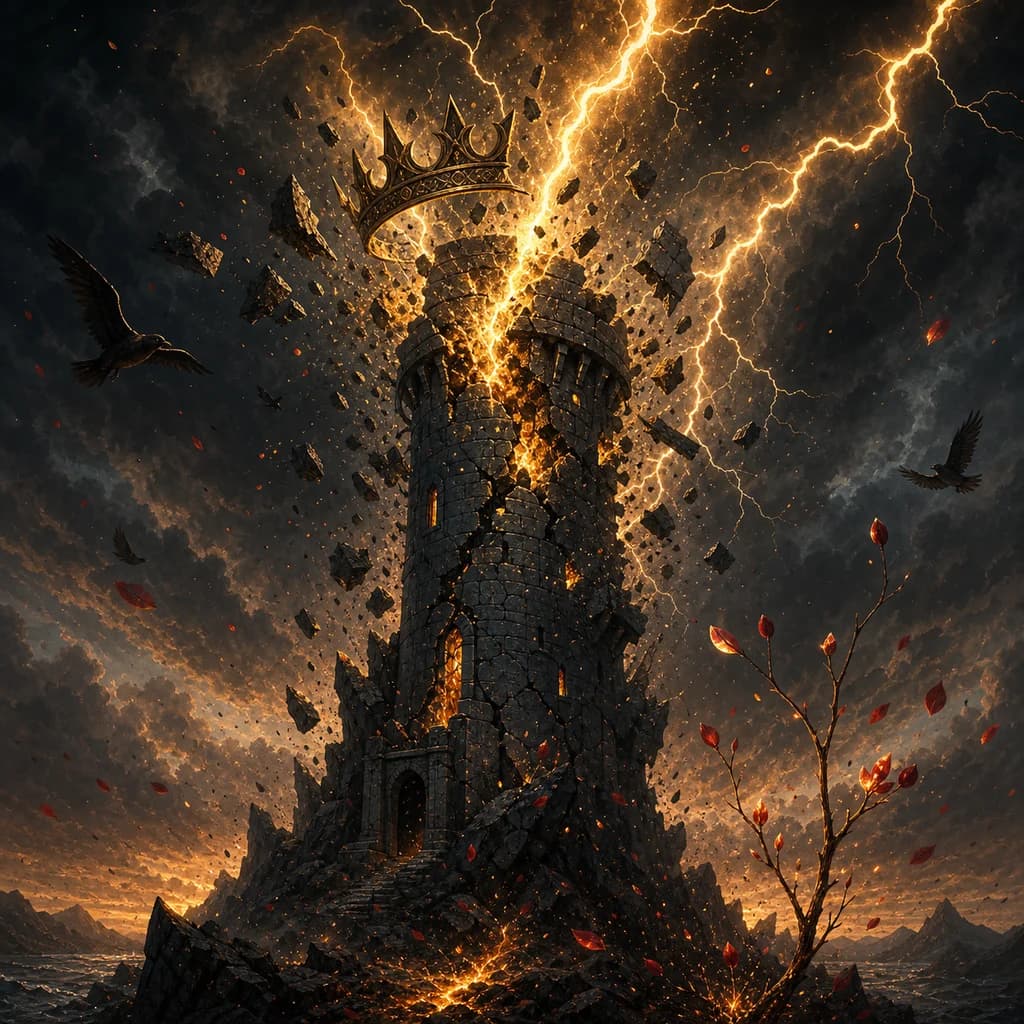
The Tower is the card readers dread to draw and clients dread to see. The image does the work the words don't have to: a lightning strike, a crown knocked off, two figures falling in opposite directions. Most articles describe what happens. Fewer articles describe why this particular structure, or why the card is followed in the deck by the most hopeful card we have. The Tower is not a card about disaster. It is a card about the specific moment when a structure built on a wrong premise gives way — and about what the deck holds for you on the other side.
This guide reads The Tower as the Rider-Waite-Smith image actually draws it: the Mars rulership most popular guides bury in a footnote, the 22 yods falling through the air that almost no reader counts, the structural difference between the crowned figure and the uncrowned one, and the distinction between The Tower, Death, and the Wheel of Fortune — three cards about change that work in completely different physics.
Quick Answer
The Tower is Major Arcana card XVI, ruled by Mars and the element of Fire. Upright, it signals sudden upheaval, revelation, the collapse of a structure that was built on a false premise, and the involuntary clearing that follows. Reversed, it suggests resisted change, fear of necessary collapse, or a delayed Tower that is going to land anyway. Yes/No: No, but the No is in service of a Yes that doesn't exist yet.
Basic Information
| Attribute | Details |
|---|---|
| Card Name | The Tower |
| Number | XVI (16) |
| Arcana | Major Arcana |
| Element | Fire |
| Planetary Rulership | Mars |
| Hebrew Letter | Peh (mouth) |
| Yes / No | No, with the caveat that the No often clears space for something the question doesn't yet know it wants |
| Upright Keywords | Upheaval, revelation, sudden change, collapse, awakening, liberation |
| Reversed Keywords | Resisted change, delayed collapse, fear of upheaval, slow-motion Tower, internal restructuring |
What The Tower Is Actually Drawn From
A short detour before the imagery, because the source frames the card.
The Tower's image carries two layers. The first is the biblical Tower of Babel — humanity building toward heaven, presuming the climb is theirs to make, and being interrupted by a single divine act. The second is the medieval Maison Dieu — the "House of God" struck by lightning, an iconographic standard in older decks. Both share one structural claim: a tower built on the wrong foundation cannot stand, and the wrongness is revealed by an event that comes from outside, fast, with no warning the figures inside the tower were able to read.
This matters because The Tower is often described as random or arbitrary. It is neither. The strike is the moment the wrong premise becomes visible. The premise has been wrong all along.
Card Imagery & Symbolism
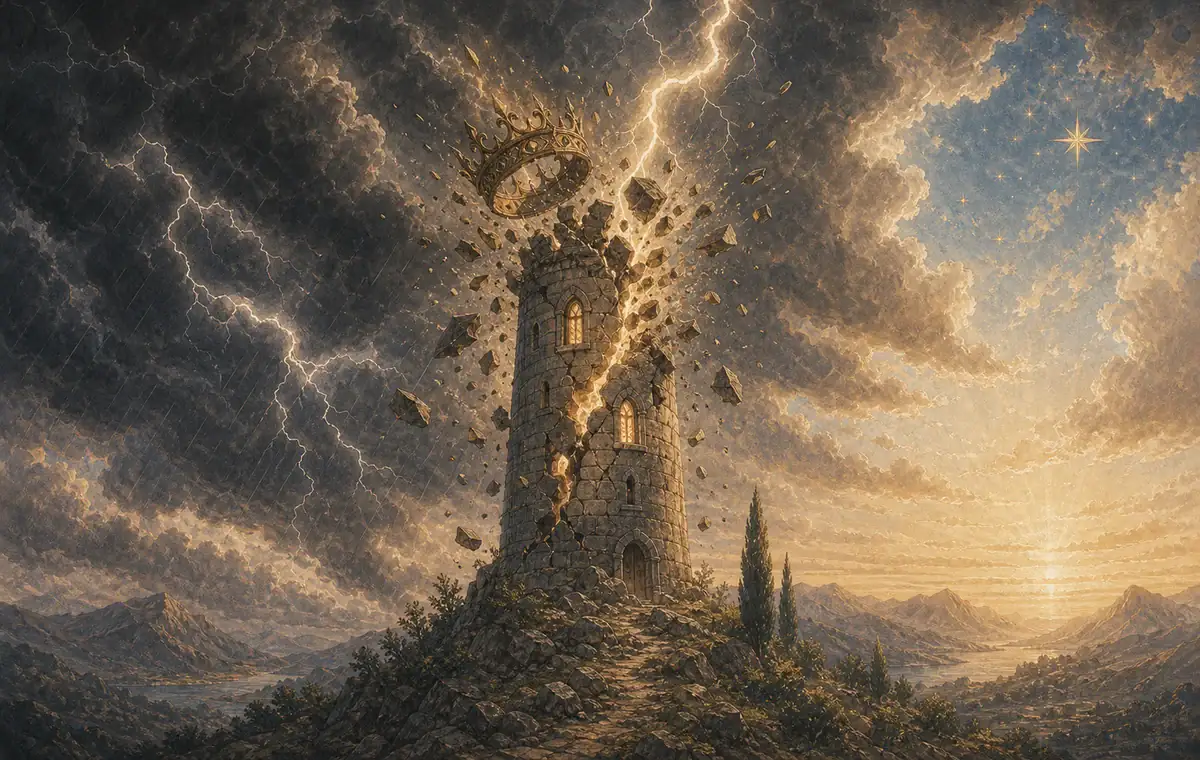
A stone tower stands on a rocky peak under a black sky. Lightning strikes the top of the tower. A golden crown is knocked off and hangs in the air. Flames erupt from three windows. Two figures fall from the tower — one crowned, one not — in opposite directions, mid-air. Around them, 22 small flame-shaped marks drift down. The ground below them is also rocky.
Every element here is deliberate. Read them in order.
The Lightning at the Crown
The lightning hits the top of the tower and knocks the crown loose. Crowns in tarot mark sovereignty — what is ruling. The strike is targeted: it does not destroy the tower from the bottom (foundation) or the middle (structure). It removes what was on top. The Tower's first message is that the ruling principle of your current configuration is what needs to go. The structure underneath may survive. The crown does not.
This is the part of the card that softens the popular reading. The Tower does not erase your life. It removes the wrong thing from the top of it.
The 22 Yods
Around the two falling figures, 22 small flame-shaped marks drift through the air. In Hebrew, the yod is the smallest letter — a single seed-stroke from which every other letter is built. There are 22 letters in the Hebrew alphabet, and 22 Major Arcana cards. The yods falling around the Tower are not debris. They are seeds.
This is the detail most popular guides skip, and it is the structural counterweight to the destruction. The card is telling you that the same event tearing the tower down is also seeding what comes next. The lightning carries the alphabet. The deck holds The Star on the very next card for a reason.
The Crowned and Uncrowned Figures
One figure falls wearing a crown. The other does not. They fall in opposite directions, which is the part most articles miss. The Tower is not a collective catastrophe; it is a precise one. Two roles are being undone — the one who was in charge of the structure and the one who served under it. Both fall. Neither is rescued. The lightning does not respect rank.
In a reading this often points to a relational dimension of the collapse. Whatever fell was held up by two people, not one. Both are being released, whether they understood themselves as participants or not.
The Three Windows of Fire
Three windows show flames. Three is the structural number of the deck's stable forms (The Empress, the threes of each suit). Fire is the active element. The Tower's fire is not consuming the structure from the bottom up the way a normal fire would; it is escaping through openings that were already there. The lightning didn't bring the fire. The fire was inside. The lightning gave it somewhere to go.
This is the most uncomfortable layer of the card. The Tower's collapse is partly external — the strike — and partly internal — the fire that was already burning. The combination is what makes the structure unsalvageable.
Mars and the Energy of the Strike
Mars rules The Tower, and the rulership is more relevant than most articles let on. Mars is force, direction, and the will to act. Mars in its constructive form builds — the soldier, the surgeon, the athlete, the entrepreneur. Mars in its destructive form is the same energy in reverse — the strike, the cut, the demolition.
The Tower is Mars destroying what Mars built. That is the card's specific physics. The strike comes from the same energy that put the structure up; it is not an external punishment, it is a redirection of the same force. Mars in The Tower is asking: where did you build with force and refuse to let the structure speak back to you? Where did you mistake momentum for foundation?
I bring this up in readings whenever a client treats the Tower as random. It is not. It is your own Mars finally turning around.
Upright Meaning
Upright, The Tower is announcing a collapse that is either underway or imminent. The structure can be a relationship, a job, a worldview, an identity, a financial setup, or a long-held assumption about who you are. What unites them is that they were built without an accurate read of the underlying terrain. The lightning is the moment that misalignment becomes undeniable.
The Tower is not negotiable. Most cards offer a choice between two paths; The Tower offers the choice of how to fall — gracefully or hard, alert or surprised, with self-respect or without. The collapse itself is not up for debate.
A reading from last winter: a Tokyo client came in shaken after her marriage of twelve years ended with one phone call. The call was the lightning; the cracks had been there for five years. We laid the cards out and The Tower was the second one. She was angry that the card had nothing useful to say — it just confirmed what had already happened. I told her the card was not commenting on the phone call. It was commenting on what came next: which crown she was going to refuse to put back on. The Tower's work is rarely about the strike. It is about the years after, when the structure is being rebuilt and you have a single chance to build it on something true. She moved cities six months later. The Tower had been telling her, from the start, what to do with what was left.
The Tower Reversed Meaning
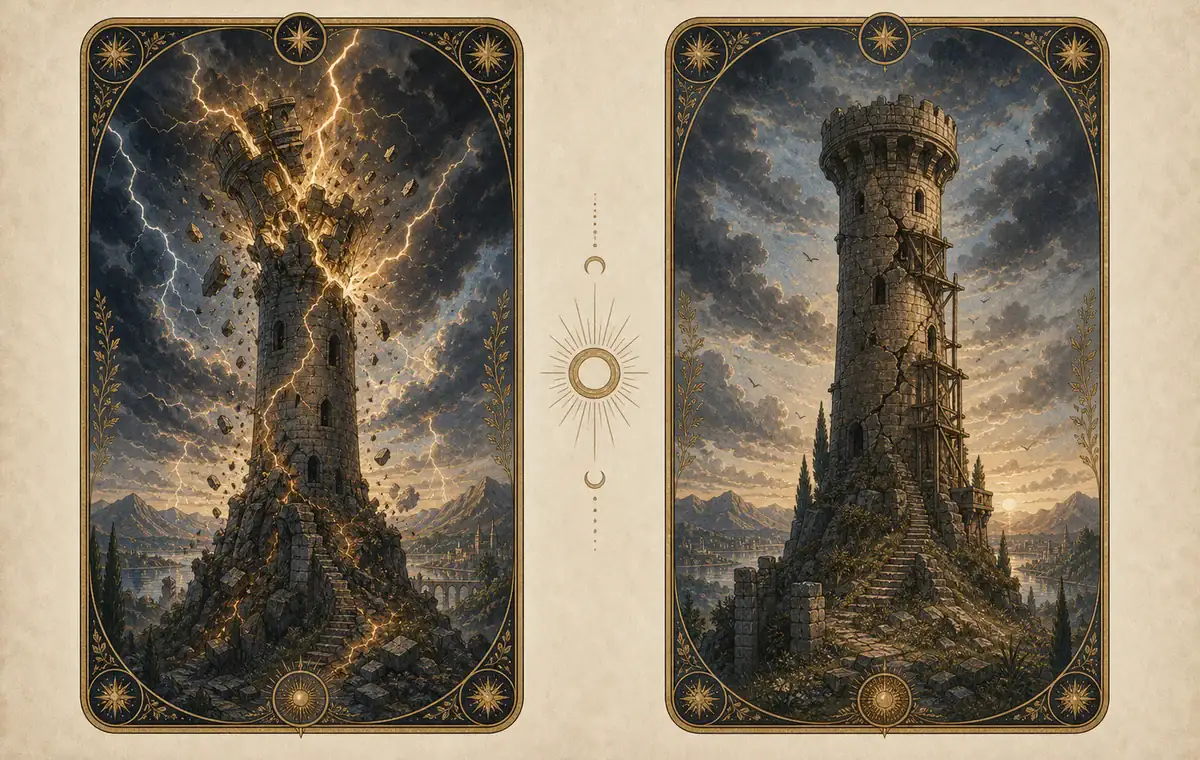
Reversed, The Tower has two honest readings.
The delayed Tower. The collapse is real and necessary, and you are resisting it. The strike is being held off through willpower, denial, or external propping. This is rarely a good arrangement; reversed Towers tend to land harder than upright ones because the delay accumulates pressure. The reading here is to look at what you are holding up and ask whether the holding is worth the cost.
The internal Tower. The collapse is happening, but invisibly. You are restructuring something fundamental — beliefs, identity, values — without any external event marking the change. This is the kindest version of the card and the easiest to miss, because the work looks like nothing from the outside. The structure is coming down quietly. The yods are still falling. You are doing the Tower's work without the lightning. In fact, among the cards where flipping changes the tenor most, the Tower reversed often signals disaster averted — the strike held off, or already weathered.
Distinguishing the two depends on the rest of the spread. Cards of stillness near a reversed Tower (Hermit, Hanged Man) usually point to the internal version. Cards of pressure or external force near it (Five of Wands, Five of Pentacles, anything Mars-flavored) usually point to the delayed version.
The Tower vs. Death vs. The Wheel of Fortune
Three cards about change, three completely different physics:
The Tower (XVI): sudden, involuntary, structural. The change is not negotiated. Time horizon: a moment.
Death (XIII): gradual, transformative, ending followed by reorganization. The change can be participated in. Time horizon: months to years.
The Wheel of Fortune (X): cyclical, impersonal, neither beginning nor ending. The change is a turning. Time horizon: an arc.
A client drawing all three across a reading is rare and useful. The Wheel sets the cycle, Death moves through it gradually, The Tower interrupts it when the cycle gets stuck on a wrong premise. Each card answers a different question about how change is happening in a life. Reading them as interchangeable flattens the deck.
Love and Relationships
The Tower in a relationship reading is rarely subtle. It usually signals a discovery, a confrontation, or a structural failure that ends the configuration the relationship was running on. Affairs come out. Long-held resentments name themselves. Hidden information surfaces. The relationship may continue after, but the version of it that existed before the strike is over. When the question is about a specific person's inner world, what the Tower means as someone's feelings traces that sudden upheaval at close range.
If the reading is about a relationship that already feels strained, The Tower is often confirming what the client already knows. The lightning is not new information; it is the moment the information becomes unignorable.
If you are single, The Tower in a love reading usually points to a belief about love that is going to be dismantled — the type you thought you wanted, the story you thought you were in. The dismantling is uncomfortable. It is also the only way to draw someone who matches a more honest version of you.
Career and Money
Career Towers are layoffs, sudden firings, organizational collapses, and the discovery that the role you were committed to never existed in the way you understood it. These are painful and, in retrospect, almost always show as obvious in hindsight. The Mars-built career was being asked to bear weight it was never built to bear.
If the same collapse keeps surfacing around work, it is worth reading what it means to keep pulling the Tower in career readings inside a dedicated layout. Money Towers are sudden expenses, the collapse of a financial assumption, or the moment the spreadsheet stops working. The reading in either case is the same: rebuild on something true. Not bigger, not flashier — truer. The clients who recover well from Tower readings are the ones who use the recovery period to ask what they actually want, instead of rebuilding the same structure with reinforced walls.
Card Combinations
- The Tower + The Star: the deck's most hopeful sequence. Collapse followed by healing. The yods land.
- The Tower + Death: structural ending plus gradual transformation. Usually a long arc with a sudden trigger.
- The Tower + The Devil: the chain breaks, but not by your choice. Sometimes the only way out of a Devil configuration.
- The Tower + Three of Swords: the painful version. Heartbreak as the collapse itself.
- The Tower + Ace of Pentacles: rebuilding on new ground. Material foundation after material loss.
- The Tower + Judgement: the strike was a calling. The collapse was the message.
- The Tower + Knight of Cups: idealized romance that collapses once the strike reveals the gap between the fantasy and what was really there.
- The Tower + Ten of Swords: the Tower's sudden shock and the Ten's personal devastation in its aftermath — rock bottom, fully felt.
- The Tower + Knight of Swords: fast, headlong action triggering the very collapse it was charging toward.
Numerology and Astrology
XVI reduces to 1+6 = 7, which is The Chariot. The link is operative. The Chariot is the card of willed direction; The Tower is what happens when willed direction collides with terrain it didn't read. The same Mars energy runs both. The Chariot drives; The Tower is the moment the driver was wrong about the road.
Astrologically, Mars's rulership colors everything. Mars events are fast, direct, and corrective. The Hebrew letter Peh means mouth, which fits the lightning: the moment when something that needed to be said finally is.
Frequently Asked Questions
Is The Tower always bad?
No. It is hard. The card describes a collapse that clears space for the most hopeful card in the deck (The Star). Whether it is bad depends on what was being held up and whether the holding was costing you more than the collapse will.
What does The Tower mean for love?
Usually a discovery, confrontation, or structural failure that ends the previous version of the relationship. The relationship may continue in a new form. The old form will not.
Can The Tower be a positive card?
Yes, in the medium term. The lightning removes what was built on a wrong premise. Anything you rebuild after will rest on something truer. The yods around the falling figures are seeds, not debris.
How is The Tower different from Death?
Death is gradual, participable transformation. The Tower is sudden, involuntary collapse. Both are change cards; only Death lets you walk through it slowly.
What zodiac sign or planet rules The Tower?
Mars. The card's destruction is the same Mars energy that built the structure in the first place, turning around. This is why Tower events are rarely random — they are usually self-built and self-released.
Does The Tower predict an actual disaster?
Sometimes literally. More often it predicts a moment when a structural assumption fails. Disaster is one form; revelation is another; layoffs, breakups, and identity collapses are the most common.
What should I do if I draw The Tower?
Stop reinforcing what is falling. The card's most consistent guidance is: do not put the crown back on. Let what is collapsing collapse. Then read The Star.
Closing
If The Tower drew today, identify the crown — the single ruling assumption at the top of the current configuration. Not the foundation, not the walls, the crown. The thing on top. Then ask whether the assumption is still earning its place. The lightning's job is to remove what isn't earning the height. Yours is to recognize what that is before the strike does.