Death is the card clients ask me to put back in the deck. Almost every reader will tell you a version of the same paragraph: it doesn't mean physical death, it means transformation. That paragraph is true and it is also incomplete. The Death card means something more specific than "change" — and unless you understand what specifically it means, you will read every Death pull as the same vague reassurance.
This guide goes deeper than the standard reassurance. It covers the four figures in the foreground of the Rider-Waite-Smith image and what each one represents — a structural reading I have not seen in the top guides, and which gives the card its actual teaching — the twin towers and the sun on the horizon, the upright and reversed meanings, and how Death differs from the two cards it's most often confused with: The Tower and the Ten of Swords.
Quick Answer
Death is Major Arcana card XIII, ruled by Scorpio (Pluto in modern correspondence) and the element of Water. Upright, it signals a definitive ending — a chapter closing, a transformation through release, a clean break that makes space for what comes next. Reversed, it points to resistance to a needed ending, fear of change, or a transformation happening privately, out of view. Yes / No: upright leans Yes (often as a yes-but-through-change); reversed leans No or "not yet."
Basic Information
| Attribute | Details |
|---|---|
| Card Name | Death |
| Number | XIII (13) |
| Arcana | Major Arcana |
| Element | Water |
| Zodiac Correspondence | Scorpio (Pluto in modern astrology) |
| Yes / No | Yes (upright, through change); No or "not yet" (reversed) |
| Upright Keywords | Endings, transformation, release, transition, rebirth, closure |
| Reversed Keywords | Resistance, stagnation, fear of change, private transformation, delayed ending |
Card Imagery & Symbolism
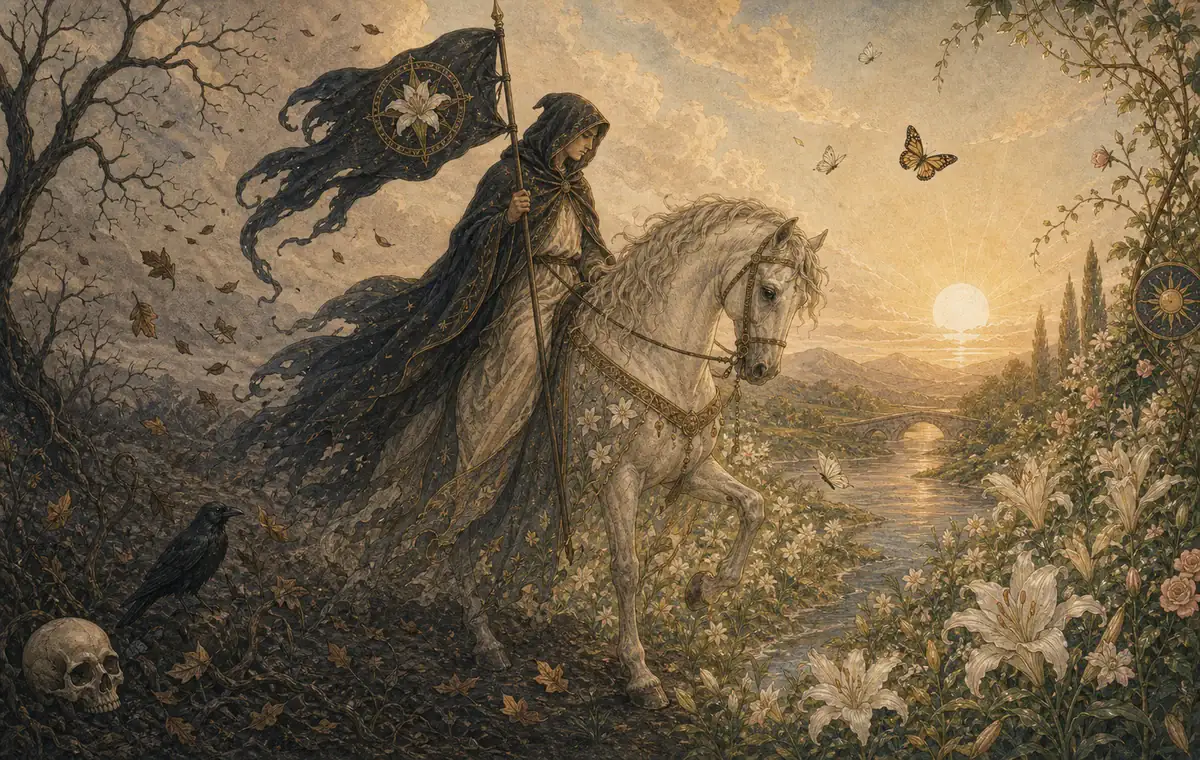
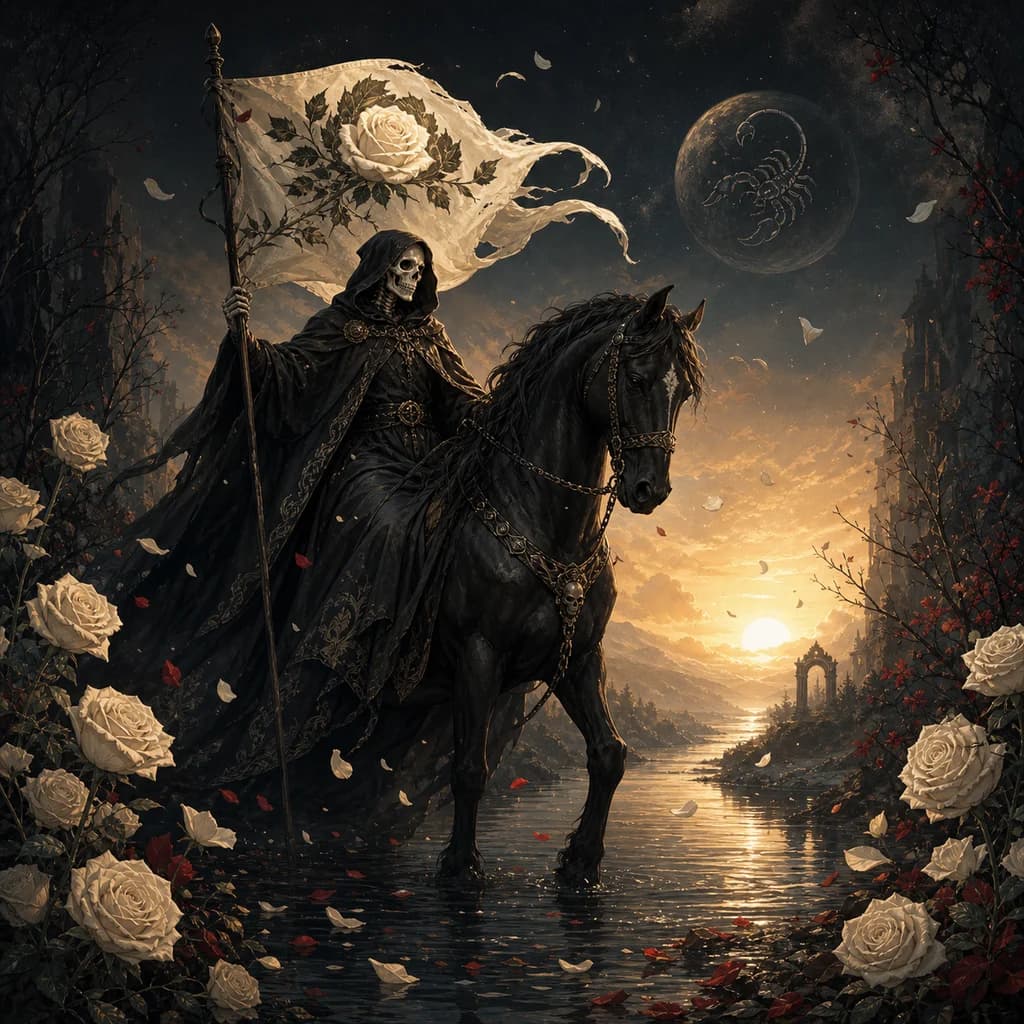
A skeleton in black armor rides a white horse across a low field. He carries a black banner with a white five-petalled rose. Four figures are arranged in front of him — a fallen king, a praying bishop, a young woman turning away with her head bowed, and a child looking up. On the horizon, two towers and a sun (the question of whether the sun is rising or setting is itself a small interpretive battle).
Almost every popular guide describes these elements. Almost none of them read the four figures structurally. That structural reading is where Death's real teaching lives.
The Four Figures: A Hierarchy of Acceptance
These four figures are not decorative. They model four different relationships to ending — ranked, in my reading, from least to most able to meet what is happening.
The king is fallen. His crown has rolled off; he is on the ground. The king represents the version of identity that was most rigid, most attached to its position. Power that could not bend cannot meet Death — it can only be unhorsed by it. When clients tell me they cannot imagine surviving the change in front of them, they are usually identifying with the king. The rigidity is what dies; the person continues.
The bishop stands and pleads. The bishop represents institution, tradition, the inherited framework that thinks it can negotiate with Death. He's the most "respectable" of the four, and he's also the one who has the least understanding of what's actually happening. Death is not arguing back. The bishop is performing a script the situation does not call for.
The young woman turns away with her head down. She represents the recent, the unfinished, the still-attached. Her grief is real — too real to face directly. She cannot meet Death's gaze. Most adult clients move between bishop and woman: pleading the case, then collapsing into grief, then pleading again. This is normal and the card is patient with it.
The child looks up at Death. The child is the only figure who meets Death's gaze, and it is not because the child is brave. The child has not yet built the kind of identity that has something to lose. The child can see Death as Death is — a figure on a horse, present, not malevolent.
The structural lesson is uncomfortable: the version of you that meets Death most cleanly is the version with the least invested in being unchanged. This is not advice to remain childlike. It is the card saying: the part of you that grew up around the thing that is now ending is the part that has to be released. The rest of you continues. The child in the image is not the destination; the child is what is left when the king is unhorsed.
The Banner: Black Flag, White Rose
Death's banner is black with a white five-petalled rose. Black is the absence; white is what comes through it. The five-petalled rose is the alchemical rose of transformation — a symbol that appears throughout Western esoteric tradition specifically marking the transmutation of base into refined. The number five is also the number of change in numerology. This is not a death-flag in the morbid sense. It is the flag of refining-through-loss.
The Two Towers and the Sun
On the horizon, two towers stand on either side of a sun. Whether the sun is rising or setting is a real interpretive question — Biddy reads it as setting, the older Waite commentary reads it as rising. I read both at once: from the perspective of what's ending, the sun is setting; from the perspective of what's beginning, the sun is rising. The same celestial event, two valid readings. The towers (which also appear in The Moon) frame this ambiguity. Death is the card that says the same horizon is both.
The White Horse
The horse is white. White is purity, but also — crucially — neutrality. Death is not malevolent. The horse carries its rider forward at the same steady pace regardless of who is on the ground in front of it. The card's emotional temperature is not "evil." It is "inexorable."
Death Upright Meaning
Upright Death is the most heavy-weather card in a beginner's first deck because of its name. It deserves the weight, but not the dread.
Core Upright Keywords
- Definitive ending — A closure that does not reopen in its previous form
- Transformation through release — Change accomplished by letting go, not adding
- Transition — The moment between what was and what is
- Inevitable closure — A completion that has been preparing for some time
- Liberation through loss — Freedom on the other side of grief
In-Depth Upright Interpretation
The most common reading I give for upright Death: something is over. The question for the client is not "is this happening?" — it is, and they usually know. The question is "what's the part of you that needs to release this so the rest can move?"
A client came to me last autumn frightened by a Death pull she'd had in a YouTube reading. She was in a job she had quietly hated for two years. She wanted me to tell her the YouTube reader was wrong. I asked her instead what she had already started doing. She admitted, slowly, that she had been emailing recruiters for three months. The Death card was not a prediction. It was a description of what she had been doing internally for the better part of a year. The job was already over for her; what she was waiting for was permission to admit it. That is the most honest reading I can give for upright Death — it is rarely news. It is the card naming what the client has already begun.
A subtler reading: Death often arrives just before the person has consciously accepted the ending. The card sometimes hits in a session where a client is still defending the thing that is leaving. In those readings the most useful question is "what would you do if you knew it was already over?" Their answer is the work.
The trap to avoid: reading upright Death as catastrophic. The card is not a tragedy. It is a closing. Tragedy is the king's reading. The card itself offers more options than that.
Death Reversed Meaning
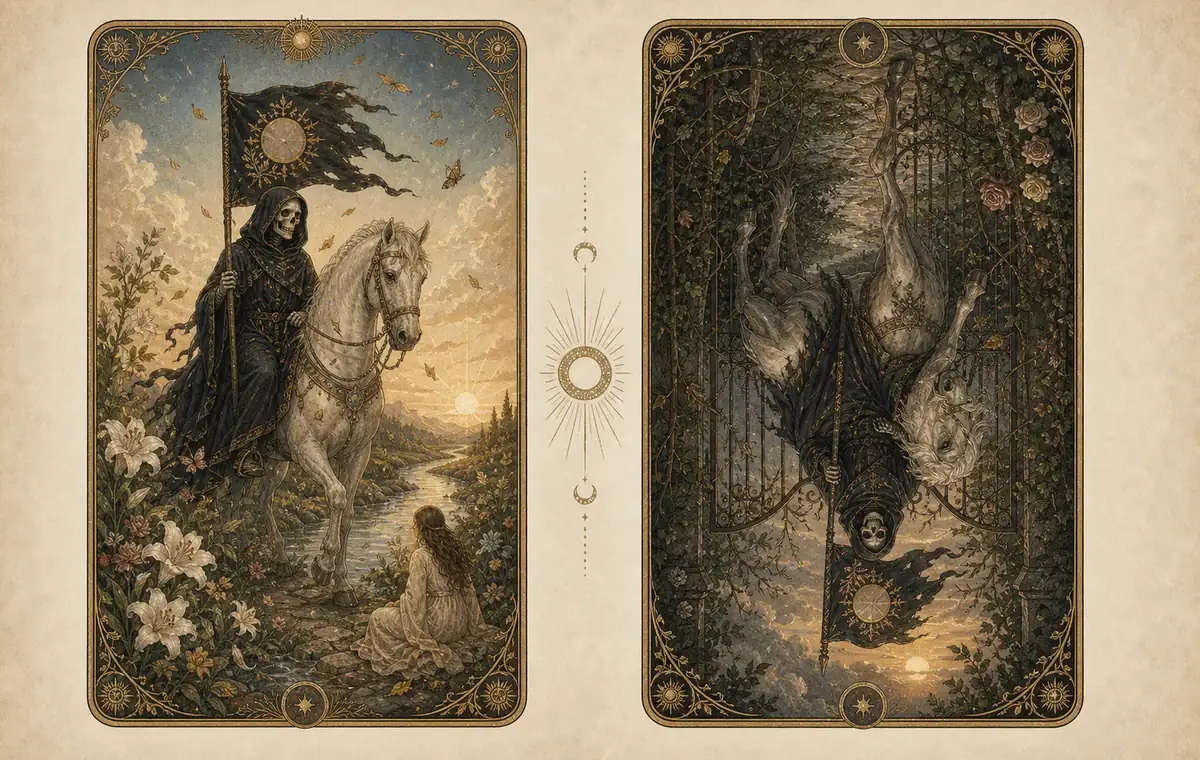
Reversed Death is one of the more interesting reversals in the deck because the card's energy is so directional that pausing or inverting it produces specific shapes of stuckness.
Core Reversed Keywords
- Resistance — Refusing a needed ending
- Stagnation — Holding on past the natural close
- Fear of change — The dread that prevents release
- Private transformation — Change happening internally, not yet visible
- Delayed ending — A close that the situation keeps deferring
In-Depth Reversed Interpretation
The first reading is resistance. You see the ending and you're refusing it. You're staying in the job, the relationship, the city, the role, the self-image past its closure point. The card here is sympathetic but firm — the longer you postpone, the more the ending costs when it finally lands. Reversed Death is the card asking whether you'd rather choose the release or have it chosen for you.
The second reading is the more hopeful one, and it surprises clients: private, internal transformation already underway. Reversed Death sometimes signals that the visible situation has not changed and the inner one has. The release is happening — quietly, away from public view. You may be the only one who knows yet. Clients sometimes draw reversed Death right at the moment they have stopped grieving without telling anyone. The card is naming that hidden completion.
The third reading, less common, is the prolonged dying. A situation that has been ending for so long that it has started to feel permanent. The card here is asking for the mercy stroke — the final, kind act of letting the thing close rather than dragging it through another season.
Death vs. The Tower: What's the Difference?
These are the deck's two great cards of ending, and they get confused constantly. The distinction is concrete.
Death is closure through completion. Something has run its course. The ending is natural — even if painful, it is the conclusion of an arc that had a beginning, a middle, and now an end. Death's ending is timed, even when it doesn't feel that way. The chapter is finishing on its own terms.
The Tower is closure through sudden collapse. Something that was supposed to hold did not hold. The ending is abrupt, structural, and often shocking. The Tower's ending was not preparing in any visible way; it arrives by lightning strike.
Useful shorthand: Death is the death of an old man at the end of a long life. The Tower is the death by accident, by earthquake, by sudden revelation. Both are endings; only one is in the arc of natural conclusion.
When both appear in a spread, the meaning is usually that a long-running ending is being accelerated by a sudden event — a slow closure being cut short by a fast one. Common in spreads around major upheavals.
Death vs. Ten of Swords: The Other Confusion
The Ten of Swords is the other card people read as "the end." It isn't.
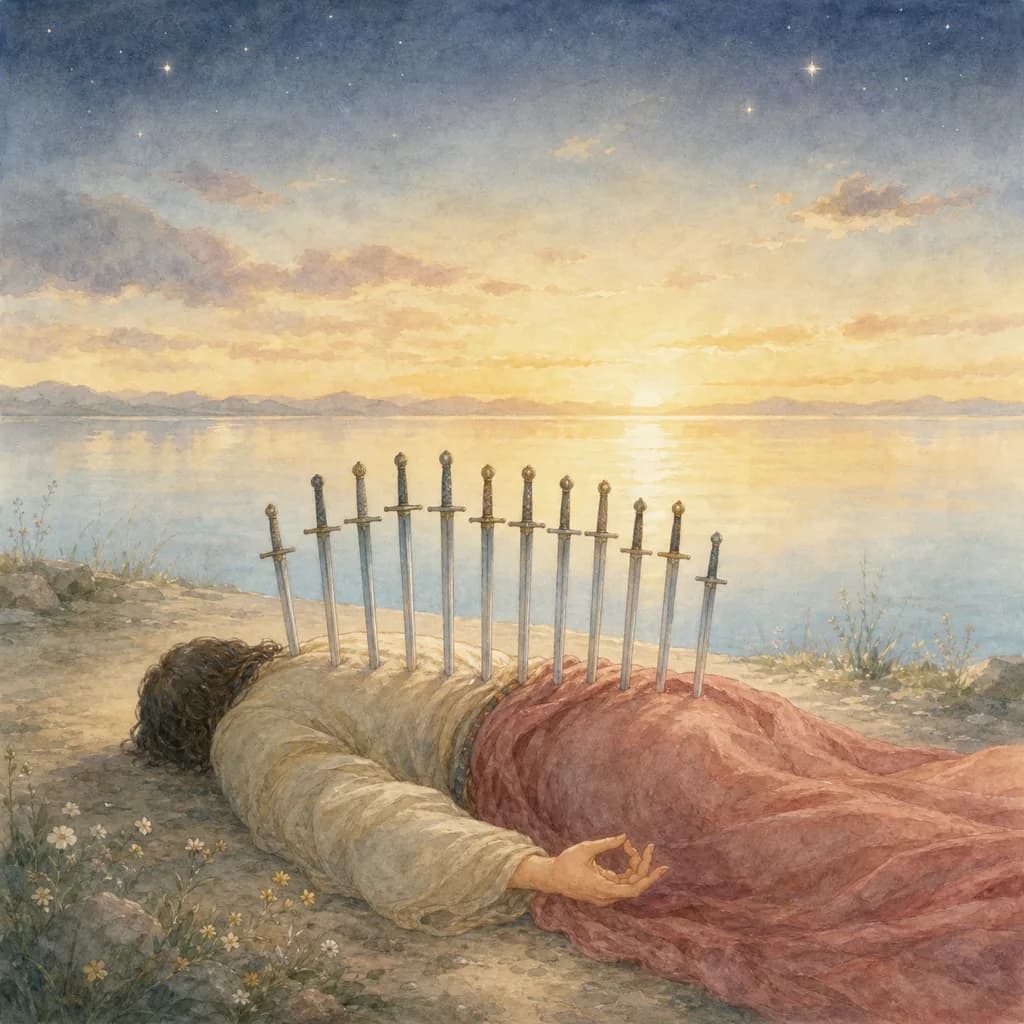
The Ten of Swords is exhaustion, betrayal, the rock-bottom of a particular suffering. The figure on the card is face-down with ten swords in his back. It is dramatic, painful, and — crucially — it is the bottom of one specific kind of experience, not the structural end of a chapter. The sky in the Ten of Swords is already lightening on the horizon; the worst has happened, and dawn is coming.
Death is structural closure of a chapter. It is not specifically painful (the figures' responses model the range of pain available), but it is more total.
In practice: if a client is in the depths of a specific kind of suffering, you'll often see the Ten of Swords. If they're in the middle of a chapter ending, you'll see Death. When both appear, the reading is usually "the worst of this is over, and the chapter is closing." That's actually one of the more hopeful combinations in the deck, even though it sounds heavy.
Death in Love & Relationships
Upright Death in love readings means an ending — but not always the relationship's ending. More often, it's the end of a particular version of the relationship: the courtship phase, the avoidant phase, the version where you both pretended a certain issue wasn't there, the version where one of you was carrying it all. Something in the dynamic is closing so something else can begin.
When Death does mean the relationship's ending, the card is rarely the news. It is usually the formal acknowledgement that the connection had already ended internally for one or both partners. Clients drawing this card in a love reading have almost always known.
For singles, Death often signals the closure of a pattern — the type of person you've been drawn to, the role you've been playing in relationships, the assumption you've been operating from. The clearance creates the conditions for genuinely different connections.
Reversed Death in love usually points to either someone refusing to let an ended relationship end, or to a partnership that is being transformed quietly from within — the work is happening, but neither partner has spoken it aloud yet. For a closer look at how this card reads when the question is specifically about a person's heart, see Death as someone's feelings.
Death in Career & Money
In career readings, upright Death often signals the end of a chapter — a job ending, a career path closing, a project finally complete. The card is rarely catastrophic in this position; more often, it's the formal completion of something that had been winding down. The reading I give most often around Death in career: stop pretending this is going to continue. Plan for what's next.
For money, Death can indicate the closure of a financial chapter — a debt finally paid off, a long financial pattern ending, an inheritance, a major sale or transition. Less often it indicates loss. The card is more about completion than depletion.
Reversed Death in career is one of the more common cards I see for people staying too long in roles that have stopped serving them. The transformation is wanting to happen; the client is delaying it. The card is asking whether you want to choose the close, or have it chosen for you in a less graceful way.
Death Card Combinations
Death + The Tower
Combined ending — slow closure accelerated by sudden upheaval. Common in spreads around major life transitions that arrive faster than expected.
Death + The Wheel of Fortune
A cycle finishing. The Wheel's turn meets Death's closure. Often signals an ending that is part of a larger karmic or generational pattern — not just this chapter ending, but a longer pattern that includes this chapter.
Death + The Hanged Man
Surrender followed by closure. The natural sequence in the Major Arcana — XII to XIII. The pause has done its work; now the closure happens. Common around major spiritual or life transitions where waiting precedes letting go.
Death + Six of Cups
An ending tied to the past. Often closure with an old relationship, an old version of self, a connection from childhood or earlier life. The Six of Cups carries the past; Death releases its hold.
Death + Ace of Pentacles
Material rebirth. An ending in one domain (often career or living situation) producing a tangible new beginning. One of the genuinely encouraging Death combinations.
Death + Judgement
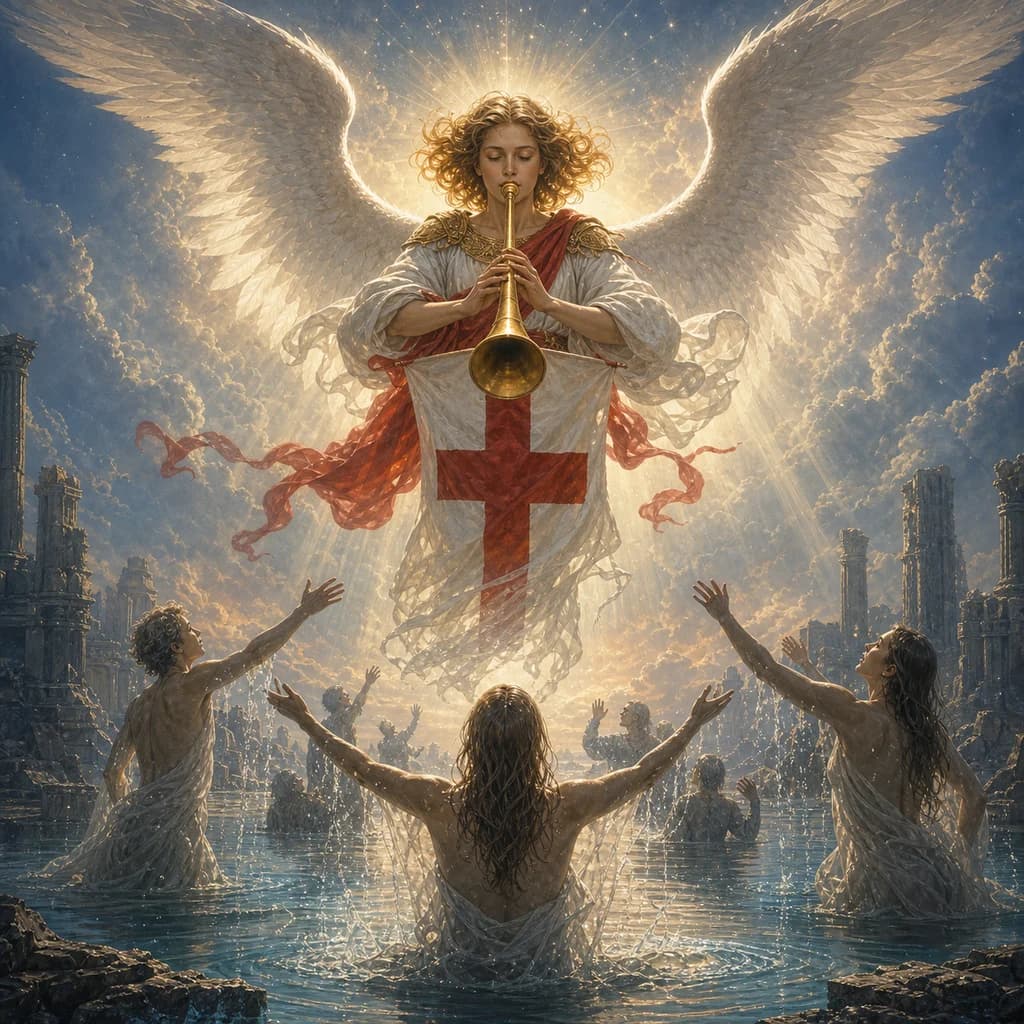
The ending answered by a summons. Death and Judgement, the call that follows the closure, share a flag in the Rider-Waite-Smith imagery, and they pair as a structural sequence: first the chapter closes, then comes the call to rise into what the closure made room for.
Numerology & Astrological Correspondences
The Meaning of Number 13
Thirteen carries Western cultural baggage — unlucky, ominous, the number some hotels skip. Tarot inherits some of that load. But in the structure of the Major Arcana, 13 is simply the position between The Hanged Man (12) and Temperance, the integration that follows closure (14): suspension, closure, integration. Death sits at the structural pivot of the second half of the journey. The cards before it describe the encounter with the self; from Death forward, the self is being transformed by what it cannot keep.
In esoteric numerology, 13 reduces to 4 (1+3) — the number of structure, foundation, the world made solid. Death's closure is what makes new foundation possible. Without the ending, no new ground.
Astrological Correspondence: Scorpio and Pluto
Scorpio is fixed water, modern-ruled by Pluto. The combination is precisely what Death depicts: depth, transformation through dissolution, the destruction that becomes regeneration. Scorpio doesn't tinker. It bottoms out and rebuilds from the foundation.
Pluto's energy is the alchemical principle of nigredo — the blackening, the dissolution of the existing form before the new can emerge. Death is the card of nigredo. Reversed Death often slides toward Pluto's shadow — obsession with what's ending, refusal to let the dissolution complete, getting stuck in the dark phase rather than moving through it.
In Japanese タロット占い Death is often translated 「死神」 with the connotation of a spirit of ending rather than a personification of physical death. Japanese readers tend to be more comfortable with this card than Anglophone clients because the cultural framing around 無常 (mujō, impermanence) is more developed — Death is simply the visible face of mujō, not an aberration.
Frequently Asked Questions
Is Death a Yes or No card?
Upright Death leans Yes, but a Yes that arrives through change rather than continuation. The card answers binary questions with "yes, and the situation will look different on the other side of that yes." Reversed leans No or "not yet," often because someone in the situation is refusing the needed transformation.
Does Death mean someone is going to die?
Almost never literally, and asking the card that question directly will mislead you. Tarot doesn't make medical predictions. The card means closure of a chapter, a pattern, a phase. When clients ask whether the card predicts physical death, the answer I give honestly is "no, and I would not read a card for that question if it did."
How do you read Death in a love reading?
In love, Death usually means the closure of one version of the relationship — sometimes the end of the partnership, more often the end of a phase. The card is rarely news to either partner; it usually names something at least one person has already felt. Read alongside the surrounding cards for whether the closure is of the relationship itself or of a phase within it.
How does the Japanese tarot tradition read Death?
In タロット占い Death is often associated with 無常 (mujō) — the impermanence of all phenomena. The Japanese reading tends to be less catastrophising than the Anglophone reading, treating the card as a familiar truth (everything ends) rather than a shocking revelation. I find this framing closer to the card's actual content.
Can Death indicate good news?
Often, yes. The card is good news when the thing ending was already costing the client more than it gave. Most Death readings I do are with people who are quietly relieved that something is finally over — the card gives them permission to admit it.
What does it mean to keep drawing Death?
Either you are mid-transformation and the card is naming the ongoing process, or you are refusing a transformation and the card is insisting. Look at whether you've actually begun letting something go. If you have, the repeated draws are confirmation. If you haven't, they are pressure.
Closing
Death is the deck's most honest card. It does not negotiate, it does not flatter, and it does not pretend that what's leaving might stay. It names the ending. The reason clients ask me to put it back in the deck is the same reason it's worth drawing: it cuts through the wishful narratives we use to keep things going past their close.
If you've drawn Death, the most useful thing I can tell you is the thing the card's image already tells you: the figure on the horse is moving forward at a steady pace. Whatever in you is rigid will be unhorsed. Whatever in you is recent will turn its head away. Whatever in you is still small enough to meet the moment will look up. All of those parts of you will survive the card. Only the rigidity will not.
Continue exploring the Major Arcana: read about The Hanged Man for the surrender that often precedes Death's closure, or The Wheel of Fortune for the cycle in which this ending takes its place.