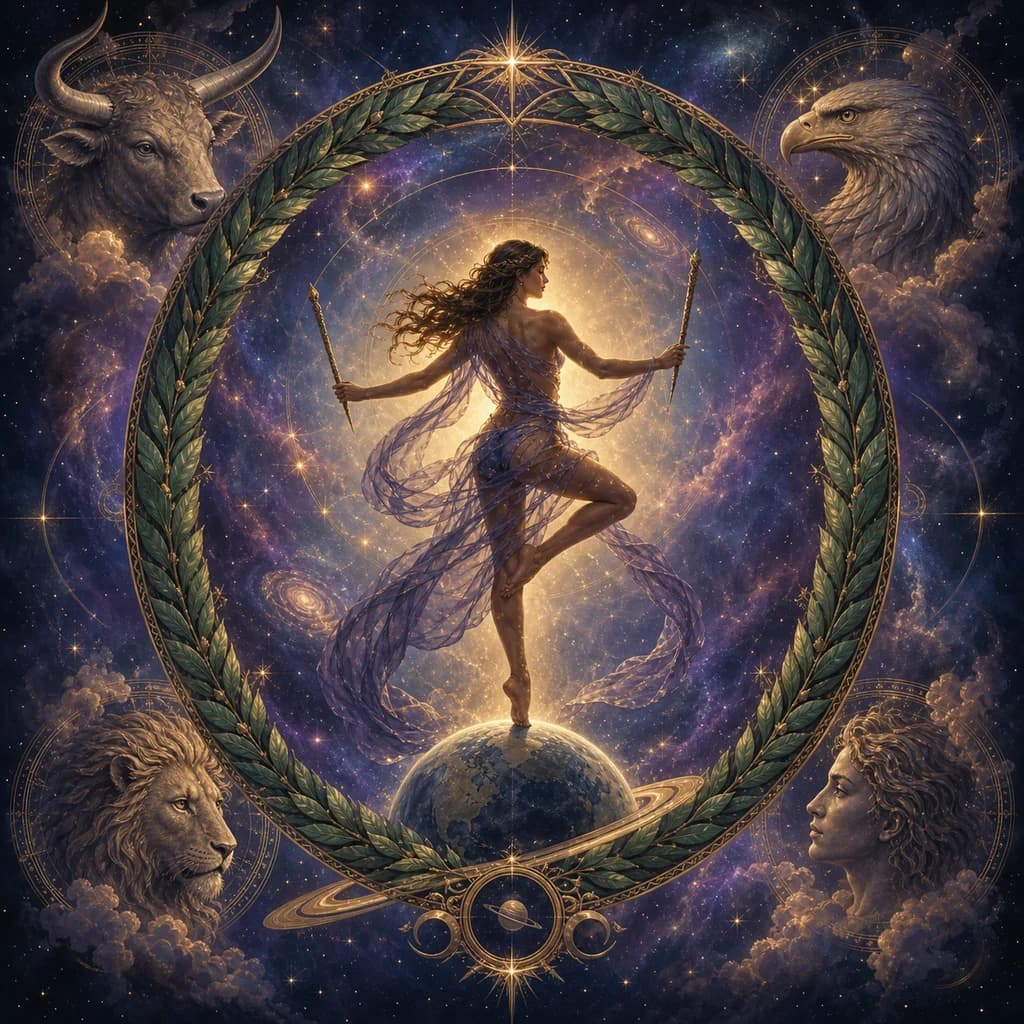
The World is the card most readers either oversell ("everything you wanted, achieved, the end") or underread ("oh good, completion, moving on"). Both miss what the image is actually drawing. A figure dances inside an almond-shaped wreath, holding two wands, surrounded by the same four creatures that frame the Wheel of Fortune. The wreath is bound top and bottom by red ribbons that form a sideways figure-eight. Nothing about this image says "the end." It says completion that opens — the cycle closing in a way that makes another cycle possible.
This guide reads The World the way the Rider-Waite-Smith image is drawn: the mandorla shape that most articles call a "wreath" without naming the geometry, the two wands that echo the Magician's one (the deck's literal closing argument), the gender ambiguity Waite described and most modern guides quietly omit, the structural pair with The Fool that turns the deck into a circle, the Saturn rulership that gives the card its specific flavor, and the four creatures' real difference from the same four on the Wheel of Fortune.
Quick Answer
The World is Major Arcana card XXI, ruled by Saturn and associated with the element of Earth. Upright, it signals successful completion of a long arc, integration of what was learned, accomplishment recognized, a cycle closing cleanly and another one preparing to begin. Reversed, it suggests a near-completion held back by a missing piece, refusal to close, or a celebration claimed prematurely. Yes/No: Yes — but the Yes is structural, and it usually arrives after real work.
Basic Information
| Attribute | Details |
|---|---|
| Card Name | The World (also "The Universe" in the Thoth deck) |
| Number | XXI (21) |
| Arcana | Major Arcana — the final card |
| Element | Earth |
| Planetary Rulership | Saturn |
| Hebrew Letter | Tav (the mark / the cross / the seal) |
| Yes / No | Yes — structural, earned |
| Upright Keywords | Completion, integration, accomplishment, wholeness, fulfillment, closure that opens |
| Reversed Keywords | Near-miss, missing piece, refusal to close, premature claim, stalled cycle |
What The World is Actually Closing
A short detour before the imagery. The World is unique in the deck because its meaning depends on what came before it — twenty cards' worth of journey. Reading it as a standalone "you did it" card flattens what it is doing.
The deck is structured as a journey often called the Fool's Journey: the Fool (0) walks through twenty-one experiences and arrives at The World (XXI). Saturn — the card's ruling planet — was historically the outermost known planet, the limit of the solar system, the edge of structure itself. The World sits at the same kind of edge: the boundary of one cycle, just before the next opens. The 22nd Hebrew letter Tav means mark, sign, or cross — the final letter of the alphabet, the seal that closes the text. That letter is not chosen by accident.
The card is naming a specific kind of arrival: not a destination reached by accident, but the structural closing of a real arc you walked. The deck is making a claim — that real completions look like this, and that the markers of a real completion are visible in the image.
I bring this up with clients who draw The World thinking it means "everything is fine now." It doesn't. It means this arc is closing. Naming which arc is the work of the reading.
Card Imagery & Symbolism
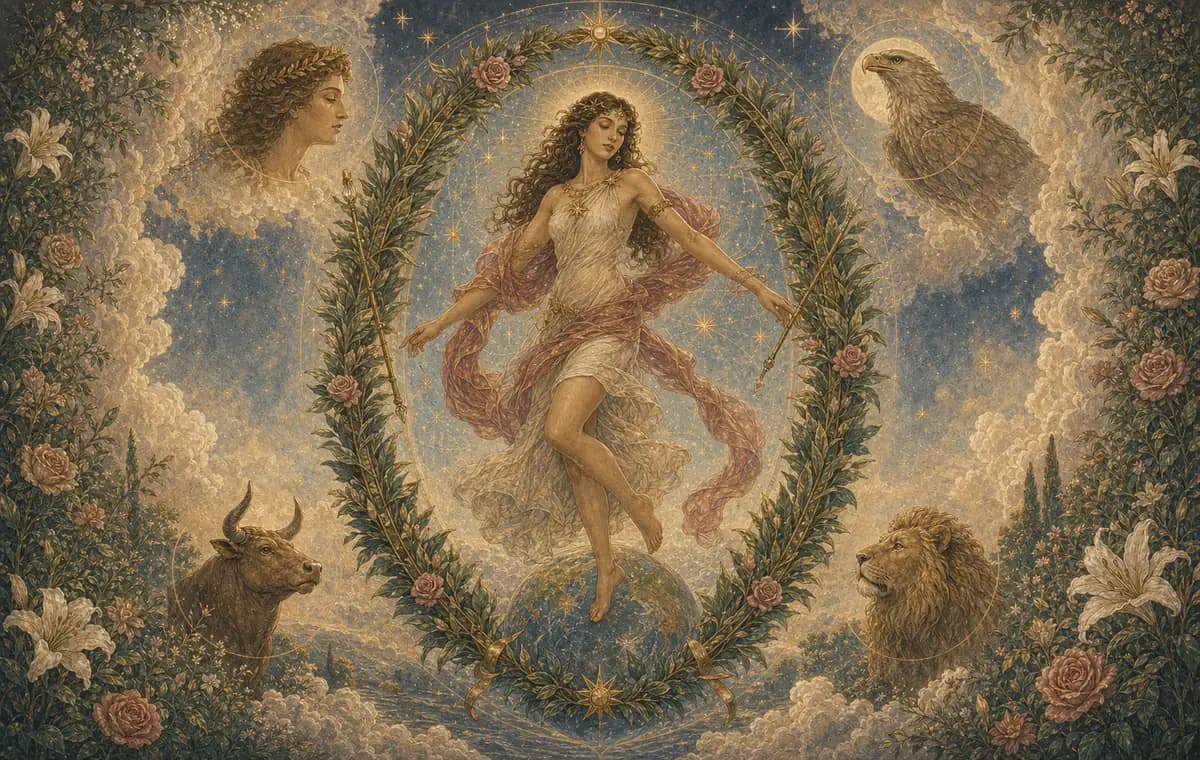
In the center of the card a nearly nude figure dances — one leg crossed behind the other, body turned mid-step. A purple sash is draped across the body. In each hand the figure holds a short wand. Around the figure a thick green wreath forms an almond shape, bound at top and bottom by red ribbons that wind into a figure-eight. In the four corners of the card appear the same four creatures from the Wheel of Fortune: a winged man (Aquarius), an eagle (Scorpio), a lion (Leo), and a bull (Taurus). The background is the open sky.
Every element here is doing precise work.
The Mandorla (Not Just a Wreath)
The shape the wreath forms is not a circle. It is a mandorla — the almond-shaped frame used in Christian and Byzantine art to surround figures of divinity or transcendence (Christ in Majesty, the transfigured Christ, the assumed Virgin). Most popular guides call it a "wreath" and move on, missing the iconographic claim the card is making.
The mandorla is created by the intersection of two circles — the spiritual and the material, the inner and the outer, the heavens and the earth. The figure dancing in the center is dancing in the space where the two overlap. That is the card's structural claim about completion: it is not a flat state but a position held at the intersection of two worlds. The dancer has not transcended the material; the dancer is in the place where material and spirit meet.
This matters for the reading. Clients who draw The World often expect it to mean "I have escaped the everyday and arrived at peace." It rarely does. It means "the everyday and the meaningful have integrated, and I am now standing in the space where they overlap." The dance is the integration.
The Two Wands
The figure holds two short wands, one in each hand. They look almost identical to the wand the Magician holds in card I. This is the deck's quietest and most structural rhyme. The Magician held one wand, the tool of channeling spirit into matter. At The World, the figure holds two — the work of the Magician completed, doubled, mastered. The journey from I to XXI is the journey from a single tool wielded with effort to two tools held with ease.
The dancer's pose, with the crossed legs, sometimes reads as a hanging stance — a deliberate visual echo of The Hanged Man (XII). The deck is making a structural argument: the surrender of the Hanged Man is what eventually walks you to the dance of the World. The same body, reoriented.
Most articles I have read do not name either link. Naming them is one of the most useful World-reading moves available.
The Figure's Gender
Waite, in The Pictorial Key to the Tarot, described the dancing figure as a "divine androgyne" — not a woman, not a man, but a figure deliberately holding both. Pamela Colman Smith's illustration preserves this ambiguity: the purple sash falls in a way that conceals rather than declares, and the body itself is rendered without strong gender markers.
Most modern guides describe the figure as a woman. This is a small but consequential softening. The card is claiming that completion looks like the integration of opposites — masculine and feminine, active and receptive, spirit and matter, conscious and unconscious. The androgynous figure is the card's most concentrated symbol of integration: not the dominance of one polarity but the held union of both.
This reads operatively in reversed Worlds, where the missing piece is often gendered — the unintegrated masculine in a feminine-coded life, or vice versa. The card asks for both to be present in the dance.
The Red Ribbons
The wreath is bound at the top and bottom by red ribbons that twist into the shape of a lemniscate — the sideways figure-eight, the symbol of infinity that also appears on the Magician's hat and over Strength's head. Same symbol, same job. The ribbons say: this completion is not the end. The wreath is not sealed shut; it is bound by infinity ribbons, the same symbol that opened the deck.
This is the card's structural argument against reading The World as "the end." The ribbons are the visible promise that the cycle closes into another cycle. Saturn's limit is real but not final.
The Four Creatures
The same four creatures that watch the Wheel of Fortune watch The World — the winged man, the eagle, the lion, the bull. They are the four fixed signs of the zodiac (Aquarius, Scorpio, Leo, Taurus), the four elements (air, water, fire, earth), the four evangelists in the Christian tradition (Matthew, John, Mark, Luke), and the four directions.
Here is the difference most readers miss: on the Wheel of Fortune, the four creatures are reading books. On The World, they are not. They sit in the corners and watch.
The shift is the point. On the Wheel, the creatures are still learning — the cycle is still teaching them. On the World, they have read the books. They now stand as witnesses to a completion they helped produce. The same four guides, at two different stages of the same education.
I had not seen this difference named in any of the mainstream guides I researched. It is one of the cleanest structural arguments the deck makes for its own coherence.
Saturn and the Specific Flavor of Completion
Saturn rules The World, and Saturn's flavor explains why World-completions feel the way they do. Saturn is the planet of structure, time, discipline, and earned arrival. Saturn does not give gifts; Saturn returns what was built. A Saturn-flavored completion is not a windfall, not a sudden grace, not a lucky break. It is the recognition that the long, often unglamorous work has produced a real outcome.
This is the rulership most popular guides skip past. It is the key to reading the card accurately. World-completions tend to feel quieter than people expect. There is satisfaction, but rarely euphoria. There is recognition, but it often comes with a slight melancholy — the awareness that the long arc is closing and a new one will begin. Saturn's gifts have weight, not sparkle.
In practice this means I almost always check, with clients drawing The World, whether they feel the satisfaction of the card or whether they are expecting more drama from it. If they are disappointed, the card is often working correctly and the expectation is the problem.
Upright Meaning
Upright, The World is naming the close of a real arc. A long project, a degree, a relationship, a phase of life, a body of work, a recovery, a child raised — something that has actually been walked is now actually closing, and the integration of what was learned is consolidating into who you have become.
Three forms of completion most commonly surface under The World:
The vocational completion. A project, a degree, a body of work that has reached its honest end. Not the end of all work — the end of this work. The card frequently appears in the final weeks of a long arc.
The relational completion. A relationship that has run its full course (which can mean either reached its mature form or finished its real ending). The card does not by itself say which. The reading determines that.
The personal-arc completion. A phase of life — the long single period, the years of recovery, the decade of raising small children, the chapter abroad — closing cleanly into the integration that follows. The card is naming the boundary, not the next phase.
A reading from earlier this spring: a Tokyo client came in three days before turning in the manuscript she had been writing for five years. She drew The World. She told me she had been bracing for the moment of submission to feel cathartic. It hadn't. It felt quiet and slightly sad. I told her the card is precisely about that quiet — Saturn's gift is not catharsis, it is the recognition that the work is real. She wrote me later. The publication date is this fall. She still describes the feeling of the close as "quiet" — and now she knows that was the correct feeling, not a missing one.
The World Reversed Meaning
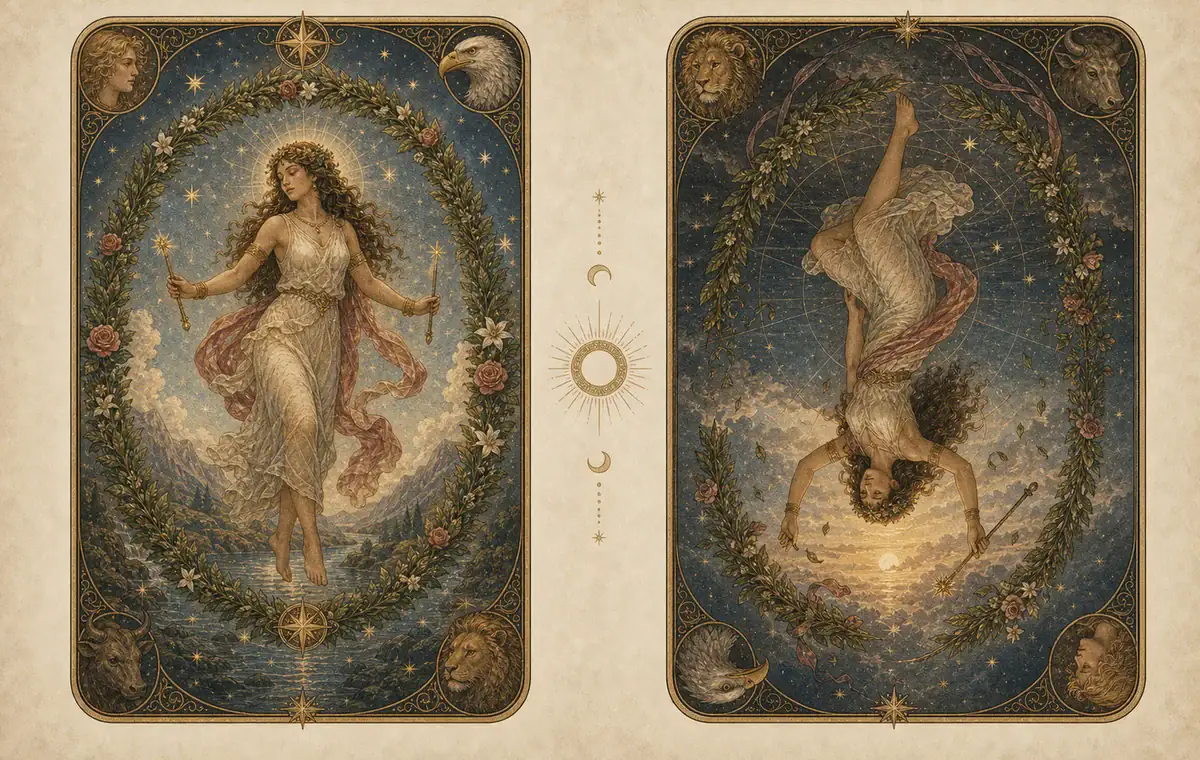
Reversed, The World has two honest readings.
The missing piece. The arc is 95% complete but one element is still unintegrated. The dissertation written but not defended; the relationship matured but one unspoken truth still held; the project shipped but the documentation never finished. The card reversed asks what the last 5% actually is and whether you are avoiding it.
The refused close. Less commonly discussed: the arc has reached its real ending and you are refusing to let it close. The relationship that has actually completed but you are still treating as ongoing; the role you have outgrown but cannot leave; the identity you have moved past but still claim. The card reversed names the refusal. The cost of refusing to close a real completion is that you cannot start the next cycle.
Distinguishing the two reversals depends on what is actually missing. If the work is unfinished, finish it. If the work is finished and the close is refused, name the refusal and let the cycle end.
The World vs. The Fool
The deck's full circle. The Fool (0) is the beginning of the journey — the figure stepping off the cliff with the small bag, the dog at the heels, the open sky ahead. The World (XXI) is the close — the figure dancing in the mandorla, the wreath bound by infinity ribbons. The two cards are explicitly paired.
Look at the structural rhymes: both figures are alone in an open landscape. Both face forward. Both carry something light (a bag, two wands). Both stand at an edge (a cliff, the boundary of a cycle). The Fool is the beginning that has not yet learned anything; the World is the close that has integrated everything. Same figure, two ends of the same journey.
The implication for reading: World-completions are not endings but the precondition for the next Fool-beginning. After the World, the Fool steps off again, with everything learned now integrated as instinct rather than thought. This is what the red infinity ribbons are claiming: the cycle is sealed, but it seals into the next opening.
Love and Relationships
The World in a relationship reading is rarely about a small adjustment. It is about an arc reaching its mature close — either the relationship arriving at its full, integrated form (the partnership that has actually worked through what it needed to work through) or the relationship reaching its honest ending.
In a partnered reading, The World most often points at integration: a relationship that has crossed enough together to feel like a real shared life. The card is the deck's most affirming card for long partnerships that have done the work.
In a single reading, The World is more nuanced. It can point at the completion of a long phase of being single — the arc closing in a way that opens space for the next chapter. Or it can point at the integration of being single as a real and valid life, not a waiting room. The reading determines which.
Reversed in love, the most common form is the relationship 95% complete that refuses to close — either by maturing or by ending. Naming the 5% is the work.
Career and Money
Career Worlds are almost always real. The promotion that follows long work, the project shipped, the credentials earned, the recognition that takes a decade to arrive. The card is rarely about a windfall and almost always about a Saturn-shaped arrival. If you draw The World in a career reading, the question is not "will I succeed" but "am I going to receive this completion cleanly, or am I going to immediately start the next thing without letting this one close?"
Money Worlds are similar. The financial milestone reached through long work, the debt cleared, the savings consolidated, the financial chapter that opens new space. The card does not promise wealth; it promises closure of a financial arc, which often turns out to matter more.
The hardest career Worlds are the ones where the completion is the recognition that this career is now actually finished. Saturn returns what was built; sometimes what was built was the runway for the next thing.
Card Combinations
- The World + The Fool: the deck's full circle. Completion that opens the next beginning. The most structurally complete pair in the deck.
- The World + Judgement: the call answered, the cycle closed. The closing arc of the Major Arcana.
- The World + Ten of Pentacles: material completion, family or estate, the long arc realized in concrete form.
- The World + Eight of Wands: the rapid arrival following the long arc. Often a publication, a release, an announcement.
- The World + The Magician: the two-wand dancer meets the one-wand beginner. A reading about teaching, mentorship, or the transmission of what was learned.
- The World + The Hermit: the long inward arc reaching its mature close. Often a card pair for someone completing a contemplative or spiritual chapter.
Numerology and Astrology
XXI reduces to 2+1 = 3, which is The Empress. The link is operative. The Empress is creative abundance; The World is what creative abundance looks like after twenty cards of integration. Both are about generation, but the Empress generates outward and the World generates by integration. The same fertility, at two different stages.
Astrologically, Saturn's rulership gives the card its specific weight. Saturn is the slow planet, the structure-builder, the teacher whose lessons take a full Saturn-return (about 29 years) to register. The Hebrew letter Tav — final letter, meaning mark or seal — closes the alphabet the way the World closes the Major Arcana. Both letter and card are about what gets stamped at the end of a real cycle.
Frequently Asked Questions
Is The World always a positive card?
Yes, structurally, but "positive" understates it. The World is the deck's clearest Yes — but it is a Saturn-flavored Yes, which means earned, weighty, and often quieter than expected. Clients sometimes feel disappointed by a World drawing because they expected euphoria. The card is working correctly; the expectation was the issue.
What does The World mean in a love reading?
The mature close of a real relational arc. Either the partnership arriving at its full integrated form (long partnerships that have done the work) or the relationship reaching its honest ending. Reversed, the most common reading is the relationship 95% complete that refuses to close — by maturing or by ending.
Does The World mean the end?
No — it means the close of a cycle in a way that opens the next one. The red infinity ribbons that bind the wreath are the visible claim that the World seals into the next Fool. The deck is structured as a circle. The World is the seal, not the period.
What zodiac sign or planet rules The World?
Saturn — the planet of structure, time, and earned arrival. The Saturn rulership is the key to reading the card: World-completions are weighty, real, and rarely euphoric. They are the kind of completion that registers later as more meaningful than it felt in the moment.
What's the difference between The World and the Wheel of Fortune?
Both cards show the same four corner creatures, but the creatures are doing different things. On the Wheel, they read books — they are still learning. On the World, they watch — they have read the books. The Wheel is the cycle in motion; The World is the cycle completed. The same four guides, at two different stages of the same education.
Why is the figure androgynous?
Because the card's claim about completion is integration of opposites. Waite described the figure as a "divine androgyne" — masculine and feminine held together. The dance is the integration. Reversed Worlds often turn out to be about an unintegrated polarity in the querent's life.
What should I do if I draw The World?
Let the arc close. The most common World-error is to refuse the close — to immediately start the next thing without letting this one register. Saturn rewards the pause. Sit with the completion long enough for it to actually consolidate. Then the next Fool-step opens on its own.
Closing
If The World drew today, name the arc that is closing. It is probably an arc you have been walking longer than you realized. The card's quiet claim is that the work has been real and the close is earned. Let it close. The red ribbons are already binding the next cycle. You don't have to reach for it. Saturn's gift is the recognition that the cycle is sealed — and the next one opens when you've actually finished standing in this one.
For related reading see The Fool, Judgement, and The Wheel of Fortune.