The first thing I tell clients who pull Justice is: this card is not on your side. It isn't on the other person's side either. It's the card of the deck that genuinely doesn't take sides — which is why people who draw it hoping for vindication often leave a session more uncomfortable than when they sat down.
In Rider-Waite-Smith readings, Justice is the eleventh Major Arcana card (with a twist on the numbering I'll get to). It rules the part of the deck where the Fool's journey stops being purely personal and starts having consequences other people can see. This guide covers the imagery in detail — including the cube of salt at her foot, which most articles skip — its upright and reversed meanings, why Justice and Judgement get confused (they shouldn't), and what Justice actually says about karma if you read it carefully.
Quick Answer
Justice is Major Arcana card XI, ruled by Libra and the element of Air. Upright, it signals truth, accountability, fair outcomes, and decisions made with both logic and intuition. Reversed, it points to injustice, evasion of responsibility, dishonesty, or harsh self-judgment. The card is less about who "wins" and more about what becomes visible — Justice shows what was actually done, by everyone involved, including you.
Basic Information
| Attribute | Details |
|---|---|
| Card Name | Justice |
| Number | XI (11) — VIII (8) in Marseille and Crowley decks |
| Arcana | Major Arcana |
| Element | Air |
| Zodiac Correspondence | Libra |
| Yes / No | Yes (upright, conditional on having acted with integrity) |
| Upright Keywords | Truth, fairness, accountability, karmic balance, legal outcome, integrity |
| Reversed Keywords | Injustice, dishonesty, evasion, harsh self-criticism, legal complication |
The VIII / XI Numbering Question
Before getting into imagery, the numbering deserves a paragraph because it shapes how you read Justice.
In the older Marseille deck and in Aleister Crowley's Thoth deck, Justice is card VIII (8) and Strength is XI (11). When Arthur Waite designed the Rider-Waite-Smith deck in 1909, he deliberately swapped them — Strength became VIII, Justice became XI. Waite's reasoning was astrological: he wanted the Major Arcana to follow the natural order of the zodiac, and Leo (Strength) comes before Libra (Justice) in the wheel. The Golden Dawn occult tradition he was working from agreed.
This matters in practice. If you read Strength as VIII, you're saying "before judging, master yourself." If you read Justice as VIII, you're saying "before mastering yourself, see clearly." These are different teachings and they imply different orders of work. Most modern readers use the Waite numbering (XI), and I do too — but if you draw from a Marseille deck, the same image carries a slightly different position in the journey. I covered this swap from Strength's side in the Strength article; this is the other half of the same controversy.
Card Imagery & Symbolism
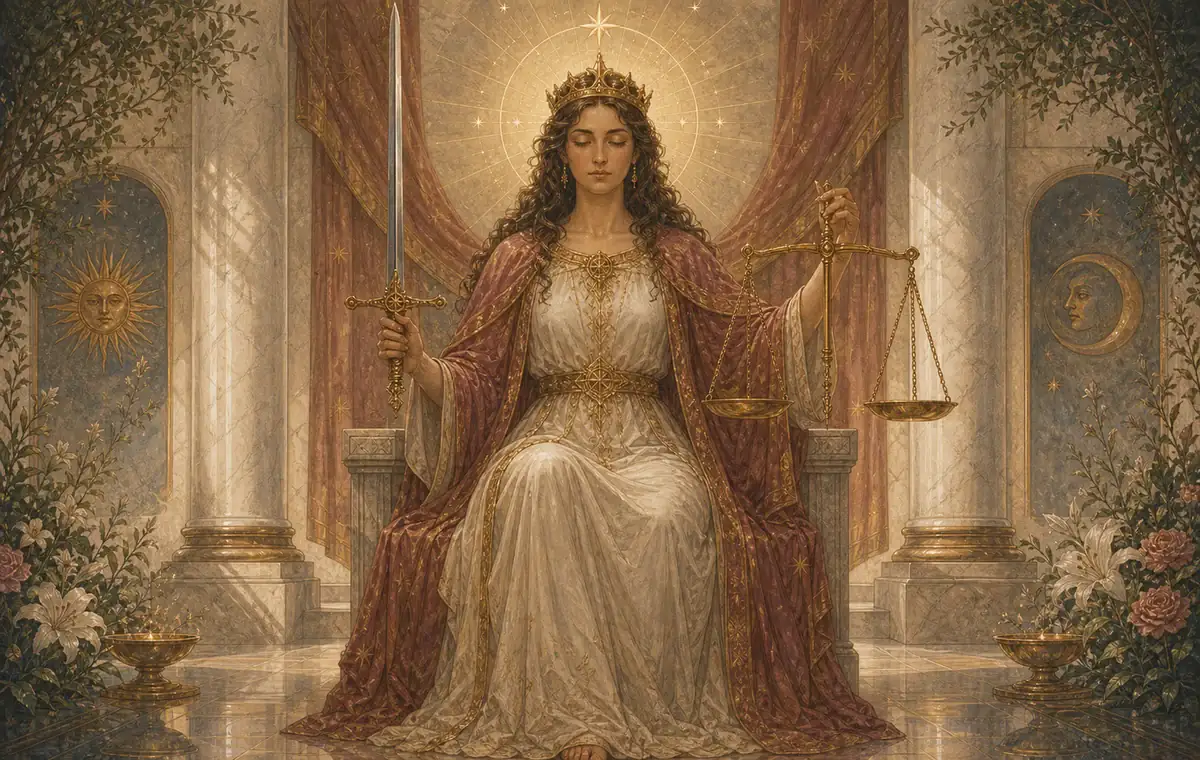
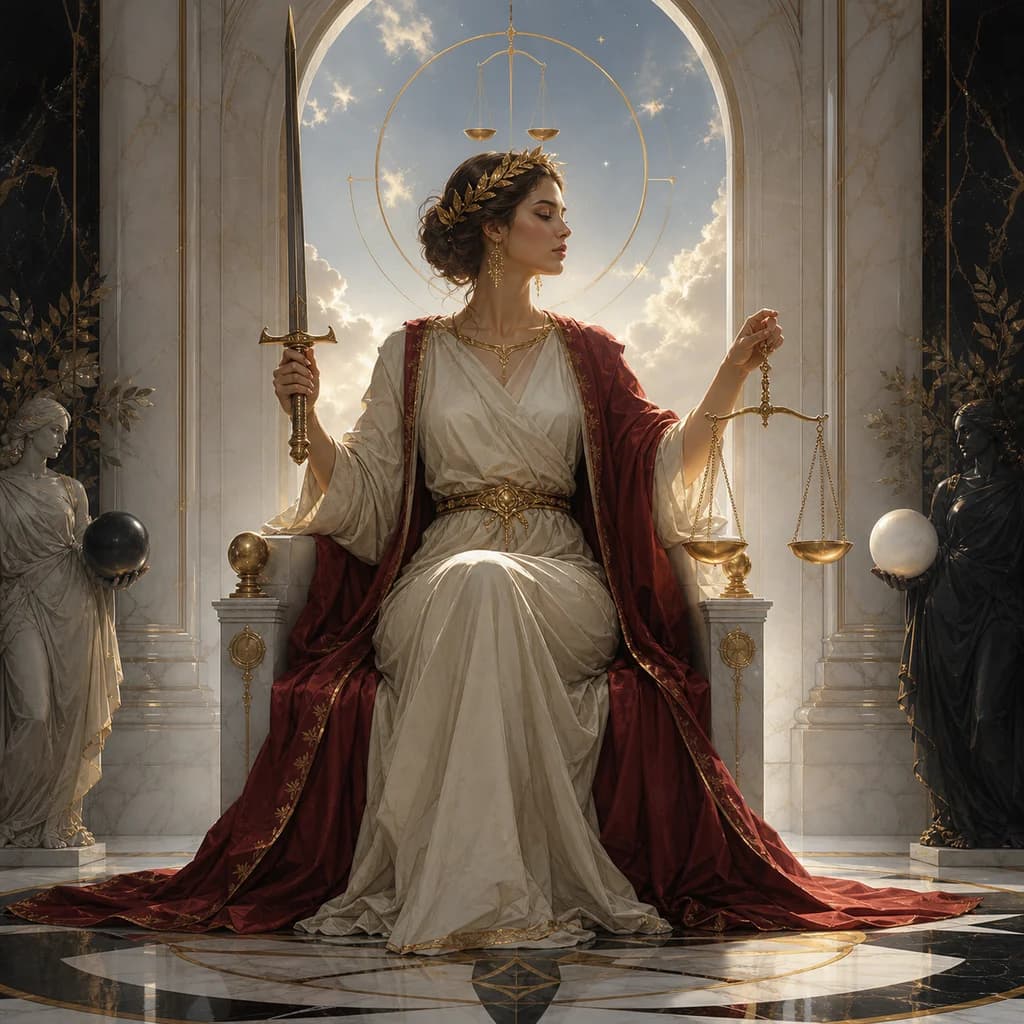
Justice sits on a stone throne between two grey pillars, draped in a red robe with a green mantle. The pillars match those behind The High Priestess and the Hierophant — Waite uses the same architectural frame three times in the Major Arcana, and the difference between those three cards is exactly what's between the pillars.
The Sword Held Upright
In her right hand Justice holds a double-edged sword, point straight up. The sword is logic, intellect, and decision — but the orientation matters. A sword held upright cuts both up and down; the doubled edge means a decision affects everyone in the situation, including the person making it. There is no clean way to wield this sword. Whatever ruling falls falls on you too.
The Scales
Her left hand holds a pair of scales. Most guides translate this as "weighing right and wrong." That's part of it, but the deeper read is that the scales aren't yet level in the card — they're being held. Justice is not the verdict. Justice is the act of weighing. The verdict is what happens after the card. This is also where Justice gets confused with another balance card: Temperance is fluid balance, not the fixed verdict Justice eventually hands down.
The left-hand placement is intentional: in Western occult tradition the left side is the intuitive, receptive side. Logic holds the sword. Intuition holds the scales. You can't read this card honestly if you pretend it's about pure reason — Justice insists that integrity requires both.
The Crown with the Square
Justice wears a crown topped with a small blue square. That square is the mind in its ordered form — thought structured enough to make a decision rather than spinning. Most readers walk past it. In an esoteric reading, the square at the crown says: this is judgment that has cooled enough to be issued.
The Cube of Salt at Her Foot
This one almost no popular guide mentions. At the corner of Justice's robe, by her right foot, you can see what is conventionally read as a small cube — alchemically, the cube of salt. Salt in alchemy is the fixed principle: what stays. The cube under Justice's foot says her ruling has weight, will stay, won't be argued away. When this card appears in a reading and you're hoping the situation will quietly resolve itself without anyone having to say what happened, the cube of salt is the card telling you no — the truth is going to be set down somewhere where it remains.
The Purple Curtain
Behind Justice hangs a purple veil. Purple is the colour of compassion and royalty — and in this card it does something specific: it closes off whatever is behind her. There's no further appeal. Compare this to The High Priestess, where the same curtain is partially translucent and conceals esoteric knowledge. The High Priestess's veil hides; Justice's veil ends.
Justice Upright Meaning
Upright Justice is the card of the situation becoming clear in a way the people involved can no longer pretend not to see.
Core Upright Keywords
- Truth surfacing — What was hidden or denied becomes visible
- Accountability — Consequences arriving for actions already taken
- Fair outcome — A ruling, settlement, or resolution that matches what was actually done
- Karmic balance — The closing of a loop set in motion earlier
- Decision with stakes — A choice you'll be measured by later
In-Depth Upright Interpretation
The most common reading I give for upright Justice: a situation that has been ambiguous is about to stop being ambiguous. Either the truth comes out, or a decision gets made, or a consequence arrives. The card is not predicting which way the result will go. It's predicting that the period of "we'll see" is closing.
In Tokyo readings I see this card most often in two contexts. The first is legal — divorce settlements, employment disputes, formal mediation. The second is internal — clients who have been quietly avoiding a reckoning with themselves and are about to stop being able to.
The hardest reading I gave around this card was a client mid-divorce who wanted me to confirm she would "win." She had a strong case and she was furious. I told her what the card actually says: Justice will see what both of you did. The card does not promise vindication; it promises visibility. She got most of what she asked for in the settlement, and she also got mirrored back to her, by the process itself, a few patterns she had not been ready to look at. Both happened. That is exactly what Justice looks like when it lands.
The trap to avoid: reading upright Justice as "the universe is on my side." That's not the card. Justice is on truth's side. If the truth is on your side, the card favours you. If part of the truth isn't, the card surfaces that too.
Justice Reversed Meaning
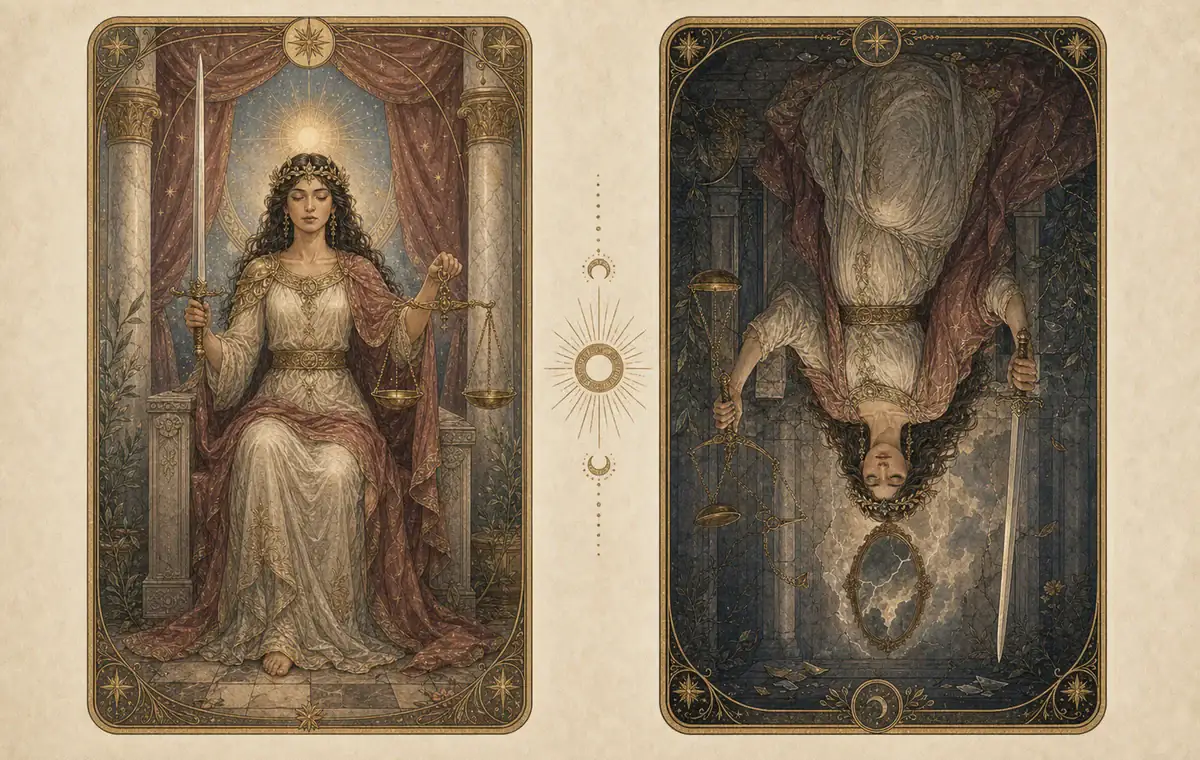
Reversed Justice has three common readings, and they're more different from each other than the reversals of most cards.
Core Reversed Keywords
- Unfairness — A situation where the truth is being suppressed or distorted
- Evading accountability — Someone (possibly you) refusing to own a part of what happened
- Dishonesty — Active deception in the situation
- Self-judgment — The inner critic turned up too loud
- Legal complications — Delays, retrials, settlements that don't settle
In-Depth Reversed Interpretation
The first reading is being on the receiving end of injustice. A situation where you have acted with integrity and the outcome doesn't reflect it. Someone else is lying, the system isn't working, the truth isn't being seen. The card here is sympathetic but stern: keep your own integrity intact even while the external outcome is wrong. Reversed Justice does not give you permission to become dishonest in response.
The second reading is the one most clients don't want. You're the one evading. There's a part of what happened that you contributed to and you've been narrating it as if you didn't. Reversed Justice asks you to drop the version of the story that protects you. This is the harder card to deliver, and I've learned to deliver it gently — but the card is unambiguous about it.
The third reading is harsh self-judgment. Justice reversed sometimes appears for clients who have already taken accountability and are now over-correcting — punishing themselves for something that has been handled, refusing to forgive themselves for something the other party has already moved past. The card here is asking you to take the scales off your own neck. You've weighed yourself enough.
The reversed card is not the same as no card. It's a Justice that's tipped — and the question the reading has to answer is, tipped which way and by whom.
Justice in Love & Relationships
In love readings, upright Justice often signals the moment of truth in a relationship. For couples, this can be a long-deferred honest conversation, a confrontation about an unresolved issue, or — in some readings — a marriage decision or contract being finalised. The card can also point to outside parties: counsellors, mediators, parents weighing in. Whatever has been left ambiguous is about to be named.
For singles, Justice usually means a new connection will arrive that matches what you've actually been doing rather than what you've been wishing for. Clients sometimes don't like this reading. If you've been showing up to dating from a fair, honest place, the card is good news. If you've been doing something else — chasing avoidants, dating people who match an old wound, not telling potential partners important things about yourself — the next connection will reflect that pattern back to you. Justice gives you what you brought, not what you wanted.
Reversed in love most often points to a partnership where someone is being dishonest or where one person is carrying significantly more of the relationship's weight. It can also signal a relationship that ended unfairly and hasn't been processed.
Justice in Career & Money
Upright Justice in career is one of the more concrete cards in a work reading. It often signals contracts being signed, formal reviews, salary negotiations, raises, promotions decided by committee, or legal matters connected to your work. The card favours people who have done the work and documented it. It rarely favours people who have been performing rather than delivering.
For money specifically, upright Justice can indicate financial settlements, owed money arriving, tax matters resolving, or a fair valuation in a sale or negotiation. The card tends to land precisely where the numbers actually justify, which sometimes means less than the client hoped and sometimes more than they expected.
Reversed Justice in career is the card I see most often in workplace mistreatment that's been going on too long — an unfair manager, a pattern of credit being taken by someone else, a promotion that should have happened years ago. The reading is rarely "leave tomorrow." It's "stop pretending this is fair and decide what you're going to do about it."
Justice vs. Judgement: What's the Difference?
These two cards are the deck's two great accountability cards, and they get confused constantly. The distinction is important — and if you want the full map, think of Judgement, Justice, and Death as three scales of reckoning, each operating at a different depth.
Justice (XI) is causation. You did X, X has consequences, the consequences are arriving. The frame is this life, this situation, this set of actions and their visible result. Justice rules legal matters, fair outcomes, the truth of what happened being seen.
Judgement (XX, near the end of the Majors) is a different operation entirely. Judgement is the soul-level reckoning, the calling that asks who you have become across the whole arc — sometimes across a whole life or, in esoteric readings, across more than one. The frame is much larger. Judgement is the trumpet that wakes you up, not the gavel that comes down.
The shorthand I use: Justice is the courtroom; Judgement is the calling. Justice is "what did you do and what does it deserve?" Judgement is "what have you become, and is it time to rise to the next thing?"
When both appear in a spread you're usually looking at a moment where a long-running pattern is being accounted for and a deeper transformation is being asked of you. It's heavy and it's worth taking seriously.
Justice Card Combinations
Justice + The Hierophant
Formal, institutional truth. Often legal contracts, marriage, formal agreements with religious or institutional weight. The Hierophant brings the structure; Justice brings the binding decision within it.
Justice + The Magician
A decision that combines clarity of will with clarity of fact. Often the card combination for someone about to make a defining choice — a business move, a major declaration, a public stance. The Magician's intent meets Justice's accountability.
Justice + The Tower
A sudden ruling, often unwanted. A truth comes out and a structure collapses around it. The combination usually involves something that was being held together by silence finally being said aloud.
Justice + Two of Swords
Indecision meeting a deadline. The Two of Swords is the moment of refusing to choose; Justice is the card saying the choice will be made for you if you don't make it yourself. A common combination before forced decisions.
Justice + Ace of Swords
A breakthrough of clarity. Truth and new insight arriving together — often the moment in a reading where a client suddenly sees the situation they're in for what it is.
Numerology & Astrological Correspondences
The Meaning of Number 11
Eleven is a master number in numerology — a doubled one, a magnified single. It carries the energy of the original number (initiation, leadership) intensified into a public, witnessed form. Justice is initiation that other people will see. The card sits at a hinge point in the Major Arcana: the cards before it describe the personal qualities the Fool has been developing; from Justice onward, those qualities have to meet the world.
Astrological Correspondence: Libra
Libra is cardinal air, ruled by Venus. Cardinal means it initiates; air means it does so through thought; Venus means it does so with concern for relationship and aesthetic. The combination is precisely what Justice depicts — decision-making that is logical but not cold, that cares about balance because it cares about people, that begins something (cardinal) by drawing a line (Libra's defining act).
Libra's shadow is indecision and a tendency to keep weighing past the point of usefulness. That's exactly what reversed Justice can look like — scales that won't stop tipping, a decision endlessly deferred, fairness used as an excuse not to choose.
In Japanese タロット占い Justice is often translated 「正義」 with strong overtones of moral rectitude. The Libra reading softens this — Justice in the Libra sense isn't moral certainty; it's the ability to weigh competing goods and decide anyway.
Frequently Asked Questions
Is Justice a Yes or No card?
Upright, lean toward Yes — but a conditional Yes that depends on whether you've acted with integrity in the situation you're asking about. The card answers binary questions with "yes, if the truth of what you've done supports a yes." Reversed leans toward No, often with a note that something dishonest in the situation is preventing a clean outcome.
Does Justice mean a legal outcome?
Often, yes. Justice is one of the most reliable cards in the deck for legal matters — court rulings, settlements, mediation, contracts, formal disputes. Upright generally favours fair outcomes; reversed often points to delays, unfair rulings, or complications. If your question is specifically legal and Justice appears, the card is taking the question literally.
What does Justice say about karma?
Justice's karma is this-lifetime karma — actions and consequences within the current situation, not across past lives. The deeper karmic card in the deck is Judgement. Justice is asking: what did you put into the situation in front of you, and what does that earn back? It's compound interest on choices you've made, not a soul-level accounting.
How does the Japanese tarot tradition read Justice?
In タロット占い Justice is usually called 「正義」 and read with attention to social truth — what becomes visible to others, what gets formally recognised, what the situation looks like from the outside. The Japanese reading tends to emphasise the visibility dimension of the card more than the Western moral framing, which I find clarifies its actual instruction.
Why is Justice numbered XI and not VIII?
The Rider-Waite-Smith deck (1909) renumbered Justice from VIII to XI to align with the astrological wheel — Leo (Strength) before Libra (Justice). Older Marseille decks and Crowley's Thoth deck keep the original numbering with Justice as VIII. Most modern readers use Waite's numbering. The image and the core meaning are the same; only the position in the journey shifts.
Can Justice indicate a marriage or formal commitment?
Yes, often. Justice in love combined with The Hierophant or the Ten of Cups is one of the more reliable marriage indicators in the deck — a formal, witnessed, contracted commitment. On its own, Justice in love usually points more to a defining honest conversation than a specific marriage event.
Closing
Justice is not the card you draw to find out whether you'll win. It's the card you draw to find out what was actually true. If you've done the work and acted with integrity, that truth tends to favour you; if part of what you've done you haven't wanted to look at, this card will look at it for you.
The most useful thing I can tell anyone who has just pulled Justice: stop arguing the case in your head. Whatever is about to be seen is already real. Your task between now and the resolution is not to spin it. It's to stand inside the truth of what you actually did, and let the sword and the scales do their work.
Continue exploring the Major Arcana: read about Strength for the other half of the VIII/XI numbering controversy, or The Wheel of Fortune for the karmic cycle that often sets Justice in motion.