Most card guides will tell you Strength is about courage. That's the headline, not the card. After more than a decade reading the Rider-Waite-Smith deck, what I've noticed is that Strength almost never appears in readings about whether to act bravely. It appears when a client is about to overreact — and the card is asking them not to. The lion in the image isn't an enemy to defeat. It's the part of you that wants to.
This guide covers what Strength actually means in a reading: the symbolism most articles skim past (including the numbering controversy and the Seal of Solomon overhead), upright and reversed interpretations, how to read it for love, work, and self-mastery, the questions clients ask me most often — and how Strength differs from The Chariot, which gets confused with it constantly.
Quick Answer
Strength is Major Arcana card VIII in the Rider-Waite-Smith deck (XI in older Marseille decks — the swap matters, see below). It's ruled by Leo and the element of Fire. Upright, it means mastering an impulse by sitting with it rather than fighting it — patience, dignity, and quiet courage. Reversed, it points to either bullying yourself into being strong or letting an emotion you've ignored take the wheel. The card is less about toughness than about temperament.
Basic Information
| Attribute | Details |
|---|---|
| Card Name | Strength |
| Number | VIII (8) in Rider-Waite-Smith; XI in Marseille tradition |
| Arcana | Major Arcana |
| Element | Fire |
| Astrological Correspondence | Leo |
| Yes / No | Yes (upright) — but a slow yes |
| Upright Keywords | Inner strength, patience, compassion, self-control, quiet courage |
| Reversed Keywords | Self-doubt, forced toughness, emotional volatility, control issues |
A Note on the Numbering: Why Strength Is Sometimes VIII and Sometimes XI
Open a Marseille deck and Strength is card XI; Justice is VIII. Open Pamela Colman Smith's 1909 deck and they've been swapped. This wasn't a misprint. A. E. Waite and the Golden Dawn moved Strength to position VIII to align the Major Arcana with the Hebrew alphabet and the zodiac — Leo is the fifth sign, and Strength belongs near the start of the spiritual journey, before the descent that begins with The Hermit and The Wheel.
Most modern decks follow Waite. If you read with a Marseille deck or one of its descendants, expect XI. The meanings are the same; only the position changes.
This detail matters in actual reading because the position tells you where the lesson sits in the arc — Strength as VIII is the first major test of self after The Chariot; Strength as XI is the midpoint test, the pivot before the wheel turns. If you've never thought about which deck tradition you're working in, this card is the one that will quietly remind you.
Card Imagery & Symbolism
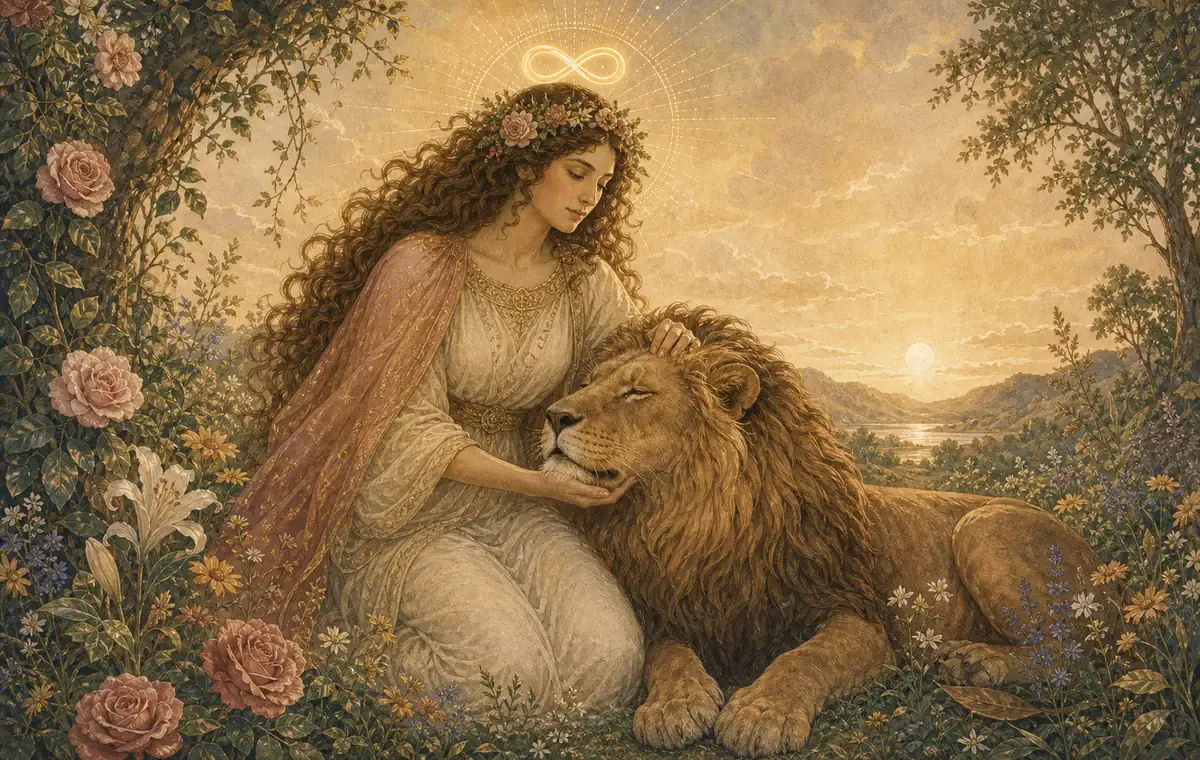
The Woman and the Lion
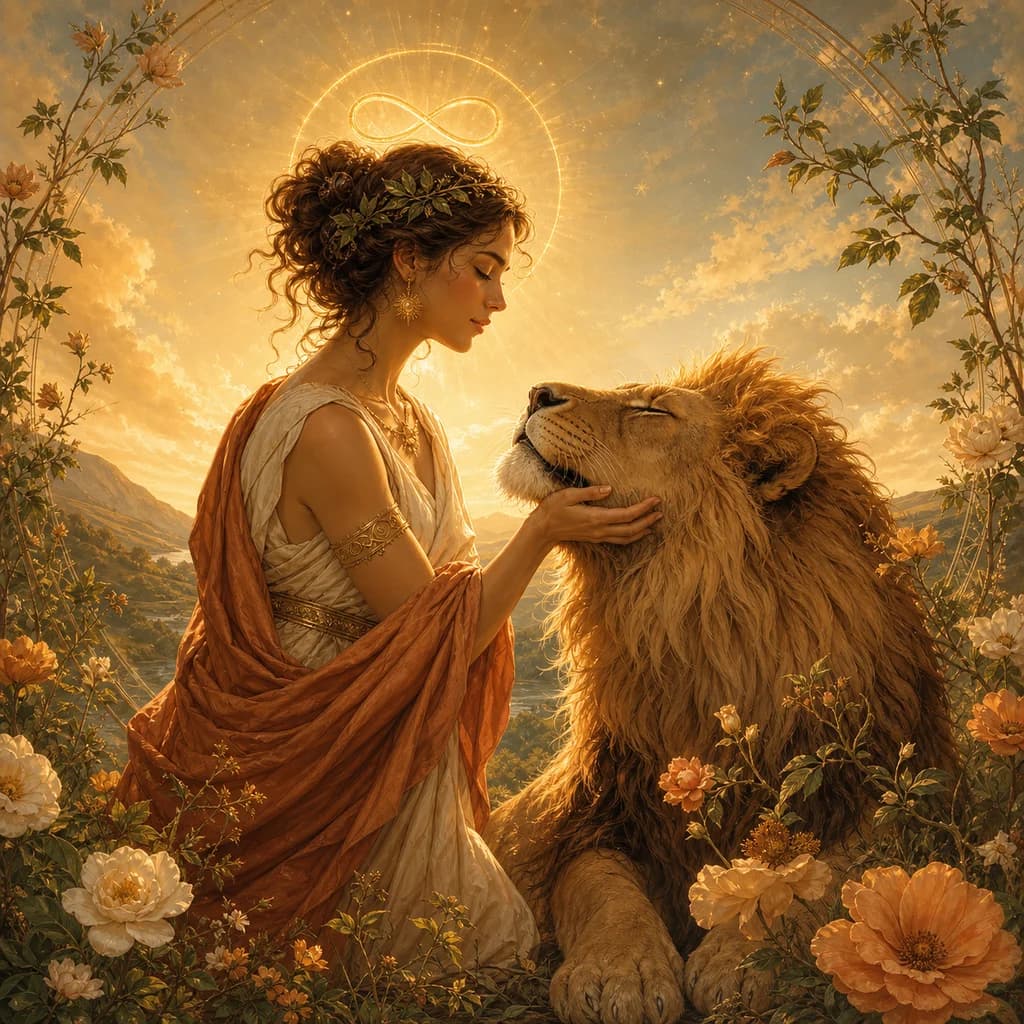
A woman in a white robe stands beside a lion, her hands gently around its head. She's not subduing it. Look closely at Pamela Colman Smith's illustration: the lion's tongue is out, almost like a dog being petted. The woman's posture is upright, calm, neither dominant nor frightened. This is the central instruction of the card. Power is not what happens when you defeat your animal self — it's what happens when your animal self trusts you enough to be touched.
In tarot iconography the lion is everything raw: lust, rage, hunger, ambition. Strength is the moment you stop being afraid of any of that.
The Infinity Symbol (Lemniscate)
Above the woman's head floats a lemniscate, the same figure-eight infinity loop that hovers over The Magician. The two cards share this symbol on purpose. The Magician channels infinite will outward into creation. Strength channels the same energy inward, into self-government. Together they're the two ways power moves through a person — to do something, or to refrain from doing it.
I find that beginners notice the lemniscate on The Magician and miss it here. It's the same energy. Different direction.
The Flower Chain and Crown
The woman wears a chain of flowers around her waist and roses in her hair. Roses are a recurring Rider-Waite-Smith motif — they appear on The Magician's arbor and The Fool's tunic, signifying desire that has been refined into intention. The chain isn't restraint; it's the thing she has woven herself. Her power is not given to her. She made it, slowly, from the things she once wanted.
The Mountain in the Background
A single mountain rises behind the figures. This is the same mountain that appears behind The Lovers and The Hermit — the implication being that all three cards describe a different way of climbing the same peak. Strength climbs it by mastering the self.
Strength Upright Meaning
Strength upright is not the card of victory. It's the card of restraint that turns into transformation.
Core Upright Keywords
- Inner Mastery — Power held in reserve, not deployed
- Compassionate Strength — Patience that disarms what force can't
- Quiet Courage — Acting from steadiness rather than adrenaline
- Self-Trust — Knowing your own response time
- Dignity Under Pressure — Refusing to be made smaller by a situation
In-Depth Upright Interpretation
When Strength comes up, the question to ask is rarely "do I have the courage to do this?" It's "do I have the patience to not do this for one more day?" This card is often misread as encouragement to push through. In real readings, it usually means the opposite — slow down, breathe through it, let the urge to react pass.
A client in Tokyo once drew Strength three months in a row while deciding whether to confront a colleague who had taken credit for her work. Every reading I did with her ended with the same instruction: not yet. By the fourth month the colleague had been moved off the project for unrelated reasons. The conversation she'd been rehearsing never had to happen. She told me afterward she'd spent that whole quarter convinced the card was telling her to be brave. It was telling her to be still.
This is the misread that costs people. Strength rewards waiting longer than feels natural.
Strength Reversed Meaning
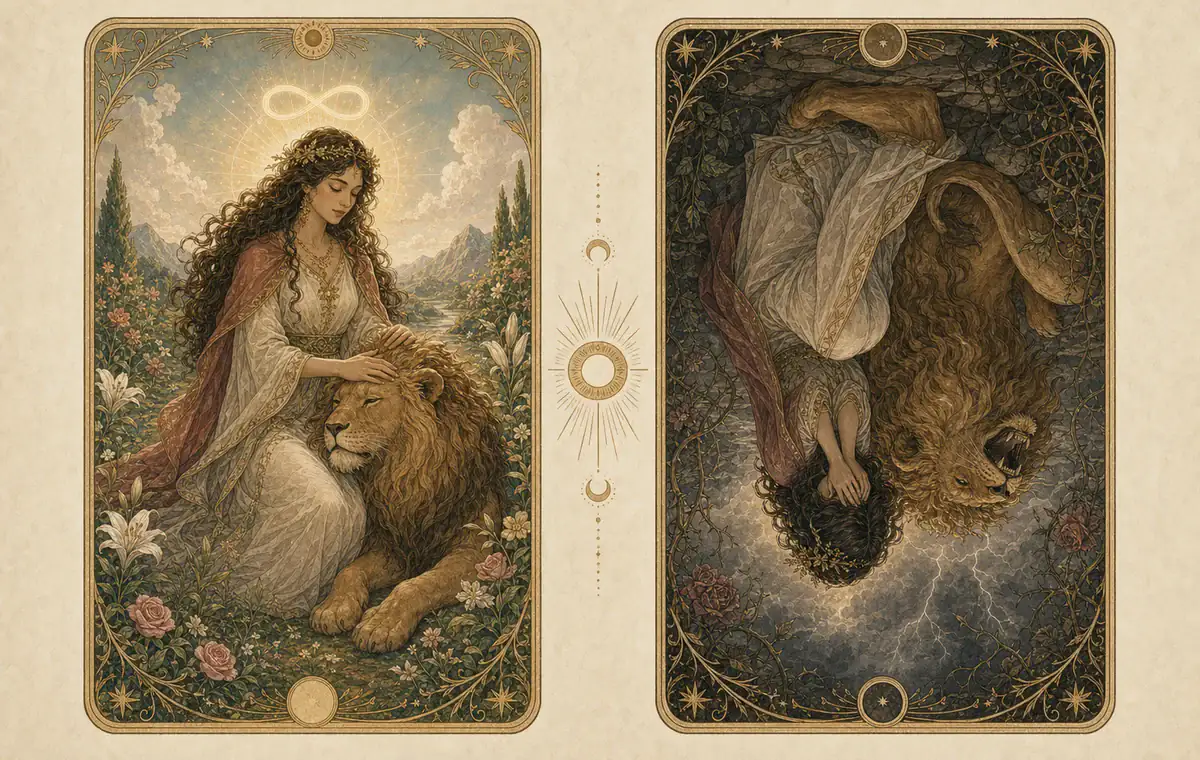
Before reading the reversed card as negative — most card meanings flip too cleanly when reversed, and Strength is one of the cards that resists that. Reversed Strength isn't weakness. It's the same energy turned against itself.
Core Reversed Keywords
- Forced Toughness — Performing strength rather than feeling it
- Self-Doubt — Mistrusting your own steady response
- Volatility — The lion you stopped petting
- Control as Defense — Gripping tightly because vulnerability feels unsafe
- Burnout from Suppression — Strength as a posture you can no longer hold
In-Depth Reversed Interpretation
Reversed Strength has two distinct readings and they often look opposite from the outside.
The first is collapse. Someone has been holding themselves together too long, and the lion they kept at bay has come back through the back door — irritability, sudden anger over something small, crying jags that don't match what triggered them. The reading isn't "be stronger." It's "you've been strong for too long without rest, and the body is filing its grievance."
The second is overcorrection. Someone has decided to be powerful by being hard. They've cut off softness, set rigid rules, and called it discipline. Reversed Strength reads this as the same problem in a different costume — they're still afraid of the animal part of themselves, just managing the fear by trying to dominate it.
In both cases the work is identical. Sit with what you've been pushing down. The reversed card doesn't ask for more willpower. It asks for honesty about the cost of the willpower you've already been spending.
Strength in Love & Relationships
In love readings, Strength is one of the most underrated cards in the deck because it doesn't promise anything dramatic. It promises something quieter: the relationship has the temperament to survive a hard month.
Upright, Strength in a love reading often signals a partnership where one or both people have learned to respond instead of react. The fight you would have had at year one doesn't happen at year five, not because the irritation isn't there but because both of you know how to let it pass. For singles, Strength upright signals readiness — you've stopped needing a partner to regulate your emotional life, and that's the prerequisite for attracting one who won't need you to do the same for them.
Reversed, Strength in love commonly points to a power dynamic that has gotten quietly uneven. One person is doing all the emotional regulation for both of them, and they're tired. The other reading: someone is trying to control the relationship by being relentlessly composed, never letting the partner see them upset. Either pattern eventually breaks. The card asks the steadier partner to risk being unsteady, and the controlling partner to risk being soft.
Strength in Career & Self-Mastery
Strength is a fire card and an inner card, which is a contradiction that makes it complex in work readings.
Upright in career, Strength rarely signals a promotion or a win. It signals a project, conflict, or transition where your composure under pressure is itself the asset. The client who draws Strength before a difficult negotiation is being told the same thing every time: the other side wants to provoke a reaction. Don't give them one.
I've had clients draw this card before salary conversations, before firing someone, before delivering bad news to a board. The reading is always the same — your power in this room is the steadiness you bring into it. Anything dramatic you do will cost you the room.
Reversed in career suggests burnout disguised as discipline, or self-doubt eating someone alive in a job they're actually doing well. The fix here is rarely "try harder." It's more often "tell someone the truth about how you're feeling and let them help you carry it."
Strength vs. The Chariot: What's the Difference?
These two cards are constantly confused because both look like they're about willpower. The distinction is one of the most useful in the Major Arcana.
The Chariot is power that moves. It's the card of disciplined will harnessed toward a specific external direction — winning, traveling, finishing. The charioteer holds the reins of two opposing sphinxes and points them down a road.
Strength is power that stays. It's the card of disciplined will turned inward, mastering the self before the self goes out to master anything else. The woman doesn't pull the lion anywhere. She just stands with it until the lion no longer needs to be pulled.
If The Chariot is the warrior, Strength is the warrior's training — the version of you that exists before you ride into anything.
When both appear in a spread you're usually looking at someone who has the will (Chariot) but is being asked to develop the temperament (Strength) before the will gets dangerous.
Strength Card Combinations
Strength + The Magician
The two infinity-symbol cards. Together they describe complete mastery — the will to create (Magician) joined with the temperament not to be ruled by what you create (Strength). Often appears for someone building something that demands both initiative and restraint, like founding a company or raising a child.
Strength + The Tower
A useful combination. The Tower is sudden collapse; Strength is the steadiness that lets you survive it. Together they mean the collapse is coming but you have the temperament to walk through it without becoming someone you'll regret being.
Strength + The Devil
Worth examining. The Devil is unconscious attachment — to a person, a substance, a pattern. Strength here is not "break free now." It's "look at the chain calmly and notice it's looser than you thought." Real liberation rarely comes from rage.
Strength + The Hierophant
The patience to learn inside a structure. Often appears for someone in a long apprenticeship, training, or therapy — the work is slow on purpose, and rushing it would undo it.
Strength + Nine of Wands
A combination I see in burnout readings. The Nine of Wands is the wounded survivor still standing guard — braced, scarred resilience against Strength's quiet courage. Strength here means it's time to put the weapon down. You've already won the fight you're still bracing for.
Strength + Ten of Wands
Endurance pushed past its healthy limit. The Ten of Wands is the figure carrying more than one person should, and Strength beside it stops being a virtue and starts being the thing that's burying you. The reading: the patience you're proud of has curdled into over-carrying, and the lesson is to set the bundle down, not to grip it more nobly.
Numerology & Astrological Correspondences
The Meaning of Number 8 (or 11)
In the Rider-Waite-Smith system Strength is VIII — the number of cycles completing, of skill becoming second nature. Eight in numerology is the number of mastery through repetition. The lemniscate above her head is the same shape as the number lying on its side, and the meaning is identical: power that has been practiced so long it no longer needs to be summoned.
If you read with a Marseille-style deck where Strength is XI, the meaning shifts slightly — eleven is a master number associated with the bridge between conscious and unconscious. Either numbering tells you the same thing in a different accent: this is power held lightly.
Astrological Correspondence: Leo
Leo is the fixed fire sign, ruled by the Sun. Fixed means stable, hard to move, and willing to outlast. Fire means the inner force is still there. The combination is what the card depicts — a presence that warms the room without burning anyone. Leo's shadow side is performative pride, and that's exactly what reversed Strength looks like: power put on for an audience rather than rooted in the body.
Frequently Asked Questions
Is Strength a Yes or No card?
Upright, lean toward Yes — but a slow Yes. This card almost never answers a question that wants an immediate green light. It answers questions that needed waiting. If you're asking "should I stay calm and not act yet?" the answer is unambiguously yes. If you're asking "should I move now?" the card is hesitating.
Why is Strength sometimes card 8 and sometimes 11?
Because two major occult traditions disagree. The Rider-Waite-Smith deck (and most modern derivatives) follows the Golden Dawn's reordering, where Strength is VIII and Justice is XI. The older Marseille tradition places Strength at XI and Justice at VIII. The meanings of each card are the same; only the position changes. Use whichever your deck uses and don't worry about it.
Does Strength mean physical strength?
Occasionally, in health readings it does point to improving physical resilience or recovery. But by default this card is psychological and temperamental. If you draw it before a workout, that's fine. If you draw it before a hard conversation, it's much more about your emotional self-regulation than your body.
How does the Japanese tarot tradition read Strength?
In タロット占い, Strength is often read as 「内なる力」 (inner power) but with a specific Japanese inflection — the word 我慢 (gaman, patient endurance) sits very close to it. Japanese readers I trained with tend to emphasize the card's command to endure quietly rather than perform strength. The reversed card is often read as 我慢の限界 — the limit of endurance, the moment self-suppression has cost too much.
Can Strength indicate a specific person?
It can. Traditionally it represents a Leo, or anyone with strong fixed-fire energy — a person who is warm, steady, hard to rush, and slow to anger. In love readings I take it as describing temperament more than birth chart. If you've been dating someone calm, this card may be confirming what you already sense.
I keep drawing Strength. What does that mean?
A repeating card is a question you haven't sat with long enough. With Strength, the question is almost always: what are you reacting to faster than you need to? Spend a week noticing the moment your chest tightens before you respond to a message. The card usually stops repeating after that.
Closing
Strength is the card the deck offers you when force isn't the answer. It does not promise that staying calm will fix what's wrong. It promises that the person you become by staying calm is the person who can fix it — or can survive its not getting fixed.
If you've drawn Strength, the question isn't "where do I need to be braver?" It's "where am I trying to win by reacting, when the win is in the waiting?" Sit with that for a day before you do anything. The card has a long memory, and it rewards the slow answer.
Continue exploring the Major Arcana: read about The Chariot for the willpower that moves outward, or The Hermit for the next step on the Strength card's path inward.