A hand pushes out of a cloud holding a single sword straight up, and a crown hangs on the point. Most guides read that crown as a trophy — clarity won, the truth seized. After more than a decade reading the Rider-Waite-Smith deck in Tokyo, I've watched the Ace of Swords hand people something sharper than a trophy: a conviction so clean and so certain that they stop checking whether it's actually true. The card marks the moment the mental fog lifts — and the moment you most need to ask whether what you're now seeing so clearly is the truth, or just a confident idea wearing the truth's crown.
Quick Answer
The Ace of Swords means a breakthrough of mental clarity — a new idea, a hard truth surfacing, the fog lifting so you can finally see a situation as it is and act on it. It's the suit of Air at its sharpest: thought, communication, the moment of cutting through confusion to something decisive. Reversed, that edge dulls or turns inward: clouded judgment, miscommunication, a truth you're not ready to speak, a sharp idea misfired into conflict. Yes / No: upright leans Yes, but a Yes that depends on you being honest with yourself.
Basic Information
| Attribute | Details |
|---|---|
| Card Name | Ace of Swords |
| Suit | Swords |
| Arcana | Minor Arcana (Ace) |
| Element | Air |
| Astrological Correspondence | The cardinal air of the Swords suit (Gemini, Libra, Aquarius energy) |
| Yes / No | Yes (upright, if you face facts); No or "not yet" (reversed) |
| Upright Keywords | Breakthrough, mental clarity, truth, new idea, focus, decisive thought, communication |
| Reversed Keywords | Confusion, miscommunication, clouded judgment, misused force, unspoken idea, conflict |
Card Imagery & Symbolism
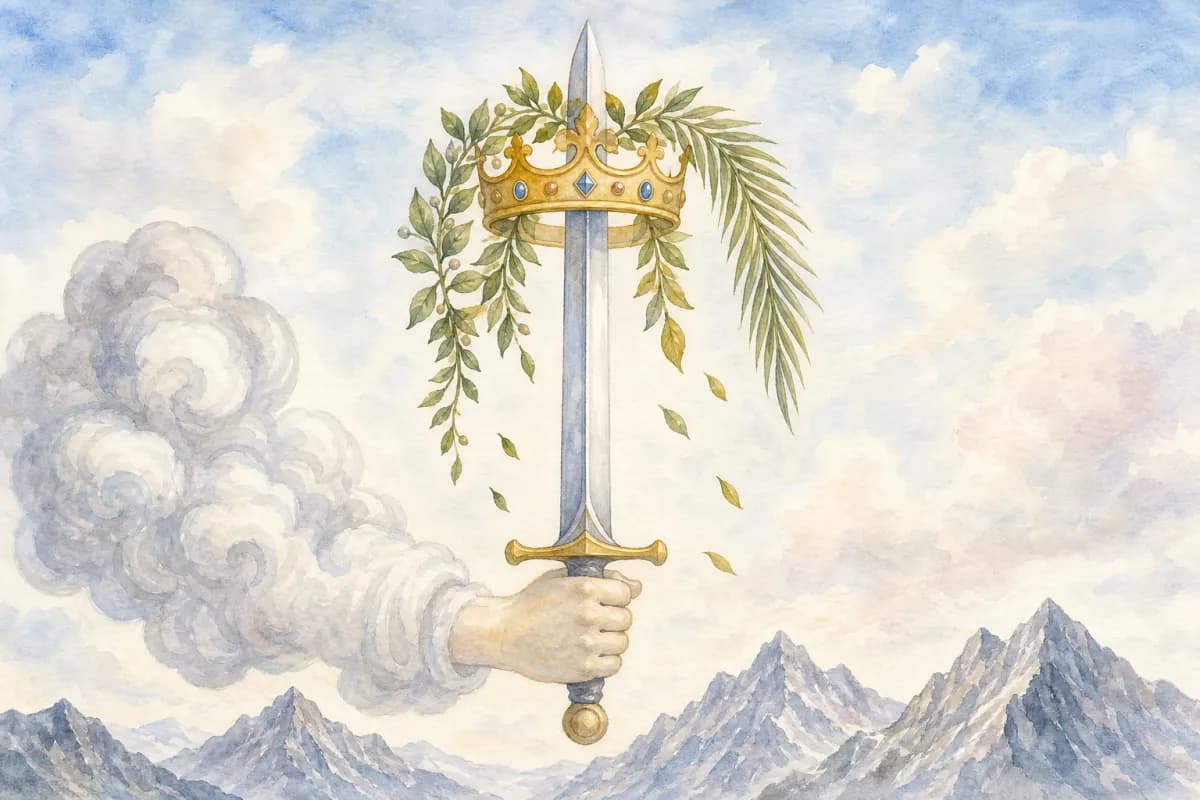
A hand emerges from a grey cloud, gripping a single upright sword. Balanced on the blade's tip is a golden crown, and draped over it are two things people miss: a green wreath of victory and a small palm frond. Below, jagged grey mountains run along the horizon under a pale, empty sky.
Most guides list these objects. Fewer notice the whole image is staging one argument about what a clear mind costs.
The Single Upright Sword
The sword stands perfectly vertical — the only Ace in the deck where the suit's tool points straight at the sky with nothing softening it. Wands lean, Cups overflow, Pentacles rest in an open palm; the sword stabs upward. That verticality is the suit's signature: Swords is the mind, whose gift is the ability to make a clean, decisive cut. There's no halfway in a blade.
Here's the detail that changes the reading. A double-edged blade has no safe side. Whatever this card cuts toward, it can cut back: the clarity the Ace offers can sever a relationship as easily as it severs a delusion, and the card does not tell you in advance which one you're about to do.
The Crown and the Wreath
The crown on the blade's tip is sovereignty — the rulership that comes from seeing clearly. When you genuinely understand a situation, you stop being at its mercy. The wreath and palm frond are victory and peace, the laurels of a battle won by the mind. But notice where they sit: balanced on a point, the most unstable place on the card. Tip the sword and the crown falls. I read that as the card's quiet warning — mental victory is real and precarious, and a clear insight held too rigidly is the next thing to topple.
The Mountains
The grey peaks along the bottom are the suit's recurring landscape, appearing behind the Queen of Swords, the Three, much of the suit. They always mean the same thing: this is the terrain of the mind, and it is austere. Sharp, cold, hard to live on. The Ace promises clarity, not comfort. The truth it hands you may be exactly what you needed and still feel like standing on a ridge in thin air — clients who draw it hoping for relief tend to get a colder, more useful thing: a view.
Ace of Swords Upright Meaning
Upright, the Ace of Swords is the lightning-strike of understanding. Something that was murky resolves. A decision that felt impossible suddenly has an obvious shape. A truth you'd been avoiding walks into the room and sits down. The keywords cluster around one event — breakthrough, decisive thought, clear communication — the mind committing to a direction it can finally see.
In-Depth Upright Interpretation
The most common reading I give for the upright Ace of Swords is that the client already has the insight — they just hadn't let themselves say it. This card rarely delivers a truth from outside. It surfaces one that was already forming, the way a fever finally breaks. When someone draws it during a stuck patch, my first question is "what do you already know that you've been refusing to act on?"
A client in Tokyo drew this card three times across two months while deciding whether to leave a business partnership. She kept asking me to read whether the partner would change. Each time the Ace came up, and by the third I stopped softening it: the card wasn't telling her about him, it was telling her she'd already reached a verdict and was waiting for permission to trust her own mind. The sword was hers; she just hadn't picked it up. When she finally did, the situation didn't get easier — but she stopped lying to herself about it, and that was the relief.
The trap to avoid: mistaking the card's confidence for correctness. The Ace gives you the feeling of clarity; whether that clarity is accurate is the whole subject of the next section.
Is It Clarity, or Just a Sharp Conviction Wearing the Crown?
This is the blind spot in nearly every Ace of Swords guide I've read, and it's the most useful thing the card can teach. Most articles flatten the double-edged blade into a tidy moral: power can be used for good or ill, so use it wisely. True, and almost useless in a live reading. The harder problem is epistemic. The Ace delivers a mental certainty that feels like truth — and a sharp conviction and an accurate insight wear the exact same crown.
From the inside, they're indistinguishable. The breakthrough that lets you see your relationship honestly and the one that's just your fear constructing a clever story both arrive with the same electric "of course, it's obvious now" relief. The sword feels equally sharp in both hands. This is why, in my experience, the Ace of Swords is the most over-trusted card in the deck: people assume that because the thought is clear, it must be correct. Clarity is a feeling; accuracy is a fact; the card never tells you which one you've got.
So how do you read which one you're holding? Don't measure how certain it feels. Check whether the cut would survive contact with the other person's reality. A true insight holds up when spoken aloud — say it to the person it concerns and the conversation goes somewhere, even if it's hard. A false conviction needs protecting: you rehearse the argument, pre-load the comebacks, get more certain the less you actually test it. That's the tell. Real clarity invites the conversation. Manufactured clarity avoids it and calls the avoidance "knowing my own mind."
The Japanese word my teacher used for the better version of this energy is 「明晰」(meisei), lucidity — a clarity that stays open to new information. The shadow is 「思い込み」(omoikomi), a fixed conviction, the mind that has decided and stopped looking. The Ace can be either, and the work is telling them apart before you swing.
Ace of Swords Reversed Meaning
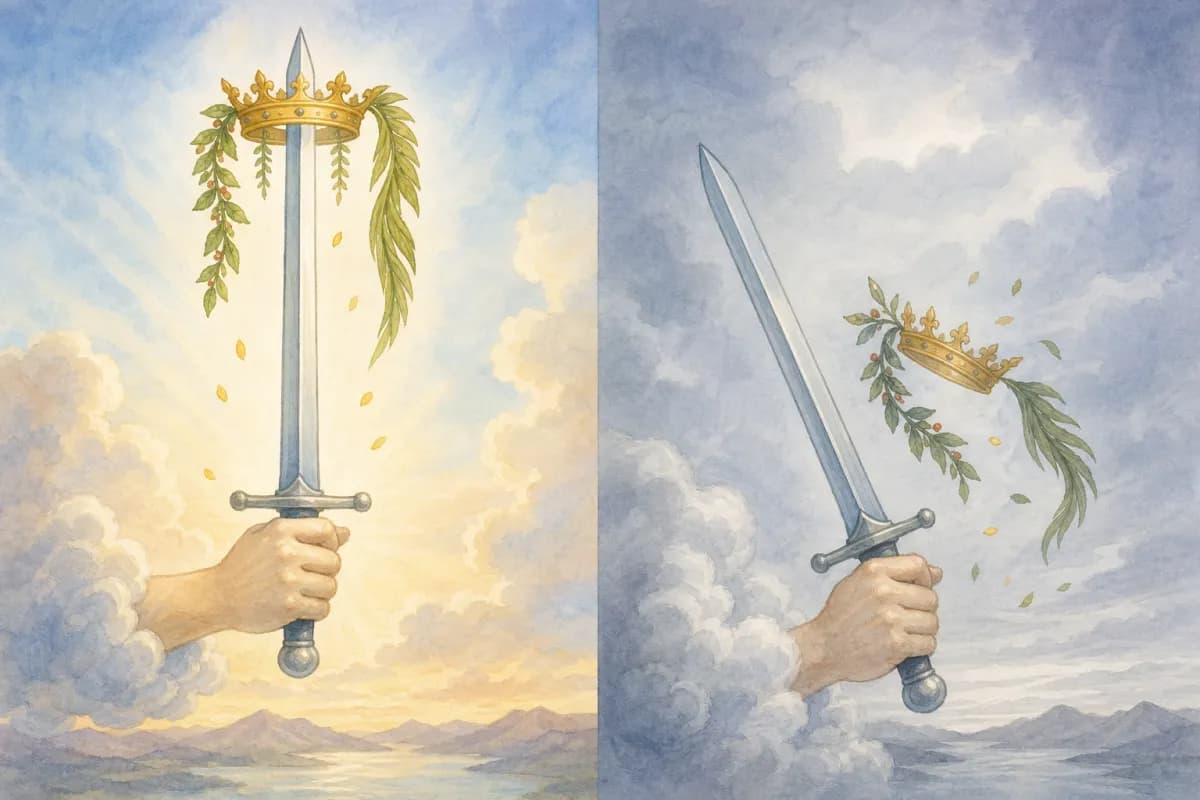
First, plainly: is the reversed Ace of Swords negative? Mostly, yes — this is one of the reversals I read as a genuine caution, well past the soft "energy in process" reading. The card's whole gift is a clean cut, and inverted it goes wrong in a few specific ways: clouded judgment, miscommunication, the sword misused, a true idea held back. Not all of them are equally bad, and one is almost hopeful.
In-Depth Reversed Interpretation
The first and most common reading is clouded judgment. The clarity isn't available right now. You're deciding in fog, mistaking agitation for analysis, and any conclusion will be unstable. This is not the week to sign, decide, or declare — forcing a decision through this reversal is how people commit confidently to the wrong thing.
The second is the sword misused — clarity turned into a weapon. Upright, the blade cuts through illusion. Reversed, it cuts people: the brutally "honest" comment that was really an attack, the cold logic deployed to wound, the argument where being right mattered more than being kind or even accurate. If your goal has quietly shifted from understanding to triumph, you're holding the card upside down regardless of how sharp you feel.
The third is the gentlest — the idea not yet ready to be spoken. Sometimes the reversed Ace is a true breakthrough still forming inside you, too new to expose. This is the only reading I'd call positive: speaking it now would get it dismissed or pressure it into shape before it's whole, so the card asks you to protect the new thought. Check your motive, though — staying quiet to protect the idea is wisdom; staying quiet to dodge a conversation you owe is the reversed sword pretending to be wise.
Ace of Swords in Love & Relationships
The Ace of Swords is an Air card in the territory of the heart, and that mismatch is the whole story. Forget butterflies and longing; this is the card of honesty arriving in a relationship, and honesty is not always tender.
For couples, the upright Ace usually marks a clearing-the-air moment: the conversation you've both been circling finally happens, and "are we okay?" resolves into a real answer. Sometimes that answer is a renewed, clear-eyed yes. Sometimes it's the recognition that you've been keeping a dead thing alive with politeness. The card delivers the truth; it doesn't promise you'll like it.
For singles, the upright Ace often points to a connection built on the mind first: someone you click with through conversation and wit, a meeting of intellects more than a sweep of romance. Read for "how do they feel about you" — this card has no separate feelings page — it tends to mean clear, rational regard: they see you clearly and respect your mind, sincere and led by the head.
Reversed in love, slow down. It points to miscommunication, words coming out wrong, a truth one of you is sitting on, or — at the harder end — honesty weaponized into cutting remarks. As feelings, it often means their feelings are genuinely unclear even to them, or something true is being withheld. Don't force the declaration; the clarity isn't ready, and pushing for it produces conflict where you wanted truth. Compare this to The Lovers: where The Lovers asks you to choose from the heart, the Ace of Swords sets honesty and clear sight as the relationship's current task.
Ace of Swords in Career & Communication
This is the Ace's home turf. Drawn about work, the upright card is one of the strongest green lights in the deck for anything that runs on intellect — a new project, a strategy that crystallizes, a stuck problem cracking open. It favors writing, law, negotiation, analysis, any field where the work product is a clear thought sharply expressed, blessing the start of intellectual work the way the Ace of Wands blesses creative fire. If you've been waiting for the right idea, the Ace says it has arrived; act while the edge is keen.
It's also a powerful communication card, blessing the difficult email, the honest review, the proposal that names the real problem plainly. The advice is consistent: say the true thing, and say it directly.
Reversed in career splits the same ways as the general reversal: plans built on faulty information, a workplace where communication has broken into crossed wires, or a sharp idea you're holding back out of fear. Read the neighbours to know which, and be careful with contracts — the reversed Ace is the card of confidently signing the wrong thing.
Ace of Swords in Decisions & Mental Health
I read this position more than the old guides suggest, because the Ace's true subject is the mind itself. Upright, in a decision question, the card is reassuring: the clarity to choose well is available, and the right move is becoming visible — once you've run it through the honesty test from the clarity-versus-certainty section above.
For inner life, the upright Ace is often a fog lifting after a hard stretch — a depression clearing enough to think, the mind coming back online. It can mark the moment therapy or reflection finally yields a real insight about a pattern.
Reversed here deserves care. It can point to mental overwhelm, racing thoughts, or the self-critical voice turning the sword inward — clarity weaponized against yourself. The instruction is gentle but firm: slow the mind, and don't trust its current verdicts. The fog is real; wait for it to lift before you believe what it's telling you about yourself.
Ace of Swords Card Combinations
Ace of Swords + The Tower
A truth that demolishes. The Tower is sudden collapse; the Ace is the cut of clarity. Together they often mean a realization that ends a structure you were living inside — the discovered secret, the line you can't uncross. Painful, clean, usually necessary.
Ace of Swords + Three of Swords
The honest words that hurt. The Three of Swords is heartbreak; the Ace is the truth-telling that produces it — the clarifying conversation that ends a relationship, the painful fact that finally gets named. Brutal but not cruel: the cut that finally lets a wound close. I read it as "the truth was worth it, even though it hurt."
Ace of Swords + The Moon
A flag worth catching. The Moon is illusion, things not as they seem; the Ace is supposed to cut through exactly that, so together they stage a tension. Often the clarity you feel is fighting a deeper murkiness, and the certainty is premature. When a client draws this convinced they've "figured it all out," I slow them down: the Moon is warning the picture isn't complete.
Ace of Swords + Ace of Cups
Head and heart arriving together. Two aces is a strong double beginning — the Cup is emotional opening, the Sword mental clarity. Rare and good: a new connection where you can both feel deeply and see clearly, the honesty and the warmth pointing the same direction.
Ace of Swords + Ten of Swords
The end of a painful mental cycle, and the first clear thought afterward. The Ten is rock-bottom, the worst already done; the Ace following it is the new clarity possible only once the old story has fully collapsed. One of the more hopeful Swords combinations — the suffering is complete, and the mind can begin again from truth.
Ace of Swords + Seven of Swords
The blade of truth meeting the workaround. The Seven is the clever, off-the-record route — managing instead of being honest; the Ace is the single clean cut that exposes it. Together they usually mean a half-truth is about to be named outright. Often a relief once it lands, even if it stings to say.
Numerology & Astrological Correspondences
As the Ace, this card is the number one of the suit — the seed of Swords, Air in its most concentrated form. The Ace of Swords is thought before it's thought, the spark of mind itself. Everything that goes wrong later in the suit — the heartbreak of the Three, the exhaustion of the Ten — begins as this clean, hopeful blade, before the mind learns it can wound.
Astrologically it carries the cardinal, initiating quality of Air, spanning the air signs — Gemini, Libra, Aquarius — without belonging to one. The card reads as the mind at its most alive and least encumbered, and the shadow, as ever with Air, is mistaking a clever thought for a wise one.
Frequently Asked Questions
Is the Ace of Swords a yes or no card?
Upright, it's a conditional yes. The Ace says yes if you're willing to face facts, communicate honestly, and decide from logic over wishful thinking. Read it as "yes, and the truth is what makes it work." Reversed, it shifts to no or "not yet," usually because confusion or miscommunication is clouding the situation.
What does the Ace of Swords mean in love?
It means honesty arriving — a clearing-the-air conversation, a truth getting named, a connection built on mental compatibility more than pure romance. It brings clarity over warmth, which makes it one of the most useful love cards even if not the most tender: it lets you see the relationship as it actually is.
What does the Ace of Swords reversed mean?
Three main things: clouded judgment (don't decide now), the sword misused (honesty turned into a weapon, or being right mattering more than being accurate), or a true idea you're not ready to speak yet. The first two are cautions; the third can be wise. Your own motive — protecting an idea versus avoiding a conversation — usually tells you which.
Does the Ace of Swords mean a new beginning?
Yes — specifically a mental one: a new idea, a fresh understanding, the start of a project or chapter that runs on thought and clarity. It's the green light for anything requiring a sharp mind. But unlike the warmer Aces, its beginning often arrives as a hard truth, which can feel bracing before it feels good.
What does the Ace of Swords mean as feelings?
It tends to mean clear, rational regard — honest, head-led interest, respect for your mind, sincere but not dizzy. It can also signal a breakthrough where confused feelings finally become clear. Reversed, the emotions are genuinely murky even to the person feeling them, or something true is being withheld.
How is the Ace of Swords different from the Ace of Wands?
The Wands Ace is fire — passion, drive, the impulse to create and act. The Swords Ace is air — clarity, truth, the impulse to understand and decide. Wands asks "what do you want to do?" Swords asks "what is actually true?"
Why does the Ace of Swords feel so intense?
It concentrates the whole suit of Air into a single point — the mind at full sharpness. A clear thought after confusion is genuinely electric. The intensity is real; just sit with the insight before you act on it.
Closing
The Ace of Swords is the deck's sharpest gift and its most over-trusted one. It hands you a clear thought after a stretch of fog, and the relief is so real that it's tempting to swing the sword the moment it lands. Don't, yet. The blade has two edges, and the same certainty that cuts through your illusions can cut through something you'll miss.
So before you act, run the honesty test from earlier: say the obvious insight out loud to the person it concerns, openly enough that they can answer back. If the conversation goes somewhere real, the sword is yours to use. If you keep avoiding it while staying convinced you're right, you were holding the reversed card all along, and the crown is balanced on a point.
Continue exploring the Swords suit and beyond: plan a full reading with our love tarot spread guide, or read about The Tower for the collapse that the Ace's truth can trigger.