Temperance is the card readers tend to deliver as a kind of pleasant non-event. "Balance," they'll say. "Patience. Moderation." All true, and all so flattened by repetition that the card stops landing. Temperance is one of the most operationally specific cards in the deck — it doesn't just say balance, it shows you the mechanics. An angel pouring water between two cups, one foot on rock and one in water, a path winding to a mountain with a crown hovering above it. Every element is a step in a recipe.
This guide treats Temperance the way the card treats itself — as instructions, not advice. It covers the imagery in detail (including the triangle-in-square on the angel's chest that almost no popular guide reads structurally), the genuine astrological controversy around its rulership, the upright and reversed meanings, and how Temperance differs from the two cards it's most often confused with: Justice and The Magician.
Quick Answer
Temperance is Major Arcana card XIV, traditionally ruled by Sagittarius (in the Golden Dawn system) and the element of Fire — though many modern sources misattribute it to Pisces. Upright, it signals integration, the conscious mixing of opposites, patience as a practice rather than a wait, and alchemical synthesis. Reversed, it points to imbalance, excess, frustrated integration, or — sometimes — a need to break the careful balance you've been holding. Yes/No: leans Maybe; tilts Yes when patience is the right move.
Basic Information
| Attribute | Details |
|---|---|
| Card Name | Temperance (called "Art" in the Thoth deck) |
| Number | XIV (14) |
| Arcana | Major Arcana |
| Element | Fire |
| Zodiac Correspondence | Sagittarius (Golden Dawn); often misattributed to Pisces |
| Yes / No | Maybe, leaning Yes when patience serves |
| Upright Keywords | Integration, alchemy, patience, moderation, healing, synthesis |
| Reversed Keywords | Imbalance, excess, impatience, frustrated integration, forced balance |
The Sagittarius vs. Pisces Question
A short detour before the imagery, because the astrological correspondence shapes the reading.
You'll find Temperance attributed to Pisces in many popular guides — partly because of the water imagery on the card, partly because Pisces feels intuitively "watery and gentle." The Golden Dawn correspondence, which Waite was working from, is Sagittarius. This is not a minor disagreement. Sagittarius is mutable fire — outward-reaching, aspirational, the archer pointing toward the higher path. Pisces is mutable water — dissolving, merging, intuitive. Reading Temperance as Sagittarius gives you the mountain path and the crown above it (the higher trajectory). Reading it as Pisces gives you the merging of the two cups (the dissolution). The card actually contains both, which is part of why the confusion persists.
In my practice I use Sagittarius as the primary correspondence and let the Piscean reading inform the dissolution-and-merging dimension of the imagery. The card itself is the integration of those two energies — fire that aims, water that mixes — which is exactly the alchemical operation it depicts.
Card Imagery & Symbolism

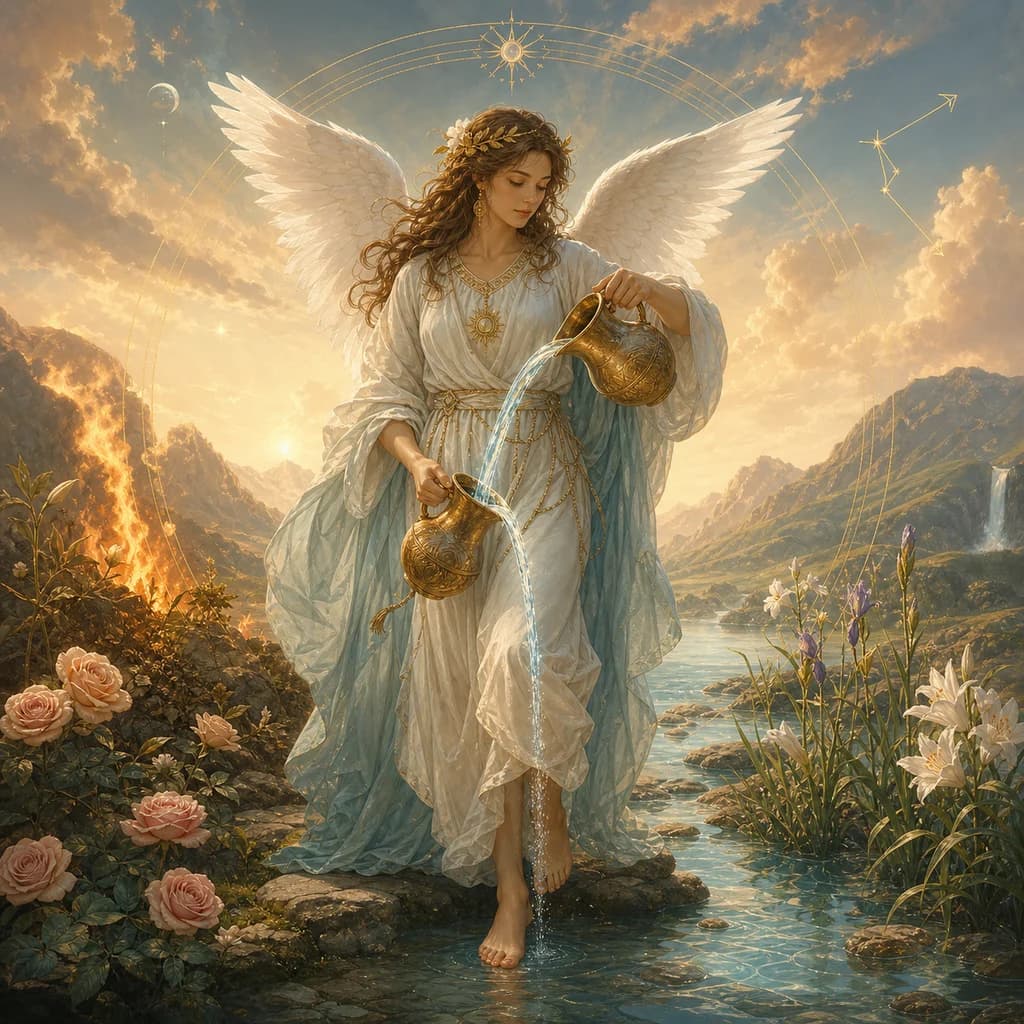
A large winged angel stands with one foot on a rock and one foot in a pool of water. They pour liquid between two cups — gold to gold — in a stream that defies physics. The angel's chest carries a triangle inside a square. Behind them, a path winds up toward a mountain range; above the mountains, a golden crown shines through light.
The card is built like a flowchart. Each element points to the next.
The Two Cups and the Impossible Stream
The angel pours liquid from one cup to the other in a stream that is horizontal — not vertical. Water doesn't pour like that under normal physics. The first thing the card is telling you, before anything else, is that what's happening here is not ordinary mixing. It's alchemical. Solve et coagula — dissolve and combine — is the operative principle. You can't get Temperance's result by adding A to B. You have to dissolve both into a third thing.
This is the part of the card that most "balance" readings miss. Temperance is not about holding two opposing things in even portions. It's about combining them so something new exists. Balance is the side effect, not the goal.
One Foot on Rock, One Foot in Water
This is often read as "stay grounded but stay in flow." That's not wrong, but it's softer than the card. The card is showing you the position from which the mixing is possible. You cannot perform Temperance's operation from purely solid ground (no fluidity) or purely water (no stability). The integration requires standing across both — half-uncomfortable, half-anchored.
When clients draw Temperance, this is what I look for: are they trying to stand purely in one element? The card is rarely telling someone to "find balance" in the abstract. It's telling them they need to put one foot somewhere they're avoiding.
The Triangle in a Square (Chest Symbol)
Almost no popular guide reads this structurally. The angel's chest carries a triangle (the number 3 — spirit, mind, soul; the upper world) enclosed in a square (the number 4 — earth, the four elements, the material world). Put together: spirit operating within matter. This is a precise alchemical glyph. The card is not asking you to transcend the material — it's asking you to do spiritual work inside material conditions.
In readings, I find this most relevant for clients dealing with practical-versus-meaningful tensions. The card is saying you don't have to pick. The triangle goes inside the square.
The Path, the Mountain, the Crown
Behind the angel, a path winds to a mountain. Above the mountain, a crown floats in light. The crown is not on the mountain — it floats above it. This is significant. The path leads to the mountain, but the reward is something the climbing positions you to receive, not something you grab at the summit. Temperance's higher goal is not produced by your effort — it appears when your effort has taken you to the right altitude.
This is also where the Sagittarius energy is most visible. Sagittarius is the arrow aimed past the visible target. The crown above the mountain is the higher aim that gives the rest of the operation its direction.
The Solar Disk and the Iris (Triangle on Forehead)
The angel has a solar disk on the forehead — sometimes drawn as a triangle, sometimes a circle with a dot. Either way, it's the third eye of insight. The integration that Temperance performs is not unconscious; it requires conscious attention. Temperance is patient, but it is awake.
Temperance Upright Meaning
Upright Temperance is one of the cards I most often slow clients down on. They expect "good news, take your time." The card is more interesting.
Core Upright Keywords
- Conscious integration — Combining elements that don't naturally combine
- Patience as practice — Waiting that is active, not passive
- Healing and recovery — The slow reassembly of something that was scattered
- Synthesis — A third thing emerging from two
- Right pace — Not slow, not fast, the pace the work requires
In-Depth Upright Interpretation
The most common reading I give for upright Temperance: the work you're doing right now doesn't yield results on the timescale you're checking. You're stirring a pot whose results are at least a season away. The card is asking you to keep stirring, not because it's noble to wait, but because the alchemy only works if you don't interrupt it.
A client came to me last winter who had been carefully managing two relationships in her life — not romantic ones, family — that had been in active conflict for years. She had been the bridge between her mother and her sister for almost a decade. Temperance came up in her reading and she rolled her eyes. "More balancing," she said. We talked about what the card was actually depicting: the work she was doing was real, the integration was real, and she had also become so identified with being the mixer that she had stopped noticing the cost. The reading I gave her was Temperance with one foot needing to come up — not from the stable ground, from the water. She had been so committed to flowing between everyone that she had stopped being on any ground of her own.
That is the harder reading of upright Temperance. The card supports the work, and sometimes also asks whether the worker has noticed they are exhausted.
A second, more straightforward reading: Temperance is one of the deck's strongest healing cards. Not dramatic healing — slow, integrative, the kind of recovery that takes months. Clients in physical or emotional recovery often draw Temperance during the long middle phase, when the dramatic part is over and the work is just patience.
Temperance Reversed Meaning
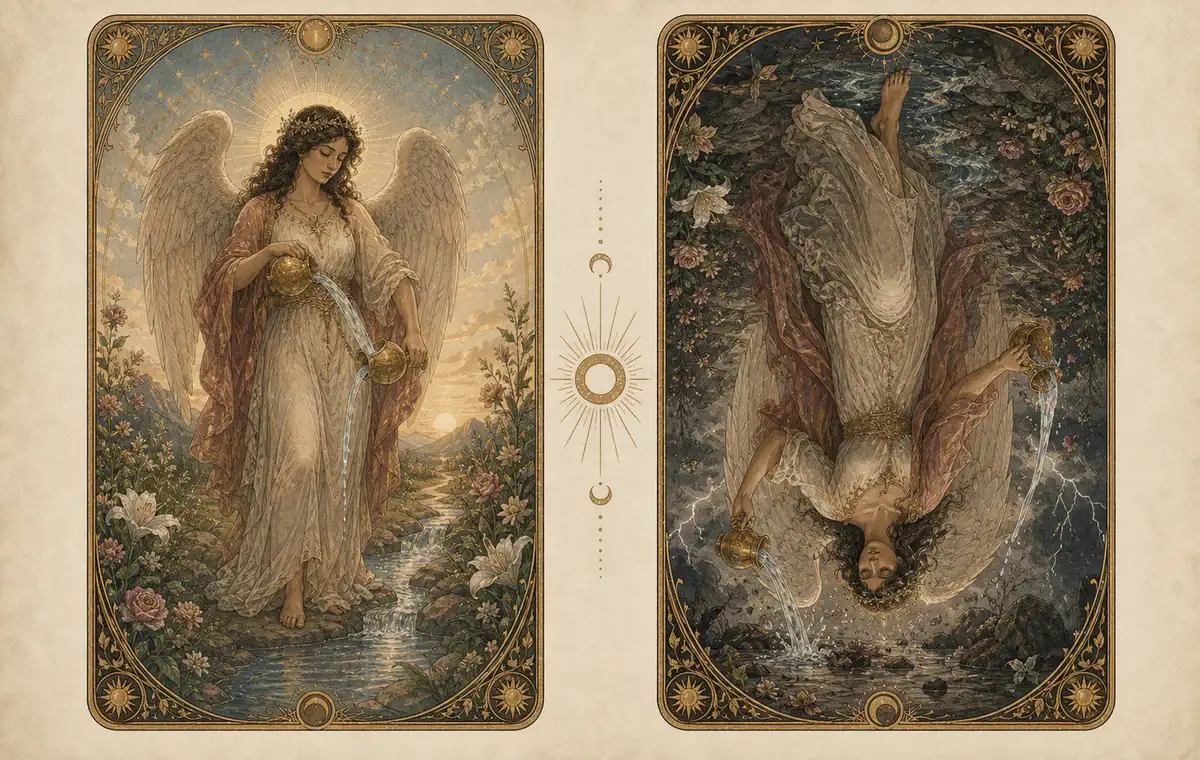
Reversed Temperance is more interesting than the standard "imbalance" reading suggests.
Core Reversed Keywords
- Imbalance — One element flooding the system
- Excess — Overindulgence in one direction
- Impatience — Refusing the pace the work needs
- Forced balance — Performing equilibrium without the underlying integration
- Time to break a careful balance — Sometimes the equilibrium was the problem
In-Depth Reversed Interpretation
The first reading is excess. One side of the mixture is flooding the other. Too much work, too little rest; too much giving, no receiving; too much control, no surrender. The card here is direct: the cups have overflowed, the alchemy has broken, and the operation needs to be restarted with proper portions.
The second reading is impatience. You're trying to rush the integration. You've been stirring the pot for two weeks and demanding the result that takes six months. Reversed Temperance here is the card saying: the work is fine, your timeline is wrong. Wait without interrupting.
The third reading, less common and the one most worth knowing: the equilibrium itself has become the problem. Some clients draw reversed Temperance during long stretches of carefully managed balance where the balance has stopped serving them. They've become so good at holding two things that the holding has become their identity. The card here is permission to break the balance — let something fall, let one element flood, in order to discover what the next configuration wants to be. This reading is less common but I see it most often in long-term caretakers, mediators, and people who have built their lives around being the stable middle for everyone else.
Temperance vs. Justice: Two Balances
These cards both deal with balance, and clients confuse them constantly. The distinction is operational.
Justice (XI) is fixed balance — the verdict, the weighing, the line drawn. Justice's scales are still. The energy is decisive: this is what's fair, this is what's true, this is the line. Justice is a result.
Temperance (XIV) is fluid balance — the ongoing mixing, the pouring, the operation. Temperance's cups are in motion. The energy is processual: this is what's being combined, this is what's emerging, this is the work in progress. Temperance is a method.
Useful shorthand: Justice decides; Temperance integrates. If a client is asking about a decision being made, Justice answers it. If they're asking about a process being worked through, Temperance answers it.
When both appear in a spread, the meaning is usually that the situation needs both — a decision and an integration. The decision (Justice) sets the frame inside which the long work (Temperance) happens.
Temperance vs. The Magician
The other common confusion. Both cards work with elements; both have figures performing operations on materials.
The Magician (I) is declaration. The Magician points and the elements respond. The work is fast, willed, decisive. The Magician's relationship to the elements is mastery.
Temperance (XIV) is integration. The angel pours and the elements blend. The work is slow, patient, alchemical. Temperance's relationship to the elements is partnership.
Both cards are about making something from materials. The difference is whether you're commanding the materials or collaborating with them. Beginners often confuse the two because both feel "active." But the Magician acts in seconds; Temperance acts across seasons.
Temperance in Love & Relationships
Upright Temperance in love readings is one of the most encouraging cards — but in a specific way. It rarely indicates new love or sudden passion. It indicates a relationship in which the slow, daily work of combining two lives is going well. Patient adjustment, mutual healing, the long stretch where partners are actually building something rather than just feeling something.
For couples, Temperance often appears around significant adjustments — moving in, blending families, recovering from a rupture, the seventh-year recalibration. The card supports the work. It does not promise the work will feel easy.
For singles, Temperance often indicates a stretch of self-integration that precedes a real partnership. Clients sometimes don't love this reading — they want the new-love card. But the card is showing what the next real relationship requires: the version of you that has done its own integration. The connection that arrives during Temperance tends to be unusually stable, but it doesn't arrive quickly.
Reversed Temperance in love usually points to either imbalance (one partner carrying significantly more) or to a relationship where the careful balance both partners are performing has become a substitute for actual integration. The second reading is the more important one.
Temperance in Career & Money
Upright Temperance in career readings is the card of the long, well-paced project — the work where steady weekly effort produces eventual significant results. It's also one of the strongest cards for collaborations that work because everyone brings a different element and the mixing is real.
For money specifically, Temperance often signals patient financial building — savings compounding, debt paying down, investments maturing. The card rarely indicates windfall, but it indicates that the slow trajectory is working.
Reversed Temperance in career often points to overwork, burnout, or a project where one element (deadlines, scope, single contributor) is flooding the others. The reading is usually about restoring proportion — not stopping the work, but bringing back the elements that have been crowded out.
Temperance Card Combinations
Temperance + The Hermit
Solitude that integrates. The Hermit's withdrawal meets Temperance's mixing. Often appears around long, private periods of inner work — the slow recombination of self that happens in retreat.
Temperance + The Hanged Man
Patience as practice. Two pause-related cards together — but where the Hanged Man simply suspends, Temperance integrates during the suspension. A powerful combination for clients in long transformative stretches.
Temperance + The Star
Healing and renewal. Both are recovery cards, and together they often appear after a difficult period — the slow, steady reassembly of self after a rupture. One of the most genuinely hopeful combinations in the deck.
Temperance + The Wheel of Fortune
Integration during a turning cycle. The Wheel brings change; Temperance asks you to integrate the change rather than just react to it. A useful combination for navigating major transitions.
Temperance + Two of Cups
A relationship doing its slow work. The Two of Cups is the initial connection; Temperance is what makes it last. Often appears for couples in the middle phase of a real partnership — past the romance, into the integration.
Temperance + Six of Swords
A gradual crossing toward calmer water. The Six of Swords carries you out of turbulence by slow degrees, which mirrors Temperance's patient alchemy — change that blends rather than breaks. Together they read as a recovery you can trust precisely because it isn't rushed.
Numerology & Astrological Correspondences
The Meaning of Number 14
Fourteen is the number of integration — the structure of seven (completion) doubled, the four (matter) plus the ten (full cycle), and in some systems the number of the day the moon waxes from new to full. Temperance sits structurally right after Death (13) and before The Devil (15). The placement is precise: after closure, integration; before the next shadow encounter, recovery.
In reduced numerology, 14 becomes 5 (1+4) — the number of change. Temperance is the change that happens through patient mixing, not through sudden disruption.
Astrological Correspondence: Sagittarius (and the Pisces Detour)
Sagittarius is mutable fire, ruled by Jupiter. The combination matches Temperance exactly — mutable means adaptive, fire means aimed, Jupiter means expansive. The Sagittarian arrow targets the higher crown over the mountain. The card depicts the practice of patient, aimed integration toward a target beyond the visible horizon.
Many modern sources attribute Temperance to Pisces, partly because of the water imagery and partly because Pisces feels intuitively gentle. The Pisces reading captures the merging dimension of the card — the dissolution of boundaries between the two cups — but misses the directional element. The Golden Dawn correspondence (Sagittarius) is closer to the card's structural meaning.
In Aleister Crowley's Thoth deck the card is renamed "Art" — the alchemical art of combining opposites — which is the most precise name for what the card actually depicts. If "Temperance" feels too passive in your readings, hold "Art" in your mind instead.
In Japanese タロット占い Temperance is often translated 「節制」 with overtones of disciplined moderation. I find the Japanese reading is closer to the card's actual content than the English-language "balance" reading — 節制 implies active, chosen restraint rather than passive equilibrium.
Frequently Asked Questions
Is Temperance a Yes or No card?
Temperance is the deck's clearest Maybe — but it leans Yes when patience is the right move. If you're asking the card a binary question, it's telling you the answer depends on whether you can do the slow, mixed work the situation requires. Reversed often tilts toward No, particularly when impatience is the issue.
Does Temperance mean a soulmate?
Sometimes, but rarely in the dramatic sense. When Temperance appears in love readings, the connection it points to is usually the kind that integrates rather than electrifies — a partnership built through patient mixing, not through immediate recognition. If you mean by "soulmate" the relationship that becomes deeply integrated over time, yes. If you mean the lightning-strike recognition, that's more often The Lovers.
What's the difference between Temperance and Strength?
Both involve patience, but with different objects. Strength is patience with your own instincts and emotional intensity — the lion that learns to be touched. Temperance is patience with the integration of different elements outside or beyond you — the cups being mixed. Strength is inner work; Temperance is integrative work.
How does the Japanese tarot tradition read Temperance?
In タロット占い the card is called 「節制」 and read with attention to active, chosen restraint — the discipline of right portioning, not passive equilibrium. The Japanese cultural framing around 程よい (hodoyoi, "just right") and 中庸 (chūyō, the appropriate middle) maps closely onto Temperance's operational meaning.
Can Temperance indicate healing?
Yes, strongly. Temperance is one of the most reliable cards in the deck for healing readings — particularly the slow, integrative kind after the dramatic part of an illness or rupture has passed. The card supports the long middle phase that most people underestimate.
Why is Temperance called "Art" in the Thoth deck?
Crowley renamed it because "Temperance" had become flattened into "moderation" in English usage, and Crowley wanted to restore the alchemical meaning. "Art" — in the older sense of the alchemical Great Work — is the precise name for what the card depicts. The image in the Thoth deck shows even more explicit alchemical iconography: a lion and an eagle, the mixing of fire and water.
Closing
Temperance is the card the deck offers when the work in front of you is the slow kind. It is not the card of dramatic transformation, breakthrough, or arrival. It is the card of stirring. The image is patient. The angel is patient. The cups are pouring at a rate the watch cannot accelerate.
If you've drawn Temperance, the most useful thing I can tell you is the thing the card already shows: keep one foot where you're uncomfortable, keep the other where you're anchored, keep pouring. The result the work is heading toward is the crown above the mountain — not yours to grab, but yours to be positioned for. Stay in the practice and you'll be standing in the right place when it arrives.
Continue exploring the Major Arcana: read about Death for the closure that precedes Temperance's integration, or The Hermit for the solitude in which much of Temperance's work actually happens.