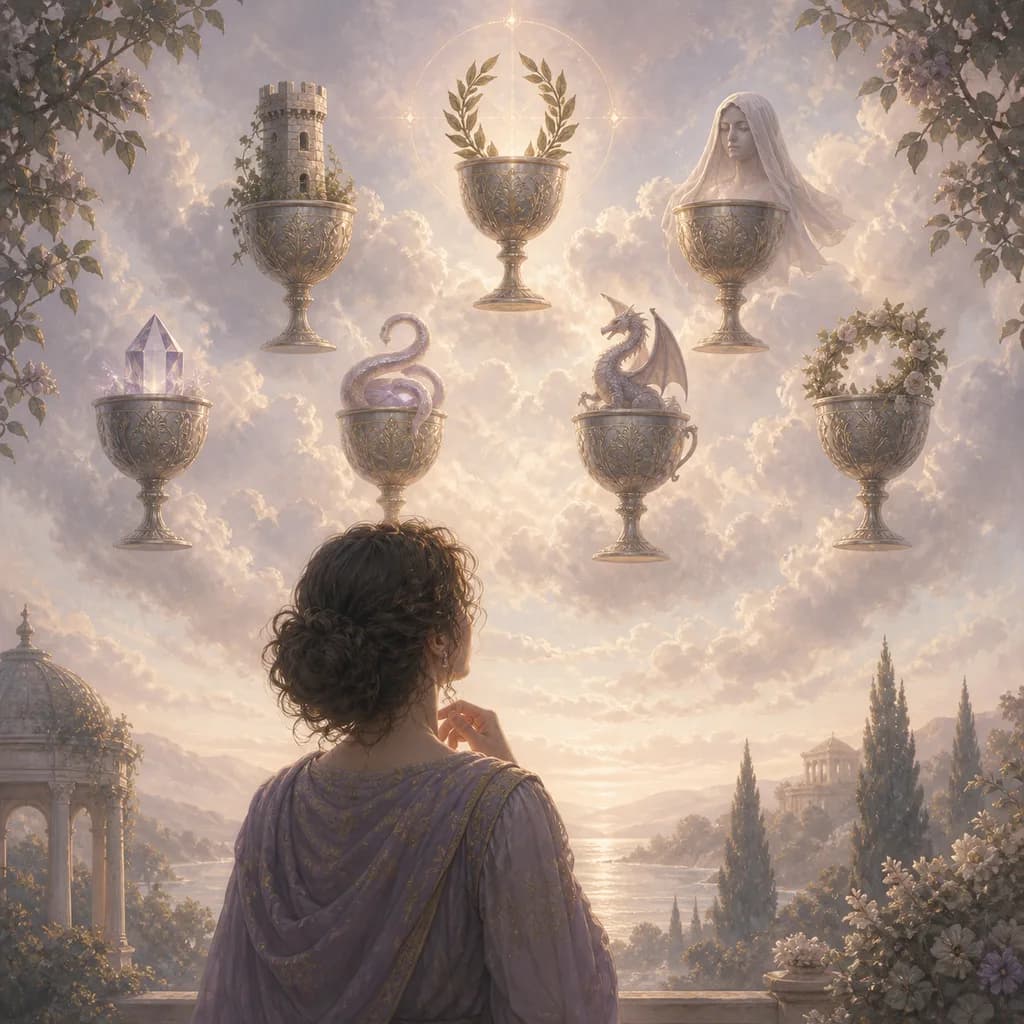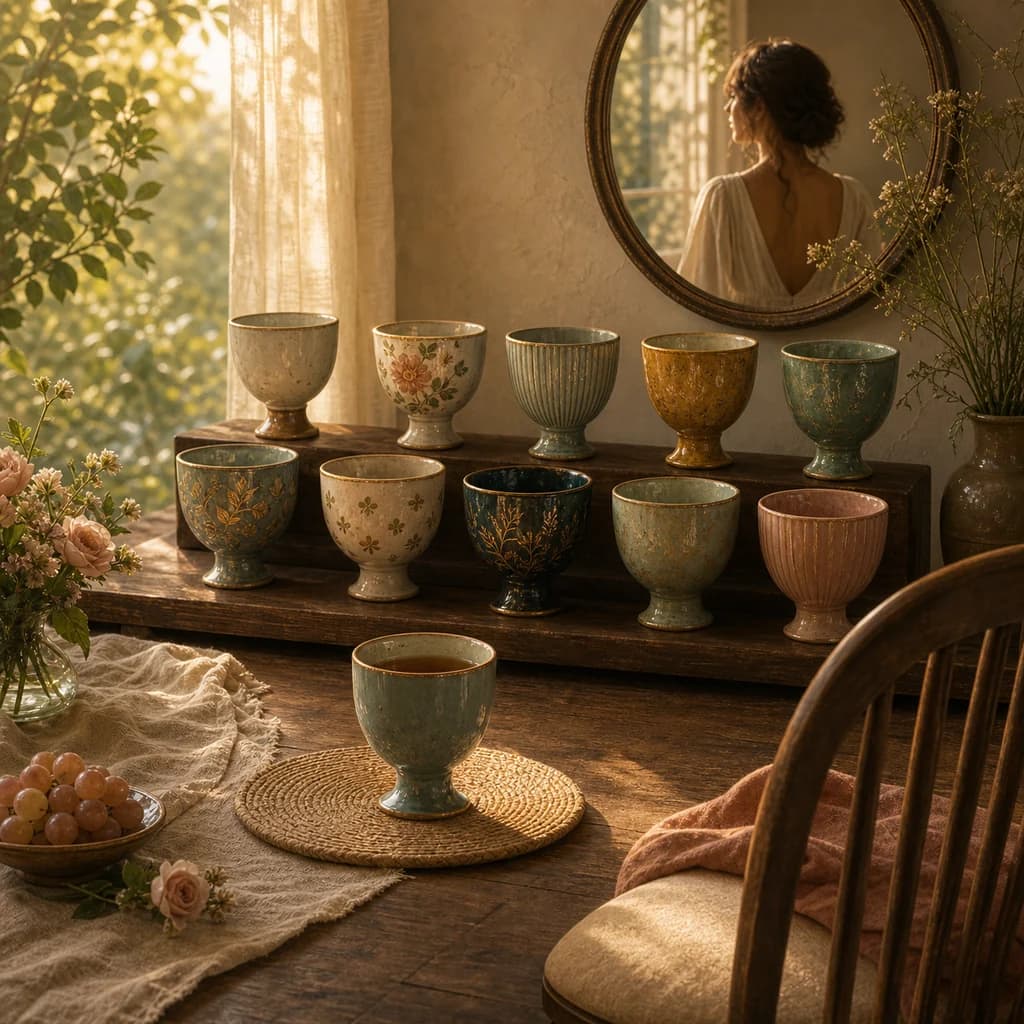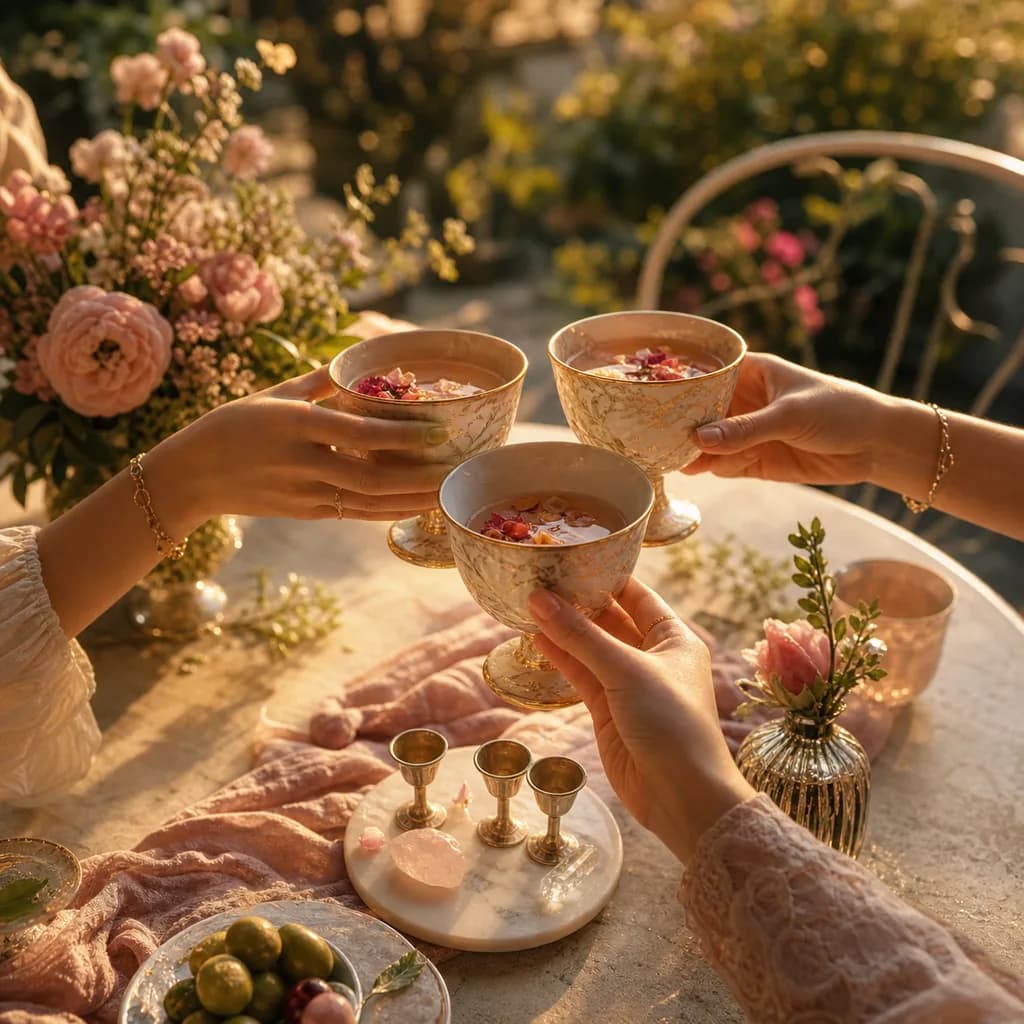
A client in my Shibuya studio drew this card last winter, asking how the man she'd been seeing felt about her. She lit up — "seven cups, he must have so many feelings." Then I watched her face fall when I told her what the picture actually shows: a figure staring at a cloud of glowing cups, none of them in his hands. The Seven of Cups as feelings is one of the most romantic-looking cards in the deck and one of the most slippery. The feeling is real. The question is whether it's aimed at you, or at something he's imagining. For the symbolism and upright/reversed breakdown beyond feelings, see the full Seven of Cups card meaning.
Quick Answer
Upright, the Seven of Cups as feelings points to someone who is captivated but confused — strong emotion tangled up with fantasy, idealization, and too many options to choose from. They may be dreaming about you more than seeing you, or weighing you against other possibilities. Reversed, it usually means the fog is clearing: either they're sobering up and choosing, or the daydream has collapsed into disappointment. Neither position means "no feeling" — it means the feeling hasn't landed on solid ground yet.
Seven of Cups Upright as Feelings
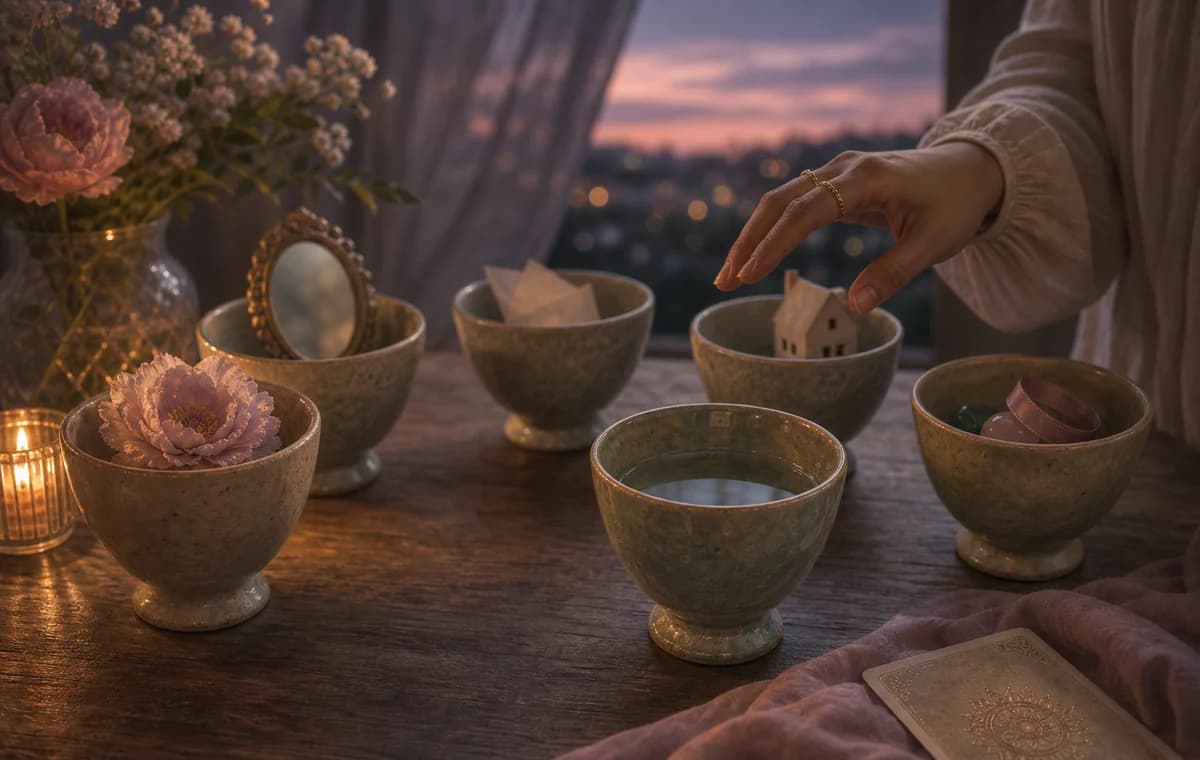
Picture the card. A silhouette stands before seven cups floating in mist — one holds a face, one a snake, one a castle, one jewels, one a wreath, one a dragon, one a shrouded glowing figure. He isn't holding any of them. He's looking. That's the emotional state this card describes: arrested at the looking stage, full of feeling, light on decision.
When it shows someone's feelings for you, expect intensity without clarity. They feel a great deal — but the feeling is mixed with imagination, with what-ifs, with a version of the relationship that lives mostly in their head. This is not a cold card. It's a flooded one.
And here's the part that trips people up. Because there are seven cups, almost everyone reads it as a love triangle — he's choosing between you and someone else. Sometimes that's true. More often the "options" aren't other people at all; they're competing futures, competing fantasies, competing fears, all of them inside one confused person. He isn't juggling lovers. He's juggling daydreams.
When you're single or it's new
Early on, this card is exciting and unreliable in equal measure. They're enchanted by the idea of you and of what this could become — and that enchantment is genuine. But they haven't committed to the real, ordinary version of you yet, the one who has bad days and opinions and morning breath. They're not ready to pick one cup. Give it time before you read the sparkle as certainty.
In an established relationship
For a couple already together, the upright Seven of Cups can sting. It often means a partner who has drifted into the realm of "what else is out there" — not necessarily another person, but another life, a fantasy of how things might be elsewhere. Restlessness, not betrayal, is the usual reading. Something in them has stopped looking at the relationship in front of them and started looking at the clouds.
Seven of Cups Reversed as Feelings
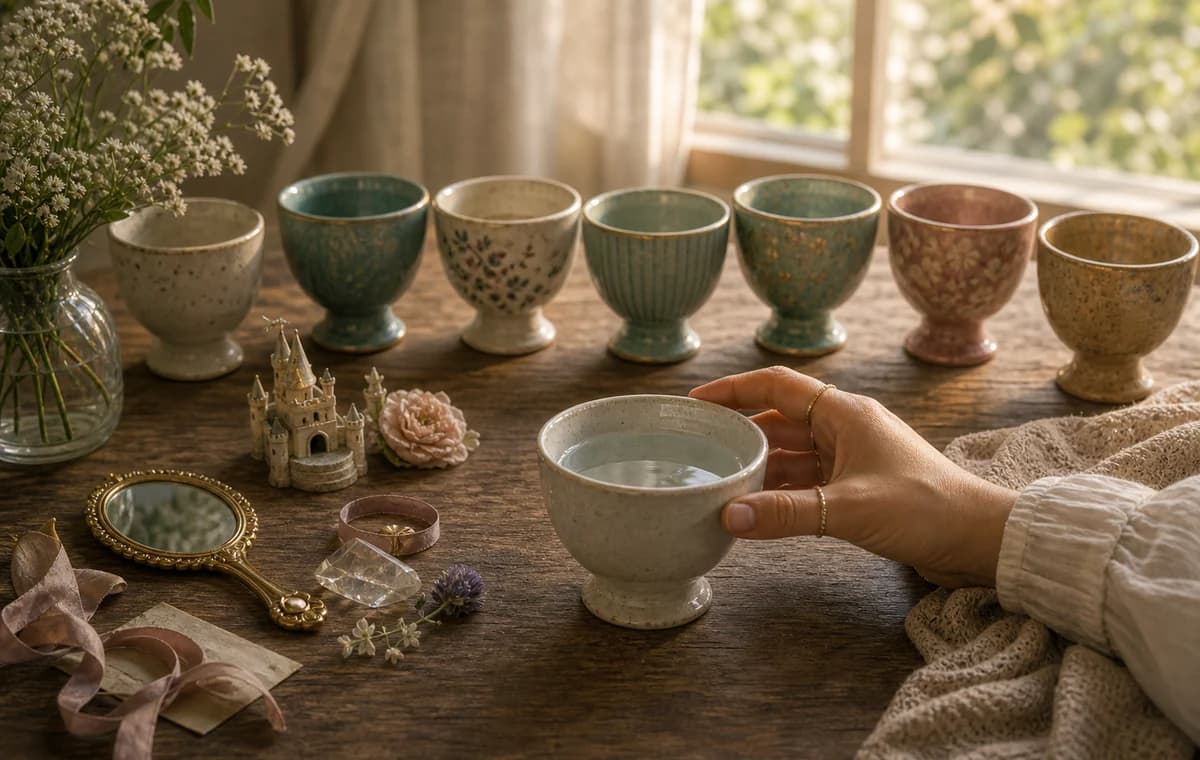
Reversed, the mist starts to burn off. Most often this is good news disguised as a hard one: the fantasy is breaking down and reality is walking in. They're getting clear about what they actually want, and you may be it — or you may be the cup they've just realized they don't want after all.
There's a harder version too. Reversed can show disillusionment — the dream they built around you (or around the relationship) has collapsed, and what's left is flat, deflated, a little disappointed. The glow is gone and they're not sure what they're looking at anymore.
The card flips between "finally seeing clearly" and "the magic wore off." Read the surrounding cards and, more honestly, read their behavior.
From a crush
Reversed Seven of Cups from a crush usually means they're snapping out of an idealized image — sometimes toward you, as in oh, you're actually real and I like that, and sometimes away, as the rose-tinted version stops matching the person they're getting to know. Which way it tips depends on whether reality made you more interesting to them or less. With a crush, this card rewards the unfiltered you over the curated one.
From an ex, or during no contact
With an ex, the Seven of Cups is famously nostalgic. Upright, they're likely lost in a remembered, polished version of you and the relationship — replaying the good parts, dreaming about reconciliation, conveniently editing out why it ended. That feeling is real but it's pointed at a memory, not at the present you. Reversed during no contact often means the rosy replay is wearing thin and they're starting to see the breakup clearly, which can go either toward closure or toward a more grounded wish to try again.
Does He Have Feelings for You — or for a Fantasy of You?
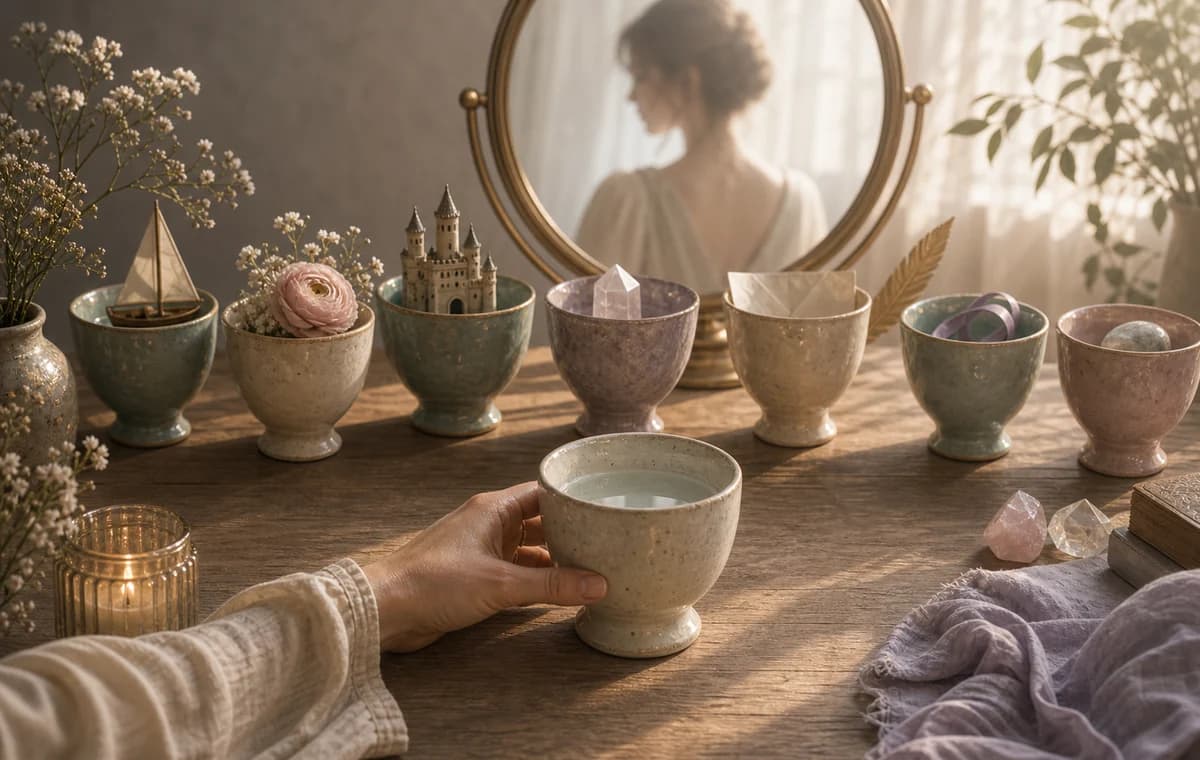
This is the question almost every other guide tiptoes around. They'll tell you the Seven of Cups means "idealization" and leave it there, as if that were comforting. It isn't, until you ask the next question: idealization of what? Because there's a world of difference between someone idealizing the relationship and someone idealizing a version of you that barely resembles you.
I'll say it plainly, because I've watched it hurt people who didn't see it coming. With this card, the feeling can be completely sincere and still not be about you. He can be genuinely, achingly in love — with a screen he has painted over your face. The cup he's gazing at has a face in it; the card never promises it's yours.
So how do you tell the difference? Watch what happens when you're inconvenient. A man in love with the real you stays interested when you contradict him, when you're tired and unglamorous, when the story gets complicated. A man in love with the fantasy goes quiet, or subtly tries to correct you back into the version he prefers, or only seems to light up around the highlight-reel you. Test it gently: show him something ordinary and true about yourself and see whether the feeling survives contact with reality. Fantasy can't survive being known. Real love is the thing that gets more solid the more it knows.
If you're the one cup he keeps coming back to look at after the mist clears — that's your answer. If he only loves you from across the room of his own imagination, that's your answer too.
Seven of Cups vs Ace of Cups as Feelings
These two get muddled because both brim with cups and emotion. The Ace of Cups as feelings is a single overflowing cup — one clear, fresh, wholehearted feeling being offered. The Seven is seven cups and no hand reaching out: feeling that hasn't chosen, hasn't committed, hasn't touched ground. The Ace says here, this is for you. The Seven says I'm dreaming about so many things, and one of them might be you. If you've been hoping for the Ace and you got the Seven, the difference is exactly the difference between an offer and a daydream.
How the Japanese Tarot Tradition Reads This
In Japanese タロット占い, the Seven of Cups is often read through the lens of 「幻想」(gensō) — illusion, fantasy, the beautiful image the mind builds and then mistakes for the thing itself. What I appreciate about reading it this way is that gensō isn't framed as a lie or a trick. It's treated as something the heart genuinely produces when it longs. A teacher of mine used to say the figure in this card isn't being deceived by anyone — he's enchanted by his own wanting. That reframes the whole reading. The person whose feelings you're asking about may not be playing games at all; he may simply be standing in front of his own beautiful fog, unable to tell which cup is real. Compassion is allowed. Clear eyes are still required.
Frequently Asked Questions
Does the Seven of Cups as feelings mean they love me?
It can mean strong feeling — but feeling that's tangled with fantasy and indecision rather than landed and committed. They may love an idealized version of you or the relationship more than the grounded reality. Treat it as real emotion that hasn't yet chosen you on purpose.
Does the reversed Seven of Cups mean they don't care?
Usually not. Reversed more often means the fog is lifting — they're either getting clear and choosing, or waking up from a fantasy into disappointment. It points to clarity or disillusionment rather than indifference. Watch their actions to see which way it's resolving.
What does the Seven of Cups say about my crush?
That your crush is captivated by an image and hasn't fully met the real you yet. Upright, they're dreaming; reversed, the daydream is being tested against reality. This card rewards the unfiltered version of you — the real one tends to win out over the idealized one, for better or worse.
Will an ex come back if I draw the Seven of Cups?
Maybe, but be careful what they're returning to. Upright, an ex is often in love with a polished memory and a fantasy of reconciliation rather than the actual relationship you had. Reversed can mean they're seeing it clearly at last. A reunion built on the fantasy version rarely holds; one built after the mist clears has a chance.
Is the Seven of Cups a yes for love questions?
It's a "maybe, not yet." The feeling and possibility are there, but so is confusion, and the card resists a clean yes. Reversed nudges it toward a real answer — either a grounded yes once clarity arrives, or a deflated no once the fantasy collapses.
Closing
If you drew the Seven of Cups for how someone feels, don't rush to celebrate the abundance of cups or mourn the lack of a clear answer. Do one thing this week: show this person something plain and true about yourself, the unedited version, and watch whether the feeling holds. Fantasy dissolves on contact with the real. Whatever survives that contact is the part worth trusting.
Want to keep mapping the emotional landscape? Compare the Ace of Cups as feelings for what a single wholehearted offer looks like, read the Moon as feelings for the cousin card of confusion and projection, or plan a full reading with our love tarot spread guide.