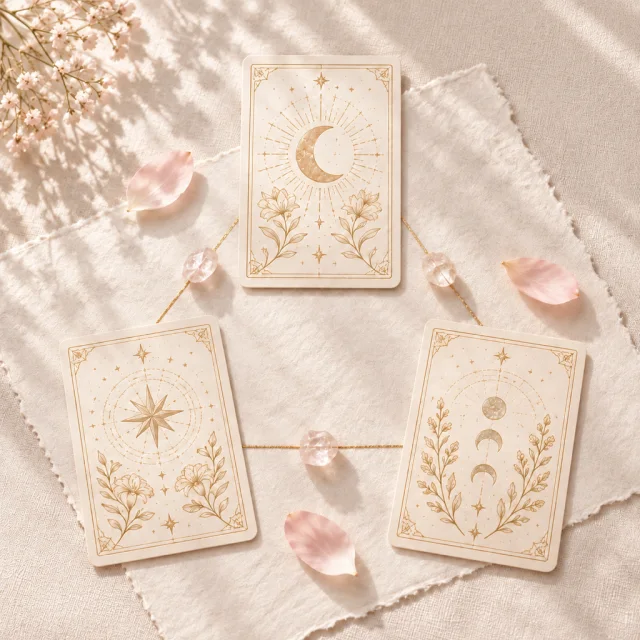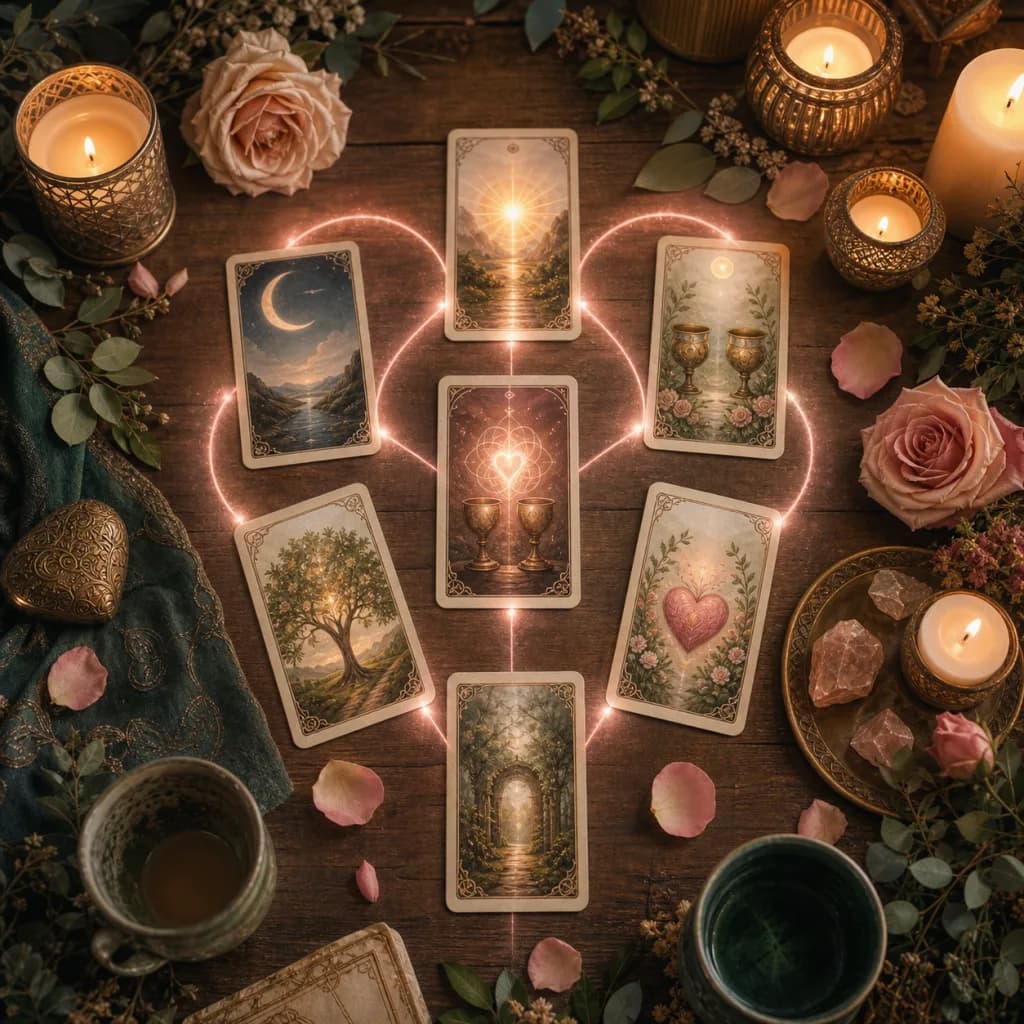
Ask any tarot reader what the first spread they ever did was, and most will say the same thing: three cards, left to right, past–present–future. It's the spread that taught me how to read tarot at all — and ten years later, it's still the one I reach for most days, before the bigger layouts and almost always before any reading I do for a paying client.
The three-card spread looks almost too simple to be useful. That's the trap. People treat it as a beginner's training-wheel exercise and then wonder why their readings feel flat. The truth is the opposite: three cards is hard precisely because there's nowhere to hide. There's no Card 6 to bail you out when Card 1 doesn't make sense. You have to actually read.
This guide covers the classic past–present–future layout, the variations that fit love, career and yes-or-no questions, the one structural trick that separates good three-card readings from bad ones, and — importantly — when three cards isn't enough and you should reach for a bigger spread.
Table of Contents
- Why the Three-Card Spread Works
- How to Lay Out the Cards
- The Classic Past–Present–Future Reading
- The One Skill That Separates Good Readings From Bad Ones
- Three-Card Variations for Love
- Three-Card Variations for Career
- Three-Card Yes/No Variations
- Common Mistakes (and What I Learned the Hard Way)
- When Three Cards Isn't Enough
- Frequently Asked Questions
Why the Three-Card Spread Works
A single card answers a single question. Ten cards answer a complicated one. Three cards do something different — they tell a story. That's the whole point.
Three is the smallest number that allows for narrative. With two cards you only get contrast. With three you get a beginning, a middle and an end — cause, situation, consequence. Our brains are wired to read three-part patterns as story, which is why almost every spread variation you'll see (Mind/Body/Spirit, Situation/Action/Outcome, You/Them/The Relationship) lands easily without much explanation.
That's also why three cards is enough for most everyday questions. The reason readers love it isn't that it's easy. It's that it forces you to commit to a single, readable narrative instead of dissolving into the noise that ten cards can sometimes become.
How to Lay Out the Cards

The mechanics are simple. The discipline behind them matters more than the steps.
- Frame your question first. Specific beats abstract every time. "Should I take the Osaka job?" beats "What about my career?" If you can't say your question in one sentence, you're not ready to pull yet.
- Shuffle until you mean it. Hold the question in your head while you shuffle. If your mind drifts, the spread tends to drift with it — you'll get cards that look random because the input was. I learned this the hard way; in my own practice, mid-shuffle drift is the number one reason a reading "doesn't make sense" later.
- Cut and draw three. Draw the top three cards. Lay them left to right. Don't fan or peek — commit to the three on top.
- Look at all three before interpreting any. This is the single biggest tip I'd give a beginner. Don't read Card 1, then Card 2, then Card 3. Take in all three at once, notice the overall mood, the suits, the major/minor balance, any visual echoes. Only then interpret.
Optional but recommended: write the cards down before you start interpreting. The act of writing slows the impulse to project meaning.
The Classic Past–Present–Future Reading
The default positions:
- Card 1 — Past: What's behind the situation. Often what you're carrying from — the foundation, the wound, the choice already made. Sometimes it's the thing that needs releasing rather than the thing that caused the present.
- Card 2 — Present: What's actually happening now. Not what you wish were happening. The present card is often the one that triggers the strongest reaction, and that reaction is part of the message.
- Card 3 — Future: The likely outcome if the current trajectory continues. This is the position most beginners misread. The future card is not destiny — it's the natural endpoint of the present momentum. Change the momentum and the outcome changes with it.
A more useful reframing
If "past–present–future" feels too abstract, try this rephrasing — it's the version I use with clients who get stuck on the time-frame question:
- Card 1 — Where am I coming from? (Beliefs, foundations, conditioning)
- Card 2 — Where am I now? (Current state of mind, current circumstances)
- Card 3 — Where am I heading? (Trajectory based on present momentum)
The positions are the same. The questions are more answerable. A client who can't tell you "what's in your past around this" can almost always tell you "what beliefs you're carrying about it."
Time-frame, honestly
How far back does "past" go? How far ahead does "future" reach? My honest answer: usually weeks to months on either side, but it depends on the question. A question about a long-running relationship pulls a longer horizon. A question about whether to send an email today pulls a horizon of hours. Major Arcana in the future position tends to indicate further out and bigger; pip cards tend to mean nearer-term, more concrete.
Don't pin a number on it. The cards know the scale of your question better than you do.
The One Skill That Separates Good Readings From Bad Ones
Here's the thing nobody tells beginners clearly enough:
A three-card spread is a sentence, not three separate words.
When I'm reading for someone and they hand back a three-card spread, the giveaway that they're new isn't that they don't know the meanings — most beginners know the meanings fine. It's that they read Card 1, then Card 2, then Card 3, as if each card were a separate paragraph. The reading sounds like a list. It doesn't feel like anything.
Good three-card readings work like grammar. Try this framing the next time you pull three:
- Subject – Verb – Object. "[Card 1] is doing [Card 2] to [Card 3]." It's a clumsy translation, but it forces you to find a relationship between the cards instead of reading them in isolation.
- Cause and effect chain. Does the Past explain the Present? Does the Present lead to the Future? Or does the Future contradict the trajectory, suggesting an intervention is needed?
- Notice imbalances. If two of three cards are Cups and one is a Sword, that imbalance is part of the message — there's an emotional situation with one intellectual element trying to push through (or cut through, depending on the Sword).
- Notice repeated imagery. If two cards share the same color, the same gesture, the same direction someone's facing — that's the cards speaking to each other. Read what they're saying.
The same three cards mean different things in different orders. The Tower–Three of Cups–Star is a story of catastrophe leading through grief to renewal. Star–Tower–Three of Cups is a story of false hope being shattered into an unexpected joy. Same cards. Different story. Because order is grammar.
Three-Card Variations for Love
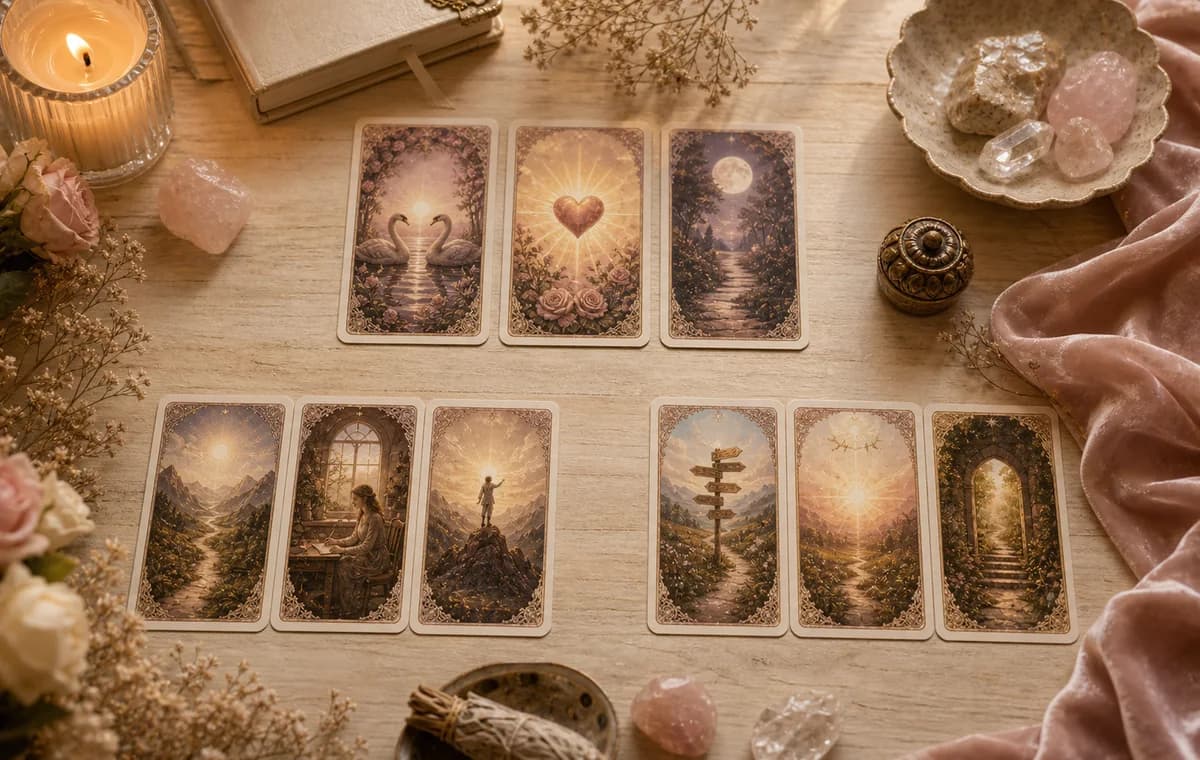
The past–present–future template works for love questions, but there are layouts that fit romance more naturally. Pick the one that matches what you actually want to know.
Energy / Obstacle / Advice (Single & Looking)
- Card 1 — Your current love energy. What you're radiating, often unconsciously. This is the card that most often shocks people in love readings.
- Card 2 — The obstacle or limiting belief. What's keeping love from landing. Frequently a pattern from a prior relationship.
- Card 3 — Advice. A specific action or shift that would change the energy.
This is the single most useful three-card spread for "why am I still single" type questions, because it points at the internal situation rather than chasing an external "when will I meet someone."
You / Them / The Connection (For a Specific Person)
- Card 1 — You in this connection. Your honest position, not the version you tell your friends.
- Card 2 — Them in this connection. How they're showing up, energetically.
- Card 3 — The dynamic between you. Not the outcome — the shape of the thing itself.
Notice that this version refuses to give you a future card. That's deliberate. Two people are involved, and predicting "the future" of a connection treats the other person as a passive object. Read the dynamic instead and let the future write itself.
Should I Stay / Leave / Pause
A decision spread for when a relationship is at a crossroads. Each card represents what would unfold under that choice. Read them as parallel timelines, not in sequence. The one that feels most truthful — not necessarily most pleasant — is usually the one to follow.
Three-Card Variations for Career
The three layouts below cover most work questions; for the longer positional layout, see the career-specific three-card variations and a full career spread guide.
Passion / Skill / Possibility (For Choosing a Path)
- Card 1 — what genuinely lights you up
- Card 2 — what you're already good at
- Card 3 — where those two overlap in the real economy
The overlap card is the interesting one. If it's a wildly different suit from the first two, the message is often "you'll need to build a bridge between the two — the obvious path isn't it."
Obstacle / Position / Opportunity (For When You're Stuck)
- Card 1 — the thing actually blocking you
- Card 2 — where you currently stand
- Card 3 — the door that's open if you turn toward it
Useful for promotions, job searches, project crises.
Ambition / Network / Next Move
- Card 1 — what you're truly aiming at (often different from what you tell your boss)
- Card 2 — what your existing network or environment will support
- Card 3 — the concrete next action
This one I use myself, in my own journal, once a quarter.
Three-Card Yes/No Variations
Strict yes/no tarot is something most experienced readers warn against, and they're right — tarot's strength is texture, not binary verdicts. But there are three-card layouts that give a directional answer without flattening the situation. (If you only want the verdict, use the dedicated yes/no spread for directional answers instead.)
Yes / No / The Condition
Card 1 = the case for yes. Card 2 = the case for no. Card 3 = the deciding factor. The third card is the gold — it shows what actually has to be true for the answer to land one way or the other. Most yes/no questions aren't really yes/no; they're "yes, if" questions in disguise.
Green Light / Yellow Light / Red Light
Pull three. Read each as a signal: go, slow down, stop. The one that lands most strongly is your answer, but the other two tell you what to watch for. Useful for time-sensitive decisions (should I send this, accept this, sign this).
Majority-Rules
A blunt version. Pull three. Count how many lean positive vs. negative based on traditional meanings. Majority wins. This works best for low-stakes questions — "is this restaurant going to be good tonight" — and badly for anything that matters. Tarot wasn't built to do polls.
Common Mistakes (and What I Learned the Hard Way)
A few honest patterns I've noticed in my own readings and in the ones I've read for friends and clients:
Re-pulling immediately. If you hate the cards you got, the temptation to shuffle and re-draw is enormous. Don't. Almost every time I've broken this rule, the second reading was clearly worse — looser, more contradictory, harder to read. If your first three cards hit a nerve, the nerve is the reading. Sit with it for a day. If the question genuinely needed reframing, ask it differently tomorrow.
Asking the same question twice in different words. This is re-pulling with extra steps. The cards know.
Forcing chronology. Not every three-card spread is past–present–future, even when you laid it out that way. Sometimes Card 1 is the thing to release, Card 2 is the lesson, Card 3 is the obstacle — and the cards will tell you that if you let them. Don't force a sequence the cards aren't actually drawing.
Treating the future card as fate. It's not. It's the trajectory if nothing changes. The whole reason you're doing the reading is so something can change.
Pulling a fourth card to "clarify." Sometimes legitimate, often a cope. If you pull a clarifier, write down what specifically you didn't understand about the original three before you pull. Otherwise you're just deferring the reading.
When Three Cards Isn't Enough
Three cards is the right tool for most questions. It is the wrong tool for some. The decision criterion I use:
- Use three cards when the question is single-thread: one situation, one decision, one relationship dynamic.
- Reach for a five-card spread when there's a clear before/turning-point/after, or when you need a "what to do" card on top of the situation.
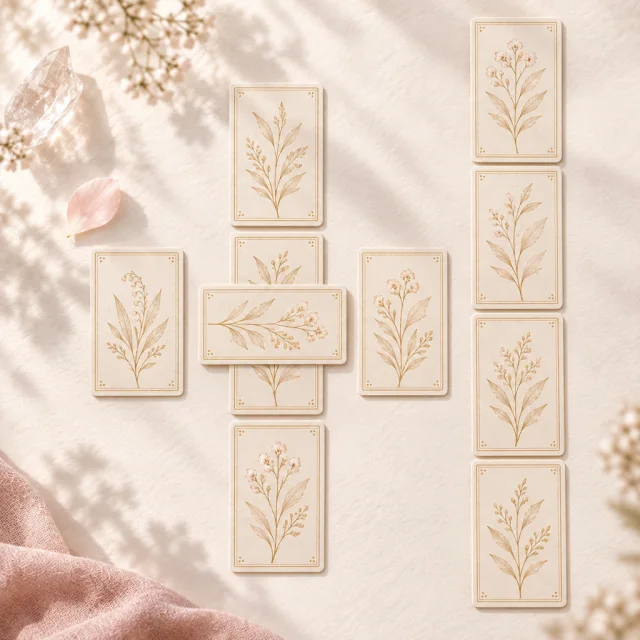
- Reach for the Celtic Cross when the situation has multiple layers — conscious goal vs. subconscious driver, internal state vs. external environment, hopes vs. fears all in play at once. The Celtic Cross is designed exactly for those "I don't even know what I'm asking" questions.
If you find yourself pulling three cards, then three more, then three more on the same question, that's a sign the question was Celtic-Cross-shaped from the start. Stop, shuffle, and lay the full ten.
Frequently Asked Questions
Is the three-card spread good for beginners?
Yes — but for the right reason. It's not "easy because there are only three cards." It's "easy because the narrative is small enough to actually read." Beginners should start here precisely because it forces the skill of reading cards as a story rather than as a list of meanings.
Can I use the three-card spread for daily readings?
Yes, and it's one of the best uses for it. A daily three-card pull — for example, today's energy / today's challenge / today's gift — takes five minutes, and a daily three-card pull builds your card vocabulary fast — faster than any other practice. Keep a tiny journal.
What if all three cards are from the Major Arcana?
It usually means the question touches something bigger than you initially framed. The Majors show up when soul-level themes are in play. Read the spread with a longer time horizon and more weight on each card.
What if I get all reversed cards?
Don't panic. A spread of all reversals often points to an internal situation rather than an external one — blocks, suppressions, things the conscious mind isn't ready to see. It's also worth asking honestly whether you were avoiding the real question.
How is the three-card spread different from the Celtic Cross?
The three-card spread answers "what's the story here?" The Celtic Cross answers "what are all the layers underneath what I think is happening?" Different jobs. Three cards is a focused beam; the Celtic Cross is a floodlight. If you're not sure which to use, default to three — and upgrade if the story won't sit still.
Can I do a three-card reading for someone else?
Yes, with one caveat: be clearer than you'd be for yourself about whose question it is. A three-card reading "about" someone else who hasn't asked tends to drift into projection territory. Either ask the querent to frame the question themselves, or frame your reading as your situation with this person, not their situation in general.
How often can I do a three-card reading for myself?
Daily is fine. Three times a day on the same question is not. The cards are most useful when you give them room to be heard.
Conclusion
Three cards, left to right. It's the most ordinary thing in tarot and it's the thing most readers — beginners and experienced alike — never quite finish learning. Every time I sit with three cards and remember to read them as a sentence rather than a list, the reading lands. Every time I forget, it doesn't.
Start with the past–present–future layout. Switch to one of the love or career variations when the question fits them. Save the yes/no formats for when you genuinely need a directional answer and accept that you're trading depth for speed. And if a question keeps refusing to be answered in three cards — that's the cards telling you the question was bigger than three.
The whole craft of three-card tarot is in two sentences: ask one specific thing, read three cards as one story.
Want to go deeper? Read our Celtic Cross Tarot Spread Guide for the ten-card layout, or start with our Tarot Beginner's Guide. If you want to try a three-card reading right now, our AI tarot tool can pull and interpret one for you.