Past Present Future Tarot – 3-Card Timeline Reading
"When exactly did this stop working?" Most people, asking that, stare hard at the present moment. The present is usually the tail end of something that was put down six months or a year ago and never picked back up.
The past present future tarot spread lays that continuation out in three cards, read left to right as a timeline: Past, Present, Future. Each position has one job, so no card has to carry two meanings at once and the outline of each stays clean. Love, work, money, whether to move to another city — a three-card tarot reading will take any of those, so long as the question has a before and an after in it.
Three sounds thin until you use it.
Or pick a common question
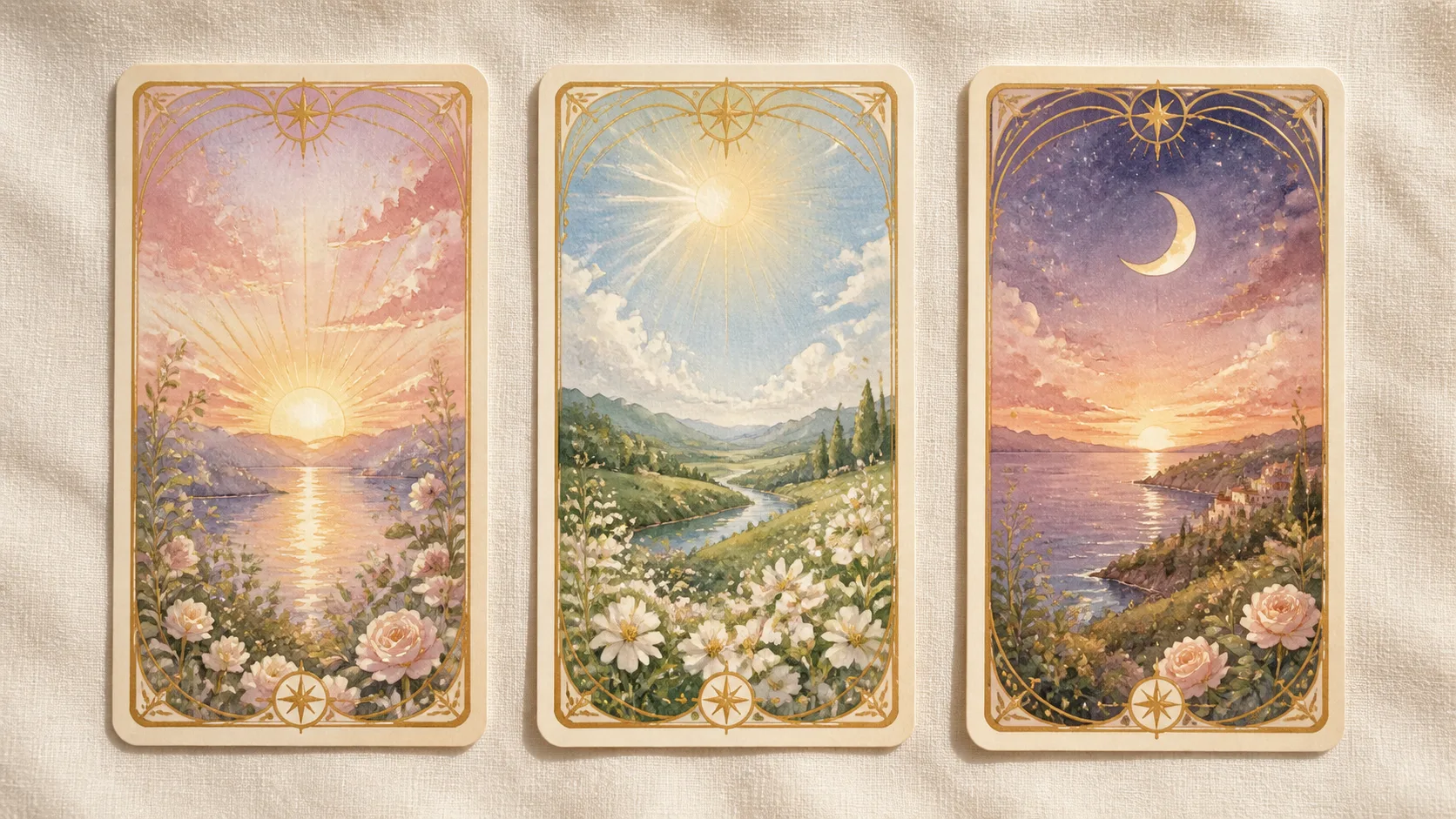
What these 3 cards show
Past
Past factors influencing the current situation
Present
Current circumstances and energy flow
Future
The natural direction things are heading
Don't read the three as separate statements. Most of what this spread knows is stored in the gaps: Past to Present, Present to Future. A major arcana in Past sitting next to a quiet minor in Present usually means a large event has finished happening and you're in the clean-up. That temperature difference between neighbours is the actual reading.
The position people misread most is Future, and it isn't close. A heavy card lands there and it gets taken as a sentence already passed — the follow-up question is usually some version of "so there's no point trying, then." That card doesn't show a fixed ending. It shows what tends to develop if you carry on at the pace you're going. Someone who drew a bleak Future here handed off two projects that same week, told her manager she was over capacity, and pulled again a month on. The third card came back reading nothing like the first one — the pace it was extending had changed. I read that card as a continuation of the second, never on its own.
Which questions suit three cards, and which ones outgrow them?
It suits anyone trying to get a grip on how something is moving. Things have felt stuck for a few months. You're half a year into a new job with nothing to show for it. You want to know whether the habit you started in January survives to March. Questions that make more sense once they're laid along a timeline. Reading three cards costs you almost no effort, so when you're undecided, start here.
It runs thin the moment there are two people in the question. All three positions take you as their subject, so none of them reaches inside somebody else's head. If what you want is what your crush is thinking, the Relationship spread goes at it directly with You, Them, and The Relationship.
A straight either-or decision is too much weight for these three as well. A timeline draws one line; it can't set two futures side by side. Use the Crossroads spread for that.
And if you're trying to take apart something you've been dragging for years, or a knot of office politics where you want to know how it got this bad, three positions won't hold it. The Celtic Cross opens the reading out far enough to catch things like the split between what you tell yourself and what you haven't admitted.
Reading two neighbours as one sentence
The Nine of Wands in Past, the Four of Swords in Present. Holding a line long past the point where it costs you, and then a card of lying down and going quiet. The question that produced those two was whether to stay at a company that had kept her on a rolling contract for two years.
That gap on its own reframed what she'd been calling stagnation. Nothing was failing. She was in the part where the damage gets repaired, and she'd been reading the quiet as falling behind.
Future was Justice — in her situation, contracts and terms. I didn't tell her she'd be made permanent. What I read was a direction: the months she was spending on recovery were turning into the material she'd negotiate with. She started writing down what she actually wanted to ask for. Three cards, read as two overlapping pairs, get you that far.
FAQ about this spread
Can three cards really say anything useful?
They can. People assume more cards means more accuracy; what more cards actually buy you is more angles. Narrowing everything onto one line — past, present, future — tends to sharpen an answer rather than blur it. Move up to a bigger layout when your question genuinely needs a second line: someone else's feelings, or two options compared.
How far ahead does the Future card look?
It follows the grain of your question. Ask about the interview you have on Friday and it reads in days; ask whether to stay in this career and it reads in months. If you want a fixed window, put it in the question — "over the next three months" — and Tsukishiro Nagi will read inside it. She won't put a date on anything, though.
The Past card doesn't match anything I remember. What now?
That happens often. This position usually shows the state you were in during that stretch more than the events themselves, and the periods we file away as "nothing much happened" are the ones where we were quietly putting up with something. Put it next to the Present card and see whether a line connects the two.
Is it fine to pull this every day?
You can. Nothing on this end is going to stop you — the readings don't cost anything, there's no daily allowance to run down, and there was no sign-up on the way in. What I'd avoid is re-asking the identical question every morning; you end up pulling until a card you like turns up, and the first one loses its weight. If you want a daily habit, change the question instead. "How does today want to go" works well in this layout.