Celtic Cross Tarot – The Ultimate 10-Card Reading
The Celtic Cross gets called the definitive tarot spread and then gets avoided, because ten cards on the table look like homework. The difficulty isn't the count. It's whether you can hold the first two cards together as one statement.
Present Situation, Challenge, Conscious, Subconscious, Past, Near Future, Yourself, External Environment, Hopes & Fears, Final Outcome. The ten positions are arranged to look at a single problem from the outside and the inside at the same time. It costs you nothing to take, but it isn't quick — ten cards want a proper sitting rather than five spare minutes.
Pro Members OnlyThis premium spread requires Pro membership
Or pick a common question
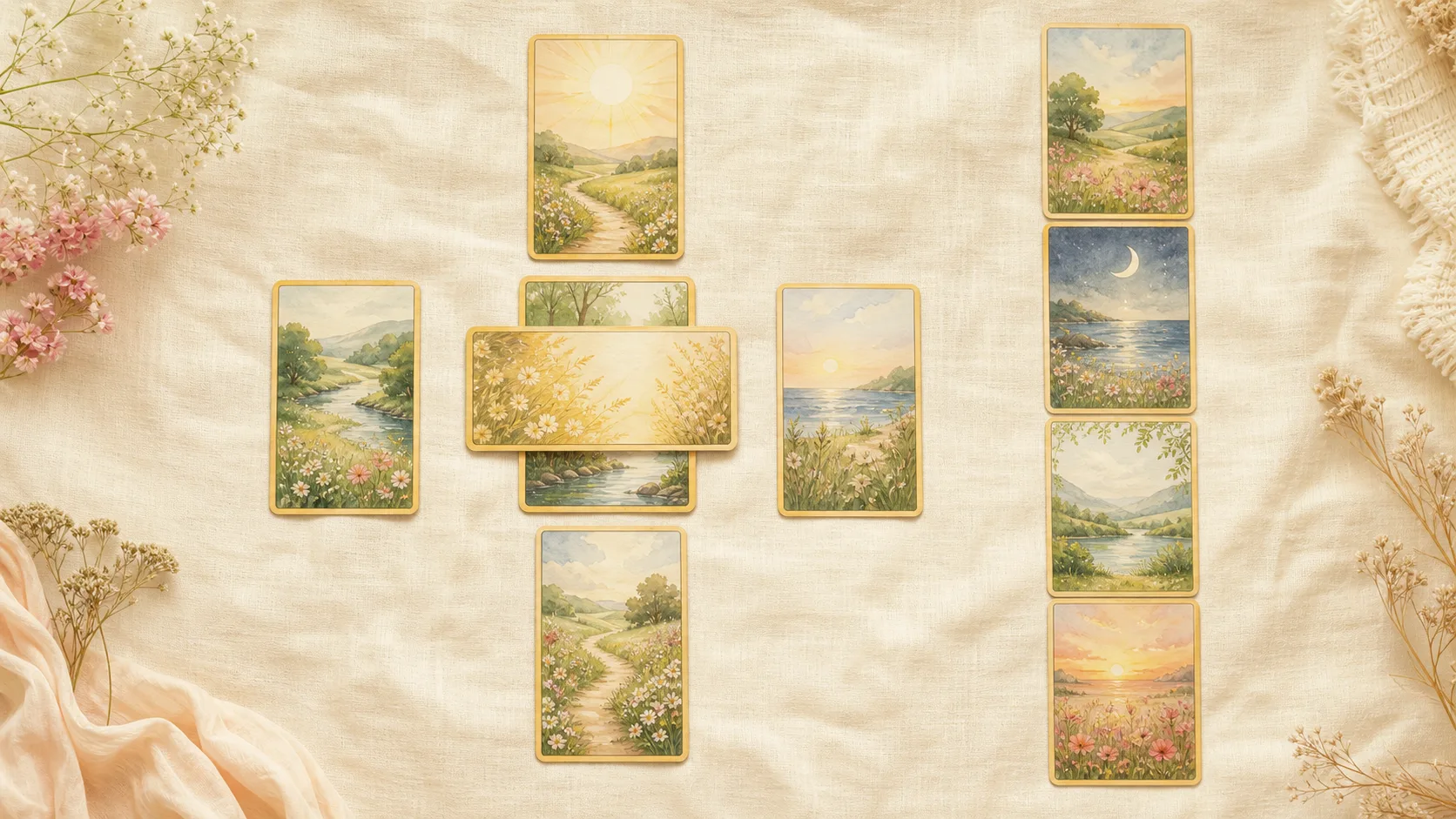
What these 10 cards show
Present Situation
Your current circumstances and central theme
Challenge
Obstacles and challenges you currently face
Conscious
Factors you are consciously aware of
Subconscious
Factors in your subconscious
Past
Past influences
Near Future
What's coming soon
Yourself
Your own position and attitude
External Environment
Impact from surroundings and others
Hopes & Fears
Your hopes and fears
Final Outcome
The final result and conclusion
The first card, Present Situation, and the second, Challenge, laid across it. Those two set the skeleton and the other eight hang off it. Card two goes down crosswise by tradition and works either as something barring your way or something holding you in place. The interesting case is a pleasant card in that seat: the Lovers landing on Challenge can mean the relationship itself is what's keeping you still.
The card I hold open longest is the ninth, Hopes & Fears. One card, two occupants — the thing you want and the thing that frightens you live there together. A solicitor weighing up going out on her own drew the Tower there and read it straight off as a warning. Both occupants were in that one card: she was afraid her life would come apart, and she also believed nothing would move until it did. Once both of those were written down side by side, Final Outcome stopped saying what she had assumed it said. Settle position nine too quickly and the whole reading goes shallow.
Does your question really need ten cards?
The Celtic Cross comes into its own when the trouble won't fit in one sentence. Work, a relationship and your health have all gone heavy at once and you can't tell which end to pick up. Ten positions will take that apart. It's also the right choice for something you've been carrying for months with no movement in it.
It's a sit-down reading. On a day when you want an answer in five minutes, this is the wrong spread.
For a question with a one-line answer it's excessive. Ask "will the weekend go well" across ten positions and Yourself and External Environment start a separate conversation, and the focus you came in with dissolves. For the trajectory alone, three cards in the Past Present Future spread will do. For a straight A-or-B, the Crossroads spread gives each option a card and a future of its own.
When the topic is already narrow, a specialist beats the generalist. To find out whether you and an ex can work, the Reconciliation spread breaks out the cause of the split and the obstacle that's still live. The Celtic Cross is a general-purpose instrument, and there are places it loses to a dedicated one.
The order I read the ten in
A question that came in from a man in his forties: "work and home are both at the limit and I don't know what to change." Here's the sequence, stripped down.
Present Situation and Challenge first. Present read as depletion; Challenge held the Ten of Wands, the load he had taken on for other people. Then Conscious against Subconscious, cards three and four. Conscious said I need to work harder. Subconscious said I want somebody else to take this. A split that wide explains a very particular kind of exhaustion.
Past and Near Future gave the timeline. Yourself and External Environment gave the position check, and External Environment was the surprise — the people around him were less unavailable than he had assumed. From there to Hopes & Fears, and Final Outcome last. The outcome leaned towards recovery, on the condition that he actually set something down — and what to set down had been named eight cards earlier, at Challenge. Ten cards looks like a lot from outside. Read in a fixed order, you don't get lost in them.
FAQ about this spread
Ten cards seems like too many. Can a beginner read it?
Yes. The meaning of each position is shown on the page, and Tsukishiro Nagi works from card one to card ten in order, so there's no point where you're left alone with a pile of images. If this is your first tarot reading and you want something you can absorb in a few minutes, the three-card Past Present Future spread is a gentler entry. The Celtic Cross is free, there's no limit on how many you take and no account to create, so it will still be here later.
What does a good card in the Challenge position mean?
That the good thing is what's holding you still. The second position is read by function. Whether the card itself is fortunate doesn't enter into it. A card about stability there says you can't move because you're comfortable; the Lovers says the relationship is clouding your judgement. That one seat runs on a different measure from the other nine.
Is the Final Outcome fixed?
No. Card ten shows where things head if the conditions described by the other nine keep running as they are. Change the conditions and the heading changes. When Final Outcome comes up rough, the handles are usually sitting in Challenge and in Hopes & Fears — and a reading that claimed to lock the ending in place would be lying to you about what a deck can do.
Why do books and websites disagree about what the positions mean?
The layout has been in use for over a century, and different schools branched off along the way. Cards three and four, and seven and eight, swap around depending on whose book you're reading. This site reads the ten positions exactly as listed on this page, so if you learned a different arrangement elsewhere, go with ours while you're here and nothing will contradict itself.