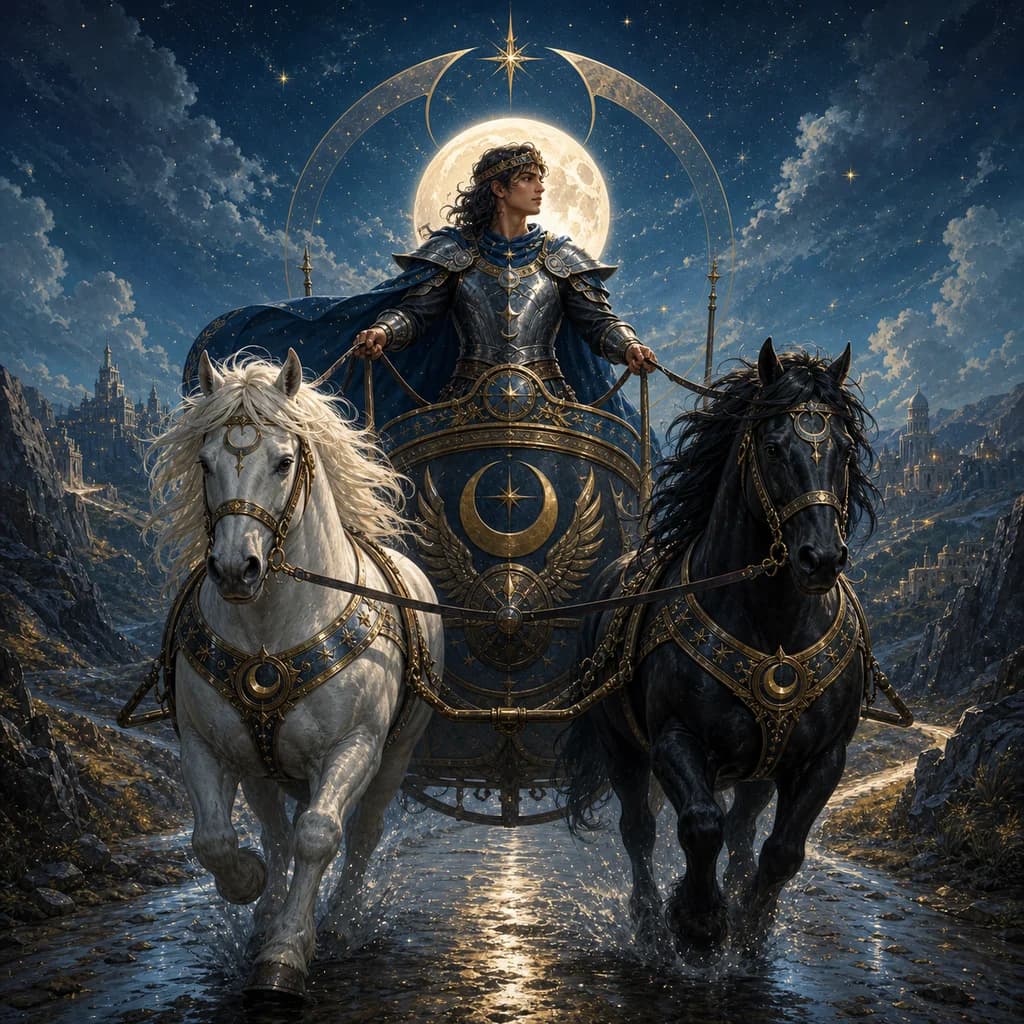
Most articles tell you The Chariot is the card of victory. That reading is correct as far as it goes — but it misses why this card is more uncomfortable than its triumphant imagery suggests. In a decade of reading the Rider-Waite-Smith deck, I've found The Chariot shows up most often not when victory has arrived but when a client is being forced to choose between two opposing pulls and harness them in the same direction.
This guide covers what The Chariot really means: the symbolism, upright and reversed readings, how it applies to love and career, and the questions clients ask me about it most — including Yes/No, timing, and why a Cancer-ruled card feels more aggressive than people expect.
Quick Answer
The Chariot is Major Arcana card VII, ruled by Cancer and the element of Water. Upright, it signals willpower applied with discipline — moving forward by reconciling opposing forces (the two sphinxes) rather than eliminating them. Reversed, it points to loss of direction, scattered effort, or aggression substituting for actual progress. The card is less about external victory and more about whether you can hold your nerve under conflicting pressures.
Basic Information
| Attribute | Details |
|---|---|
| Card Name | The Chariot |
| Number | VII (7) |
| Arcana | Major Arcana |
| Element | Water |
| Astrological Correspondence | Cancer |
| Yes / No | Yes — provided you can hold a clear direction |
| Upright Keywords | Willpower, focused movement, harnessed opposition, disciplined progress, victory through control |
| Reversed Keywords | Loss of control, scattered force, aggression, indirection, burnout |
Card Imagery & Symbolism
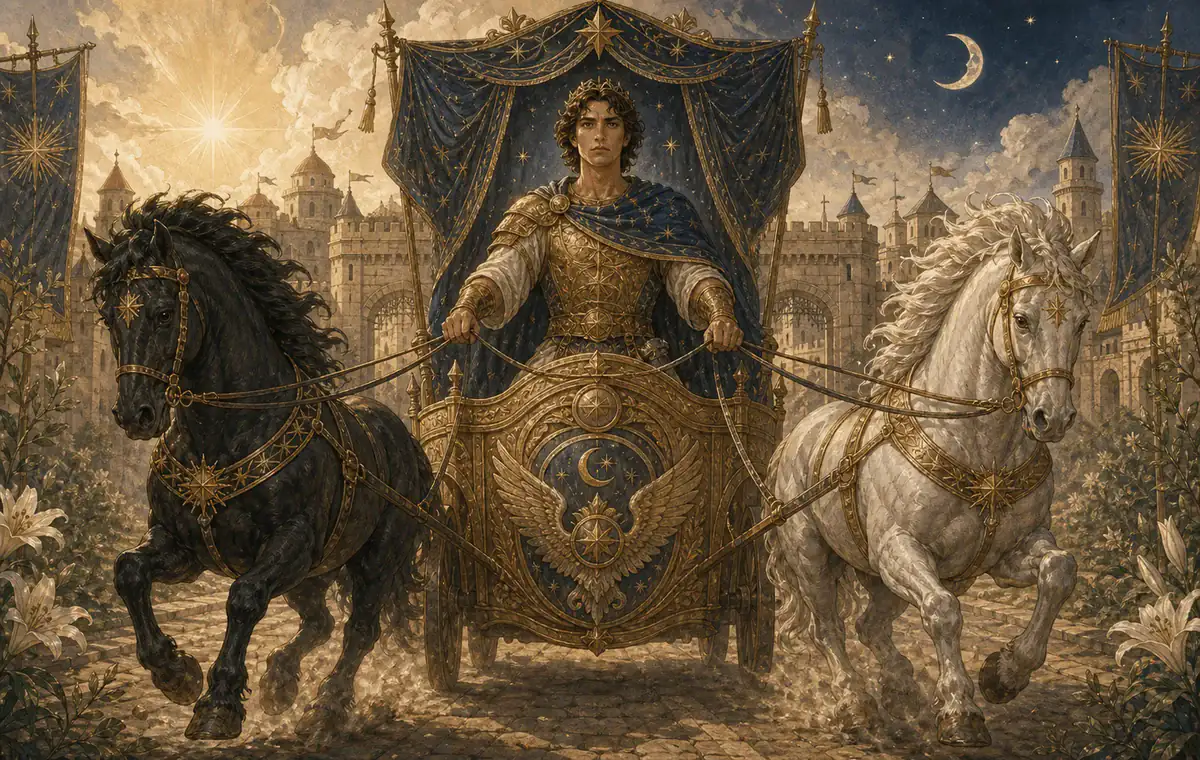
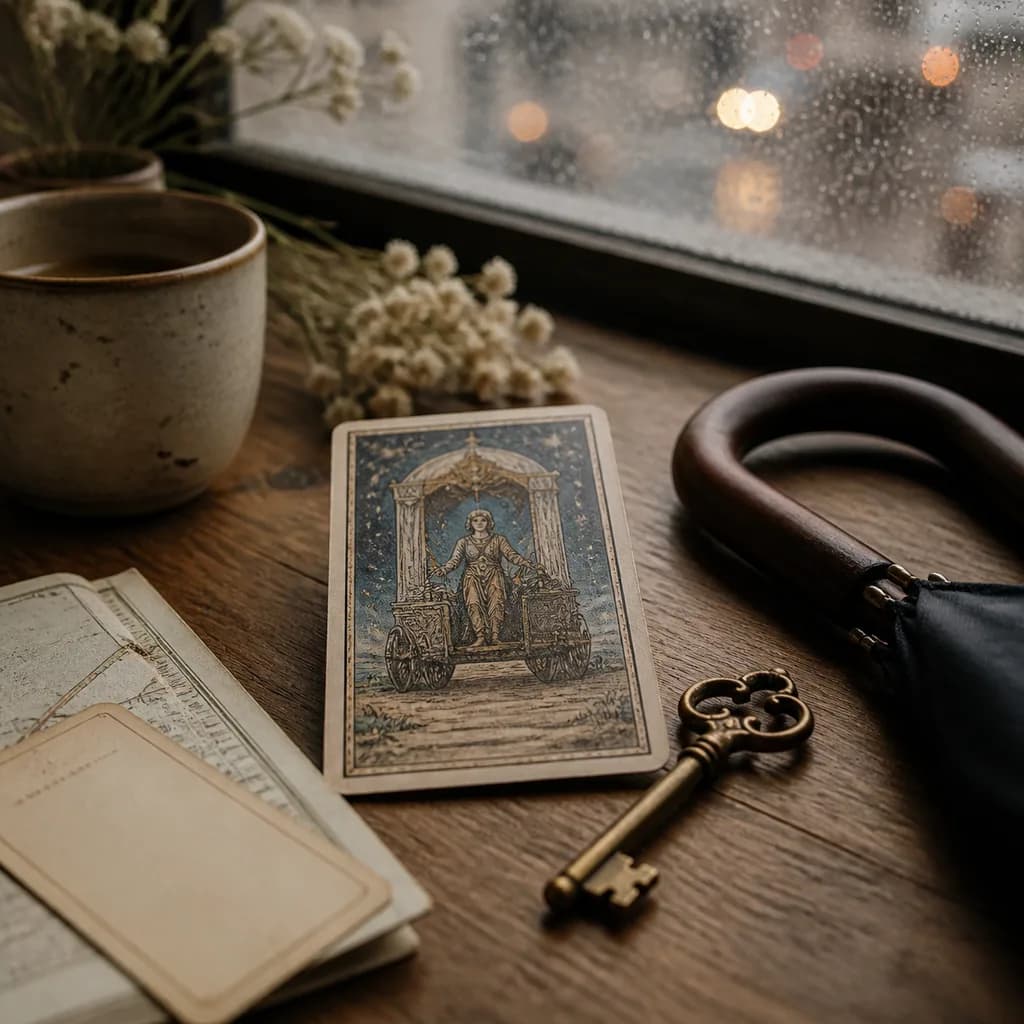
A charioteer in armor stands in a stone vehicle, holding no reins. Two sphinxes — one black, one white — sit before him, pulling in different directions. A starry canopy stretches above. A wall and city lie behind him.
The Two Sphinxes
The sphinxes are the card's central image. They face opposite directions; without reins, they should pull the chariot apart. They don't, because the charioteer holds them together by will alone. This is the practical message of the card — the opposing forces in your life right now (work and family, ambition and rest, two equally valid paths) are not enemies. They are the engine. The skill is not eliminating one but harnessing both.
No Reins
The missing reins are deliberate. In every other depiction of a horse-drawn vehicle in tarot, reins exist. Here they don't, because the chariot moves through concentration rather than physical control. The card is asking whether your willpower is genuinely focused — not whether you have the right tools.
The Armor and the City Behind
The charioteer wears armor but no helmet — protection without losing perception. The city behind him is what he built; he is leaving it deliberately, not fleeing it. This matters in reading: The Chariot is not running away. It is moving toward.
The Starry Canopy
The canopy of stars connects the card to a larger order. Will alone is not enough; the journey has to align with something bigger than personal ambition. When this card appears for someone whose drive has become purely egoic, the canopy is the rebuke — what are you driving toward?
The Chariot Upright Meaning
When this card appears upright, it indicates a moment of focused forward movement. You have competing forces in your life, and the answer is not to resolve them but to use them.
Core Upright Keywords
- Willpower — Sustained focus over time, not a single burst
- Disciplined Progress — Movement constrained by intentional limits
- Harnessed Opposition — Using contradictions instead of resolving them
- Victory through Control — Outcomes earned by holding your nerve
- Decisive Action — The kind that excludes other possibilities
In-Depth Upright Interpretation
The Chariot upright is what shows up when you've been pulled in two directions and finally chose one — and the moment of choosing released the energy that had been canceling itself out. Notice: the card doesn't come for people who have it easy. It comes for people running a startup while raising young children, for athletes returning from injury, for anyone working a demanding day job while building something at night.
A client of mine in Tokyo drew this card three months into a brutal career pivot — leaving a senior role in finance to build a small studio practice. The two sphinxes in her reading were obvious: the security she had left and the work she had not yet built. The Chariot didn't promise her success. It told her she was, for the first time in years, actually moving — and that staying still would have been the failure, not this discomfort.
Cancer rules this card, which surprises people who expect a fiery sign for such an aggressive image. Cancer's element is water — emotion held inside hard armor. That's exactly the energy The Chariot describes: vulnerability protected by structure, advance possible only because the inner life is contained.
The Chariot Reversed Meaning
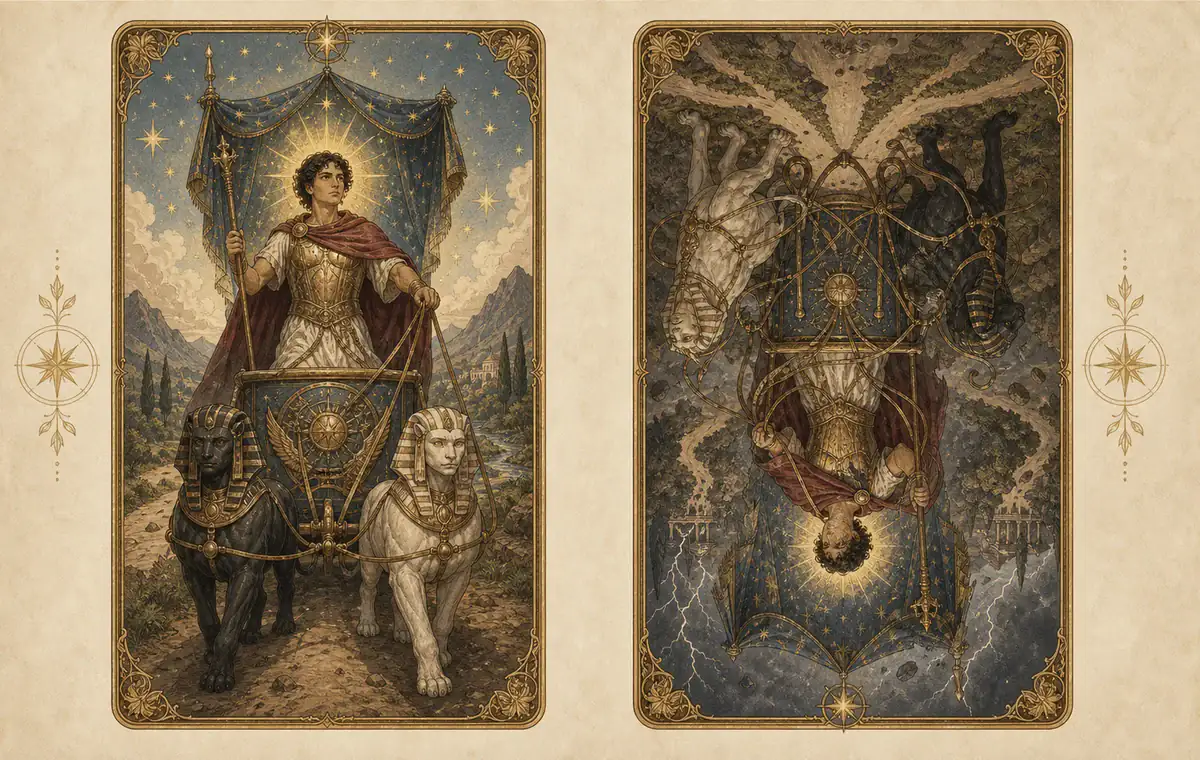
Reversed, the card points to one of two failure modes — and the difference matters for what to do next.
Core Reversed Keywords
- Loss of Direction — Movement without destination
- Scattered Force — Effort spread too thin to matter
- Aggression — Force used where discipline was needed
- Indirection — Avoiding the choice the card requires
- Burnout — Will exhausted by sustained internal conflict
In-Depth Reversed Interpretation
The first failure mode is collapse. You've been holding two opposing forces together by sheer willpower for too long, and the harness has frayed. The sphinxes are pulling you apart now — the demands of work and home, two contradictory goals, two loyalties — and you no longer have the inner reserves to align them. The fix isn't more discipline. The fix is recognizing that one of the two has to actually be released, at least temporarily.
The second failure mode is misdirection. You are still moving with force, but you've lost track of why. Activity has replaced direction. This is the card of busy people who are accomplishing nothing important — the entrepreneur shipping features instead of testing the hypothesis, the athlete training harder instead of resting, the relationship "working on itself" instead of having the conversation. Stop. Look up at the canopy. What are you driving toward?
The Chariot in Love & Relationships
Upright in a love reading, The Chariot is a card of intentional movement in the relationship — committing, moving in together, navigating a long-distance arrangement, surviving a major external stress together. It indicates that the couple's combined willpower is enough to clear the obstacle in front of them, but only if both people are pulling in the same direction.
For singles, the card points to someone who knows what they want — sometimes refreshing, sometimes intimidating. The Chariot energy in dating is direct: "I'm interested, here's what I'm building, are you in?" If you draw this card for a new connection, expect speed. To read what that drive feels like from the inside of a person's heart, see the Chariot as someone's feelings.
Reversed in love: the relationship is running on forced momentum that has stopped serving anyone. Either you're together because stopping would feel like failure, or one of you is pushing the relationship in a direction the other isn't ready for. The card asks you to take your hands off the wheel and notice where the actual chemistry wants to go.
The Chariot in Career
The Chariot is one of the strongest career-advance cards in the deck — but its message is more demanding than "you'll win." Upright, the card indicates that the career move you're considering will require sustained focus over months or years, not a single decisive action. People who pull The Chariot for "should I take this job?" tend to discover that the job is takeable but expensive in time and energy. The card doesn't say no. It says, eyes open.
I've seen this card show up almost every time someone is leaving a stable role for a riskier one. The reading is the same: yes, you can do this, but only if you stop trying to keep one foot in the old life.
Reversed: the career path you're forcing is no longer the one you actually want, or the level of effort you're putting in is mismatched to the actual returns. Time to either redirect or rest.
The Chariot vs. Strength: Two Cards of Self-Mastery
These two cards (Chariot VII and Strength VIII) sit next to each other and both depict control. The distinction is important.
The Chariot controls through structure — armor, vehicle, will. The force is external, applied to direction.
Strength controls through softness — the woman holding the lion's mouth open with bare hands. The force is internal, applied to nature itself.
If the question is "should I push harder?", The Chariot says yes if you have a clear destination. Strength says no — gentleness will get you further than force here. Both cards are right; the question is which mode the situation actually calls for.
The Chariot Card Combinations
The Chariot + The Magician
Concentrated manifestation. The Magician's tools applied with The Chariot's focused will. Often the signal that a project you're building is about to break through to its first major win.
The Chariot + The Tower
Forced direction-change. You've been driving hard in one direction; The Tower is the abrupt redirection. Hard period but usually a clarifying one.
The Chariot + The Star
After the struggle, the rest. The Chariot's exhausted forward push being followed by the Star's renewed hope. A good combination after a hard year.
The Chariot + The Eight of Wands
Speed multiplied. Both cards indicate movement; together they often mean a project, message, or change is going to land much faster than expected.
The Chariot + Knight of Swords
Raw drive meeting direction. The Knight of Swords charges fast but with no brake; The Chariot supplies the control the Knight lacks. Together they read as ambition that finally has somewhere to point — speed harnessed instead of speed for its own sake.
The Chariot + The Lovers
Direction chosen consciously. The Lovers' values-aligned choice combined with The Chariot's willpower to execute. Strong combination for any major relocation or partnership-launch decision.
Numerology & Astrological Correspondences
The Meaning of Number 7
Seven is the number of mastery after instability — the integration that follows the disruption of five and the harmony of six. The Chariot at VII is the first card where the protagonist of the Major Arcana applies all the prior lessons in a real-world test. The student becomes the practitioner.
Astrological Correspondence: Cancer
Cancer is a water sign ruled by the Moon. The pairing is the source of the card's tension: hard exterior (the chariot itself, the armor) protecting a fundamentally emotional interior. Cancer's protective instinct is what makes The Chariot's discipline possible. The card is not cold willpower; it is care, weaponized into focus.
Frequently Asked Questions
Is The Chariot a Yes or No card?
Upright: Yes, but with the condition of sustained focus. For "should I do this?" the answer is yes if you can commit to seeing it through without splitting your energy. Reversed: typically No, or "not in the direction you're pushing." The card is honest about the cost of momentum.
What does The Chariot mean for timing?
Cancer season runs late June to late July, and some readers tie The Chariot to that window. More practical: this card almost always indicates a longer journey than the question assumes. If you ask "when will I get there?", the honest answer is "after sustained effort over the next several months."
Why does Cancer rule such an aggressive-looking card?
Because the card's real subject is emotional self-containment. Cancer's gift is the hard shell over the soft body — exactly what The Chariot depicts. The aggression is the surface. The fuel is care.
Does The Chariot indicate a specific person?
When it appears in person-readings, it usually points to a Cancer sun or moon, or to someone whose visible drive masks emotional reserve. Often the kind of person who's running on willpower because they care too much to stop.
What's the difference between The Chariot and the Eight of Wands for "movement"?
Both indicate motion. The Eight of Wands is fast, light, often external — things happening to you or around you, often news or travel. The Chariot is slow, heavy, internal — sustained effort you generate. Pull both in one reading and you have momentum at two different layers.
What if I keep drawing The Chariot for the same question?
A repeating Chariot is usually telling you to stop deliberating and commit to one direction. The card doesn't repeat because the answer is unclear; it repeats because you haven't yet acted on the answer you already know.
Closing
The Chariot is misread as a victory card because the imagery shows armor and forward motion. The deeper reading is more honest: this is the card of the long, contained, internally costly push toward something you've decided is worth the cost. Victory shows up in the imagery because the card respects what discipline produces. But it asks first — are you sure of the direction, and are you willing to hold your nerve all the way there?
Continue with the Major Arcana: read about Strength for the softer counterpart to The Chariot's hard control, or The Lovers for the choice that often precedes the Chariot's push.