A client once told me she'd "finally taken decisive action" on a job she hated: she'd quit by email, mid-shift, without a plan, and felt magnificent for about four days. Then she drew the Knight of Swords and asked whether the card was congratulating her. It wasn't, quite. The Knight of Swords is the most forward-leaning card in the deck, all velocity and conviction, and the hardest thing it asks is whether the thing you just charged at was actually the right hill. Speed feels like progress. The Knight of Swords meaning lives in the gap between the two.
After more than a decade reading the Rider-Waite-Smith deck in Tokyo, this is the court card I most often watch people use to justify a decision they'd already made with their adrenaline. So this guide goes past the standard "ambitious, act fast" summary — the symbolism, the upright and reversed meanings, the three areas where this Knight changes a reading, the combinations that show up most, and the one question the card keeps putting to you: is this momentum aimed, or just fast?
Quick Answer
The Knight of Swords is a Minor Arcana court card in the suit of Swords, tied to the element of Air and the air signs (Gemini, Libra, Aquarius). Upright, it means decisive, intellect-driven action: moving fast on a clear idea, charging straight at a goal, arguing your case with force, cutting through hesitation. Reversed, that same drive comes loose from its target — impulsiveness, scattered or obsessive thinking, recklessness, conflict, words that cut before they think, or energy revved up with nowhere useful to go. Yes / No: upright leans Yes, a fast and emphatic one; reversed leans No, or "yes, but you're about to do it badly."
Card Imagery and Symbolism
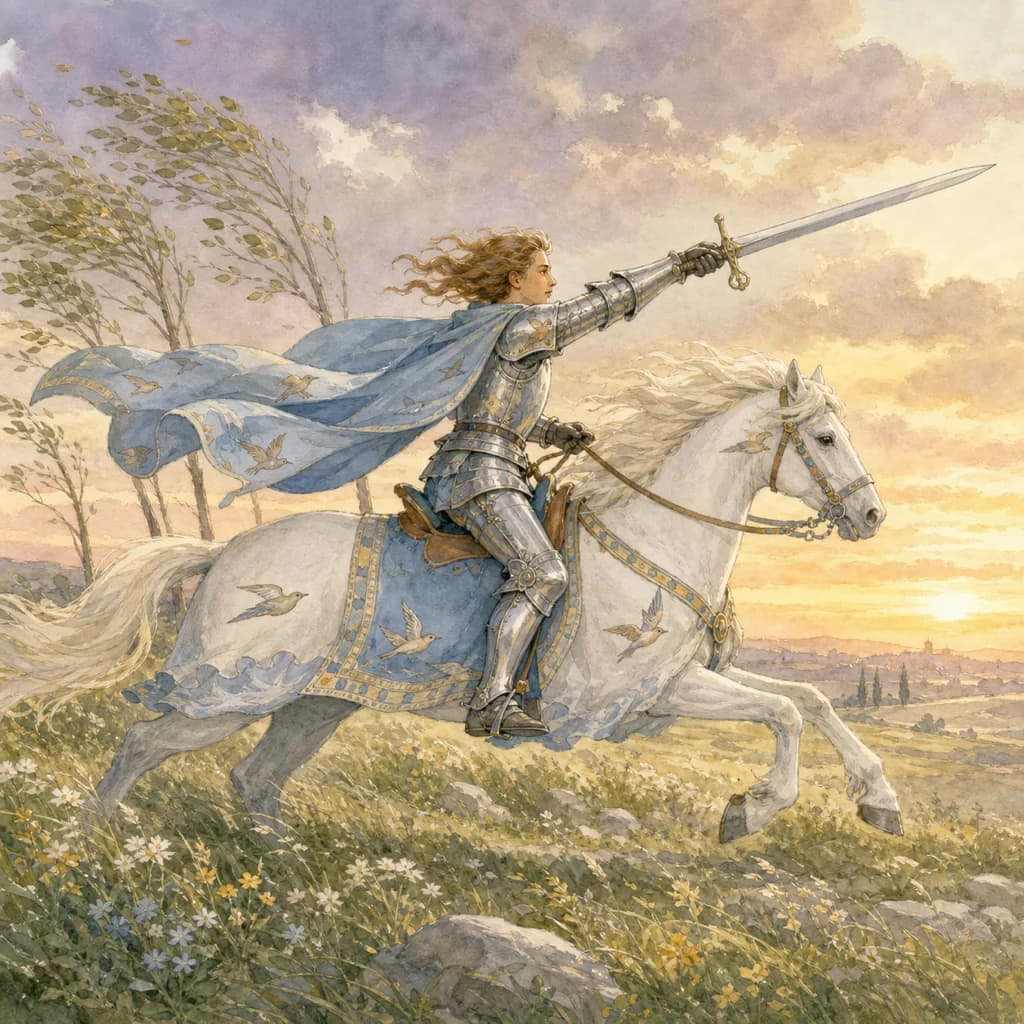
Look at the picture before you reach for a keyword. A knight in full armour charges across the card on a white horse at a flat gallop, sword up and forward, leading the way. The sky behind him is filling with grey storm clouds, and the trees are bent hard in one direction by a wind you can almost hear. Nothing here is still.
Most guides stop at "he charges into the storm, undaunted." That reads the card as a poster for courage and misses what the picture is quietly worried about.
The Forward Sword
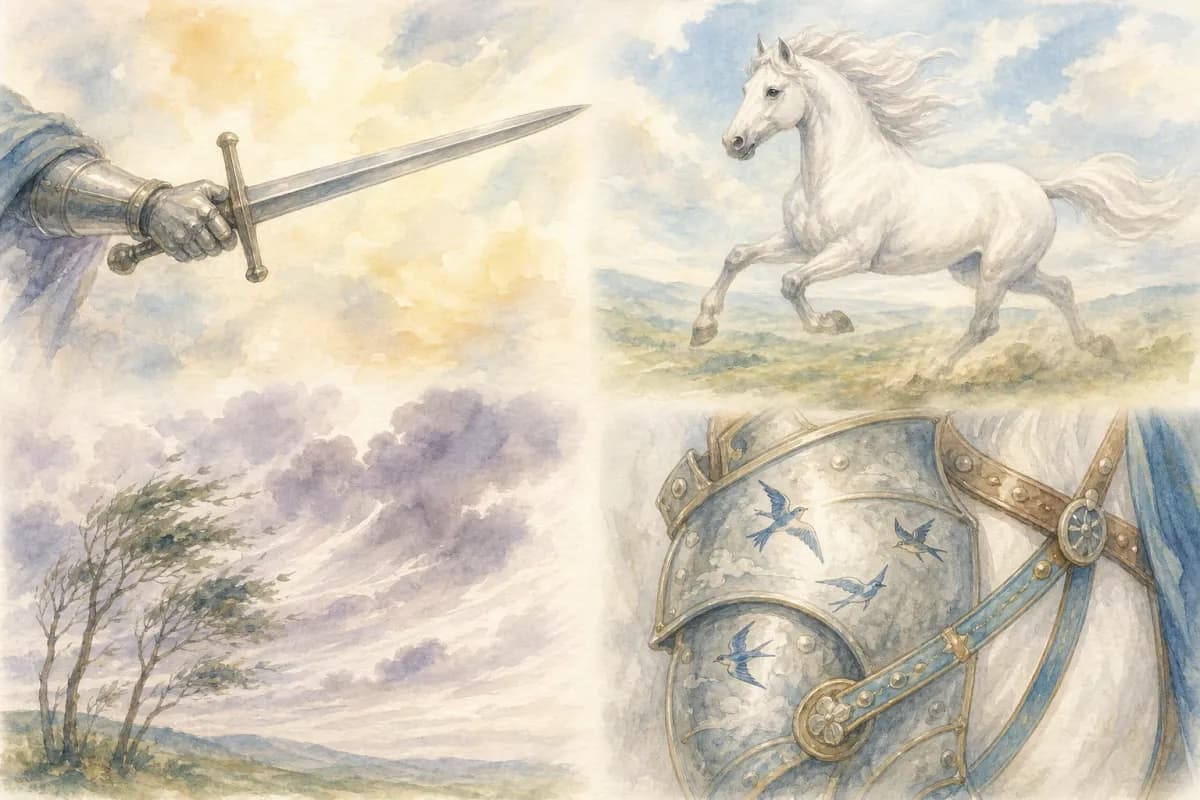
The sword points the way the horse runs — out ahead, into the wind. In the Swords court, this is the only blade held like a lance rather than upright. The Page of Swords holds his two-handed and watchful; the Queen raises hers, weighing; the King's rests across his judgement. Only the Knight has lowered the sword into the line of travel and committed. The detail people skim is that a sword held forward like that cannot also be used to look around — his weapon and his attention point at one thing. That single-mindedness is the upright card's gift and the reversed card's whole problem.
The White Horse and the Wind
The horse is white, the suit's purity of intellect, thought uncoloured by sentiment. But notice it's a horse, not a chariot or a throne. The Knight doesn't own the momentum; he's riding something faster than himself, and a galloping horse is far easier to start than to steer. The wind is the part nearly everyone underreads. The whole environment is moving, and the Knight has chosen to ride the storm rather than wait it out — which is how people end up committing hardest at the worst possible moment, mistaking the adrenaline of bad weather for a signal to go.
The Decorated Armour
His armour and the horse's tack are patterned with small birds, the suit's airy signature, the same creatures that flutter around the Page. On the Knight they're stitched into the gear rather than alive in the sky: the intellect is harnessed, pressed into service of the charge. He has turned his thinking into armour and a weapon — useful in a fight, a liability when what's needed is to feel the situation out. This is the card of the brilliant person who reaches for an argument when the moment called for a pause.
Knight of Swords Upright Meaning
Upright, the Knight of Swords is decisive action driven by the mind. An idea has landed, it's clear, and you're already moving on it — fast, direct, and unwilling to be slowed by doubt or by other people's hesitation.
Core Upright Keywords
- Decisive action — Moving the moment the thinking is done
- Mental clarity — Knowing exactly what you want and why
- Ambition and drive — Charging straight at a goal through resistance
- Directness — Saying the thing plainly, arguing your case without hedging
- Intellectual courage — Standing on a position and defending it
In-Depth Upright Interpretation
When the Knight shows up as energy, it's usually telling you the time for deliberation has closed and the time for action has opened. After a stretch of feeling stuck, this is one of the most welcome cards in the deck. If you've been circling a decision for weeks, the Knight of Swords is the deck nudging you off the fence — pick the direction and ride.
As advice, it's pointed: lead with your head, state your case directly, and don't let fear of friction keep you quiet. I give this reading often to clients who keep softening their emails into mush so nobody's upset. The Knight says send the clear version.
As a person, the upright Knight is the fast talker — quick-witted, intelligent, persuasive, a little restless, the friend who's three steps into a plan while you're still reading the menu. He tends to read as young in spirit and as an air-sign temperament: rational, articulate, drawn to debate, allergic to dithering. Exciting to be around. Occasionally exhausting.
A client of mine in Tokyo, an engineer, drew this card the week he'd been handed a stalled project three people before him had failed to move. I told him the Knight doesn't promise the outcome — it describes the only stance with a chance of working here: stop diagnosing and start shipping. He picked one direction, told the team plainly it was the direction, and rammed it through in a fortnight. It worked, because the project had been dying of deliberation and the Knight's medicine is motion. That's the upright card at its best — decisiveness as a cure for paralysis.
The caution sits inside the gift. The same forward sword that cuts through a stalled project can cut through a relationship, a reputation, or your own judgement just as fast. The upright Knight is right often enough to be dangerous.
Knight of Swords Reversed Meaning
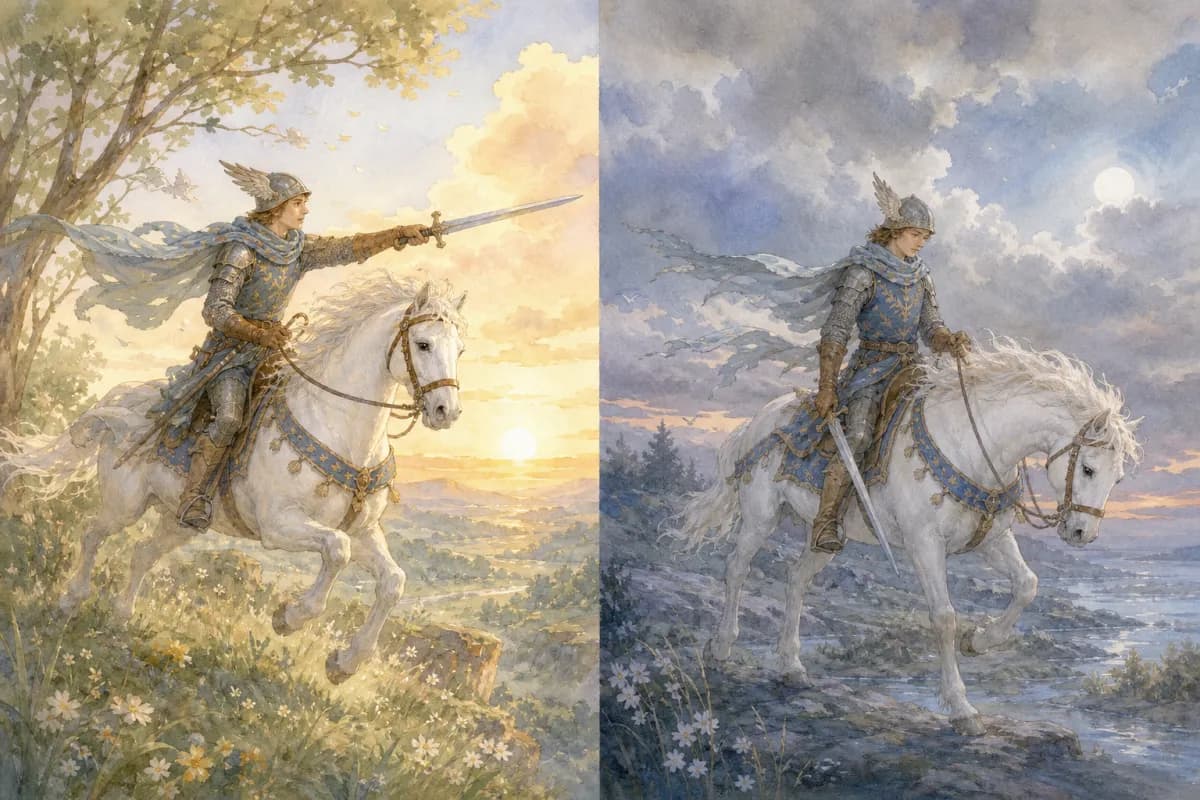
First, the question worth answering plainly: is the reversed Knight of Swords negative? Mostly, yes — more than most reversals, this one points at a real problem rather than a softly "blocked" energy. But the problem comes in two quite different shapes, and reading them as the same thing is the common mistake. One is energy that can't get out. The other is energy that's gotten out and is doing damage. They call for opposite responses.
Core Reversed Keywords
- Impulsiveness — Acting before the thought is finished
- Scattered thinking — Energy sprayed everywhere, nothing completed
- Recklessness — Charging without checking the ground
- Conflict — Words that cut, arguments that escalate fast
- Blocked drive — All the motivation, none of the outlet
In-Depth Reversed Interpretation
The first shape is energy with nowhere to go. The Knight is straining at the reins: you're full of drive and ready to charge, but something has the horse halted — the timing's wrong, the resources aren't there, you're waiting on someone who isn't ready. The frustration builds into restlessness, then into obsessive, tunnel-vision thinking, the same loop run a hundred times because the body wants to move and can't. It's a held charge, and the medicine is a smaller real outlet for the energy plus the hard discipline of waiting that the upright card never has to learn.
The second shape is the charge gone wrong. The horse is loose and the rider has lost the thread. The decisiveness degrades into rashness — snap decisions, constant changes of course, starting everything and finishing nothing. The clarity degrades into noise, thoughts racing too fast to land. And the directness degrades into the reversed Knight's ugliest face: the person who uses cleverness as a blade, who wins arguments to win rather than to find the truth, tactless and cutting, leaving a trail of people who felt run over. At the far end, the old books aren't being dramatic when they name the bully — intelligence and force come unmoored from any care for who gets hurt.
How do I tell the two apart in a live reading? I ask who's frustrated. In the first shape the Knight himself is — the harm points inward at his stalled energy. In the second everyone around him is, and he often isn't — the harm points outward. The neighbours settle it: a stuck waiting card (Eight of Swords, Four of Swords) leans blocked; a conflict card (Five of Swords, The Tower) leans runaway. When the question is specifically how someone feels about you rather than what they're doing, the Knight of Swords as feelings page works through the romantic version of that same hot-then-silent instability.
Is the Knight of Swords Progress, or Just Motion?
This is the blind spot in nearly every Knight of Swords guide I've read. The competitor pages treat the upright as "good, decisive action" and the reversed as "bad, reckless action," as though the difference were visible from outside. It isn't. From outside, decisive and reckless look identical — same speed, same certainty, same refusal to slow down. The galloping horse is the same horse either way. So when the card lands upright and you feel that surge of clarity, how do you know whether you're cutting through resistance or just running off a cliff with great conviction?
You stop measuring how fast you're moving and start measuring whether you can still steer.
Real progress keeps its hand on the rein. You're moving fast, but you could stop if new information arrived — committed to the goal, not married to the route. You can take a hard question without it feeling like an attack, because the point was the destination, not winning.
Motion has dropped the rein. The speed has become the point. New information bounces off; a slow question feels like an obstacle to mow down; stopping feels like losing. The tell isn't the velocity — it's what happens at an obstacle. Aimed momentum slows and recalculates. Loose momentum crashes through it or, worse, spends its whole force on the obstacle itself, which is how a person ends up winning an argument and losing the thing they actually wanted.
So the practical move, whether the card describes you or someone else: don't ask "decisive or reckless?" Ask "if the facts changed right now, could the charge change with them?" If yes, the Knight is upright and the speed is a gift. If nothing could turn this horse, you're looking at the reversed card whichever way it fell — and the storm behind him was never weather to charge through. It was a warning to read the wind first.
Knight of Swords in Work and Ambition
This is the Knight's strongest territory, and the one the love-heavy guides shortchange. Upright, he's close to ideal: you know what you want, you're moving on it, and obstacles read as things to get through rather than reasons to stop. He favours launches, pitches, hard conversations you've been avoiding, projects that have stalled and need someone to simply decide. The advice is to commit and execute — let go of the perfectionism holding the thing in draft, and ship.
The shadow is specific. Reversed, he's the colleague, or the version of you, who's brilliant and impossible: pushy, tactless, mowing people down to hit the goal, earning a reputation as a cutthroat. Or he's the burnout case, revving on every project at once and finishing none. The question isn't whether you're driven; it's whether the drive has a single clear target and whether anyone's still willing to ride with you.
Knight of Swords in Communication and Conflict
Swords is the suit of the mind and the word, and the Knight is its fastest tongue. Upright, he's bold, clear communication — the courage to say the hard true thing and cut through waffle. In a reading about a difficult conversation, he says have it, and have it directly.
But the suit cuts. Reversed is where the Knight does his most common damage: the message fired off in heat, the argument that escalates because both sides are racing to be right, the clever remark that lands like a blade and can't be unsaid. I tell clients who draw this around a conflict to slow exactly one beat — not to go quiet, which isn't this card's nature, but to aim before swinging. Its signature wound is the thing said fast and regretted slowly.
Knight of Swords in Mind and Mental Health
The Knight's whole subject is the speed of thought. Upright, it's sharp, energised, focused thinking. Reversed, it's the mind running too fast to land: racing thoughts, obsessive loops, anxiety dressed up as urgency, the tunnel-vision that mistakes a single fear for the whole horizon. The instruction is almost always the same — the horse needs to be walked, not galloped, the speed itself having become the symptom. The Four of Swords, if it's nearby, is the rest the Knight refuses to take.
Knight of Swords Card Combinations
Knight of Swords + The Tower
Fast action meeting sudden upheaval — a decision made in the heat of a crisis, or a charge that triggers the collapse. When a client draws this around an "I'm just going to do it" impulse, I slow them right down: the pairing warns that the speed and the wreckage are connected, that the thing you're about to ram through may be the thing that brings the tower down.
Knight of Swords + Three of Swords
The cutting words and the heartbreak they cause — the argument that goes too far, the blade of the Knight's tongue landing where it can't be unsaid. Read it as a caution to aim before you swing; the directness is about to wound someone, possibly past repair.
Knight of Swords + The Chariot
Forward drive doubled — and a strong omen for victory through focused will, because the Chariot supplies the control the Knight lacks. When both appear, the charge is likely to actually arrive rather than bolt. One of the better combinations for pushing a hard ambition over the line.
Knight of Swords + Eight of Swords
The held charge made visible. The Knight wants to move; the Eight is the trap of being bound and blindfolded. Together they're the blocked reading — all that drive with the reins locked. The work is on the Eight's imaginary bindings, not on finding more speed.
Knight of Swords + Queen of Swords
Speed meeting clear-eyed judgement. The Queen is the cool head the Knight's hot charge needs; keep the directness but add discernment — say the true thing, but choose which one and when. A good pairing for a hard conversation you want to land rather than just win.
Knight of Swords Reversed + Five of Swords
Conflict for its own sake — the runaway reading confirmed: winning the argument and losing the relationship, force used past the point of any gain. Read it as a hard caution that the fight you're having costs more than it can ever return.
Numerology and Astrological Correspondences
Court cards aren't numbered like the pips, so there's nothing to reduce to a digit. The Knight's "number" is his rank — the suit's energy in motion, after the Page receives the idea and before the Queen and King learn to hold it. He's the action stage: Swords no longer just thinking but charging, the youngest restless force in the court, with the idea and the nerve but not yet the patience.
Astrologically the Knight carries Air in its most active, outward-rushing mode, assigned across the air signs — Gemini's quick mind and quicker tongue, Libra's love of a well-argued case, Aquarius's conviction in an idea. That temperament explains the whole card: thought as the dominant element, communication as the native tool, a chronic impatience with anyone who can't keep up. As a person he often describes someone with strong air placements — fast, articulate, principled, and either a thrilling ally or an exhausting opponent depending on which way the card fell and where that forward sword is pointed.
Frequently Asked Questions
What does the Knight of Swords mean?
Decisive, intellect-driven action — moving fast on a clear idea, charging at a goal through resistance, saying the hard thing plainly. Upright it's ambition and clarity in motion, the deck's cure for paralysis. Reversed, the same drive comes loose: impulsiveness, scattered or obsessive thinking, recklessness, and conflict. The core question is whether the speed is aimed progress or just motion.
Is the Knight of Swords a yes or no card?
Upright, it's a fast, emphatic yes — go, and go now, one of the more decisive "yes" cards in the deck. Reversed, it shifts to no, or to "yes, but you're about to do it badly" — the energy is there but misdirected, so the timing or approach is off even if the goal isn't wrong.
What does the Knight of Swords mean as a person?
A quick-witted, fast-talking individual — assertive, direct, ambitious, a little restless. Often young in spirit and read as an air sign (Gemini, Libra, Aquarius), exciting and persuasive, sometimes blunt to the point of insensitive. Reversed, the same person turns rash, scattered, arrogant, or at the harsh end aggressive and bullying. The surrounding cards tell you whether he's a real individual, a role you're being asked to play, or an energy entering the situation.
What does the Knight of Swords reversed mean?
Two main things. Either energy that's blocked — all the drive with nowhere to go, building into restless, obsessive frustration; or the charge gone wrong — impulsiveness, scattered effort, conflict, cutting words, and at the far end arrogance or bullying. The tell is who's frustrated: in the blocked reading the harm points inward at the Knight himself; in the runaway reading it points outward at everyone around him.
Is the Knight of Swords a good or bad card?
Neither by default — it depends on whether the speed is aimed. Upright, it's genuinely good for breaking out of paralysis and getting a hard thing done. The risk is that decisive and reckless look identical from the outside; the same charge that cuts through a stalled project can cut through a relationship just as fast. Read the direction the sword is pointing before you celebrate the speed.
What does the Knight of Swords mean in love?
Upright, fast-moving, direct, mind-driven romantic energy — a relationship that accelerates, a bold move, a change arriving suddenly. Reversed, it leans toward conflict, mixed signals, or someone not pursuing. For what it means specifically when you've asked how someone feels about you, the Knight of Swords as feelings page goes deeper than a meaning page can.
How is the Knight of Swords different from the Knight of Cups?
The Knight of Swords charges with the mind — fast, blunt, decisive, certain. The Knight of Cups approaches with the heart — romantic, dreamy, slow and serenading. Swords leads with an argument; Cups leads with a feeling.
Closing
The Knight of Swords is the deck's purest portrait of forward motion, and forward motion is the easiest thing to mistake for forward progress. His charge is not automatically courage or automatically recklessness. He's the card that asks you to check, before you ride, whether you can still turn the horse.
So if you've drawn him, do one concrete thing before you act on the surge: name out loud the single fact that would make you change course. If you can name one and mean it, the charge is aimed, the Knight is upright, and you should commit and go. If nothing could turn this horse right now, that's not conviction — that's the storm in the background, and the wiser move is to read the wind first.
Continue with the Swords suit: read the Knight of Swords as feelings for what this card means when you've asked how someone feels about you, or plan a full reading with our love tarot spread guide.