The Hanged Man is the card clients argue with most. They draw it before a job decision, an apartment move, a confrontation they've been rehearsing — and the card says wait. They don't want to wait. They want me to find a different reading. There rarely is one. The Hanged Man means what it appears to mean: a deliberate pause, taken by your own choice, in the middle of something you wanted to push through.
This guide covers the imagery in detail — including the Norse mythological backbone that almost no popular guide names directly — the upright and reversed meanings, and the two cards The Hanged Man is most often confused with (Death and the Four of Swords). The differences between them matter more in practice than most readers acknowledge.
Quick Answer
The Hanged Man is Major Arcana card XII, ruled by Neptune and the element of Water. Upright, it signals voluntary surrender, a pause taken for perspective, sacrifice for a deeper insight, suspension of action. Reversed, it points to resistance to a needed pause, martyrdom, stalling, or — sometimes — the end of a long pause and the return to motion. The card's yes/no answer is no. Or more precisely: not yet.
Basic Information
| Attribute | Details |
|---|---|
| Card Name | The Hanged Man |
| Number | XII (12) |
| Arcana | Major Arcana |
| Element | Water |
| Planetary Correspondence | Neptune (modern); often associated with Pisces |
| Yes / No | No (or "not yet") |
| Upright Keywords | Surrender, pause, new perspective, voluntary sacrifice, suspension, insight |
| Reversed Keywords | Resistance, stalling, martyrdom, missed signal, or release after long pause |
Card Imagery & Symbolism
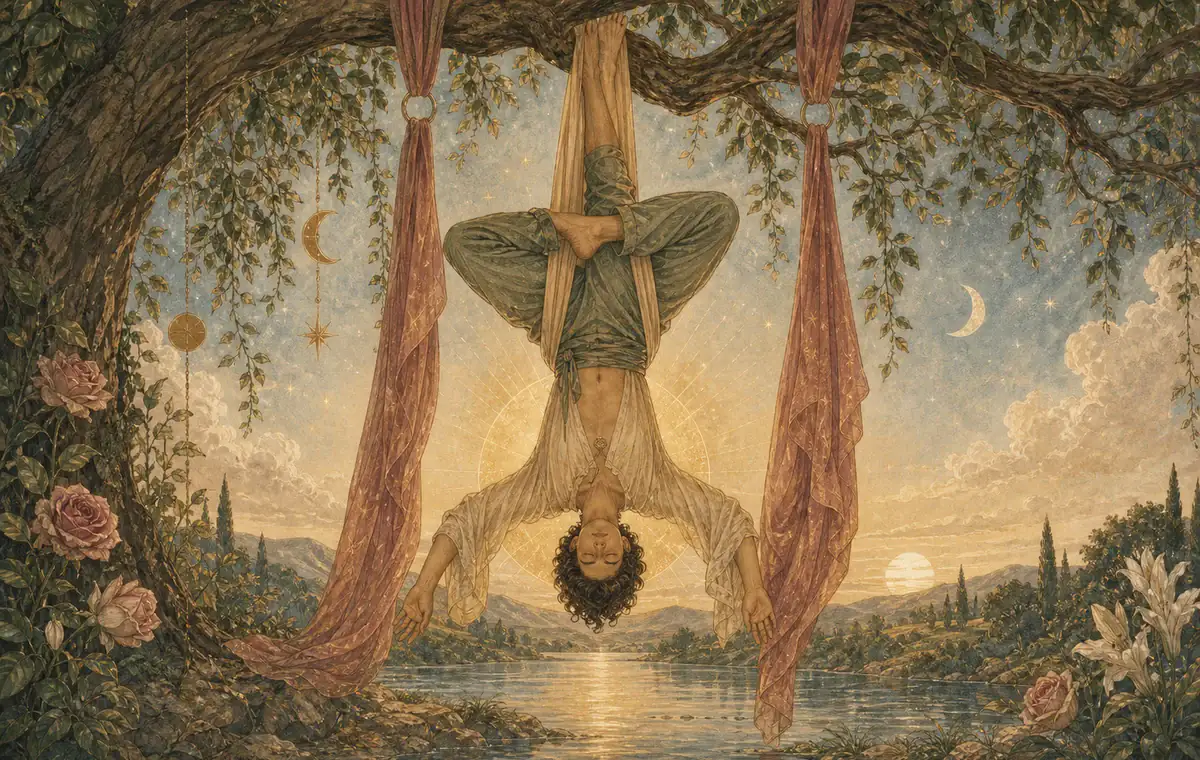
The Hanged Man hangs upside-down from a T-shaped wooden cross — a living tree, in fact, with leaves still on it. His right foot is bound; his left leg crosses behind to form the figure of a 4. His arms are folded behind his back, making an inverted triangle. A bright halo rings his head. His face is calm, not in pain.
This image carries more mythology than any other card in the Major Arcana, and the popular guides on the first page of Google reliably skip the most important piece of it.
The Living Tree: Yggdrasil and Odin
This is the detail Biddy Tarot, Labyrinthos, and Tarot.com all leave out. In Norse mythology, the god Odin hangs himself by one foot from Yggdrasil, the World Tree, for nine days and nine nights — a voluntary sacrifice to gain the wisdom of the runes. He gives up his eye in the process, but more relevantly, he gives up motion. He suspends himself deliberately. He chooses the discomfort. The runes come to him because he stopped going to them.
The Hanged Man is that story painted on a card. The tree is alive (Yggdrasil is the tree of life); the leaves are still on it (the suspension is generative, not deadening); the hanging is voluntary (the calm face tells you so); the halo arrives during the hang, not after. The card is making a specific claim: certain kinds of knowledge only arrive when you stop trying to reach them. The popular guides translate this as "new perspective." That's not wrong — but the actual teaching is sharper. The Hanged Man says you cannot grab the insight. You have to hang there until it grabs you.
The Halo
The yellow halo around his head is the visible mark of the insight already arriving. It isn't waiting for him to come down. The reward of the suspension is happening during the suspension. Beginners often miss this and assume the Hanged Man is a card of paying dues now for payoff later. The card is more interesting than that: the payoff is concurrent with the pause. You are getting something the moment you stop.
The 4-Shape of the Leg
His left leg crosses behind his right to form the digit 4. Aleister Crowley made much of this — the four is the number of the world, of matter, of the cube. By making the four with his body while hanging upside-down, the Hanged Man is "the world inverted." You're seeing material reality from the other side. That's what the perspective shift actually is — not a metaphor but a literal inversion of the frame you were using.
The Red and Blue
Red tights, blue tunic. Red is the body, blue is the spirit; the colour combination is the same one painted on saints and on the Magician (whose colours are reversed — blue robe, red mantle). The pairing here is held together by the suspension. The body is on top, the spirit below; what the Hanged Man surrenders is the ordinary hierarchy.
What He Doesn't Have
Almost as important as what's in the card is what's missing. There's no instrument of torture. There's no executioner. No struggle, no crowd, no shame. The hanging is private and chosen. Western readers educated on Christian crucifixion imagery often import a suffering frame the card doesn't actually carry.
The Hanged Man Upright Meaning
Upright Hanged Man is one of the cards I push back hardest against rushing through. Almost everyone wants the reading to be "things will move soon." The card is rarely saying that.
Core Upright Keywords
- Voluntary pause — A halt you choose, or one you'd be wise to accept
- New perspective — The vantage point only available when you stop
- Sacrifice for insight — Letting something go to receive something else
- Suspension of action — Pressing pause on a decision or push
- Spiritual reorientation — The reordering that happens during the pause
In-Depth Upright Interpretation
The most common reading I give for upright Hanged Man: stop trying to make this happen. Whatever you're pushing on is not the right kind of push, or it's not the right time, or — most often — the situation is going to clarify on its own if you stop interfering. The card asks for a specific posture: stillness chosen, not stillness imposed.
A client I read for last spring was in a job she'd been actively trying to leave for nine months. She drew the Hanged Man three sessions in a row before her promotion review. She hated this. She wanted action cards. I told her — gently, because she was already tired — that the card was asking her to stop sending applications for a stretch. Stop the search. Sit. She didn't want to. She tried it anyway. Within six weeks her manager left and she was offered a much better internal role she hadn't been considering because she'd been so focused on getting out. She was the right person for that role precisely because she had stopped applying frantically and was visible as someone steady. The Hanged Man knew. She had to not push during that window.
That story is not exceptional. Most Hanged Man readings turn out to be about a window in which deliberately not acting is the move. The hardest part of the reading is convincing the client that the card isn't punishing them.
The second, less common upright reading is the one closer to Odin's myth: this is a stretch in which giving something up — comfort, security, an old self-image — buys access to something only available on the other side of that surrender. People in spiritual practice often draw the Hanged Man at the start of a sustained meditation or retreat phase. The card is honest about it: there will be a price, and you'll know it was worth paying only afterwards.
The Hanged Man Reversed Meaning
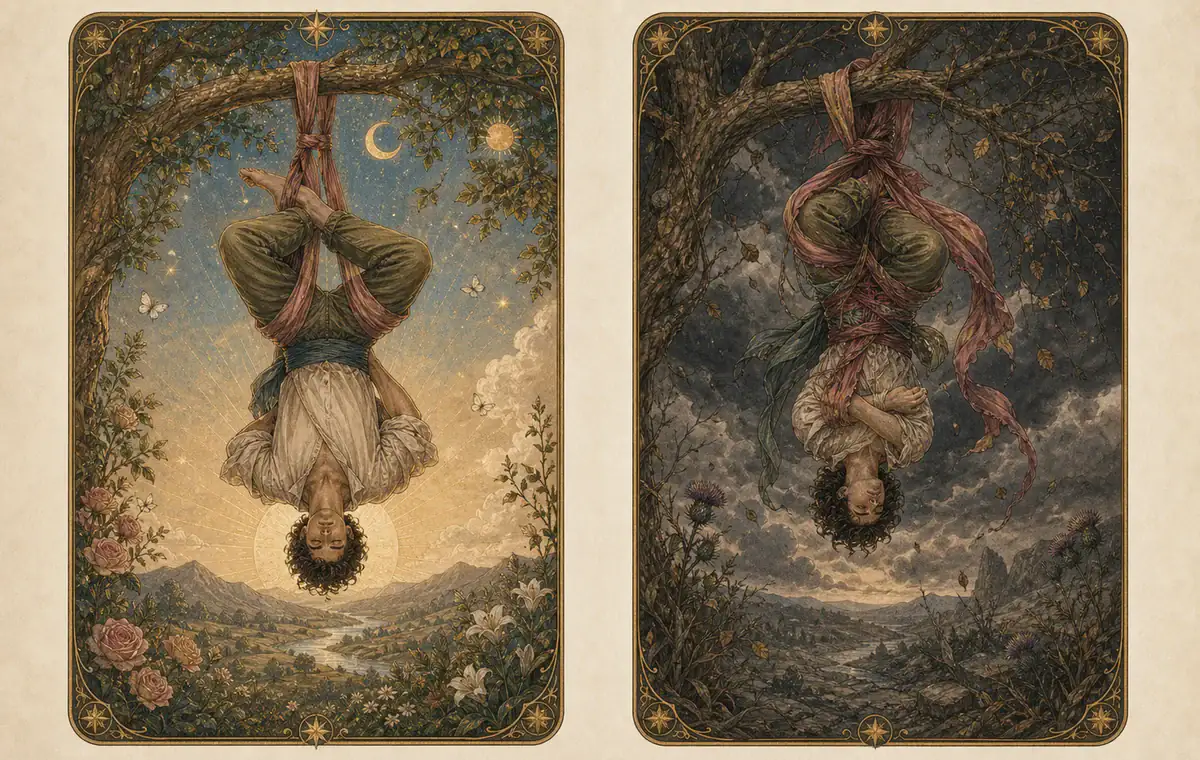
Reversed Hanged Man has two readings that point in opposite directions, and you have to read the surrounding cards to know which one is active.
Core Reversed Keywords
- Resistance to a needed pause — Spinning instead of sitting
- Martyrdom — Sacrifice without the corresponding insight
- Stalling — Pause that has stopped being productive
- Pause ending — The suspension is releasing, motion is returning
In-Depth Reversed Interpretation
The first reading is resistance. The pause is the right move, and you're refusing it. You're filling your days with motion so you don't have to sit with what the stillness would show you. This is the more common reversed pattern in modern life — we have endless tools for not stopping. Reversed Hanged Man here reads as: the surrender is coming, and refusing it is making the eventual stop sharper. Easier to go willingly.
The second reading is martyrdom. You've been sacrificing for a long time and the insight or reward has not come. This is the Hanged Man without his halo — suffering without yield. The card here asks the harder question: are you sure this is a Hanged Man suspension, or have you confused it with someone else's expectation that you stay still? Some "pauses" people are in are actually unsigned contracts to be the one who waits. Reversed Hanged Man calls this out.
The third reading, often a relief to deliver, is release. If you've been in a long, real pause, reversed Hanged Man can mark its end. The suspension has done its work; the perspective has been gained; the motion is returning. This reading is more reliable when reversed Hanged Man appears alongside cards of action — the Chariot, the Eight of Wands, any of the Aces.
The Hanged Man vs. Death: What's the Difference?
These two cards are often confused because both involve "letting go." The distinction is concrete and matters in real readings.
Death (XIII) is closure that doesn't reverse. Something ends. The thing that's ending is over; the chapter does not resume in its previous form. Death is one-directional.
The Hanged Man (XII) is suspension. The pause can end. Motion returns. What's suspended is not over — it's held still. The Hanged Man is recoverable; Death is not.
In practice: if a client draws the Hanged Man around a relationship struggle, the relationship is on pause; it can resume in some form. If they draw Death, the relationship as it was is over, even if some new arrangement might emerge. Mixing these up is the most common diagnostic error I see in beginner reading.
When both appear in a spread (XII followed by XIII is the natural order of the Major Arcana), the meaning is sequential — first a pause, then a closure. This pairing is common before major life transitions that have a "wait, then commit" structure.
The Hanged Man vs. Four of Swords: The Two Pauses
The other card constantly mistaken for the Hanged Man is the Four of Swords. Both are pause cards, but they pause for different reasons.
Four of Swords is recovery. Someone has been in battle (the swords on the wall), is exhausted, and lies down to restore. The pause is medicinal. The frame is rest after exertion.
The Hanged Man is suspension for perspective. There is no battle behind it. The frame is voluntary inversion, not recovery. You stop while still in the situation — not afterwards.
Useful shorthand: Four of Swords is the pause after the storm. The Hanged Man is the pause in the eye of it.
When you draw the Hanged Man and assume it's the Four of Swords ("I just need rest, I'll come back to this fresh"), you're avoiding the harder part of what the card is asking. The Hanged Man requires you to be conscious during the suspension, not unconscious. It's not a nap. It's a watch.
The Hanged Man in Love & Relationships
Upright Hanged Man in love readings almost always points to a stretch where one or both partners need to stop pushing for an answer, a defined status, or a resolution. For couples, it can mean a relationship in a real but undefined phase — the work is happening underneath, and forcing a label will collapse it. For singles, the card often signals a stretch where you stop dating actively and the connection that eventually arrives will find you in stillness.
The client questions I hear most often around this card are variations of "when will they decide?" or "should I push them?" The card's answer is the same one I give: stop pushing. The answer you're chasing will arrive faster if you stop chasing it. This is not romantic strategy; it's what the card says.
Reversed in love most commonly means one partner has been sacrificing too long, or someone is refusing a needed pause in the relationship and demanding answers the situation isn't ready to give. Both readings are common in stuck partnerships.
The Hanged Man in Career & Money
In career readings, upright Hanged Man often appears at the most frustrating moments — when a decision is held up by someone else, when a long project has stalled, when a planned move has been delayed. The card's instruction is consistent: use the delay. Whatever you'd do with the time after the move is the work that the delay is making space for. Most people waste the wait on anxiety. The Hanged Man asks you to use the wait on the thing the move would have interrupted.
For money specifically, Hanged Man indicates a stretch of financial pause — not necessarily lack, but suspended movement. Loans pending, payments delayed, investments holding. Often the right move in this period is the boring one: do nothing dramatic, do the maintenance, wait for clarity.
Reversed Hanged Man in career often signals martyr-mode at work — sacrificing too much for too long without proportionate return. The reading is often the start of someone finally noticing they've been doing this.
The Hanged Man Card Combinations
The Hanged Man + The Hermit
Deliberate withdrawal for insight. Two pause cards together — the suspension paired with the solitude. Often appears around major life recalibrations, spiritual retreats, periods of intentional reorientation.
The Hanged Man + Eight of Cups
Walking away to gain perspective. The Hanged Man pauses; the Eight of Cups departs. Together they often indicate the necessary leaving of a situation that has stopped offering what you came for.
The Hanged Man + The Wheel of Fortune
A pause inside a turning cycle. The wheel is moving, but your role in this stretch is to stay still while it turns. One of the most strategically useful combinations in the deck — it tells you both that change is coming and that your job is to be the still point inside it.
The Hanged Man + The Magician
Will paused. Often shows up for clients who are gifted at making things happen and are being asked to stop making things happen for a stretch. The Magician hates this. The Hanged Man asks anyway.
The Hanged Man + Ten of Swords
A long suffering that's about to end. The Ten of Swords is rock bottom; the Hanged Man is the moment of accepting it. Together they often appear before the actual turn — the dawn that follows acceptance, not the dawn that follows action.
Numerology & Astrological Correspondences
The Meaning of Number 12
Twelve is a number of completion — the twelve signs of the zodiac, the twelve months, the twelve hours. But the Hanged Man is the upside-down twelve. The completion is being viewed from the other side. This is also the card that pairs structurally with Card XXI, The World — if you read the Major Arcana as a 21-step journey, XII is the inversion of XXI. The World is completion arrived at; the Hanged Man is completion glimpsed by hanging the wrong way up.
Astrological Correspondence: Neptune and Pisces
Neptune (modern ruler) and Pisces are the natural correspondences. Both are about dissolution of fixed boundaries — Pisces is the sign where the ego boundaries soften enough for the larger picture to come through. Neptune's energy is precisely what the Hanged Man depicts: not action, not decision, but the loosening that lets a different vision in.
Neptune's shadow is delusion, escapism, drowning in the dissolution rather than learning from it. Reversed Hanged Man often slides toward Neptune's shadow — pause that has turned into avoidance, sacrifice that has turned into self-erasure.
In Japanese タロット占い the Hanged Man is often translated 「吊された男」 with strong overtones of 修行 (shugyō — disciplined practice). The Japanese reading tends to emphasise the chosen-discipline aspect of the suspension more than the "victim" framing some Western readers default to, and I find it closer to what the card actually shows.
Frequently Asked Questions
Is The Hanged Man a Yes or No card?
The Hanged Man is a No, with a softness. More precisely: "not yet." If you're asking the card a binary question, it's telling you the answer isn't going to arrive in the timeline you're asking on. Sometimes the no is permanent (the situation needs to release); more often it's a "wait, the conditions for a yes haven't formed."
Does The Hanged Man mean a literal sacrifice?
Sometimes, but rarely the dramatic kind. The more common sacrifice is giving up your timeline, your need to know, your assumption that pushing harder will work. Occasionally the card points to a real material sacrifice — money, time, comfort — but the more typical reading is internal: surrender of the assumption that you control this.
How long is the Hanged Man pause?
Variable, but the card itself models nine — Odin hung for nine days. In readings I take the Hanged Man as a season rather than a moment: weeks, months, occasionally a year. If you're drawing it daily for the same question, the larger pause hasn't started yet — it's asking you to actually sit, not just acknowledge.
How does the Japanese tarot tradition read the Hanged Man?
In タロット占い this card is often associated with 修行 (shugyō) — disciplined practice, deliberate suspension for spiritual growth. The Japanese reading emphasises the practitioner's agency in the pause more than the Anglophone tradition does, and tends not to read the card as suffering. I find this framing closer to the card's actual content.
Can the Hanged Man indicate good news?
Yes, often, but the good news is the quality of the pause, not its end. A successful Hanged Man stretch produces insight, recalibration, and the conditions for what comes after. If you can read "you'll know something soon that you couldn't have known by pushing" as good news, then yes — that's exactly what upright Hanged Man promises.
What does it mean to keep drawing the Hanged Man?
You're being asked to actually pause, not just notice that pausing has been suggested. The repeated draws are the card insisting. The pattern usually stops when the client actually sits down — not when they intellectually accept that they should.
Closing
The Hanged Man is the deck's clearest statement that some kinds of progress only happen when you stop trying to make progress. The pause is not the absence of motion. The pause is the motion — done in a different direction, on a different axis, by hanging upside-down for long enough that the world reorders itself around the inversion.
If you've drawn the Hanged Man, the most useful thing I can tell you is the thing my client didn't want to hear: stop. Stop the search, stop the push, stop the rehearsal of the conversation, stop the application, stop trying to make the decision land before its time. The thing you're trying to reach will reach you instead. That's the deal Odin took. It's the deal this card offers.
Continue exploring the Major Arcana: read about The Hermit for the solitude that often accompanies the Hanged Man's pause, or Death for the closure that sometimes follows the suspension.