The Moon is the card most likely to be misread by readers who don't slow down. The popular shorthand — "illusion, fear, deception" — is so common that the card stops doing its actual work, which is much stranger and more useful. The Moon is not warning you that something is hidden. It is naming the specific moment when something half-buried in the unconscious has started rising toward the surface, and you are still deciding whether to let it come up.
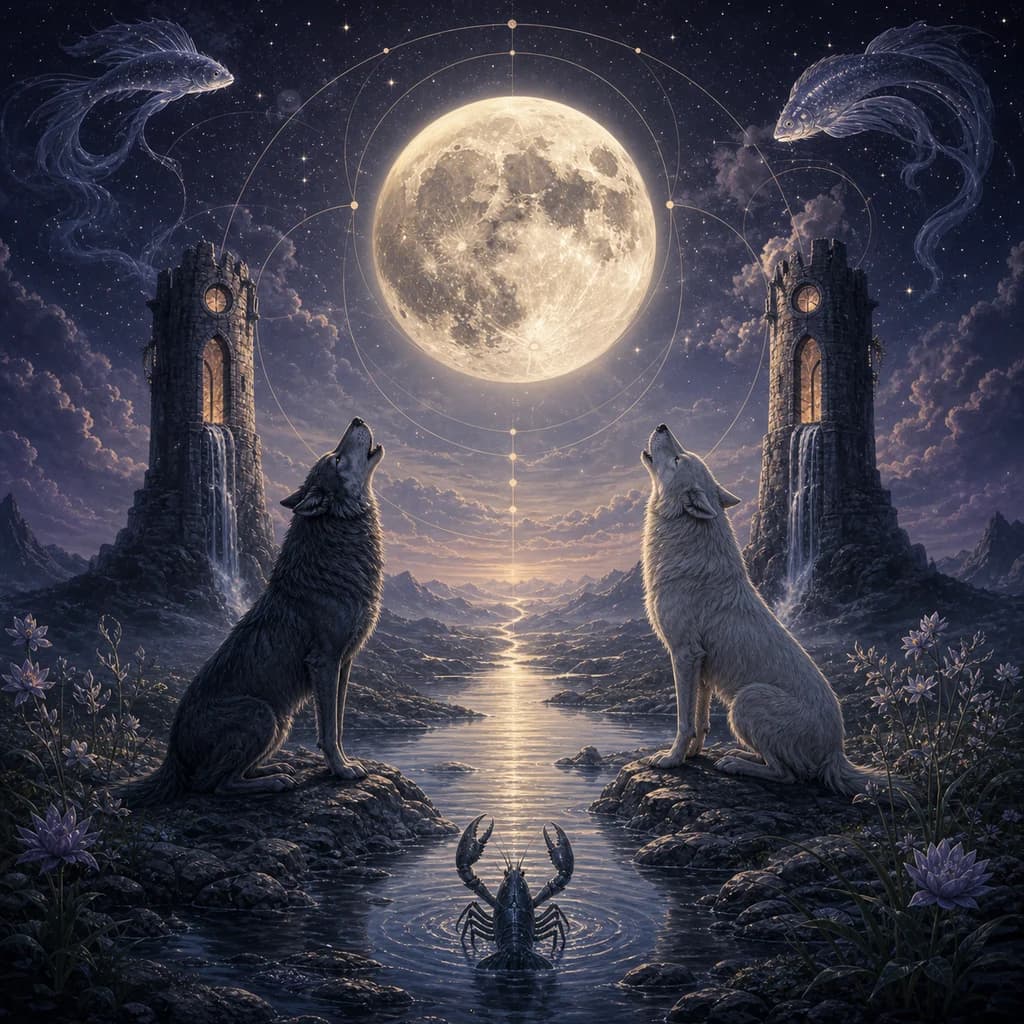
This guide reads The Moon the way the Rider-Waite-Smith image was drawn: with the crayfish only partly out of the water (most articles miss this), the dog and the wolf howling at the same moon, the 15 yods drifting down (fewer than The Tower's 22, and rarely counted), and the two towers — the same towers from the Death card — flanking the path. It covers the Pisces rulership, the upright and reversed meanings, and how The Moon differs from The Star and The High Priestess, the two cards it shares a vocabulary with.
Quick Answer
The Moon is Major Arcana card XVIII, ruled by Pisces and the element of Water. Upright, it signals the rising of unconscious material, ambiguity, projected fear, intuitive openings, and a period when nothing in front of you is exactly what it appears to be. Reversed, it suggests fears clearing, secrets coming to light, or — less hopefully — a continued refusal to look at what is asking to be seen. Yes/No: No. While part of the picture is still hidden, the Moon won't say yes.
Basic Information
| Attribute | Details |
|---|---|
| Card Name | The Moon |
| Number | XVIII (18) |
| Arcana | Major Arcana |
| Element | Water |
| Zodiac Correspondence | Pisces (ruled by Neptune) |
| Hebrew Letter | Qoph (back of the head) |
| Yes / No | Unclear; The Moon refuses the question |
| Upright Keywords | Illusion, fear, intuition, unconscious, dreams, projection, ambiguity |
| Reversed Keywords | Clearing fears, secrets revealed, intuitive blockage, continued avoidance |
Why The Moon Sits Between The Star and The Sun
A short detour before the imagery, because the position frames the card.
The Moon is XVIII. The card before it is The Star (hope, orientation). The card after it is The Sun (clarity, joy). The Moon is the test in the middle. The Star establishes the direction you're walking; The Sun delivers the arrival; The Moon is the night you walk through to get there, when the path runs between water and field and the same hope that oriented you starts looking dubious in the dark.
Most readers want to skip The Moon. Most clients want to skip The Moon. The deck is structurally claiming you cannot. The Star without The Moon is sentimental optimism; The Sun without The Moon is bypass spirituality. The Moon is where the orientation gets tested by doubt, which is the only way it earns enough weight to survive contact with reality.
I bring this up in every Moon reading. The card is not a punishment placed between two hopeful cards. It is the bridge that makes them honest.
Card Imagery & Symbolism
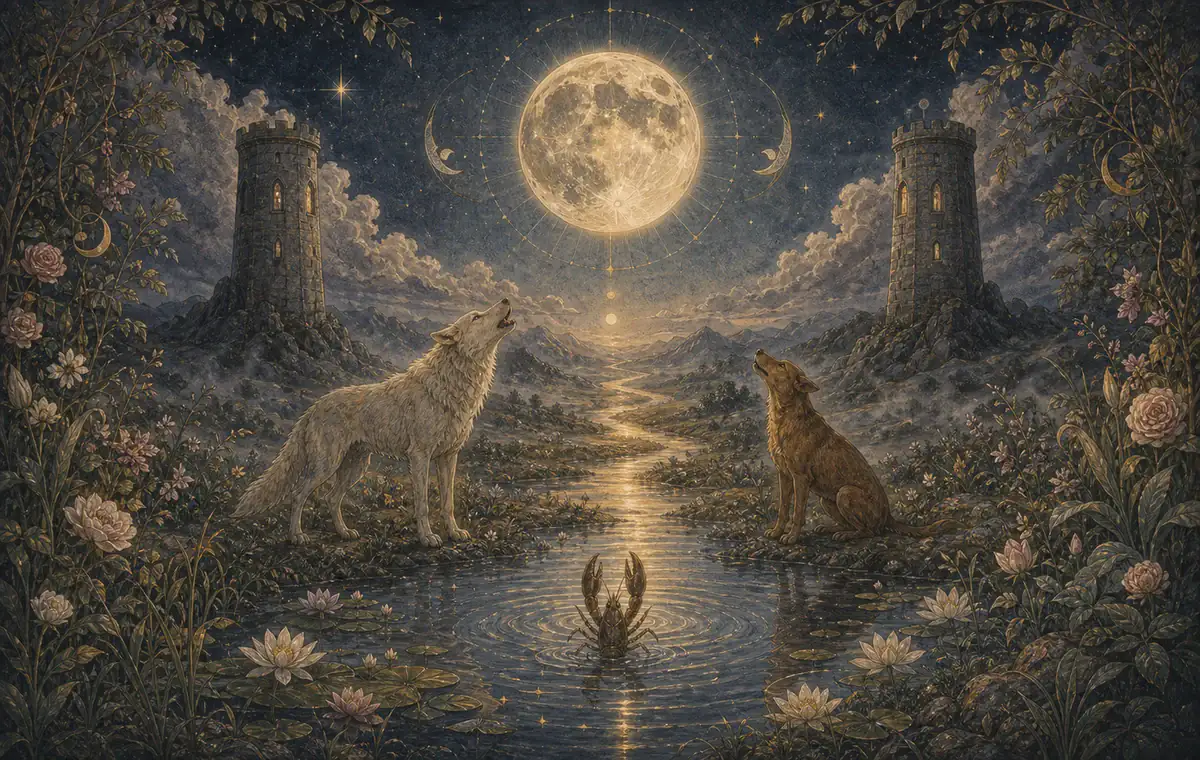
A pale moon hangs in the sky, drawn with both a crescent profile and a full disc visible — a full lunar cycle compressed into one image. Fifteen small yods drift down from it. Below, a dog and a wolf stand in a field, heads tilted up, howling at the moon. Between them, a path begins at a pool in the foreground and runs back into the distance, passing between two grey stone towers and continuing to the horizon. A small crayfish emerges from the pool, only partly out of the water.
Read every element. The Moon's vocabulary is precise even when its message isn't.
The Crayfish, Only Partly Out
This is the detail most articles mention without explaining. The crayfish is not on the bank. It is not still underwater. It is halfway. Mid-emergence. The card is naming a specific developmental moment: something from the unconscious has started rising into awareness, and it has not yet decided whether to commit. The crayfish can sink back. It can also keep climbing. Both are still on the table.
This is what makes Moon readings difficult and useful. The material the card is naming is not yet stable enough to be seen clearly. Pressing it for a clear answer will usually push the crayfish back into the water. The work is to let what's emerging emerge at its own pace.
The Dog and the Wolf
A dog (domesticated mind, civilized response) and a wolf (instinctual mind, wild response) stand together, howling at the same moon. The detail most readings miss is the shared object. Both aspects of the psyche are looking at the same thing. This is not a card about choosing between the tamed and the wild parts of yourself. It is a card about the moment when both look up at the same time, called by the same signal.
In practice this often manifests as a reading where the client's "reasonable" interpretation and their "gut" interpretation are pointing at the same suspicion, and the client is treating them as separate inputs. The Moon is the card that names them as one.
The Two Towers (and Where You've Seen Them Before)
Two grey stone towers flank the path. These are the same towers visible on the Death card — a deliberate visual echo. The Death card showed them at the horizon of an active ending. The Moon shows the path running directly between them. The structural reading is that The Moon is the long walk through the territory that Death's ending opened up. The towers mark the borders of the passage. They are not threats. They are the architecture of the transition.
This cross-reference is almost never made in popular guides, and it is one of the most useful tools for reading The Moon next to Death or after a major ending.
The 15 Yods
Fifteen small yod-shaped marks drift down from the moon. The Tower had 22 yods; The Moon has 15. The difference matters. The Tower's yods were the seeds of the next configuration falling from the strike — generative debris. The Moon's yods are quieter — they are the slow precipitation of unconscious material into consciousness. Same shape, different physics. The Moon is not destroying anything. It is condensing.
Counting them is worth the minute it takes. Most articles will tell you "yods" without saying how many, and the count is one of the few hard facts inside the card's most ambiguous symbol.
The Two Faces of the Moon
The moon in the image is drawn with both a profile (crescent) and a full disc visible at the same time. This is impossible physically — you cannot see both phases at once — and that's the point. The full lunar cycle is being compressed into one symbol. The Moon is not a moment of moonlight; it is the entire arc of waxing, full, waning, dark, repeating. Time inside this card runs in cycles, not lines.
Pisces and the Shape of Moon-Sight
Pisces — mutable water, ruled by Neptune — is the rulership most popular guides treat as a footnote. It is the key to reading The Moon accurately.
Pisces is the part of the zodiac where boundaries dissolve. Where one feeling becomes another without a clear edge, where dreams blur into waking, where the self loses its outline and becomes porous to whatever is around it. This is the source of both the card's intuitive openness and its propensity for projection and confusion. The same dissolution that lets unconscious material rise also lets external anxieties enter undetected.
In a reading this matters because Moon-flavored intuition is unreliable about origin. The feeling is real. Whether the feeling is yours, or something you've absorbed from someone else, or something you're projecting onto someone else — that requires further work to determine. Pisces under Neptune is the most receptive sign in the zodiac. The card carries the same receptivity, which is its gift and its trap.
Upright Meaning
Upright, The Moon is naming a period when reality is in flux. Information is incomplete, emotional content is rising from places you haven't visited, and the part of you that wants a clear answer is going to keep being denied one. This is not the card's failure. This is the card's work. The Moon is asking you to stop demanding clarity and start observing the territory.
Three specific things often surface under The Moon:
Projected fear. A feeling that something bad is happening or about to happen, based on pattern-match to a past wound rather than current evidence. The fear is real; the threat may not be. The Moon's job is to slow the client down enough to tell the difference.
Genuine intuition. A knowing that arrives without a chain of reasoning. The Moon can be the card that confirms it. The difficulty is that genuine intuition and projected fear feel almost identical from the inside. Time and patience are the only reliable filters.
Buried information. A truth — about yourself, about someone close to you, about a situation — that has been kept underwater. The Moon often appears in the weeks before that information surfaces. Sometimes the client is the one who has been keeping it down.
A reading from late last year: a Tokyo client came in convinced her partner was cheating. She drew The Moon three sessions in a row. Each time I asked her to slow down before acting. The fourth session she brought a different question — about her own undiagnosed depression that had started six months earlier and that she had been treating as a relationship problem. The Moon had been naming projection the whole time. The relationship turned out to be intact. The unmet need was hers. The Moon is patient about which truth it lets rise; sometimes the truth is not the one the client came in looking for.
The Moon Reversed Meaning
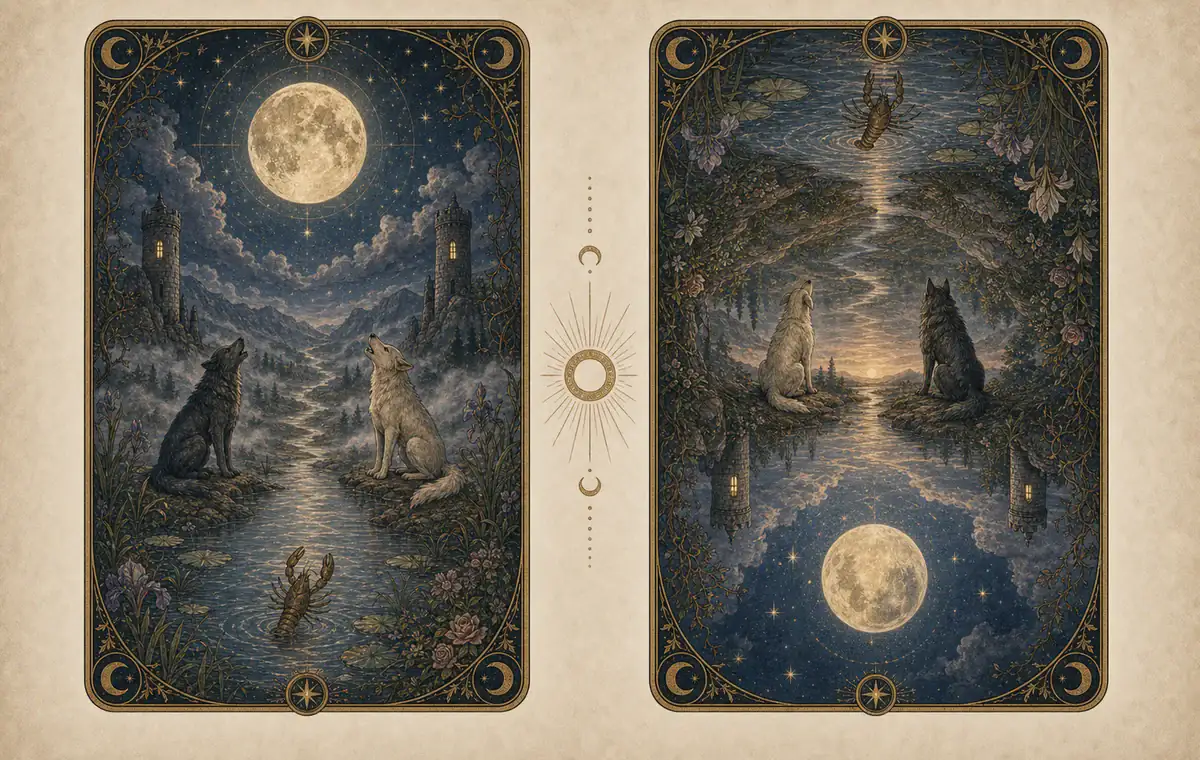
Reversed, The Moon has two honest readings.
Fears clearing. The fog is lifting. What seemed threatening is being revealed as a projection, an old wound, or someone else's anxiety that you absorbed. Information that was hidden is becoming visible. This is the most hopeful reading and the most common one in practice.
Continued avoidance. Less hopefully, the reversed Moon can signal that the rising material has been pushed back down. The crayfish has gone back into the pool. The honest work has been declined, and the card is naming the cost — a continued ambient anxiety with no resolution, because nothing has been allowed to come up far enough to be looked at.
Distinguishing them depends on context. Cards of relief nearby (The Star, Four of Swords, Six of Cups in a healing context) usually point to the first reading. Cards of repression (Two of Swords, Seven of Cups, Four of Cups) often point to the second.
The Moon vs. The Star vs. The High Priestess
Three cards that share a vocabulary of water, night, intuition, and feminine receptive force. They are not the same:
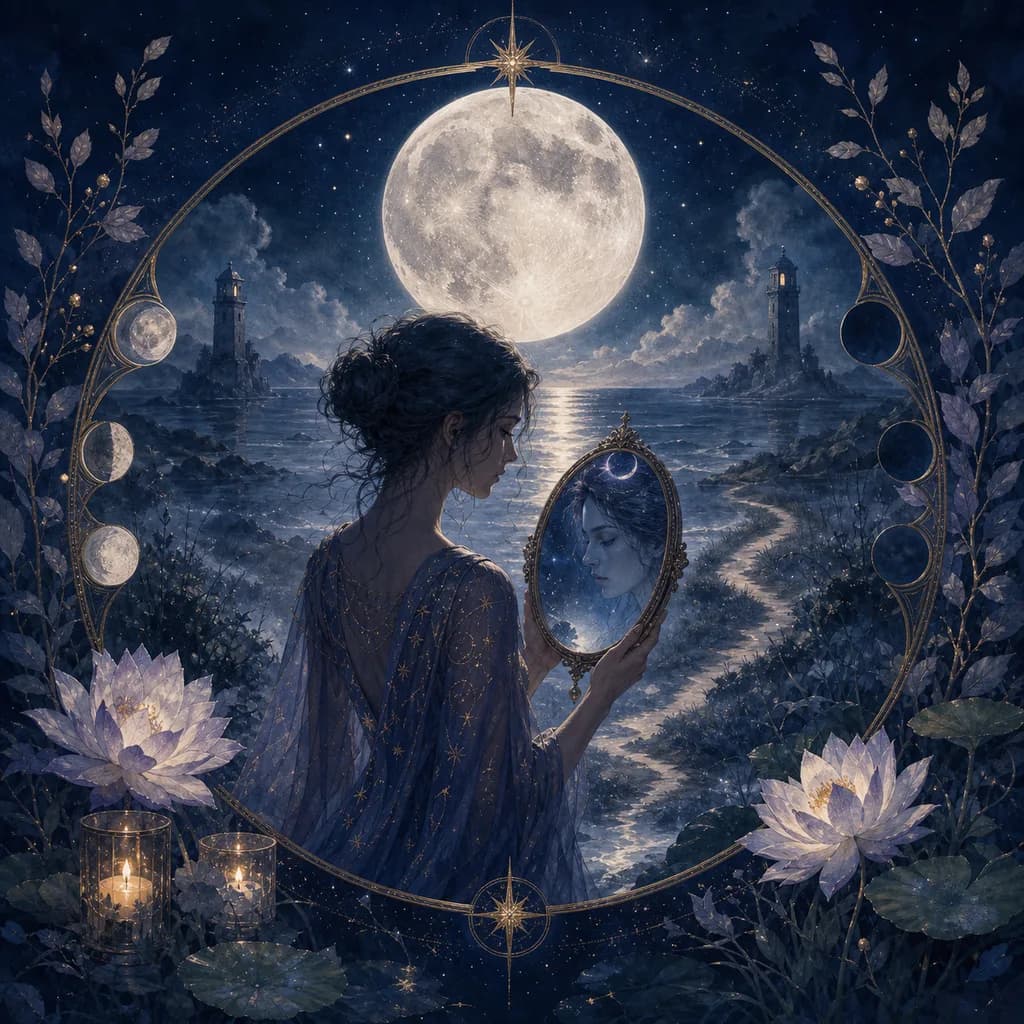
The Star (XVII): night sky, calm water, the hope that orients you. Light arrives as direction.
The Moon (XVIII): night sky, restless water, the test that earns the hope. Light arrives as ambiguity.
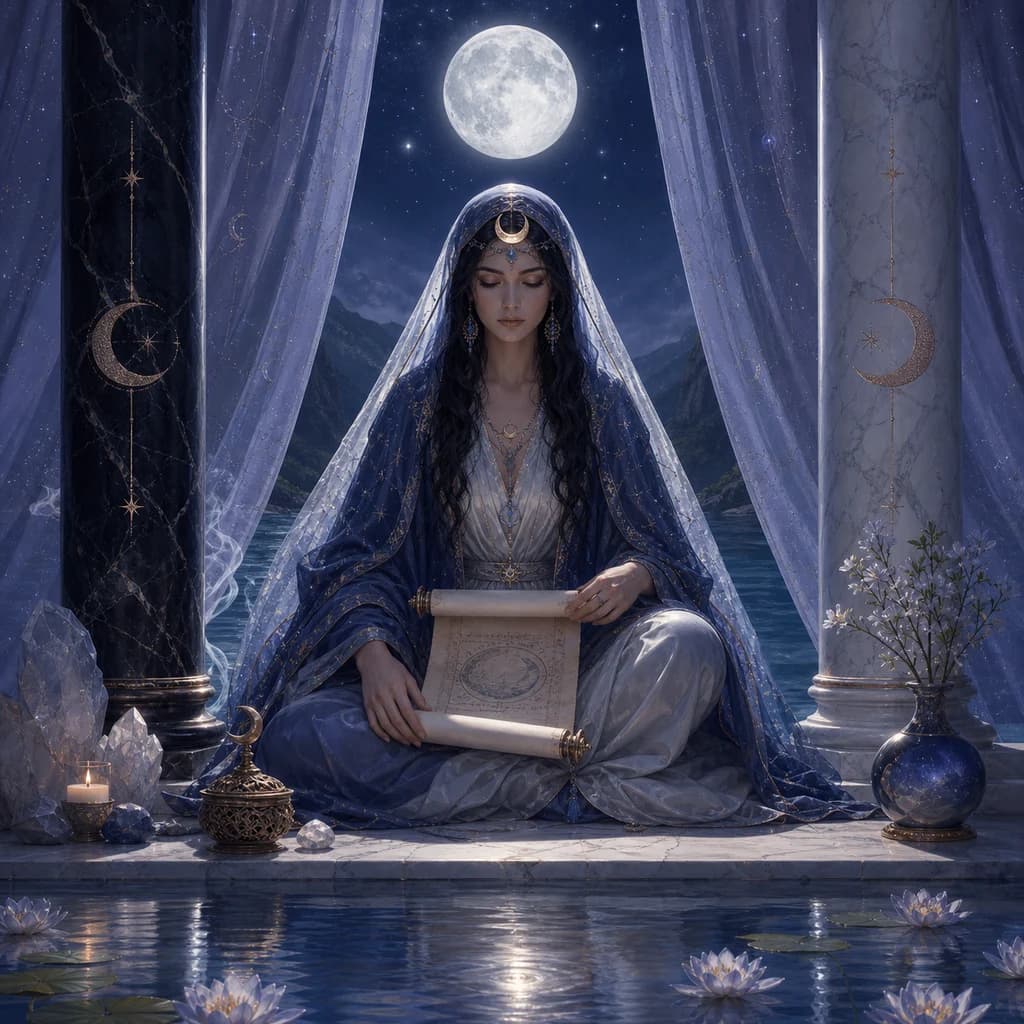
The High Priestess (II): indoor sanctuary, hidden water (behind the curtain), the knowledge that doesn't need to be tested. Light arrives as silent knowing.
Reading any of them as interchangeable flattens the deck. The High Priestess is composed — she already knows what The Moon is still trying to surface. The Star is honest — she has just survived what The Moon is now testing. The Moon is the middle — the passage between the loss the Star survived and the certainty the Priestess holds. Each card answers a different question about how the unconscious is operating.
Love and Relationships
The Moon in a relationship reading is rarely about deception in the cinematic sense. It is far more often about projection — the fear that what hurt before is hurting now, applied to a partner who may or may not be doing the thing being feared. The card is asking you to slow down enough to check.
If the reading is for a relationship that already feels uncertain, The Moon is often naming the ambient anxiety without confirming the suspicion behind it. This is uncomfortable because clients want confirmation. The Moon's honest answer is usually "not yet — keep watching, don't act."
If you are single, The Moon in a love reading often points to a pattern of magical thinking — falling for the projection rather than the person, or maintaining a distance that lets the projection live longer. The card is asking you to look at the actual person in front of you, not the story you've layered onto them.
Career and Money
Career Moons are usually about incomplete information. A workplace dynamic you sense but can't prove, a decision being made above you that you haven't been read into, a project whose actual scope is being hidden by enthusiasm. The reading is patience: do not commit on Moon information. Wait for the picture to clarify.
Money Moons are warnings against speculative decisions made while the picture is unclear. Investments based on gut, contracts signed without full reading, financial agreements with people whose motives haven't been verified. The Moon does not say "don't" — it says "not now, not without more light."
Card Combinations
- The Moon + The Star: hope being tested by doubt. The most honest sequence of healing. Both have to be walked.
- The Moon + The Sun: the night ends. Often the clearest "you will get clarity, just not yet" reading.
- The Moon + The High Priestess: deep intuitive opening. The card to draw if you are learning to read tarot for yourself.
- The Moon + The Devil: the projection has chained you. Often a relationship-with-the-fantasy reading.
- The Moon + Death: the long walk through the towers. A passage with a specific structural meaning.
- The Moon + Eight of Cups: leaving without certainty. The Moon's "you don't need full information to leave" reading.
- The Moon + Nine of Swords: the two great cards of nighttime fear, side by side. The Moon's formless confusion meets the Nine's sharp 3 a.m. dread.
- The Moon + Seven of Cups: fog on fog. Illusion compounded — the Moon's projection layered over the Seven's fantasy menu, the hardest combination to get a clear answer from.
- The Moon + Nine of Cups: the contentment you're not seeing clearly. The wish looks granted, but the Moon asks whether you can trust what you're looking at yet.
- The Moon + Queen of Cups: intuition reaching through the fog. The Queen can feel her way across water the Moon has clouded — her steadiness is what keeps the reading honest. The Knight of Cups beside the Moon reads differently: idealization hiding something murkier underneath the romance.
- The Moon + Two of Swords: a stalemate fed by real fog. The blindfold of the Two meets a situation that genuinely can't be seen yet — sometimes the standstill is wise. Drawn with the Page of Swords, the warning sharpens: you're gathering information that can't be trusted yet.
- The Moon + Seven of Swords: something is not what it seems. Deception inside the fog — where the Moon's ambiguity hides an actual workaround. With the Eight of Swords, the seeing itself is distorted: blindfold plus fog, a self-image you can't yet trust.
Numerology and Astrology
XVIII reduces to 1+8 = 9, which is The Hermit. The link is operative. The Hermit walks alone into the dark with his own lamp; The Moon is the territory The Hermit walks through. Both cards are about navigating ambiguity. The Hermit carries his own light; The Moon withholds external light to force the practice.
Astrologically, Pisces under Neptune gives the card its specific receptivity. The Hebrew letter Qoph means back of the head — the part you can't directly see, the blind spot, the unconscious. The card's symbol is asking you to attend to what you cannot directly observe.
Frequently Asked Questions
Is The Moon a bad card?
No. It is a hard card. The Moon names a period of incomplete information and rising unconscious material — uncomfortable, but not bad. Decisions made well during a Moon period can be among the most honest you'll make, because they are informed by parts of yourself you usually keep buried.
What does The Moon mean for love?
Usually not deception in the obvious sense. More often projection — a fear that what hurt before is hurting now, applied to a partner who may or may not be the source. The card is asking you to slow down and check before reacting.
Does The Moon mean my partner is cheating?
Rarely literally. The Moon flags ambient anxiety and incomplete information, not a specific behavior. Treating it as a confirmation of infidelity is one of the most common ways the card gets misread.
What's the difference between The Moon and The Star?
The Star establishes hope and direction; The Moon tests them. The Star arrives after collapse with the orientation; The Moon is the night you walk through to reach The Sun's clarity. Reading them as interchangeable flattens the recovery arc.
Why is the crayfish only partly out of the water?
Because the card is naming a developmental moment: something from the unconscious has started rising into awareness and has not yet decided whether to commit. The crayfish can climb out or sink back. Both are still possible. Pushing for a clear answer usually sends it back down.
What zodiac sign rules The Moon?
Pisces, ruled by Neptune. The most receptive sign in the zodiac. This rulership is the key to reading the card: Moon-flavored intuition is real, but unreliable about origin — the feeling is yours, but the source may be inside you, in someone close to you, or in the ambient field.
What should I do if I draw The Moon?
Slow down. Do not make irreversible decisions on incomplete information. Pay attention to dreams and to feelings that arrive without explanation. Let the crayfish rise at its own pace. The clarity is on its way — just not today.
Closing
If The Moon drew today, locate the rising material — the feeling, suspicion, or knowing that has started moving toward the surface but is not yet there. Do not press it for clarity. Do not act on it as if it were already certain. Let it come up at its own rate. The Moon's gift is not a clear answer; it is the practice of staying still long enough for the answer to arrive on its own schedule.
For related reading see The Star and The High Priestess.