Ten blades in one man's back, and most readings of the Ten of Swords go wrong right there: people see all ten and assume the disaster is ten times the size, when the card is really measuring the gap between what happened and how thoroughly your own mind has kept stabbing the wound since. Ten of Swords is the deck's image of rock bottom, a more specific and more survivable place than the grim picture suggests, with one piece of good news drawn right into the horizon.
After more than a decade reading the Rider-Waite-Smith deck in Tokyo, this is the Minor Arcana card clients most often arrive already braced for. Someone has seen it in a phone-app reading, googled "ten of swords meaning," and walked in expecting the worst. So this guide goes past the betrayal headline to the question almost no other guide will put to you directly: how much of this is real damage, and how much is your mind making it total.
Quick Answer
The Ten of Swords means a painful, complete ending — the lowest point of a particular ordeal, often involving betrayal, exhaustion, or collapse, after which there is genuinely nothing worse left to come. Upright, the worst has already happened; the card's quiet promise is the sunrise on its horizon. Reversed, it most often points to recovery and the worst lifting, though it can also mean resisting an ending that needs to finish. Yes / No: upright leans No; reversed, a fragile Yes as recovery begins.
Basic Information
| Attribute | Details |
|---|---|
| Card Name | Ten of Swords |
| Suit | Swords |
| Arcana | Minor Arcana |
| Element | Air |
| Astrological Correspondence | Sun in Gemini |
| Yes / No | No (upright); fragile Yes / "recovering" (reversed) |
| Upright Keywords | Painful endings, rock bottom, betrayal, collapse, exhaustion, finality, the worst being over |
| Reversed Keywords | Recovery, release, healing, survival — or resisting an inevitable end, buried wounds |
Card Imagery & Symbolism
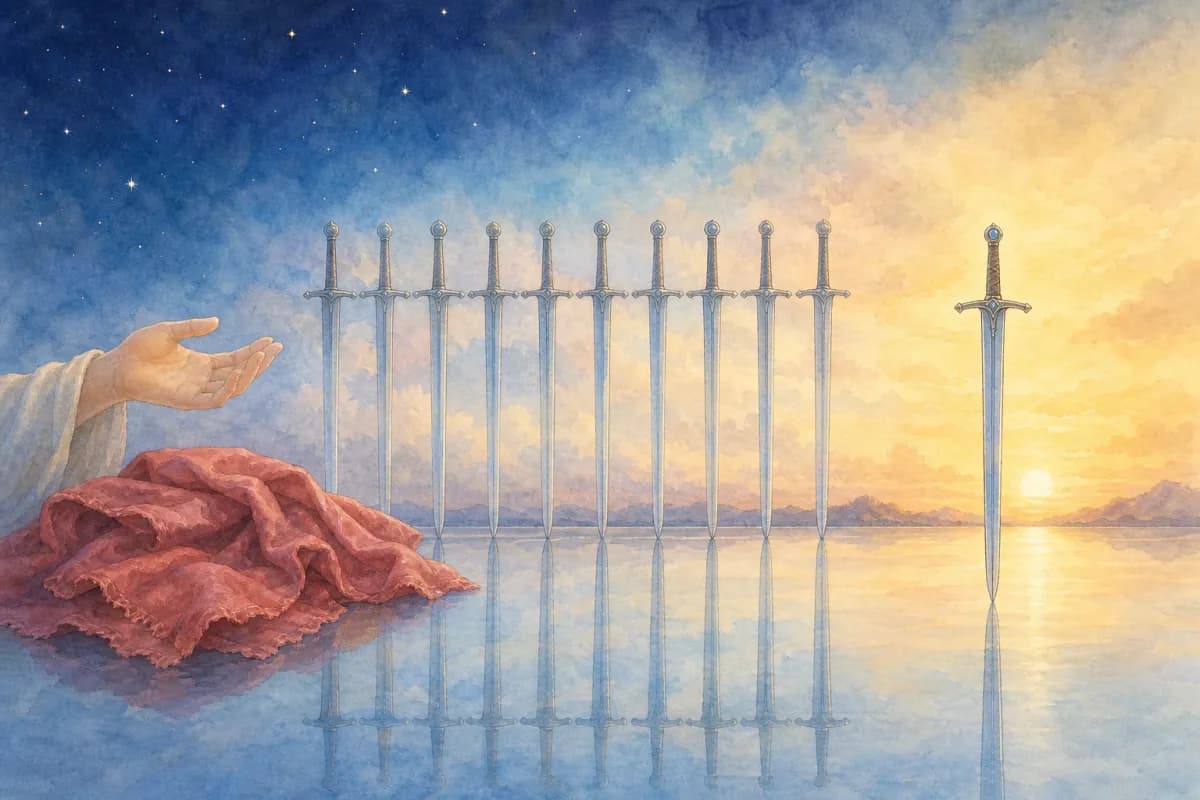
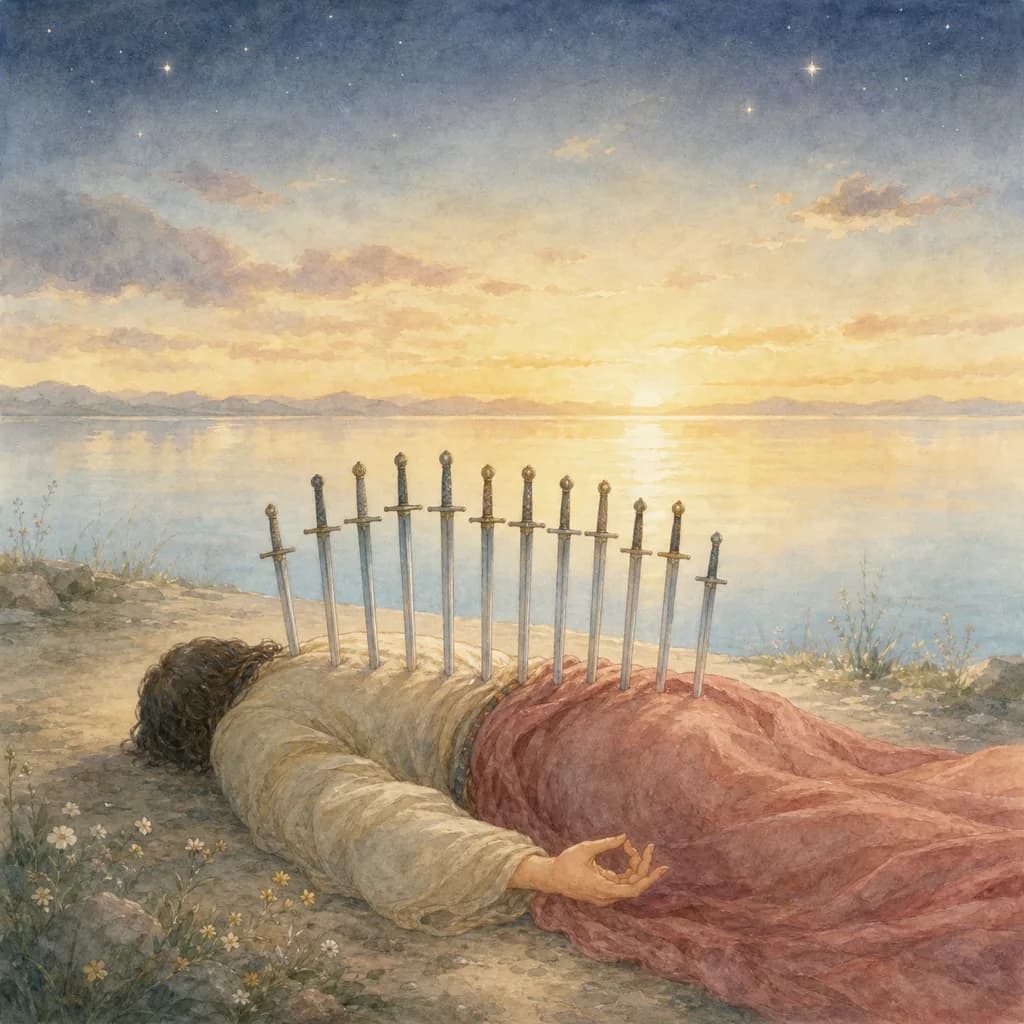
A man lies face down on bare ground at the water's edge, ten swords driven into his back along the line of his spine. The sky above him is black, the water flat and still, and along the horizon, beneath the black, a band of yellow: the sun, either setting or rising. A red cloak covers his lower body. This card is built out of contradictions placed deliberately side by side, and reading it means reading what they argue about.
The Ten Swords: Why the Overkill Matters
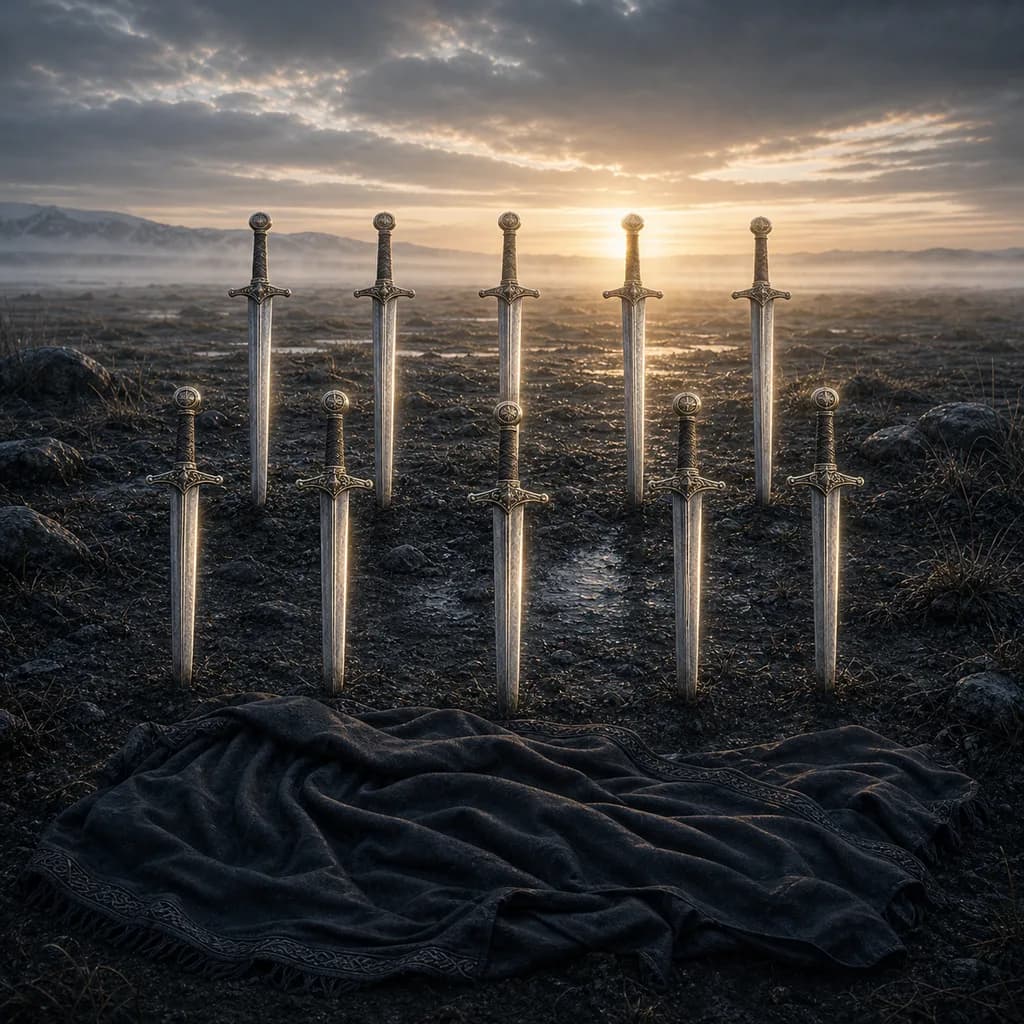
Here is the detail that decides how you read the whole card, and the one people skim straight past. Ten swords is too many. One blade in the back does the killing; the other nine are commentary — the number you reach only when the wounded mind keeps stabbing long after the outcome is settled. In a suit that governs the mind and language, that surplus is a diagnosis, and a working tool I unpack further down.
The Black Sky and the Yellow Horizon
The top half of the card is the darkest sky in the deck; right at the waterline, it turns bright. Whether that band is sunset or sunrise is deliberately undecidable: from what just ended, the sun is going down; from where things go next, it is coming up. The card refuses to settle the matter because the figure has not yet turned his head to look. The dawn is real and waiting on him, and that gap is the card's emotional center.
The Still Water
In front of the fallen figure, the sea is perfectly calm, the tell that separates the Ten from the cards before it. The Three of Swords is the blade going in; the Eight of Swords is the trapped dread before the feared ending; the Nine of Swords is the sleepless night. By the Ten, the churning has stopped and the water is flat because the fight is over. Clients often describe this texture: a strange flatness after the sharp pain, a numbness they mistake for depression when it is the silence that follows a settled ending.
The Red Cloak and the Hand
The red cloak over the man's lower body is a remnant of vitality not yet gone, and his right hand is bent into a sign of benediction, the gesture priests make in blessing. Even at rock bottom, the card holds something sacred about the fall: the figure is broken, but not desecrated, and the ending carries dignity.
Ten of Swords Upright Meaning
Upright, the Ten of Swords is the bottom of a specific descent. Something has reached its absolute end, and the relief buried in that "absolute" is the part the card's reputation hides.
Core Upright Keywords
- Rock bottom — the lowest point of a particular ordeal
- Painful, complete ending — a closure that does not reopen in its old form
- Betrayal — being undone by someone you trusted
- Collapse and exhaustion — giving out after holding on too long
- The worst being over — nothing more to fear from this source
- Forced finality — an unchosen ending that is now undeniable
In-Depth Upright Interpretation
The most useful thing I can tell you about upright Ten of Swords is that it rarely warns of something coming; it describes something that has already landed. When clients pull it asking "what's going to happen," I reframe it as a report instead of a forecast: the worst has occurred or is occurring now. The question then shifts from "how bad will it get" to "what do I do now," and the bottom, counterintuitively, is a stable place to stand.
The classic upright reading is betrayal: the partner who cheated, the colleague who took credit, the friend who repeated a confidence. The stabbed-in-the-back image is literal — the wound came from behind. Yet plenty of Tens have no villain at all. Sometimes you held a dying situation upright by sheer will until you collapsed under it: a job you should have left two years ago, a project you over-extended on until burnout finished it. The card looks the same either way; only who put the swords in differs.
A client came to me in early spring convinced she had drawn "the death card by accident" — she meant the Ten of Swords. Her business partnership had imploded after a year of warning signs, and she wanted me to tell her it could be repaired. I told her the card was confirming a floor it had already reached: the partnership in its old form was over, and the work ahead was simply to stand up. By the end of the session she had moved from pleading to planning — the upright Ten doing its real job, ending the negotiation with a reality that has already decided.
Ten of Swords Reversed Meaning
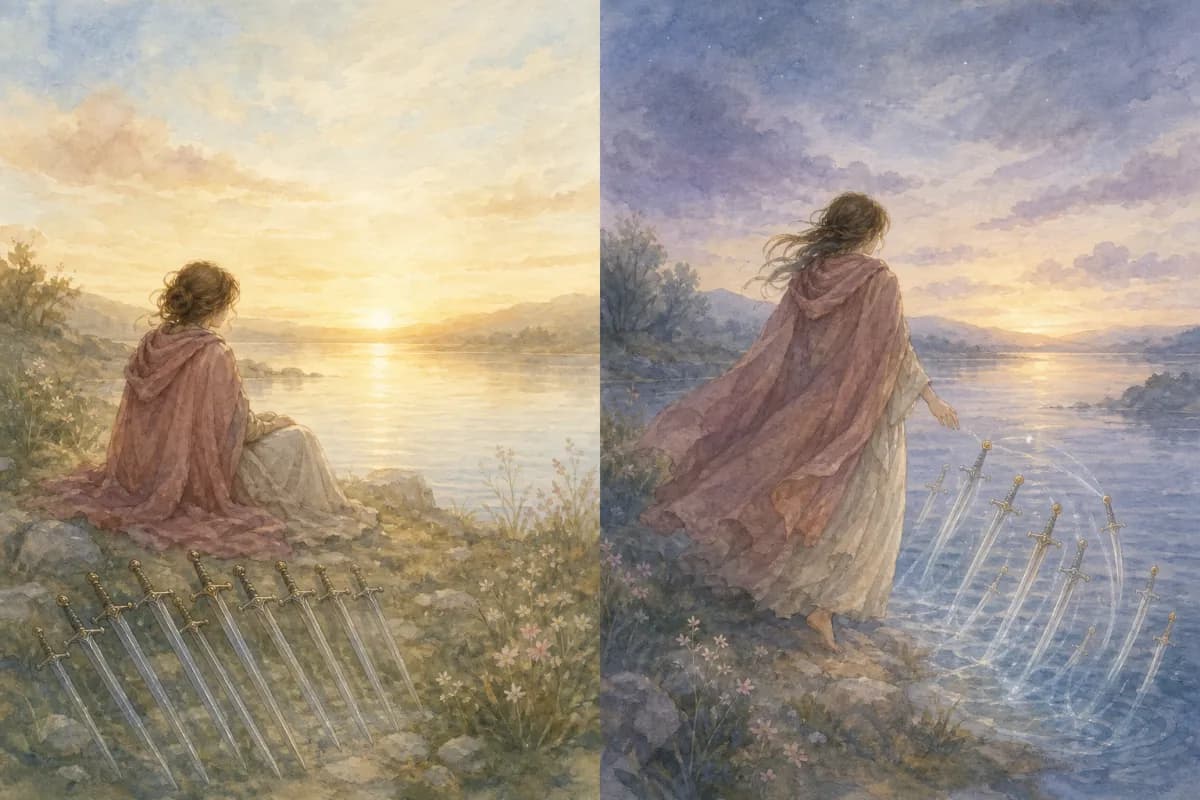
First, the question the card forces: is reversed Ten of Swords negative? Mostly, no — this is one of the reversals I treat as cautiously good news. The dominant reading is recovery: the swords loosening, the figure beginning to rise. But "mostly good" leaves room for trouble, and telling the hopeful reversal apart from the stuck one is the whole skill here.
Core Reversed Keywords
- Recovery — the worst lifting, the figure starting to get up
- Release — the swords sliding out, the pain beginning to drain
- Healing — repair of an old wound, sometimes literal
- Survival — having come through the thing you thought would finish you
- Resisting the inevitable — refusing to let an ending finish
- Buried wounds — old pain pushed so deep you forgot it was still working
In-Depth Reversed Interpretation
The first and most common reading is recovery. Turned over, the swords slip out of the back under their own weight, and the pain that was total starts to drain. This is the card of "you made it through": the convalescence after the worst, the slow return of ordinary appetite for life. When a client has come through a brutal season and pulls reversed Ten, I read it as the floor tilting back toward standing — recovering, which is its own stage short of healed.
The second reading is the harder one: resistance to a finished ending. Here the seeker refuses to let the worst complete. You can see the situation is over and you will not put it down — you keep the dead partnership on life support, re-litigate the betrayal, reopen the closed conversation. The longer this goes, the longer the recovery stays postponed. Tell the two reversals apart by direction: recovery looks forward, resistance looks backward.
The third reading is buried wounds. An old ending you "got over" without processing, now surfacing because something in the present has pressed on the scar. The card asks you to go back and feel the thing you skipped feeling, because a buried wound does not stop working; it just works in the dark. Reversed Ten also carries a literal-health sense — recuperation, the body mending — which I weight more heavily in medical-adjacent questions, with the reminder that tarot does not diagnose.
Is the Ten of Swords Real Damage, or Your Mind Making It Total?
This is the blind spot in almost every Ten of Swords guide I have read, and the most practical thing the card can teach you. The popular guides mention this card "can be melodramatic," then move on without a way to tell which Ten you are holding: genuine structural damage, or a real-but-survivable hurt the Swords-mind has inflated into a catastrophe. The count of the blades, as the symbolism shows, hands you the tool. The first sword is the real damage; the other nine are the inflation, the way "He cancelled the trip" becomes "I am unlovable and always will be." The ratio between those two kinds of pain is what the card measures.
So here is the diagnostic I run with clients, and on myself. Name the event in one plain sentence, just what happened, no adjectives, then notice everything else you are carrying about it. If the plain sentence is genuinely severe and the weight matches it, you are holding the structural Ten: the damage is real, the work is recovery, and you should be gentle with yourself for being on the floor. If the plain sentence is survivable and the weight is crushing, you are holding the melodramatic Ten, and the work is to pull out the nine swords your own mind drove in after the first.
A melodramatic Ten still hurts — the nine commentary-swords hurt as much as the one. What makes this fearsome card hopeful is that nine of them are removable.
Ten of Swords in Career & Burnout
This is the Ten's strongest non-romantic territory. Upright, it is the collapse at the end of holding on too long: the burnout that takes you down, the layoff after months of dread, the project that fails despite everything you poured in, the workplace politics that stab you between the shoulder blades. The card rarely surprises anyone; it confirms something you had felt coming and kept overriding.
The reading I give most often here is permission to stop holding the weight. People draw it while still trying to revive something already over — the role, the company, the career they planned at twenty-five. Your exhaustion is the proof you kept it standing past its time.
Reversed in career is one of the more genuinely encouraging cards I see: the move out of a punishing situation into a lighter one, the recovery after burnout, the relief of having survived the worst year. If your reading is about coming back from a professional low, reversed Ten leans toward yes.
Ten of Swords in Recovery, Mental Health & the Mind
Because Swords is the suit of the mind, I read this card in mental-health-adjacent questions more often than the old guides suggest. Upright, it can describe hitting an emotional bottom, the point where the spiral stops because there is no further down — a turning point, a place with an exit.
Reversed here is the recovery reading at its most literal and welcome: the lifting of a depressive episode, the slow return of energy. Tarot is not a substitute for professional support, and I say so plainly in every reading that touches this ground; the card describes the emotional weather and leaves treatment to those trained for it.
Ten of Swords in Love & Relationships
Upright in love, the Ten of Swords is the painful, complete ending of a relationship or a version of one, usually confirming what has already happened. The betrayal reading is strong: infidelity, a broken confidence, the discovery that undoes the trust the relationship stood on. It can also describe a relationship that collapsed under accumulated weight, no villain required, both people exhausted past repair.
For singles, it more often points to the closing of a painful pattern — the end of a cycle of being drawn to people who leave you on the floor, finished decisively enough that something different becomes possible. For what someone is feeling — whether a silent ex is wounded or genuinely done — the companion Ten of Swords as feelings page carries the behavioral decoder this meaning-focused page leaves to it.
Reversed in love splits the usual way: recovery after a brutal breakup, the slow rebuilding of trust, the healing of an old relational wound — or, less happily, one partner keeping an ended relationship propped up because letting go is harder than holding on.
Ten of Swords Card Combinations
Ten of Swords + Death
Two different endings. Death is structural, a chapter completing on its own terms; the Ten of Swords is the painful low inside that close. Together they most often read as "the worst is over, and the chapter is genuinely finished" — heavy-sounding and actually one of the cleaner, more freeing combinations in the deck.
Ten of Swords + The Tower
A betrayal or collapse that arrived by lightning. The Tower is sudden, structural shock; the Ten of Swords is the personal devastation in its aftermath. I see this around blindsides — the affair revealed out of nowhere, the firing with no warning.
Ten of Swords + The Sun
One of the most hopeful pairings the Ten ever lands in, because The Sun is the dawn the Ten only promises — the yellow band on its horizon becomes full daylight. When both appear, the recovery is coming, and it is bright.
Ten of Swords + Three of Swords
The wound and the rock bottom of the wound, in sequence. The Three is the heartbreak landing; the Ten is where it bottoms out — a grief that has run its full arc, pierced then collapsed, now at the still water. Often appears when someone is further through a loss than they feel.
Ten of Swords + Ace of Pentacles
Rebirth on solid ground. An ending in one domain producing a tangible new beginning in another — a career or living-situation collapse clearing the way for a material fresh start. The Ace is the seed planted in the ground the Ten just cleared.
Numerology & Astrological Correspondences
Tens are the end of the suit's number line, where its energy has run completely to conclusion. The Ten of Swords is the suit of the mind taken to its terminus, and that terminus, when the mind has been turning on a wound, is collapse. That exhaustion of the line is why the card carries both rock bottom and the relief that nothing more remains to come.
Astrologically, the Ten of Swords is assigned to Sun in Gemini: mutable air, the restless, fast-moving mind at its most mental. Placing the bright, vital Sun in that airy sign and carrying it to the suit's final station produces the card's paradox — the mind blazing until it burns through to its end. The light that drove the overthinking is the same light that will rise again.
In Japanese タロット占い, ソードの10 is most often read through 「どん底」(donzoko) — the absolute bottom — and held alongside the proverb 「夜明け前が一番暗い」, darkest just before dawn. The framing my teacher used treated the bottom as a place with an exit, the card's real content beneath the catastrophe the image first suggests.
Frequently Asked Questions
Is the Ten of Swords a yes or no card?
Upright, it leans No — or more precisely "this is over." It is a poor card for hoping a situation continues, because its whole subject is the ending of one. Reversed, it shifts toward a fragile Yes as recovery begins. Read it less as a verdict and more as "not in this current shape."
Does the Ten of Swords always mean betrayal?
No. Betrayal is the most famous reading — the stabbed-in-the-back image makes it the headline — but the card describes any painful, total ending. Sometimes there is no villain at all: a burnout collapse, an exhausted relationship, a project that simply failed. Look at the surrounding cards to see whose hand is on the swords.
Is the Ten of Swords a bad card?
It is a heavy card, though far from a hopeless one. Its most important feature is the sunrise on the horizon: the worst has happened, so the dread of "how much worse will it get" can stop. The bottom is painful, yet you cannot fall off the floor.
Does the Ten of Swords mean death?
Almost never literally, and I would not read any card for a question about physical death. Swords govern the mind and communication, and mortality sits outside their reach. The card means the metaphorical end of a chapter, a pattern, or a phase. If you have drawn it worrying about literal death, that worry is most likely the mind's nine extra swords at work.
What does the Ten of Swords reversed mean?
Most often recovery — the swords loosening, the worst lifting, the figure beginning to rise. Less often it means resisting an ending that needs to finish, or an old buried wound resurfacing to be felt. Tell them apart by direction: recovery looks forward, resistance looks backward. It can also carry a literal sense of physical healing or convalescence.
What does it mean if I keep drawing the Ten of Swords?
Usually one of two things. Either you are genuinely mid-collapse and the card is naming the ongoing bottom, so the repetition simply confirms it. Or you are refusing to let an ending finish, and the card keeps returning because the situation cannot complete while you hold it up. Ask whether you have actually put the thing down.
What does the Ten of Swords mean in love?
Upright, the painful, complete ending of a relationship or a version of one — often a confirmation of something already felt, sometimes betrayal, sometimes mutual collapse. For singles it can mark the close of a damaging pattern. Reversed leans toward recovery and the rebuilding of trust, or occasionally one person refusing to let a finished relationship end.
Closing
The Ten of Swords is the most frightening Minor Arcana image and one of the least dangerous to actually draw, because by the time it appears the worst is already in the past tense. It reports the floor, and the floor, for all its pain, is where the falling finally stops.
If you have drawn it, run the one-sentence diagnostic before you decide what it means. The plain sentence is the sword that put you down; whatever weight exceeds it you can begin to pull out today. The sun on the horizon is already up — you just have not turned your head yet.
Continue exploring the Swords: read the Ten of Swords as feelings for what this card says about how someone feels and what their next two weeks will reveal, or compare endings with Death and The Tower.