A client in Setagaya came to me four months after a breakup wanting a will my ex come back tarot reading. Before she shuffled I asked her one question: if a different person who looked nothing like him, sounded nothing like him, but could give her the same Sunday-morning routine — would she take that person instead? She thought for a long time and said yes. We didn't pull the spread that day.
Almost every reconciliation reading fails for the same reason: the reader is answering the wrong question. They want to know what their ex feels. They should be asking what they themselves are missing.
Quick Answer: What the 'Will My Ex Come Back' Tarot Spread Actually Tells You
The will my ex come back tarot spread is a 6-card layout that maps your real motive, their current feelings, what is blocking reconciliation, what would drive their return, the root of the obstacle, and where this trajectory lands if nothing changes. Card one always reads YOUR motive first, because reading their feelings before naming your own bias guarantees projection. Reframe the question from binary "will they?" to "what is the truth of this situation" — open questions surface usable answers, yes/no questions flatten the deck.
Before You Shuffle: Which of the Four 'I Want Them Back' Sub-Types Are You?
Before you shuffle, name which of four reasons you actually want them back. They look identical from the inside. They are completely different readings.
Sub-type 1: You miss THEM, specifically. Their laugh. The way they argued when you got bossy. A particular person, not a role they filled. Highest reconciliation odds, and the only sub-type where green-light cards mean what they look like. Six of Cups, The Star, Two of Cups read as real here. Not nostalgia. Real.
Sub-type 2: You miss the routine. Good morning texts. Sunday grocery runs. Knowing which side of the bed is yours. You'd take this routine from someone else, honestly. Under sub-type 2, the same Six of Cups reads as a nostalgia trap. Reconciliations here tend to break the moment the routine resumes and the original incompatibility surfaces again.
Sub-type 3: You miss the sex. Be honest. Specifically the body, specifically the in-between-the-sheets fluency that took two years to build. Under sub-type 3, The Devil as feelings is your diagnostic card, not The Lovers. These reconciliations almost always end inside four months.
Sub-type 4: You miss being partnered. Loneliness. Social standing. A plus-one at your cousin's wedding next March. Every cup card flips meaning — you are not pulling for them, you are pulling against being alone. If you can't tell whether you'd take anyone over solitude, postpone the spread.
Why this is card #1: reading their feelings before naming your own motive guarantees you'll read your hope back as their feeling. Projection bias is mechanical, not moral, and the fix is mechanical too — write your sub-type on paper, fold it, set it on the table. Now the bias has somewhere to sit besides inside the cards. Honesty is not a feeling you summon; it's a piece of paper with one word on it.
The 6-Card Will-My-Ex-Come-Back Spread: Position-by-Position Layout
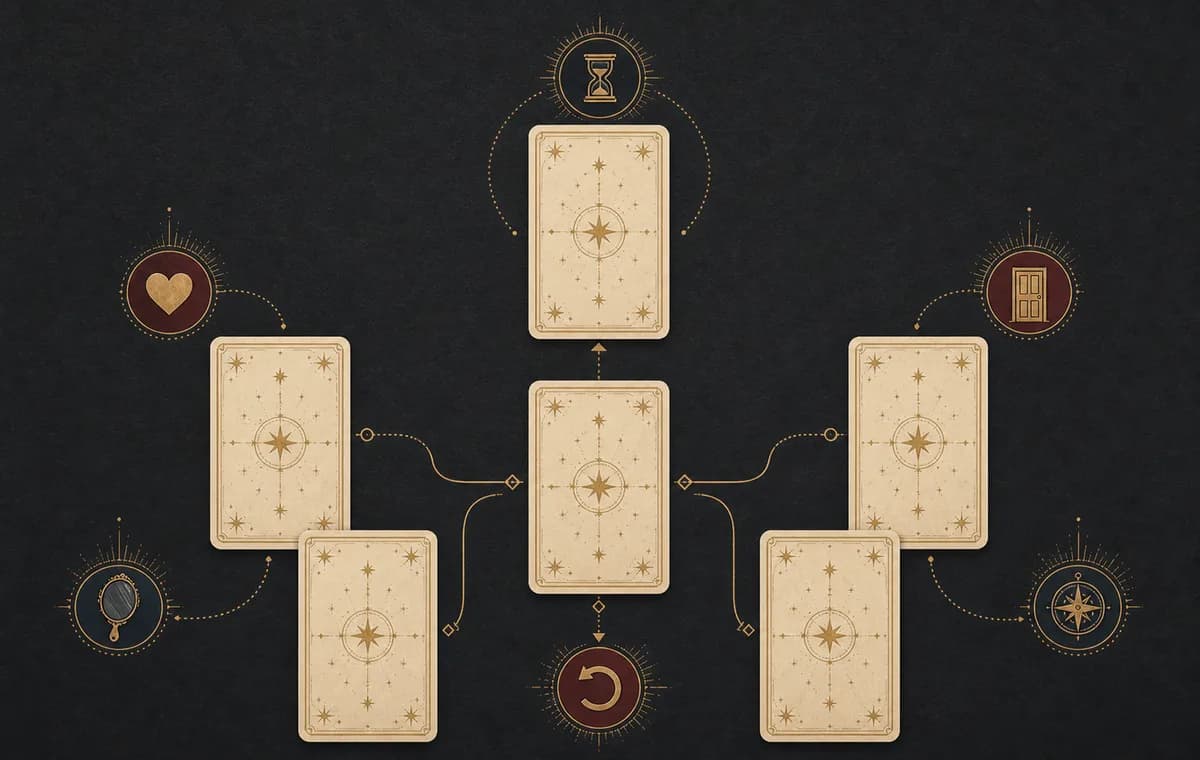
Six positions. In order. Each phrased as an open question, never a yes/no.
Position 1 — Why do I really want them back? The sub-type card. Compare it against the word on your folded paper. If the card disagrees with what you wrote, trust the card.
Position 2 — What are they actually feeling about me right now? Their state, not their prediction. What lives in them when your name comes up unexpectedly.
Position 3 — What is keeping us apart? Not "will we" — the shape of the obstacle, named. You can sometimes move an obstacle. You cannot move "will they."
Position 4 — If they were to come back, why? The position no other reconciliation spread isolates, and the most important one for predicting revolving-door pain.
Position 5 — The root of the obstacle. Usually older than the breakup itself. The pattern the relationship was built on top of, made visible by its ending.
Position 6 — Where this trajectory lands if nothing changes. A projection of the current vector. Your behavior between now and then rotates this card.
Why six and not three: three collapses your motive and theirs into one read, and projection floods the gap. Why not ten: hope leaks in to fill the extras. Six is the smallest spread I've used that holds the two psychologies apart long enough to read them. For complicated cases — workplace overlap, a current new partner, six months past the breakup — step up to the Celtic Cross spread guide.
Cards That Signal Real Reconciliation — and the Combinations That Make Them Trustworthy
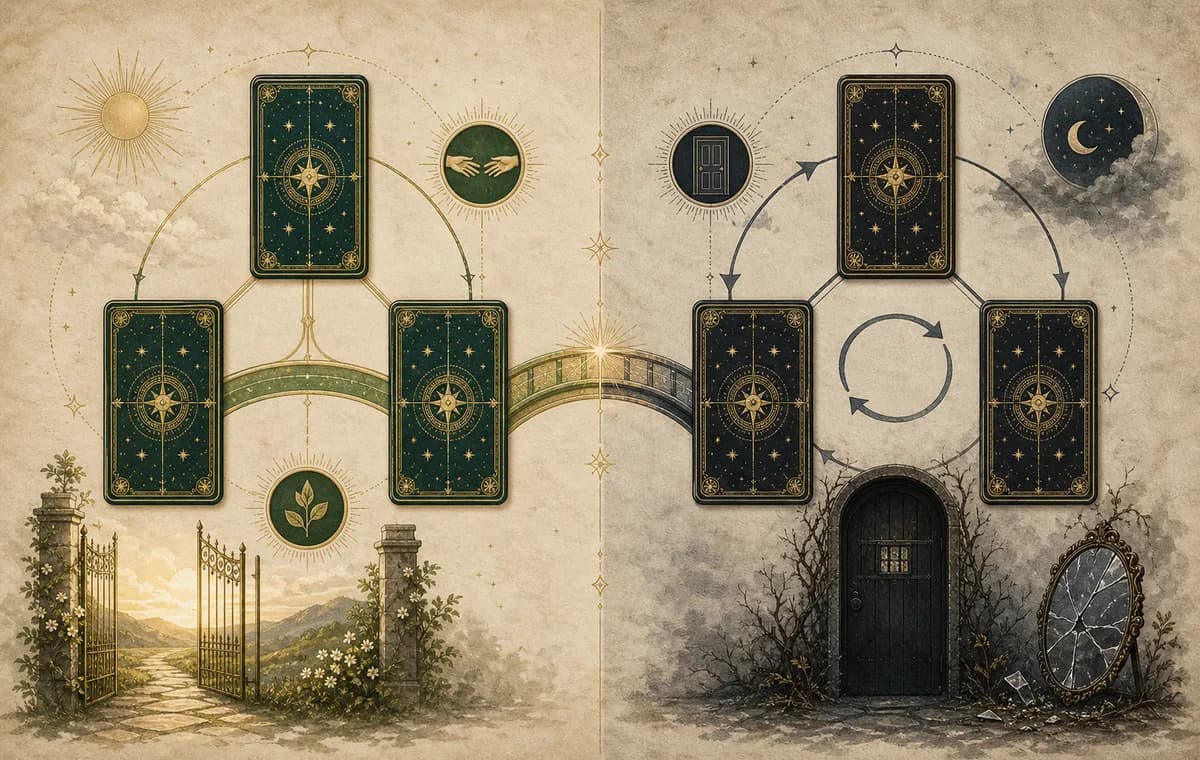
The green-light list every guide names: Six of Cups, Two of Cups as feelings, The Lovers tarot card meaning, The Star as feelings, Judgement, The Empress, Ten of Cups, Ace of Cups. Correct, almost useless on its own — a single card means very little; combinations and positions mean everything.
Six of Cups is the most-misread reconciliation card in the deck. It looks like reunion. What it actually says is nostalgia, childhood-like familiarity. Under sub-type 1, in Position 2, it signals warmth still alive. Under sub-types 2 through 4, it reflects your own backward-looking heart. (For the full breakdown of the Six of Cups (nostalgia) as their feelings, and the trap of mistaking missing the past for missing the person, that page goes deeper.)
Two of Cups is the strongest single green-light card in Position 2 — a balanced exchange, mutual bond. The equation is balanced from their end.
The Lovers is choice-level connection. In Position 4, the read is they'd come back because they're choosing you, deliberately.
The Star is the calm reconciliation — healing-driven, hope restored. Quiet does not mean lukewarm.
Combination reads earn the spread its keep:
- Six of Cups + The Star. Nostalgia layered with healing. Real reconciliation pattern.
- Six of Cups + The Devil. Nostalgia layered with unhealthy attachment. Revolving-door pull — you'll mistake the grip for love.
- Judgement + The Lovers + Two of Cups. The three-card cluster that, in my practice, almost always lands as genuine second-chance reconciliation.
Cards That Say 'Closed Door' — Don't Wait, Don't Re-Pull, Don't Negotiate
The deck is rarely subtle about ending. When these stack with Position 6, the read is not "wait harder." It's "this is the chapter where you write yourself out."
- Ten of Swords. Finality. Reconciliation here usually means re-injury.
- The Tower. The foundation was structurally unsound. Rebuilding on the same lot fails the same way.
- Five of Swords. A relationship where one of you needs to win. Reconciliations re-enter the same fight from word one.
- Eight of Cups. Walking away from what's left. Eight of Cups as feelings (feet-walking vs heart-walking) distinguishes active no-contact departure from the partner who's checked out but still texting.
- Reversed Lovers / Two of Cups. Choice-level misalignment — not a fixable scheduling problem.
When two or more appear in Position 6, the spread is finished talking about reconciliation. It's talking about your next chapter.
How Long Until They Come Back? Reading Timing by Suit
Tarot timing is a range, not a date. Anyone offering "47 days" off a tarot pull is making things up. The honest read goes by suit.
- Wands — days to weeks. The 2 a.m. message belongs to Wands.
- Cups — weeks to months. Emotional processing takes the time it takes.
- Swords — mental delay, not external time. A Sword in the timing position is an unresolved thought loop in one of you; the wait is until something gets thought through.
- Pentacles — months to seasons. Slower. Pentacle-timed reconciliations tend to be the most durable.
- Major Arcana — read meaning, not number. The Star means "whenever the healing finishes," not seventeen weeks. Readers who convert Majors to weeks lose accuracy at exactly the moment they wanted more of it.
Locked-future predictions are where tarot fails hardest — see the broader reconciliation tarot reading guide for the longer argument.
Should You Respond If They Reach Out? A Decision Tree Based on Your Spread
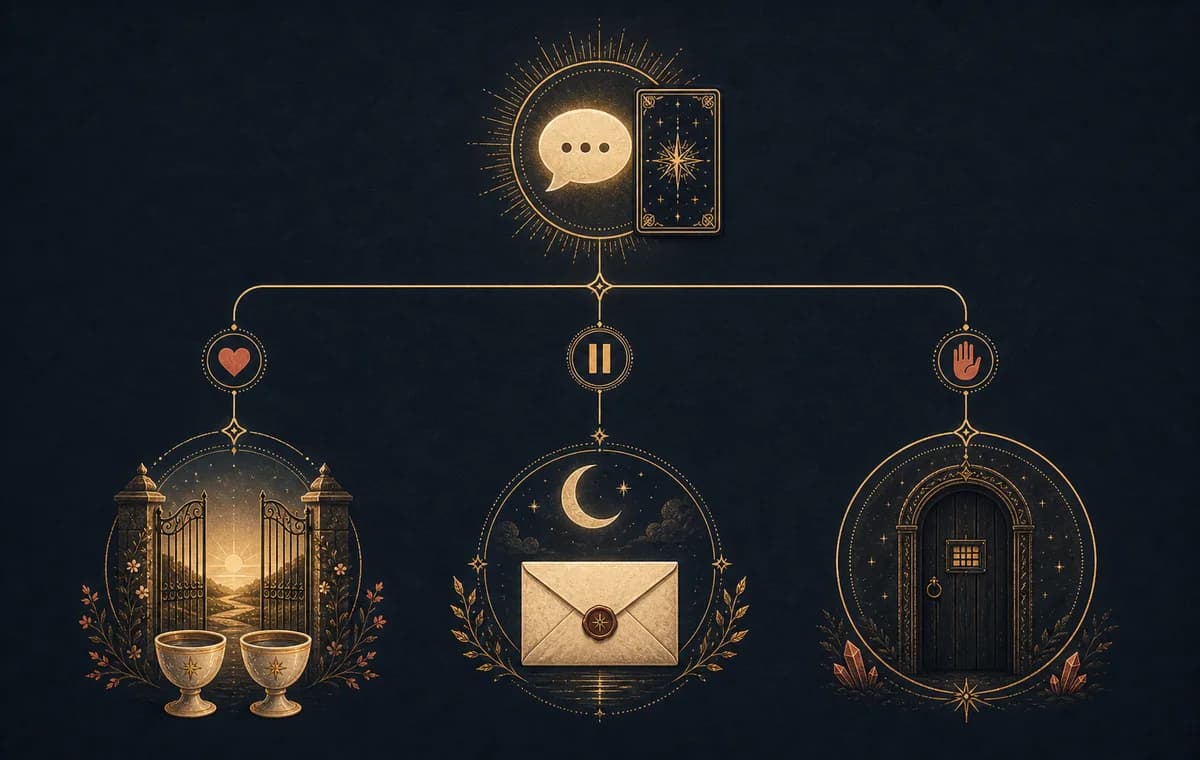
Every other reconciliation guide stops at "the cards say X." Then your phone buzzes at 11:47 p.m. and you're back where you started. The branches below read off Position 4 (their motive if they came back) crossed with Position 1 (your sub-type).
Branch A — Their Position 4 = real growth. Judgement, Temperance, The Star reads as actual reflection. If your Position 1 was sub-type 1, respond — slowly, no immediate meet-up. Real growth survives a week of waiting; rebound urgency does not.
Branch B — Their Position 4 = boredom or convenience. Four of Pentacles, Knight of Cups reversed, Page of Cups reads as "comfortable familiar option." Do not respond for at least two weeks. They want comfort, not you. Two weeks is usually enough for someone running on convenience to find a different couch.
Branch C — Their Position 4 = new-partner-fell-through. Three of Swords as feelings, Five of Cups, reversed Lovers. Highest revolving-door risk pattern I see. You are the soft landing, not the destination. I've watched it enough to name it: a client gets Three of Swords plus Five of Cups in Position 4 right after her ex's rebound relationship visibly ends online. She asks if she should respond. I tell her what the cards are telling me. Two of the three women who took my advice and waited two more weeks said the message stopped coming. The third said it kept coming, slower, and that was when the read changed.
Branch D — Your Position 1 was sub-type 4. Do not respond, regardless of their motive. Your loneliness will gild whatever they offer. Wait a month of being genuinely fine alone before re-pulling.
Tarot tells you the field, your action tells you the outcome. The cards don't override your behavior — they describe the gravity you're working with.
How to Read This Spread for Yourself Without Bending the Result
Half the reconciliation guides on the web mention projection bias. None give a solved procedure for it. Here is mine.
- Write your sub-type on paper before you shuffle. Fold it. Set it next to the deck.
- Shuffle while phrasing the open question — "what is the truth of this situation right now" — not the binary one.
- Lay all six cards face-down, then flip them all at once. Don't interpret as you go.
- Photograph the spread. Walk away for ten minutes. Come back and read the photo as if a friend just texted it to you.
- Journal your first read in plain prose before opening any tarot reference. Your first reaction is the projection signal.
Re-pull rule: minimum three to four weeks before re-asking the same question. Pulling weekly trains your brain to keep going until the answer feels right.
The first time I read for an ex of my own — twenty-three, a tiny apartment in Nakameguro — I pulled Six of Cups in the outcome and immediately decided it meant we would reconcile. We did not. What the card was showing me was my own nostalgia, not his energy. I had not yet learned to name my motive before shuffling. That spread is why I now make every client write their sub-type on paper before they touch the deck.
Better Questions Than 'Will My Ex Come Back?'
Open questions get usable answers. Binary ones get distorted ones. Six better:
- What is the truth of this situation between us right now?
- What is keeping reconciliation from happening?
- What is the most effective thing I can do right now if reconciliation is what I actually want?
- What am I meant to learn from this breakup, regardless of whether we reconcile?
- What would I have to release to be ready for this person to come back?
- What does the version of me who is fine either way already know?
Tarot images carry direction and texture, not boolean values. Asking the deck yes-or-no asks it to drop ninety percent of what it has to show you.
A free-will note: the cards describe the current field, not destiny. Your behavior between now and the outcome card can rotate any read.
Frequently Asked Questions
Can tarot really tell if my ex will come back?
Tarot doesn't predict a locked future — it maps the current energy field and shows where it's heading if nothing changes. So yes, it gives a reliable read on whether the door is open and what kind of motive is moving on each side. What it cannot do is guarantee a date or override your behavior between now and then.
When will my ex come back? (tarot timing)
Timing is read by suit. Wands = days to weeks (impulsive contact). Cups = weeks to months (emotional processing). Swords = internal mental delay, not external time. Pentacles = months to seasons (slower, more durable). Major Arcana — read for meaning, not number; The Star means "whenever the healing finishes," not seventeen weeks. Treat tarot timing as a range, never a date.
What are the strongest tarot signs my ex will come back?
The most reliable green-light pattern is a cluster, not a single card. Judgement plus The Lovers plus Two of Cups is the strongest signal of mutual second-chance energy I see. Six of Cups with The Star reads as real healing-driven reconciliation; Six of Cups with The Devil reads as revolving-door risk. Read combinations against your Position 1 motive.
Which tarot cards mean an ex will come back?
Green-light: Six of Cups, Two of Cups, The Lovers, The Star, Judgement, The Empress. Closed-door: Ten of Swords, The Tower, Five of Swords, Eight of Cups, reversed Lovers or Two of Cups. None mean anything in isolation — read them against the position they land in and against your honest motive.
What is the best tarot spread for will my ex come back?
The 6-card spread in this guide is what I use because it's the smallest layout that separates your psychology from theirs. Three cards collapses both into one read and over-feeds projection. Ten cards gives you too many positions and hope leaks in. Six is the diagnostic minimum that holds the two psychologies apart.
Should I ask tarot the same question every day about my ex?
No — this is the habit that erodes accurate reading faster than any other. Re-pulling daily trains your brain to keep shuffling until the answer feels right. Wait at least three to four weeks before re-asking, and only re-pull if the situation has materially changed.
Can tarot guarantee my ex and I will reconcile?
No. Tarot describes the current trajectory extended forward — it does not lock the future. A yes means reconciliation is open as a path; a no isn't fixed either, since changing your state shifts the read. The cards reflect now, not destiny.
Closing: The Spread You Pull Once, Honestly
Lay the six cards once, after you've named your sub-type on paper. Photograph the spread, walk away, come back as a friend. Re-pull no sooner than three to four weeks. The AI Mizuki Yuna reconciliation tarot reading walks you through a lived version; the love tarot spread guide has the broader framework. The most useful answer in this spread is the one Position 1 gives you about yourself, not the one Position 6 gives you about them.