Most people who land on a reconciliation tarot guide have already pulled the cards a few times — usually with slightly different answers each round. "Does he still think about me?" Three pulls, three flavors of yes. By the fourth, no one trusts the deck anymore. When clients come to me about an ex, the first thing I ask is how many spreads they've laid down in the past two weeks. If it's more than three, the cards go away first.
The most important thing to get right in a reconciliation reading isn't the cards — it's the state of the person pulling them. Cards drawn in the middle of the cooling-off period, when the grief is still hot, will almost always read as "they still feel something." That's not the reader's failing. That's how the brain reads symbols when it's looking for evidence of connection.
This guide covers the spreads that actually work for reconciliation, how to phrase questions about an ex without distorting the reading, and — the part most guides skip — how to pull the wishful answer out of your own results. If you want to try a real spread, the AI Mizuki Yuna reconciliation reading is at the end.
Quick Answer: What a Reconciliation Tarot Reading Actually Does
A reconciliation tarot reading uses 3 to 10 cards to map out the possibility of getting back together with a former partner — their current feelings, the real reason behind the breakup, what's blocking reconciliation, and your best next move. The most useful spreads are the Hexagram (7 cards), Time Arrow (3 cards), and Celtic Cross (10 cards). The accuracy of the reading depends less on the spread choice and more on whether you break your question into roles — feelings, cause, obstacle, action — instead of asking one vague "will we get back together?"
Reconciliation Questions That Work — And the Ones That Don't
This is the most important section, so it goes first.
Questions worth asking
- What is my ex feeling about me right now? (state, not prediction)
- What was the actual root cause of the breakup? (often something neither of you named)
- What's blocking reconciliation from happening? (shape the obstacle)
- What's the most effective thing I can do right now? (your action)
- Roughly how much more cooling-off time would be useful? (timing hint, not a date)
Questions that distort the reading
- When exactly will we get back together? (locked-future predictions are where tarot fails hardest)
- Are they sleeping with someone new? (questions born from jealousy bend the read)
- What is my ex thinking right at this moment? (third-party reading without consent)
- Will they message me this week or next? (specific day/date questions)
- Who do they really love — me or her? (comparison framing carries hostility)
The line between a good and bad reconciliation question is whether you can act on the answer. "When will we get back together?" leaves you waiting. "What's the most effective thing I can do right now?" gets you out of bed tomorrow morning with a plan. Tarot reads most accurately when you ask a question that leads to a next step you can take.
Three Spreads That Actually Work for Reconciliation
These three earn their place for ex-partner work. Pick by situation.
Hexagram (7 cards) — the default
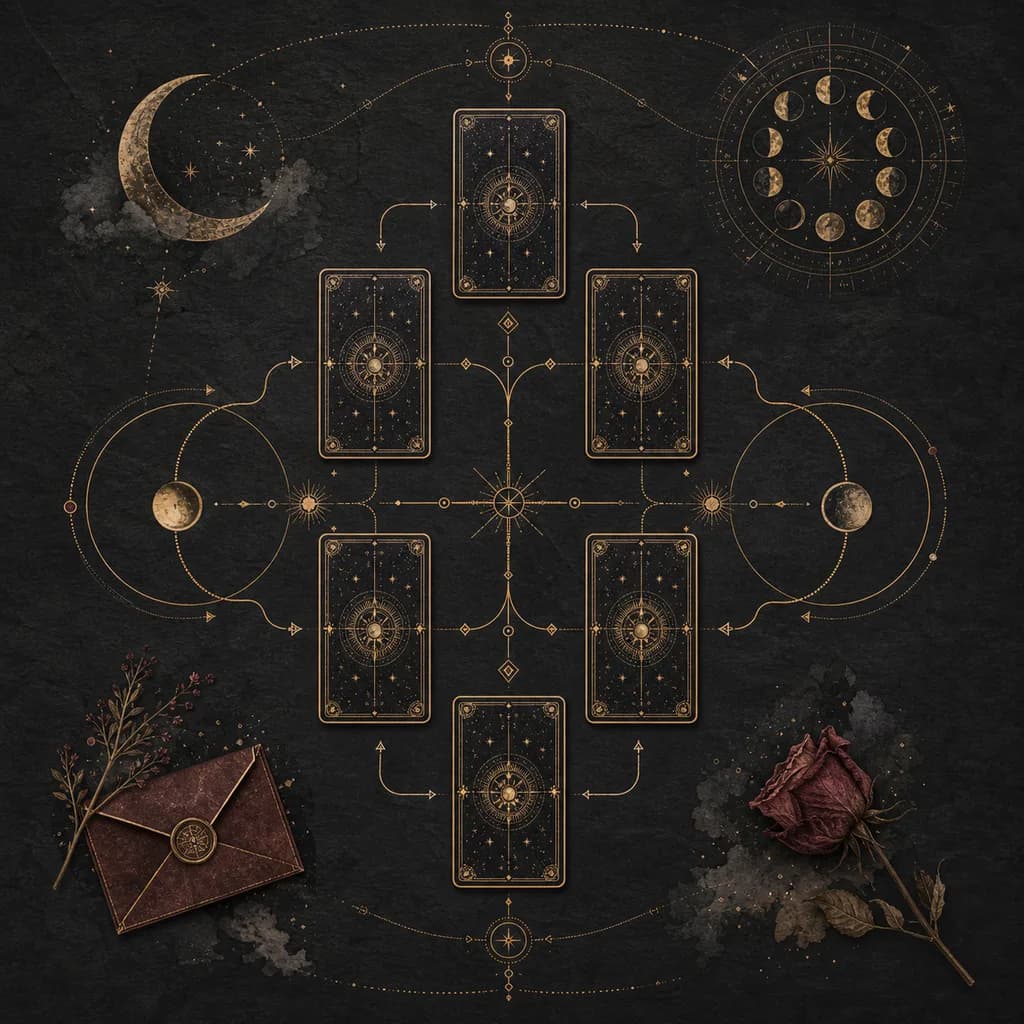
This is the standard for full-picture reconciliation reads. Past, present, future, their feelings, your feelings, the obstacle, final outcome — seven positions covering almost every angle of the situation. It fits best when the cooling-off period has run at least three months and you're weighing whether to make a move. The Unmei Tarot reconciliation reading uses this hexagram layout.
Time Arrow (3 cards) — minimalist
A three-card timeline: past (the real cause), present (their current state), future (where this trajectory lands). Useful when you mostly know the situation and just want a direction check. Because each card carries more interpretive weight, trust your first read — overthinking three cards into ten readings is the easiest way to lose it.
Celtic Cross (10 cards) — for the complicated cases
When the breakup is six months out, when there's a new partner in the picture, when you and your ex still share workplaces or friend groups — Celtic Cross is the spread that has room for all of it. The ten positions include subconscious motivations, surrounding environment, and hopes and fears, which often surface attachments you didn't know you were holding. Layout details are in our Celtic Cross guide.
Reading by Ex Pattern — Same Card, Different Meaning
Most reconciliation guides miss this: the same card means different things depending on what your ex is actually doing. Tune the read to the situation.
Pattern A: They still contact you sometimes
When messages still come through occasionally, the card you draw is often describing continuation of the current limbo, not a fresh reconciliation. The Lovers in this position usually means "the in-between state will keep going," not a reunion. If you actually want to reconcile, the reading is often telling you to stop replying first — break the limbo so something real can land.
Pattern B: Complete silence since the breakup
When there's been no contact at all, you're reading what's moving inside silence. Cards like The Hermit, The Moon, or The High Priestess are common, and they don't mean they've forgotten you — they mean something is being thought through without being said. Death, on the other hand, is honest news: the relationship has ended on their end. Don't talk yourself out of that read. The whole point of pulling cards is to see what's there.
Pattern C: They're with someone new
This is the trickiest pattern. Conflict cards — The Devil, The Tower, Five of Swords — don't automatically mean "their new relationship is failing and you're next." They often mean the new relationship has tension. Reading that as "so they'll come back to me" is projection. Note the tension as fact, then make your decisions from your own ground, not from waiting for their relationship to break.
Pattern D: You ended the relationship
This one catches a lot of people off guard. When you were the one who broke things off, the cards often reflect your own regret and unresolved grief, not your ex's state at all. Temperance, Justice, Judgement — the self-reckoning cards — show up a lot here. Before reading them as messages about your ex, separate the real question: Do I actually want this person back, or am I grieving the version of me who made the decision?
When the Reading Says No
The hardest reconciliation reads are the ones where the cards are clear and the answer is the one you didn't want. Death stacked on Three of Swords. The Tower in the outcome. Reversed Lovers in their feelings position.
When this happens, almost everyone's first instinct is to reshuffle. Don't. Re-asking the same question repeatedly doesn't clarify anything — it teaches you to keep pulling until you get the answer you wanted. That habit erodes your trust in the deck more than any bad reading ever could.
What to do instead: change the question and pull again. If "can we reconcile?" gave you Death, accept that answer, then ask: "What am I meant to carry forward from this experience?" Death isn't just the ending card — it's the card that tells you what survives the change.
Something I've noticed reading clients over the years: the ones who got a clear "no" and listened almost always tell me, a year later, that the breakup was the right call. The ones who pulled "yes" and actually reconciled — about half of them break up again within six months over the same issue. The cards don't show what you want. They show where you're already heading, given who you are right now.
Should You Pull Cards During the Cooling-Off Period?
This is the core of the guide.
Most people searching for reconciliation tarot are in the middle of the cooling-off period — one to three months out from a breakup, grief still partly raw. Cards drawn in this window will almost always read as "they still feel something." That's not a tarot problem. That's how the brain works.
The brain right after a breakup can't tolerate the loss of connection and starts searching for evidence the connection still exists. Tarot is symbol-rich enough that you can find that evidence on virtually any card, if you're looking for it. The reading isn't wrong — your reading of it is doing extra work.
Safer questions during cooling-off
I'm not going to tell you to stop pulling cards altogether. But during cooling-off, limit the questions to these three:
- What is the most important thing I should hold onto right now? (about you, not them)
- What is the theme I'm meant to learn from this breakup? (about the lesson)
- What small action can I take today, for myself? (about action)
Wait until the cooling-off period has crossed at least three months before asking about your ex's feelings directly. Until then, keep the subject of the question on yourself. That single discipline turns cooling-off-period tarot from a projection mirror into an actual sorting tool.
Frequently Asked Questions
How often should I do a reconciliation tarot reading?
At most once a month unless the situation has materially changed — they reached out, you learned something through a mutual friend, you genuinely shifted how you think about it. If nothing has moved and you're pulling weekly, you're training yourself to keep going until the answer feels right, which is the exact habit that lowers your odds of actually reconciling.
Are Death, The Tower, or The Devil hopeless in a reconciliation reading?
No. Death in this context most often marks the end of a phase — "the breakup is done; move into the next chapter," not "give up on life." The Tower signals that a buried truth is surfacing, usually the real problem in the relationship becoming visible. The Devil asks whether what you call wanting them back is love or attachment — the card that makes you check your own ground. All three are "look again," not "abandon hope."
Reconciliation tarot vs. astrology — which one is right for this?
They answer different questions. Tarot is better at "the current situation and the next move." Astrology — particularly synastry between two birth charts — is better at "the underlying compatibility and the long-term arc." Use both if you can: tarot for tactical timing, astrology to check whether this is even a person you should be trying to reconcile with long-term.
My ex has a new partner. Can I still do a reconciliation reading?
You can, but change the question. "Will they leave the new partner and come back to me?" is a forbidden question — jealousy distorts every card it touches. Ask instead: "What am I meant to release about this situation right now?" The pattern stays the same but the reading becomes usable.
How many cards make a reconciliation reading more accurate?
Spread size and accuracy aren't linearly related. Three cards is enough for a recent, low-complexity breakup. Ten cards is what you need when half a year has passed and the situation has many moving parts. Using Celtic Cross on a simple situation actually scatters the read by giving you too many positions to interpret.
If the tarot says I can reconcile, does it definitely happen?
Tarot shows the trajectory you're currently on, extended forward — not a locked future. A "yes" reading means: with your current state and approach, reconciliation is open as a path. It does not mean you can sit still and it will happen. A "no" reading isn't fixed either — if you fundamentally change your state and approach, the result shifts. The cards reflect now, not destiny.
Closing
The shift that makes reconciliation tarot actually accurate isn't reading the cards better. It's picking the right question and noticing what state you're in when you draw. Drop fate-locked questions like "when will we reconcile?" Replace them with "what is their state, what's my next move, how much longer to wait" — the kind your future self can use.
And when the reading during cooling-off says "they still want you" and you feel the relief flood in, that's the moment to pause and ask once more — is this what the cards are saying, or is this what I'm hearing? Learning to tell the two apart is what makes tarot the strongest reconciliation tool you can use on yourself.
To try a real reading, the AI Mizuki Yuna reconciliation spread lays out the seven-card hexagram for free and walks through your ex's current state, the actual reason for the breakup, the obstacles, and the path forward. For more reading frameworks, see the love spread guide, the Celtic Cross spread guide, and the tarot taboos we recommend respecting.