The Eight of Cups is the card people draw when they already know the answer and are hoping the deck will argue them out of it. A man turns his back on eight cups he stacked himself and walks into the dark toward the mountains. Nothing forced him out. No one threw him out. He counted what he built, found one cup short, and decided the gap wasn't going to fill.
That is the whole card, and it is harder than it looks. The Eight of Cups is not the card of a bad situation. It is the card of a good-enough situation that you have outgrown — which is a much lonelier place to leave from.
Most guides flatten this into "walking away from what no longer serves you." True, and incomplete. Below I'll cover the symbolism the popular guides skim, the upright and reversed meanings, the three life areas where this card actually shows up, the card combinations worth knowing, and the one question the entire internet disagrees on: whether the Eight of Cups is a yes or a no.
Quick Answer
The Eight of Cups is Minor Arcana, suit of Cups, numbered eight, tied to Saturn in Pisces. Upright, it means a deliberate departure — walking away from something emotionally familiar that no longer fulfills you, in search of something more honest, even when you can't yet see what that is. Reversed, it points to being stuck at the threshold: wanting to leave and not leaving, or drifting away from everything without ever choosing. Yes / No: it depends entirely on how you phrase the question, which is exactly why it confuses people.
Basic Information
| Attribute | Details |
|---|---|
| Card Name | Eight of Cups |
| Number | 8 |
| Arcana | Minor Arcana |
| Suit | Cups (Water) |
| Element | Water |
| Astrological Correspondence | Saturn in Pisces |
| Yes / No | Conditional (No to staying, Yes to leaving) |
| Upright Keywords | Departure, walking away, letting go, soul-searching, sober disappointment, the necessary exit |
| Reversed Keywords | Indecision, staying out of fear, stagnation, aimless drifting, faking contentment |
Card Imagery & Symbolism
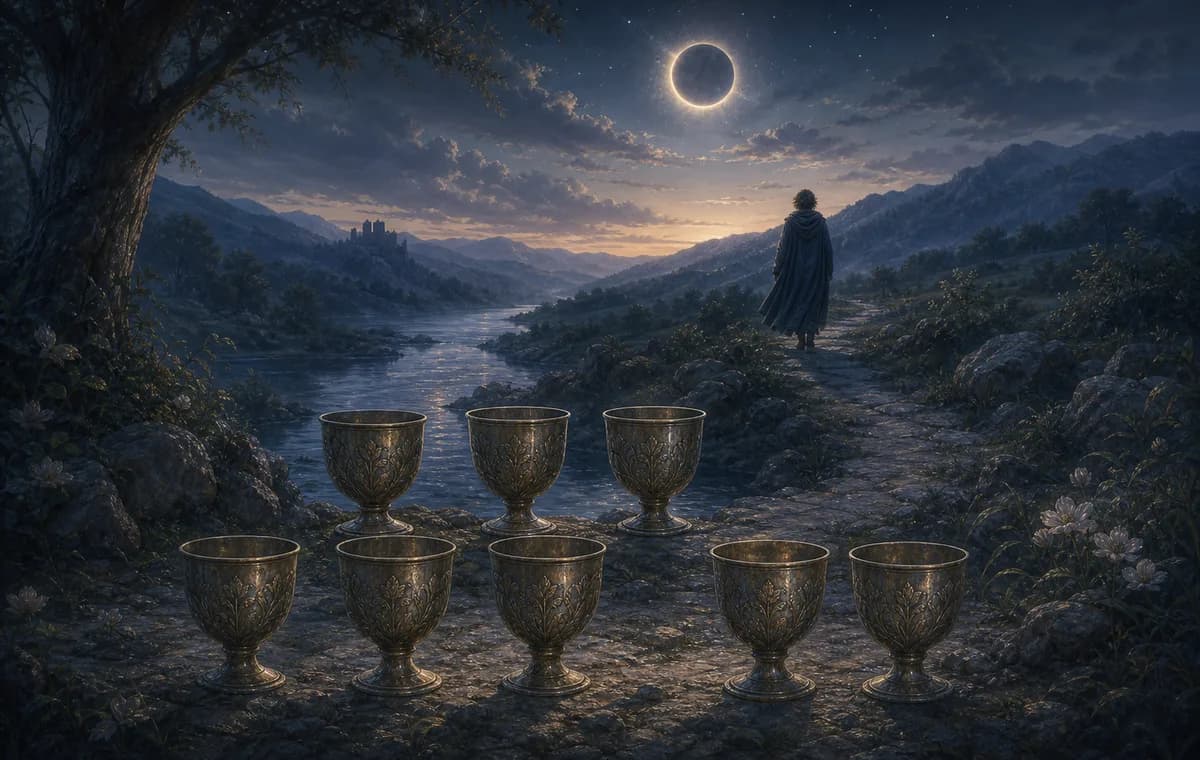
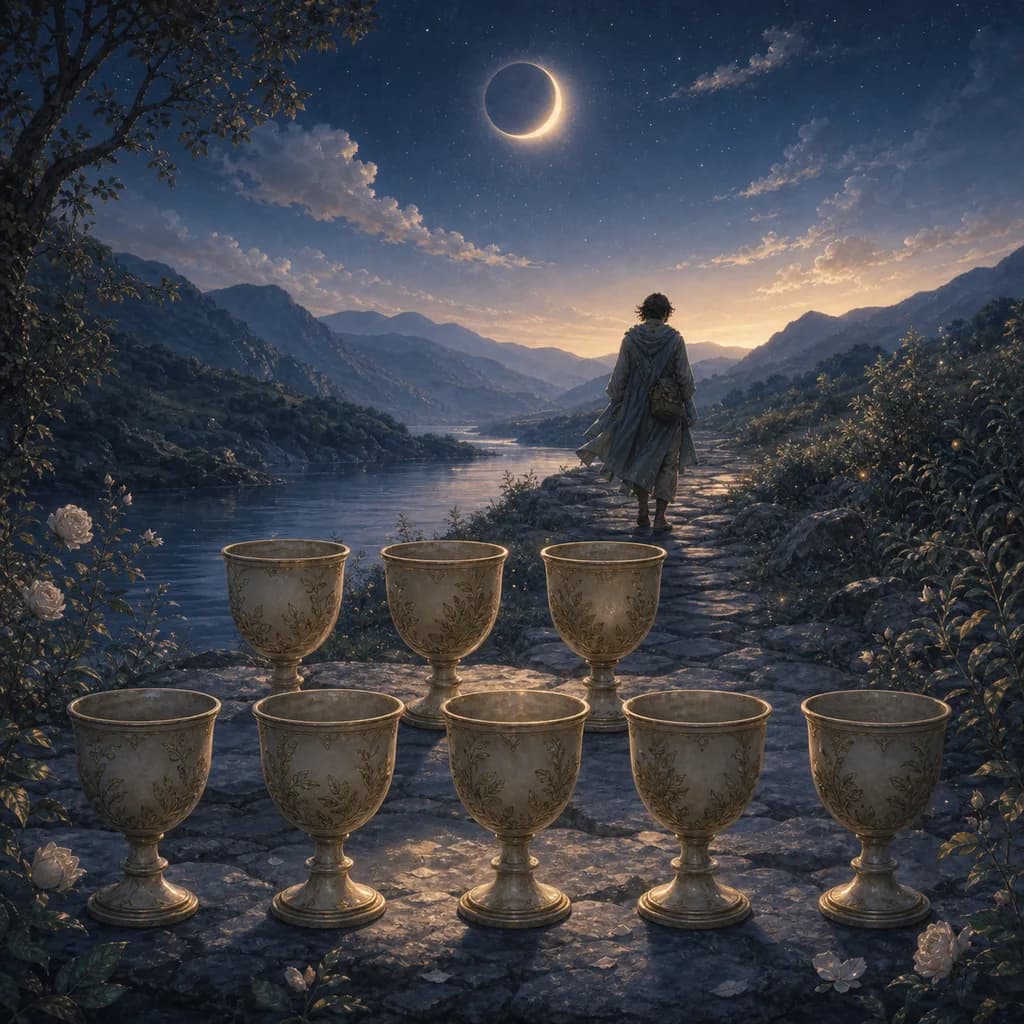
In the Rider-Waite-Smith image, a cloaked figure walks away from us with a staff, climbing toward a ridge. Eight golden cups sit in the foreground, neatly arranged. Above, a moon — both full and crescent at once, an eclipse — looks down. A river winds between the cups and the mountains. The figure is leaving at night.
Every guide describes those elements. Few of them read the arrangement of the cups, which is where the card's real argument lives.
The Gap in the Stack
Look at how the cups are placed. Five stand in a row at the bottom; three sit stacked above them, and there is a conspicuous space where a sixth one in the upper row should be. The figure did not knock a cup over. The cup was never there.
This is the detail that separates the Eight of Cups from every "things fell apart" card in the deck. Nothing broke. The figure built a careful arrangement, stepped back to look at it, and saw that one piece — the one that would have completed it — never arrived and was never going to. He is not walking away from failure. He is walking away from a structure that is almost complete, which is far harder to leave than a ruin. A ruin gives you permission. An almost gives you nothing but your own judgment.
The Eclipsed Moon
The moon overhead is doing something anatomically impossible: it shows a full disc and a crescent simultaneously. Pamela Colman Smith drew an eclipse — the moon mid-transition, neither one phase nor the next.
I read this as the card's emotional weather. The figure is not leaving in clarity. He's leaving in the half-light, during the exact moment when the old thing has not fully ended and the new thing has not begun. The Eight of Cups never shows you the destination. It only shows you the leaving, lit by a moon that is itself between states.
The River and the Night
The water between the figure and the mountains is unfrozen and moving — his feelings are not shut off. A man who had stopped caring wouldn't need to leave under cover of darkness. He leaves at night because leaving is hard, not because it's cold. The dark is doing two jobs at once: it's the privacy that a painful decision needs, and it's the small, honest admission that he doesn't entirely want to be seen doing this. Both things are true of almost everyone who draws this card.
Eight of Cups Upright Meaning
Upright, the Eight of Cups is the card of the necessary departure — the exit you make not because something went wrong, but because staying would now require you to shrink.
Core Upright Keywords
- The necessary departure — Leaving what no longer fits, by choice
- Sober disappointment — Not anger, not drama; a quiet conclusion
- Letting go — Releasing something you genuinely invested in
- Soul-searching — Walking toward a more honest version of your life
- Emotional courage — The nerve to leave the known for the unknown
In-Depth Upright Interpretation
The defining feature of the upright Eight of Cups is that the decision has already been made internally. By the time the boots are moving, the argument is over. This is what separates it from the Seven of Cups before it — the Seven is still confused, dazzled by options; the Eight has seen through the fog and chosen. The card doesn't show deliberation. It shows the body catching up to a verdict the heart reached weeks ago.
That's why the Eight of Cups is so rarely news to whoever draws it. When clients pull this card and ask whether they should leave, my honest answer is usually that they wouldn't phrase the question that way if some part of them hadn't already left.
A client in Tokyo drew the Eight of Cups about a creative career she had spent six years building — a brand with real clients, real income, a name people recognized. On paper it was working. She kept asking me whether she was "allowed" to walk away from something that wasn't broken. That word, allowed, is the Eight of Cups in one syllable. The card is not for leaving bad things. We don't need permission to flee a fire. It's for leaving the good-enough thing you outgrew — and the reason it's so hard is precisely that no one, including the card, will tell you that you're justified. The figure walks into the dark because there's no external proof he's right. There's only the missing cup.
The shadow worth naming: sometimes the leaving is avoidance wearing the costume of growth. The Eight of Cups can describe a person who walks away from every almost-complete thing the moment it asks something of them, calling it a search for meaning when it's really a refusal to finish. The tell is the pattern. One Eight of Cups departure is courage. A life of them is a different card's problem.
Eight of Cups Reversed Meaning
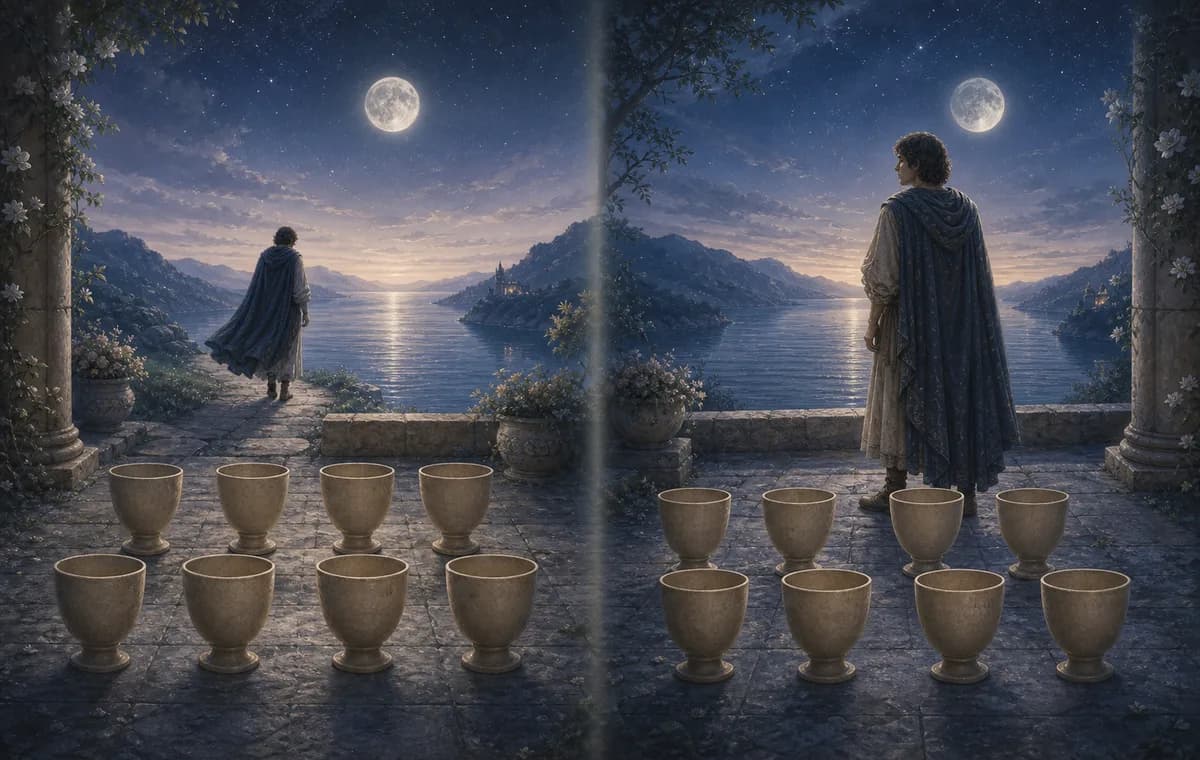
First, the question everyone asks about reversals: is the reversed Eight of Cups negative? Not inherently — but it is almost always stuck, and stuck is uncomfortable in a way the upright isn't. Where upright Eight of Cups has the dignity of a decision, the reversal catches you mid-flinch, at the threshold, with one foot raised and nowhere committed. That's the consistent flavor, and it's why the reversal feels worse to live than the upright even though the upright involves an actual loss.
Core Reversed Keywords
- Staying out of fear — Knowing you should go and not going
- Indecision — The stay-or-leave loop with no exit
- Faking contentment — Looking fine on the outside, hollow underneath
- Aimless drifting — Leaving everything, committing to nothing
- Stalled departure — The walk that started and stopped
In-Depth Reversed Interpretation
The first reading is the one you'll see most: staying when you know you should leave. The departure the upright card describes is wanted and refused. You see the missing cup as clearly as ever — you've just decided the fear of the empty road is worse than the ache of the incomplete stack. Reversed Eight of Cups here often comes with a performance of fineness. To everyone around you the arrangement looks complete; only you know you've been counting the same eight cups for a year, hoping the ninth materializes. It won't. The card is asking how long you intend to keep auditing the gap instead of walking.
The second reading is the opposite, and it's the one people miss: leaving everything, all the time, and calling it freedom. Some reversed Eight of Cups draws describe restless drifting — abandoning each situation the moment it asks for commitment, never staying anywhere long enough to find out whether the cup was actually missing or whether you left before it could arrive. Upright is the person who stays too long. This reversal is the person who never stays at all. Same card, mirror-image stuckness.
The diagnostic between the two: ask whether you are clinging or fleeing. If you've been in the same almost-complete situation for too long, you're in the first reading, and the card wants you to move. If you can't name a single thing you've finished in the last two years, you're in the second, and the card wants you to stay put long enough for one cup to fill.
The Eight of Cups in the Three Areas It Matters Most
The popular guides run the same love-career-health checklist for every card. The Eight of Cups doesn't earn all three equally. Where it speaks loudest is in leaving — so here are the three departures it most often describes.
Love & Relationships
In love, the Eight of Cups is the quiet end, not the loud one. There's no betrayal, no blow-up — just one person concluding that the connection, real as it is, isn't going to become what they needed it to be. It frequently shows up not as a breakup card but as the card of the decision that precedes one, sometimes by months. For the love-and-feelings dimension specifically — what the person walking actually feels, and how to tell which phase of leaving they're in — our companion guide on the Eight of Cups as feelings goes deep on the heart-versus-feet distinction.
What's worth saying here, broadly: this card almost never means they didn't love you. The cups were stacked. You don't carefully build eight cups for something you never cared about. The Eight of Cups in a love reading is the love that concluded staying would cost more than it could keep paying.
For singles, the card is gentler. It often means a healthy walking-away — from a type, a pattern, a tolerance for situationships — that clears the ground for something truer. Stepping back from the dating market on purpose is a very Eight of Cups move, and a good one.
Career & Vocation
The Eight of Cups is one of the most common cards I see before someone leaves a job that, by every external measure, they should keep. Good salary, decent people, no disaster — and a slow, undeniable sense that this isn't it anymore. The card rarely appears when a job is obviously bad. It appears when the job is fine and you've changed. That's the harder leaving, because nobody will validate it for you. If you've been quietly disengaged for months without moving — the Four of Cups, sitting with the cups unmoved — the Eight is the moment that passive discontent finally stands up and walks; the two cards mark the same dissatisfaction at its before-and-after.
In money terms, it often signals a willingness to trade security for meaning — a pay cut, a less certain path, a gap year — because the secure version started to feel like the missing cup would never come from there. The card isn't reckless, though. The figure brings a staff and warm clothing. He's planning a real journey, not running off a cliff.
Spiritual Searching
This is the area the Eight of Cups owns more than any other, and the one most "love-career-health" templates skip. The card is the classic emblem of the spiritual seeker who leaves a comfortable structure — a belief, a community, a successful life — because it stopped feeding something essential. It's no accident the figure walks toward mountains, the traditional landscape of solitary searching. If you've drawn this card around questions of meaning or faith, it's affirming the instinct to go looking, even though looking means leaving the warm room. In that sense it rhymes with The Hermit, below.
Is the Eight of Cups a Yes or a No?
This is the card's most-searched question, and the honest answer is that the entire tarot internet disagrees — some sites call it a firm no, others a clear yes, and most readers waffle. The disagreement isn't carelessness. It's that the Eight of Cups answers a different question than the one you asked.
Here's the resolution. The Eight of Cups is a no to staying and a yes to leaving. It's the same answer pointed in opposite directions depending on your verb.
Ask "should I stay in this job / relationship / city?" — the answer is no. Ask "should I move on, walk away, start over?" — the answer is yes. Ask "will this situation improve if I hang on?" — the answer is no, and improving isn't the point; you're being asked to leave, not to fix. The card is consistent. It's the questions that flip.
This is why I don't trust any source that gives the Eight of Cups a flat yes-or-no without asking what you're really asking. A reader who tells you "Eight of Cups means no, full stop" will mislead the person whose actual question was is it okay to go? For that person, the Eight of Cups is one of the most freeing yeses in the deck.
When it lands reversed in a yes/no spread, read it as not yet — the answer is still leave, but you haven't committed to it, so the situation is unresolved rather than decided.
Eight of Cups Card Combinations
Eight of Cups + The Hermit
Departure as deliberate retreat. The Eight of Cups walks away from something; The Hermit tells you the walking is toward solitude and self-knowledge, not just away from disappointment. Together they describe someone leaving a full life to go quiet on purpose — a sabbatical, a spiritual withdrawal, a season of figuring out what you actually want before re-entering anything. One of the cleanest "this leaving is wise" combinations in the deck.
Eight of Cups + Seven of Cups
The before-and-after of a decision. The Seven is the cloud of options and fantasies; the Eight is the moment you saw through them and chose. When both appear, the reading is usually that a period of confusion or too-many-choices has just resolved into a single hard exit. The fog lifted and showed you the door.
Eight of Cups + The Star
Hope on the far side of the leaving. The Eight is the walk into the dark; The Star is what you find when you keep walking. This pairing is reassurance — the departure leads somewhere genuinely better, and the grief of leaving gives way to renewal. If a client is terrified to walk away, this is the combination I most want to see behind it.
Eight of Cups + Death
A total ending, fully chosen. The Eight provides the willingness to leave; Death confirms the chapter is structurally over, not merely paused. Together they're emphatic — this isn't a break, it's a close. Often appears when someone has been treating a finished thing as if it might restart, and the cards are agreeing it won't.
Eight of Cups + Ten of Cups
A painful one. The Ten of Cups is the picture of complete emotional fulfillment — the rainbow, the family, the future. Beside the Eight, it often shows exactly what the person is walking away from: the imagined whole life that the missing cup was supposed to complete. The grief here is sized to the dream. They're not leaving a small thing; they're leaving the future they'd already pictured.
Eight of Cups + Knight of Cups
Walking away from a romantic offer. The Knight of Cups arrives with the proposal, the charm, the cup held out; the Eight of Cups declines it and leaves. Together they often mean turning down a connection that looks good on paper because something in it doesn't ring true. Not coldness — discernment.
Eight of Cups + Judgement
Judgement + Eight of Cups, leaving what no longer fits the call. Judgement is the deeper summons — the sense of being called toward who you're meant to become; the Eight of Cups is the practical exit that answers it. Together they describe a departure that isn't restlessness but vocation: you're not just walking away from the almost-complete stack, you're walking toward something you've finally heard clearly enough to obey.
Numerology & Astrological Correspondences
The Meaning of Number 8
In the Minor Arcana, eights are about power, movement, and consequence — the energy of the cards reaching a point where it has to do something. In the suit of Cups, that pressure turns inward and emotional: the Eight is the moment the accumulated feeling of the suit can no longer just sit in its cups. Something has to move. Where the Eight of Pentacles channels that into focused work and the Eight of Wands into rapid action, the Eight of Cups channels it into departure. The motion is real; it just points away from the table rather than toward it.
Astrological Correspondence: Saturn in Pisces
The card's correspondence is Saturn in Pisces, and it's a precise fit. Pisces is the watery, dreaming, attachment-prone sign — the part of us that wants to merge and believe and stay. Saturn is the planet of sober reality, limits, and the hard mature conclusion. Put them together and you get exactly the Eight of Cups: a Piscean attachment finally examined by Saturn's clear, unsentimental eye. The dream looked at honestly. That's why the card's grief is so quiet — Saturn doesn't rage, it concludes. In Japanese タロット占い this card is often read through 「諦め」(akirame), a word usually mistranslated as giving up but rooted in seeing clearly enough to release. That's the Saturn-in-Pisces reading in a single Japanese word: not defeat, but clarity that staying past a certain point becomes its own kind of suffering.
Frequently Asked Questions
Is the Eight of Cups a yes or no card?
Both, depending on your verb. It's no to staying and yes to leaving. If you asked whether to hold on, the answer is no. If you asked whether to move on, it's a strong yes. Reversed, read it as "not yet" — leave is still the direction, but the decision isn't made.
Does the Eight of Cups always mean walking away?
Departure is its core, but not always physical departure. Sometimes it's leaving a mindset, a pattern, a phase of a relationship, or an old version of yourself rather than packing a bag. The constant is the act of releasing something you genuinely invested in because it stopped completing you.
What's the difference between the Seven and Eight of Cups?
The Seven of Cups is confusion — too many options, fantasies, and illusions to choose between. The Eight of Cups is what happens after you see through them and decide. Seven is the dream cloud; Eight is the figure who already woke up and started walking. If they appear together, a period of indecision has just resolved into a clear exit.
Is the Eight of Cups reversed a bad sign?
Not bad so much as stuck. It usually means you know you should leave and haven't, or that you're drifting away from everything without committing anywhere. The discomfort comes from the threshold, not from a disaster. The card is nudging you to either move or settle, instead of hovering.
Does the Eight of Cups mean a relationship is over?
Often it means the decision about the relationship has been made internally, not that the feelings are gone or that it's formally ended. The cups were stacked with care — the love was real. What the card describes is someone concluding that staying would cost more than the connection can return. For the feelings side of this specifically, our Eight of Cups as feelings guide breaks down how far along the leaving already is.
Is the Eight of Cups good for love readings?
It's honest more than it's good. For someone clinging to a connection that isn't working, it's freeing. For someone hoping a struggling relationship will turn around through patience alone, it's a hard no. The card respects you enough not to flatter you, which in love readings is worth more than reassurance.
What does the Eight of Cups mean for career?
Usually that you've outgrown a job that isn't bad — decent on paper, hollow in practice — and the card is validating the instinct to leave even though no one else can see why you'd go. It can also signal trading security for meaning. Reversed, it's the hesitation: knowing it's time and stalling at the door.
Closing
The Eight of Cups is the deck's card of the hard, quiet leaving — the one nobody else will tell you you're right to make. It doesn't ask you to flee a disaster. It asks whether you have the nerve to walk away from an almost, toward something you can't yet see.
If you've drawn it, here's the concrete move: write down the one thing that's missing from the arrangement you're auditing — the specific cup that never arrived. Name it on paper, in one sentence. If naming it makes you feel relief, you already know which way the figure is walking. If naming it makes you want to argue, you're still in the fog, and that's the Seven of Cups' work to finish first.
Continue exploring: read The Hermit for the deliberate solitude the Eight of Cups walks toward, or The Star for the renewal waiting on the far side of the leaving.