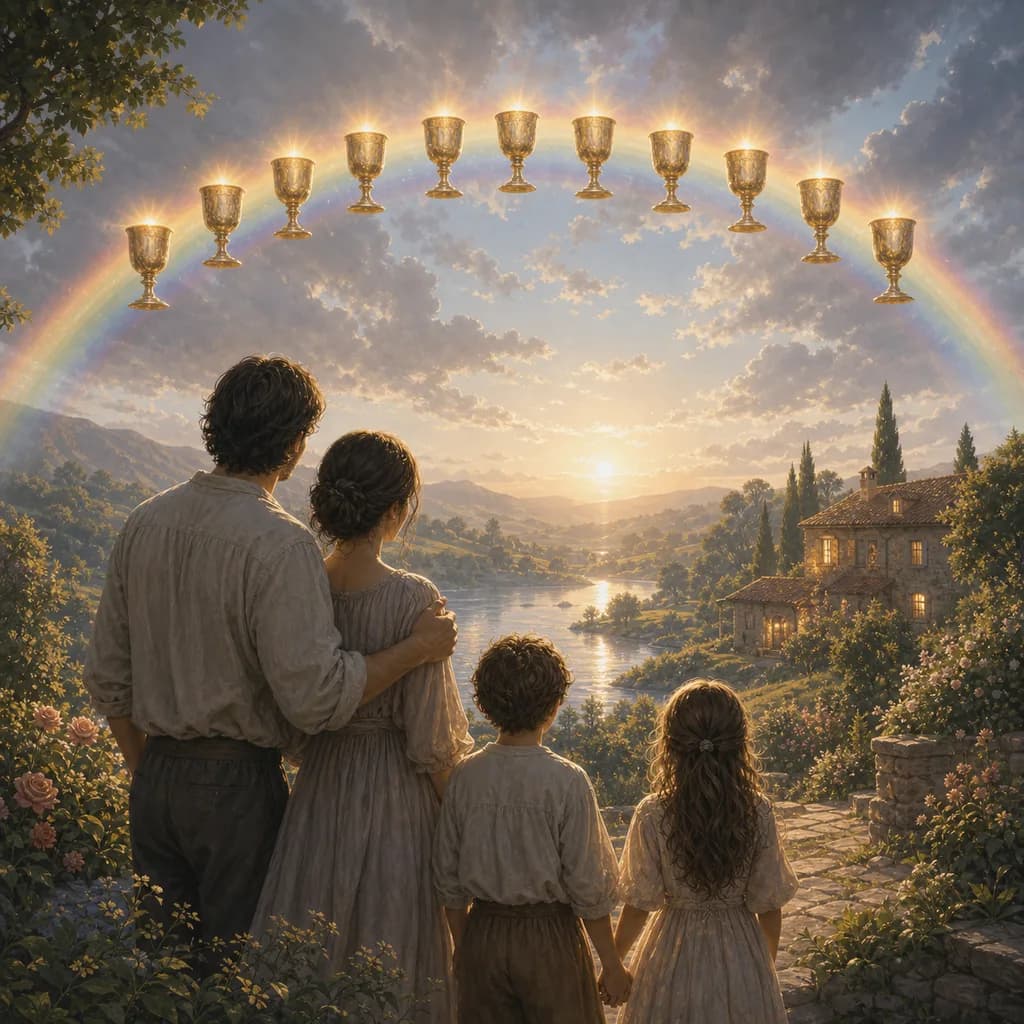
Every reader will tell you the Ten of Cups is the "happy family" card, and they are right, and it is the most boring true thing you can say about it. The rainbow, the cottage, the two children dancing, the couple with their arms thrown up to the sky — yes. Emotional fulfillment. Having it all.
Here is what almost no guide tells you. The Ten of Cups is the only Cups card where the fulfillment is pictured in the sky rather than held in the hand. The cups are up in the rainbow, ten of them, not one of them touched. And after years of reading this card for clients in Tokyo, I have come to read that as the card's actual teaching rather than a decorative flourish: the Ten of Cups shows you the promise, and it asks whether you are willing to do the unglamorous work the promise costs. It is not a card you arrive at and keep. It is a card you keep arriving at.
This guide covers what the Ten of Cups actually means in a reading — the symbolism most articles skim, the upright and reversed interpretations, the three life areas where it lands hardest, the card combinations that change its meaning, and the difference between the Ten and the Nine of Cups that almost everyone collapses.
Quick Answer
The Ten of Cups is a Minor Arcana card, the culmination of the Suit of Cups, ruled by the element of Water (Mars in Pisces in the Golden Dawn system). Upright, it means emotional fulfillment that is shared — domestic harmony, lasting love, a family (biological or chosen) at peace, the sense of having arrived somewhere you wanted to be with the people you wanted there. Reversed, it points to the gap between the picture and the reality: a home that looks happy and feels disconnected, misaligned values, or a dream one person was building alone. Yes or No: upright is one of the deck's strongest Yes cards; reversed softens to "not yet" or "not like this."
Basic Information
| Attribute | Details |
|---|---|
| Card Name | Ten of Cups |
| Suit | Cups (Water) |
| Arcana | Minor Arcana |
| Number | 10 |
| Element | Water |
| Astrological Correspondence | Mars in Pisces |
| Yes / No | Yes (upright); "not yet" / No (reversed) |
| Upright Keywords | Harmony, emotional fulfillment, family, lasting love, belonging, contentment |
| Reversed Keywords | Disconnection, broken home, misaligned values, unrealistic ideals, appearance vs. reality |
Card Imagery & Symbolism

A couple stands with their arms raised toward a rainbow made of ten golden cups, arcing across the sky. Two children dance to one side. Behind them, a river, green hills, and a small house. It is the most openly idyllic image in the Rider-Waite-Smith deck, and that openness is precisely why most readers stop looking too early.
Look longer. There's more in the frame than reassurance.
The Cups Are in the Sky, Not in Hand
In nine of the ten Cups cards, the cups are held, offered, stacked, spilled — physical, on the ground, in someone's grip. In the Ten, they're up in the rainbow. The only other card where the cups float untouched is the Seven of Cups, the other card whose cups float untouched, the card of fantasy and illusion.
That is not an accident, and it is the detail I build my whole reading of this card around. The Ten of Cups shows fulfillment as a promise written across the sky rather than a thing you are currently holding. A rainbow requires the storm to have happened and the sun to have returned; you cannot manufacture one or keep one. You can only be standing in the right place when the conditions align. The card reports that the conditions have aligned. It does not promise they stay aligned without your tending.
The Couple Faces Away From Us
The two figures have their backs to the viewer, looking at the rainbow — not at each other, and not at you. I read this as the card's quiet honesty: it shows a shared direction, two people oriented toward the same future, side by side. What it does not show is two faces confirming they're in love this exact second. That confirmation belongs to the Two of Cups, where the pair face each other across raised cups. The Ten is the future tense made calm — people who have stopped needing to gaze at each other because the bond has become the ground they stand on.
The Children, the River, the House
The two dancing children are the part everyone reads correctly: this fulfillment includes the next generation, or includes play, lightness, a future that outlives the couple. The river is the suit's emotion flowing freely. The house is small and set back, not a mansion — modest on purpose, because the Ten of Cups is not material abundance (that's the Pentacles' job). The wealth here is entirely emotional. And note where each thing sits: the house you can live in is on the ground, the rainbow you can only witness is in the sky.
Ten of Cups Upright Meaning
Upright, the Ten of Cups is as good as the deck's emotional news gets. But "good news" is where lazy readings begin and stop, so let me be specific about what kind of good.
Core Upright Keywords
- Shared fulfillment — Contentment that exists between people, not just inside one
- Domestic harmony — A home, biological or chosen, that is at peace
- Lasting love — The durable kind, not the dramatic kind
- Belonging — The felt sense of being where you are wanted
- Emotional completion — A long arc of feeling arriving somewhere whole
- Gratitude — Contentment that has noticed itself
In-Depth Upright Interpretation
The Ten of Cups describes fulfillment that has become relational rather than personal. This is the distinction that separates it from the Nine of Cups, and getting it right changes the whole reading.
The Nine of Cups is the "wish" card — one figure, arms crossed, satisfied in front of his own row of cups. It is my desire, granted — and read as an inner state, the Nine of Cups as feelings is contentment turned inward, satisfied alone. The Ten opens that satisfaction outward: the wish was never only about you, and it only completes when shared. The Ten of Cups is the Nine discovering that a satisfied life kept entirely to oneself is not the full satisfaction. The cups had to go up into a sky other people can see.
When I draw the Ten upright, the most honest reading is usually not "everything is perfect." It is "you've built, or are about to recognize, something that holds — and the work now is to notice it rather than reach past it for the next thing." It is frequently a card of gratitude not yet felt: the fulfillment is present; the person hasn't slowed down enough to register it.
A client came to me last spring convinced her reading would name what was missing from her marriage. Solid partner, two kids, the flat in the suburbs she'd wanted since she was twenty. She pulled the Ten of Cups in the present position and looked almost disappointed — she'd braced for a diagnosis. I told her the card wasn't withholding the problem; it was telling her there wasn't one, and that the restlessness she'd brought to the table was the actual subject. She'd arrived at the rainbow and kept scanning the horizon for the next storm to survive, because surviving storms was the only mode she trusted. For her, the upright Ten of Cups was an instruction to put the binoculars down. That is a reading I give more often than the romantic one.
The trap to avoid: reading the Ten as a card of effortlessness. The rainbow is the result of weather that already happened. By the time it appears, somebody did the work — chose this person again on a hard day, forgave the forgivable thing, stayed. The card honors that. It does not promise the staying is finished.
Ten of Cups Reversed Meaning
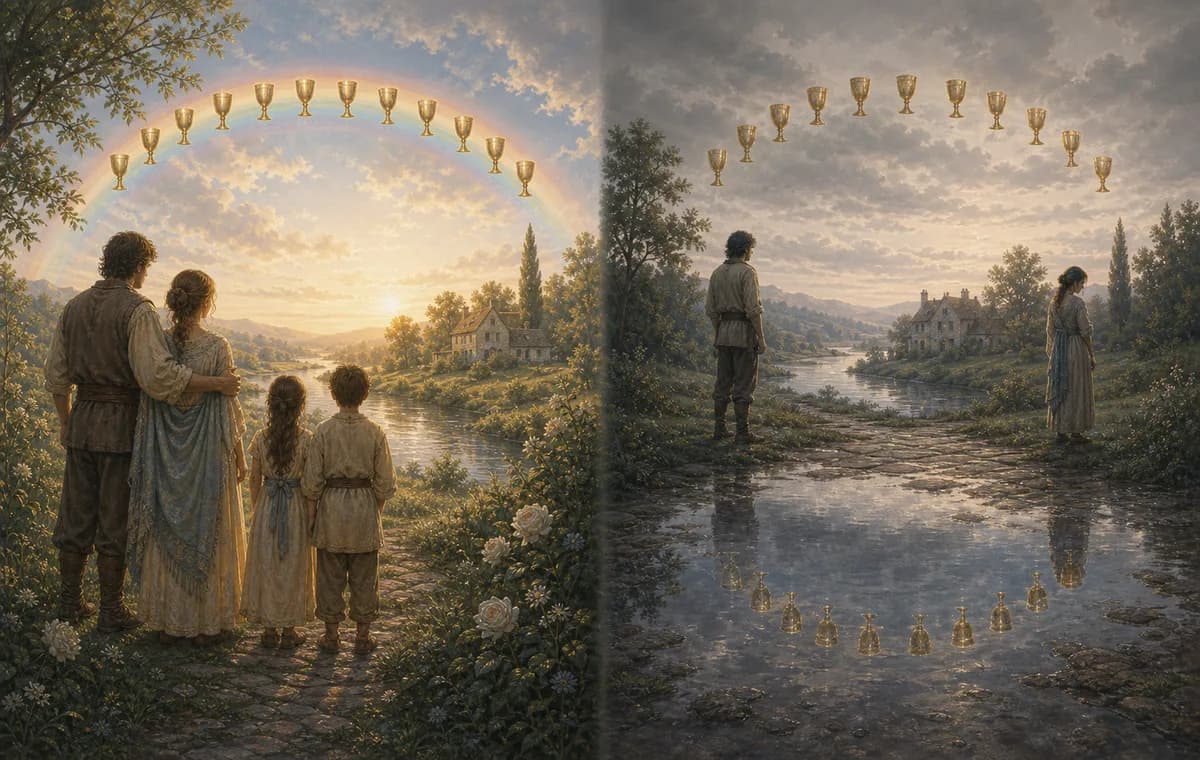
First, the question every reversal needs answered before interpretation: is reversed Ten of Cups negative? Mostly yes — more so than I'd like, because the card's upright state is so high that almost any inversion reads as a fall. But not uniformly. There is one genuinely constructive reversal, and I'll get to it, because most guides bury it.
Core Reversed Keywords
- Disconnection — A home or bond that looks intact and feels hollow
- The cracked picture — Reality failing to match an idealized image
- Misaligned values — Living someone else's version of "happy"
- Unrealistic expectations — Demanding the rainbow be permanent
- Appearance over substance — Keeping up the family photo while the family struggles
- Chosen divergence — Walking away from an expected life on purpose (the constructive one)
In-Depth Reversed Interpretation
The first and most common reading is the cracked picture. The reversed Ten of Cups is the card of the home that photographs beautifully and feels like a held breath. The love may still be there underneath; what has broken is the image — the expectation that this was supposed to feel a certain way and doesn't. I see this most in clients who measured their relationship against a picture (a parent's marriage, an Instagram couple, a younger version of their own hopes) and found the daily reality wanting. The card is rarely saying "this is over." It is saying "the gap between the dream and the Tuesday has gotten wide enough to ache."
The second reading is misaligned values. You're chasing a fulfillment that isn't actually yours. Someone handed you the picture of the good life — the marriage, the house, the family at the holidays — and you've been furnishing it dutifully while quietly suspecting you wanted something else. The card asks a sharp question here: whose rainbow are you standing under? Sometimes the disharmony isn't failure. It's your own values surfacing against an inherited script.
The third reading — the constructive one — is the deliberate fork. This is the reversal almost everyone skips. The card sometimes describes a person who has chosen, on purpose, the path their family or culture did not picture for them: not marrying, not having children, leaving the hometown or the faith, building a life that doesn't fit the postcard. The discord this causes is real — but it's the discord of integrity, not of failure. The picture cracked because you decided you'd rather have your own.
When I see this card reversed, the work is to figure out which of the three I'm looking at, and the way to tell is to ask what the client feels. Grief over the gap points to the first. A low private guilt points to the second. A nervous, clear-eyed defiance points to the third.
The Three Areas Where the Ten of Cups Lands Hardest
This card is not equally relevant everywhere. It is overwhelmingly an emotional-life card, so I read it most carefully in love, in family, and in the question of belonging — not in money, where it has little to say.
Love & Relationships
This is the Ten of Cups's home turf, and in a love reading it is among the best cards you can draw. For couples it points to durable commitment — the milestone kind (moving in, engagement, marriage, a child) or simply the felt security of a bond that has stopped being in question. For singles it's a strong omen that what's coming is the lasting kind, not the dramatic kind: less first-toast electricity, more the quiet recognition that someone could be built-with.
When a client asks specifically about another person's feelings, that's a different angle, and I unpack it in Ten of Cups as feelings — including the trap of mistaking calm love for lukewarm love. For the broad meaning, hold this: the Ten promises the shape of lasting love. It doesn't promise that shape arrives without anyone choosing it daily.
Family & Home
The Ten of Cups is the deck's clearest family card, and "family" here includes the chosen kind — the friends who became kin, the household you assembled rather than inherited. Upright, it signals a home at peace, generational healing, holidays that are actually warm. It often appears for clients who've just repaired a long family rupture, or who are about to build a household of their own and are anxious about whether they can. The answer is yes, with the caveat the rainbow always carries: peace is maintained, not installed.
Belonging & the Search for "Home"
The subtlest area, and the one I find most useful. Plenty of clients who draw this card aren't asking about a partner or a family at all. They're asking, underneath, whether they'll ever feel at home anywhere — in a city, a community, a body, a life. The Ten of Cups speaks to that directly: it is the card of the felt sense of belonging, and reversed, the ache of its absence — surrounded by people and still homesick. Upright is permission to believe the belonging is real; reversed is the honest naming of how it feels when it isn't yet.
Is the Rainbow a Promise or a Possession?
Here is the blind spot none of the popular guides name, and the question I think the Ten of Cups actually exists to ask.
The whole internet reads this card as arrival — you made it, you have it, the happy ending is yours. But the rainbow is not a thing you can own. It appears when conditions are right and vanishes when they shift. The card isn't handing you a permanent state; it's showing a promise and pointing at the work the promise quietly assumes.
I have watched clients use the Ten of Cups as a place to stop. They draw it, exhale, and treat the relationship or the family as finished — solved, secured, no longer needing attention. A year later they're back holding the reversed version, baffled the picture cracked. It cracked because they stopped tending the conditions that made the rainbow appear. The forgiving, the choosing-again, the showing-up on the unphotogenic days — that is the rain and the sun the rainbow requires. Take that work away and the light has nothing to pass through.
So when this card comes up I say a version of the same thing every time: the Ten of Cups is the most beautiful card in the deck to draw and the most dangerous to coast on. It rewards the people who treat the rainbow as a promise to keep earning and humbles the ones who treat it as a trophy already won. The card that looks like permission to relax is, read honestly, permission to appreciate — a more active thing.
This is also why it shares its floating cups with the Seven of Cups. The Seven is fantasy you mistake for reality. The Ten is reality you can turn into fantasy by refusing to maintain it.
Ten of Cups Card Combinations
A single card states a theme. The combination is where the actual reading lives. Here are the pairings I see most.
Ten of Cups + The Sun
The most uncomplicated joy in the deck, doubled. Where the Ten gives the shared, settled fulfillment, The Sun gives the visible, radiant, out-loud version of it. Together they often describe a relationship or family entering a season of open, unhidden happiness — an engagement announced, a child welcomed, a homecoming celebrated in front of everyone. When a client is anxious that their good thing has to stay secret or might be jinxed by being named, this pairing says the opposite: let it be seen.
Ten of Cups + The Moon
A telling combination. The Moon is illusion, the half-light, the thing not as it appears. Beside the Ten of Cups it casts doubt on the picture: the family looks harmonious, and something underneath is unspoken. I read it as the upright Ten quietly behaving like its reversal — the photograph is real but isn't the whole story, and someone in the frame is performing a contentment they don't feel. Worth asking what isn't being said at the dinner table.
Ten of Cups + Three of Swords
Heartbreak inside the home. The Three of Swords is the clean grief of a pierced heart; against the Ten's harmony it usually points to a rupture within the family — a betrayal, a loss, a separation that tears the picture. But there's a gentler version: the Three can be the grief that precedes the Ten, the heartbreak you move through to reach the home on the other side. Sequence tells you which. Three then Ten is healing; Ten then Three is fracture.
Ten of Cups + The Tower
The rainbow meets the lightning bolt. The Tower is sudden structural collapse, and beside the Ten it most often warns that a domestic situation built on a hidden flaw is about to be exposed — the comfortable arrangement that was never as stable as it looked. Not always disaster: sometimes the Tower demolishes a false harmony so a real one can be built. But this is where I slow down and read the surrounding cards before reassuring anyone.
Ten of Cups + Two of Cups
The full emotional arc in two cards. The present-tense spark of the Two of Cups — two people facing each other in mutual recognition. The Ten is the future that spark grew into — the same two, now side by side, facing a shared horizon. Together they describe a relationship with both the immediate chemistry and the long-term shape, which is rarer than either card alone. One of the strongest love combinations in the deck.
Ten of Cups + Six of Cups
Childhood warmth projected into a built future. The Six of Cups is innocence, nostalgia, the safe garden of the past; beside the Ten it often describes a home built deliberately to give someone the belonging they did or didn't have growing up. The tender version of generational healing — taking the good of where you came from and carrying it into the rainbow you're raising your own people under.
Numerology & Astrological Correspondences
In numerology, ten is completion — the end of a cycle and the seed of the next (it reduces to 1). The Ten of Cups is the emotional suit fully run, from the Ace's single overflowing cup to a whole sky of them. Because ten folds back into one, the card carries a small forward lean: the completion that becomes a foundation for what's built next.
The element is Water. The Golden Dawn assigns the card Mars in Pisces, a more interesting attribution than it first sounds. Pisces is the boundary-dissolving water sign of the idealized vision; Mars is drive, the force that acts. Mars in Pisces is the will applied to the dream — the energy needed to actually build the picture rather than merely imagine it. That is the Ten of Cups exactly: not the fantasy of fulfillment (pure Pisces, or the Seven of Cups), but the effort of bringing a tender vision into a maintained, lived-in home.
Frequently Asked Questions
Is the Ten of Cups a yes or no card?
Upright, it is one of the strongest Yes cards in the deck — especially for anything involving love, family, home, or long-term happiness. Reversed, the answer softens to "not yet" or a qualified No: the thing you want is possible, but the current picture isn't matching it, and something needs realigning first.
Is the Ten of Cups a marriage card?
It is widely read as one of the deck's strongest marriage and commitment indicators — not because of dramatic passion, but because it signals the steady, enduring, family-shaped love that marriage is meant to formalize. In a love reading it can point to engagement, moving in together, or starting a family. Reversed, it can flag hesitation about commitment or a gap between what the partnership looks like and what it feels like.
What does the Ten of Cups reversed mean?
Most often, the gap between the picture and the reality: a home that looks happy and feels disconnected, misaligned values, or unrealistic expectations of permanent bliss. It is usually about the image cracking rather than the love disappearing. Less commonly — and more positively — it describes deliberately choosing a life your family or culture didn't picture for you, which causes discord precisely because the bonds are strong.
What is the difference between the Nine and Ten of Cups?
The Nine of Cups is personal satisfaction — one figure, his own wish granted, contentment kept to himself. The Ten of Cups is that same fulfillment opened outward and shared, the cups lifted into a sky others can see. Nine is "my wish came true." Ten is "and it only feels complete because I'm not enjoying it alone."
What element and astrology is the Ten of Cups?
The element is Water, the medium of the entire Suit of Cups — emotion, intuition, and relationship. Its traditional Golden Dawn astrological correspondence is Mars in Pisces: the drive (Mars) to actually build the idealized emotional vision (Pisces), rather than merely dream it.
Is the Ten of Cups a good card for love?
Yes — among the best. Upright it points to lasting, secure, mutual love rather than fleeting infatuation. The one caution I'd add: it describes love that is built and maintained, not love that arrives finished. Read it as a strong green light that still asks you to keep showing up.
What does the Ten of Cups say about family?
It is the deck's clearest family-harmony card, and family here includes the chosen kind. Upright, it signals a home at peace, generational healing, and warmth among the people you call yours. Reversed, it points to surface harmony hiding real tension — the family keeping up appearances while something underneath needs an honest conversation.
Closing
The Ten of Cups is the card people fantasize about drawing, and that fantasy is the one risk it carries. It is genuinely the deck's most fulfilled image — real love, real belonging, a real home. Receive that. It is not handed out lightly.
Then do the one small thing the card is actually asking. If you drew it upright, name out loud the thing you already have and have been reaching past — tell the partner, hug the kid, sit in the home you built for one full evening without scanning the horizon for the next storm. The rainbow doesn't ask you to chase it. It asks you to look up and notice it's there, and then keep tending the weather that made it. That noticing is the whole assignment.
Continue exploring the Suit of Cups: see how this card reads when you're asking about someone's feelings in Ten of Cups as feelings, or use our love tarot spread guide for a fuller reading.