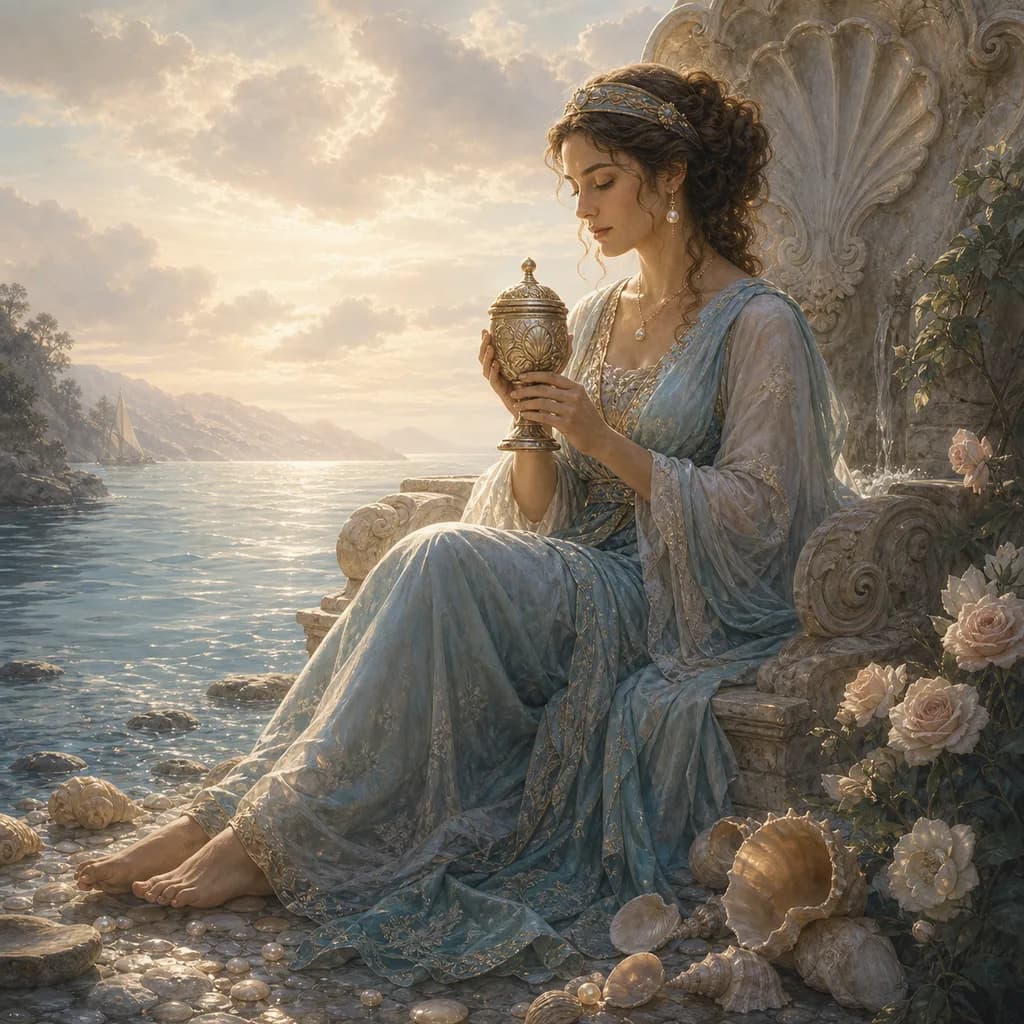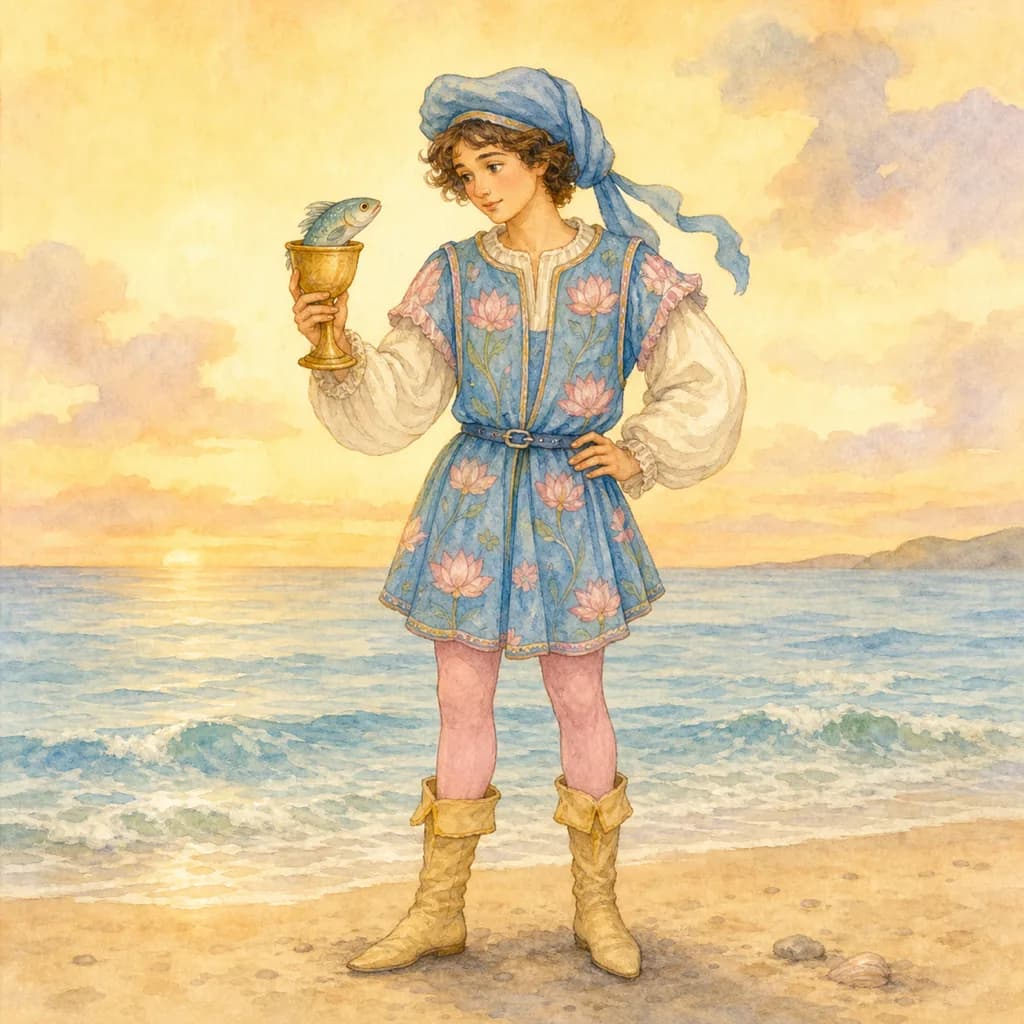
A fish pops its head out of a cup, and a young person in a flowered tunic looks at it like it just told a joke. That single image carries more of the Page of Cups than the long keyword lists most guides hand you. The fish is a surprise the Page didn't put there, and the Page is delighted and slightly baffled. Hold onto that expression — half wonder, half "wait, what?" — because it's the emotional signature the card brings into every reading, and it gets flattened when people reduce the Page to "creative message" and move on.
After more than a decade reading the Rider-Waite-Smith deck in Tokyo, I've found the Page of Cups is one of the most pleasantly misjudged cards there is. People either dismiss it as minor "good news" filler or inflate it into a love prophecy, and both miss what it actually does in a spread. The question that untangles its biggest source of confusion runs underneath everything below: is it a message, an invitation, or a person?
Quick Answer
The Page of Cups is a Minor Arcana court card in the suit of Cups, tied to Water. Upright, it means an emotional or creative beginning arriving from somewhere you didn't expect — a fresh feeling, an intuitive nudge, a gentle message, an invitation to be more open-hearted than you usually let yourself be. Reversed, that openness gets blocked or wobbly: creative self-doubt, a feeling you're hiding, or emotional immaturity. Yes / No: upright is a soft Yes; reversed leans toward "not yet, and not steady."
Basic Information
| Attribute | Details |
|---|---|
| Card Name | Page of Cups |
| Suit | Cups |
| Arcana | Minor Arcana (Court Card) |
| Element | Water (the Page's earthy, learning aspect of Water) |
| Yes / No | Yes (upright, gentle); "not yet" (reversed) |
| Upright Keywords | Emotional openness, creative spark, intuitive message, curiosity, pleasant surprise, the inner child |
| Reversed Keywords | Creative block, self-doubt, hidden feeling, emotional immaturity, moodiness, unrequited longing |
Card Imagery & Symbolism
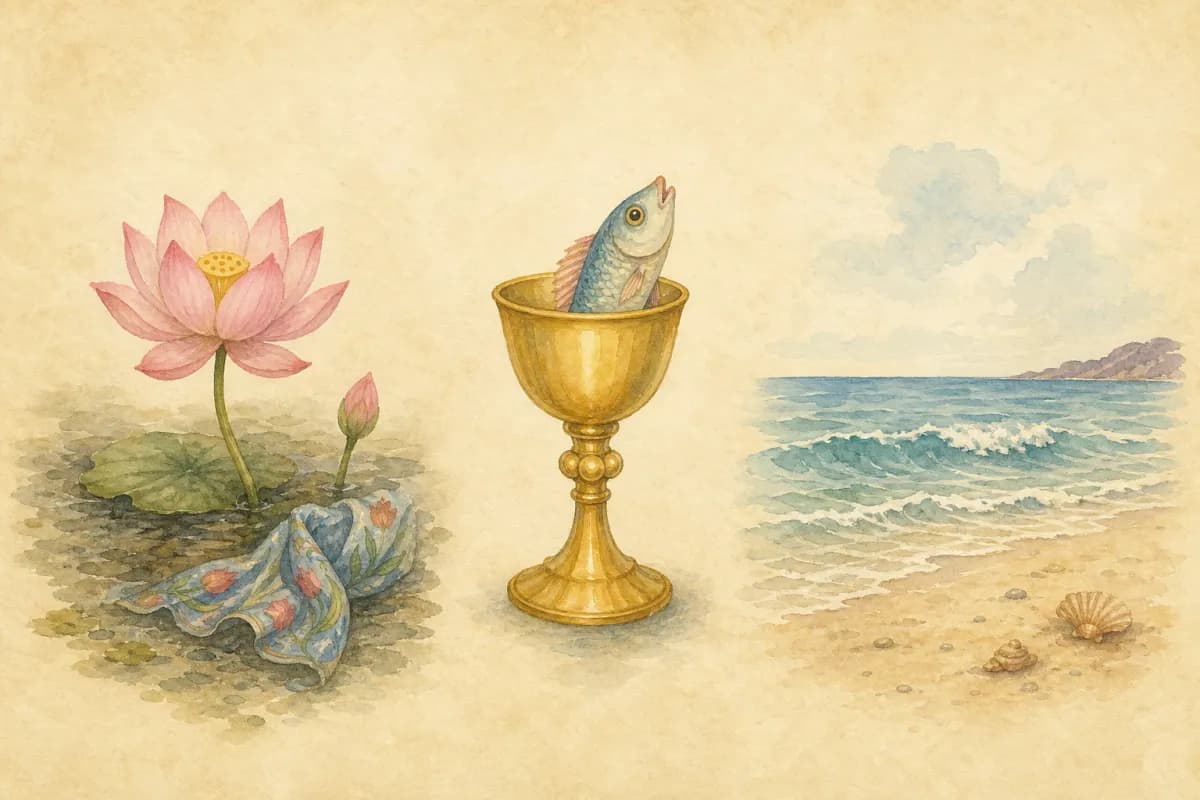
Look at the whole scene first. A youthful figure stands on a strip of shore in a long blue tunic printed with pink lotus flowers, a soft beret on their head. Behind them the sea rolls in gentle waves. They hold up a golden cup, and out of it leans a small fish, turning to face them; the Page returns the look. Most guides name these objects and stop. What they rarely do is read the posture — and the posture is where the card's lesson lives.
The Fish in the Cup
This is the detail that defines the card. A cup is for drinking; a fish is the last thing you expect to find in one. The Page lifted it intending one thing and got something else entirely, something alive that looks back. That is the card's whole relationship to feeling and inspiration: it shows up uninvited, from the depths, in the container you were using for ordinary purposes — the unconscious surfacing when you least planned for it.
Here's what I rarely see written: the Page is not afraid of the fish. A more guarded person would flinch or set the cup down. The Page leans in. That willingness to be surprised by your own inner life — to treat a strange feeling as a curiosity worth turning toward — is the actual gift of the card. As a person, it's someone who hasn't yet learned to wall off the weird, tender, intuitive parts of themselves; as a moment, it asks the same of you.
The Calm Sea and the Shore
Compare the water here to the other Cups court cards. The Knight rides along a riverbank, the Queen sits at the water's edge gazing in, the King floats on a rough open sea. The Page stands on solid shore with calm water behind, not yet gone into it — Water in its earliest, most supervised form, feeling glimpsed from the safety of dry land. That placement is the visual reason the Page reads as a beginning: the depths are present, but the Page is only just learning to fish them.
The Lotus Tunic and the Beret
The lotus flowers on the tunic are a quiet borrowing from Eastern symbolism — the bloom that grows out of muddy water without being stained by it, an old emblem of feeling that stays pure even when it rises from murky places. The Page wears that idea without fully understanding it yet. And the slightly absurd beret signals something the somber tarot tradition often forgets: this card is allowed to be playful, and that lightness is part of the medicine.
Page of Cups Upright Meaning
Upright, the Page of Cups is the suit's first cup — feeling that is brand new, curious, and unguarded. It rarely points to anything heavy. Its job is to open a door, not to walk you all the way through it.
In-Depth Upright Interpretation
The most reliable thing about upright Page of Cups is that it's an early card. Whatever it points to is at its just-begun stage, and the trouble starts when people treat a seedling like a harvest.
As a messenger, the Page often signals incoming news with an emotional charge: a heartfelt text, an apology you'd given up on, an offer for creative work. The traditional books are right that it carries messages; what they undersell is that the message usually asks something of you in return. The fish is looking at the Page. This is good news that wants a response.
As an inner state, upright Page of Cups is the card of letting your guard down on purpose. I draw it for clients who've been so competent and armored for so long that they've forgotten how to be charmed by anything. A meticulous architect in Tokyo kept pulling it across a single month and wanted it to mean a work opportunity. I told her it wasn't about her career; it was asking when she'd last done something purely because it was fun. She started a pottery class, mostly to prove me wrong, and three months later it had quietly become the part of her week she protected most. That is the card reopening a channel that had closed.
The trap to avoid is over-reading. The Page is sincere but small; it promises a beginning, not a guarantee. Read it as permission and possibility and you'll almost never be wrong. Read it as destiny and you'll set someone up to be hurt.
Page of Cups Reversed Meaning
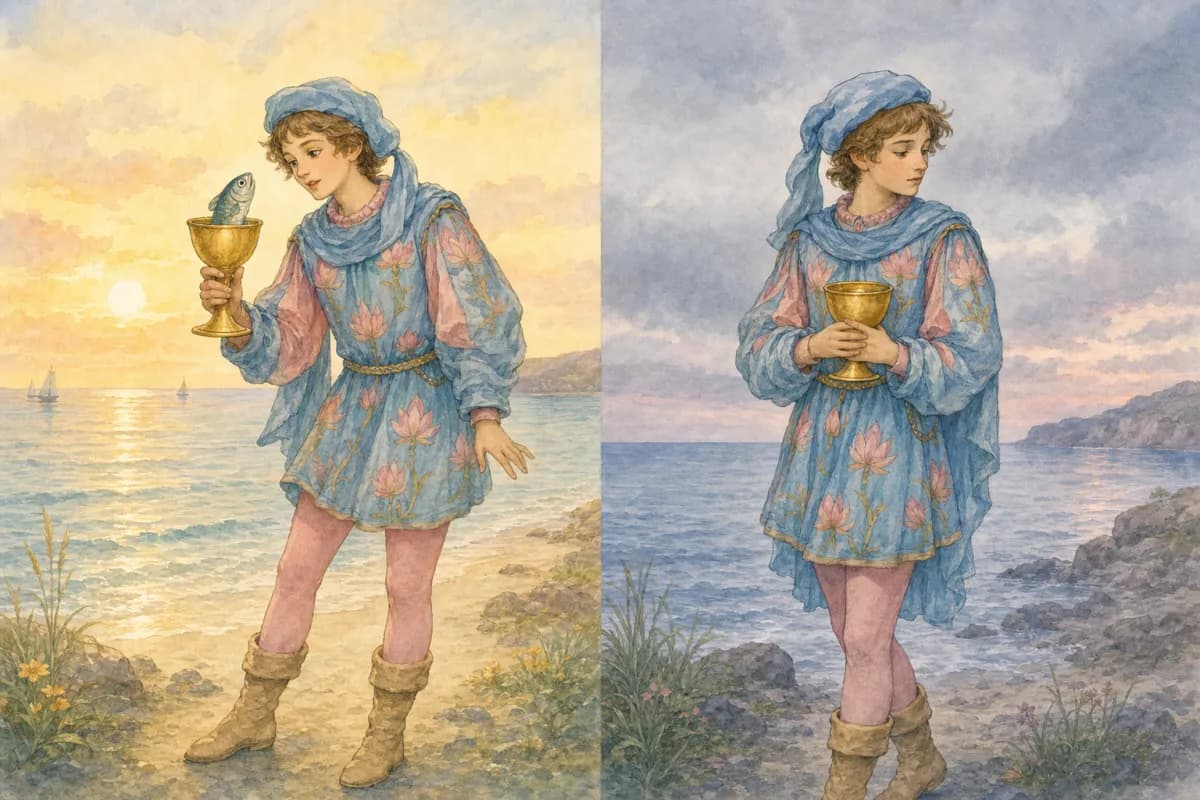
First, the question I should answer directly: is reversed Page of Cups negative? Mildly, at most. This is one of the gentler reversals in the deck, and it rarely signals the harm a reversed Tower or a poorly-placed Three of Swords might. Far more often it's a feeling or a spark that's been blocked, hidden, or handled clumsily — uncomfortable, occasionally sad, but workable. Treat it as a wobble you can steady.
In-Depth Reversed Interpretation
Reversed Page of Cups splits into a few distinct shapes, and they aren't equally troubling.
The first is the blocked or hidden spark. The fish is still in the cup, but the Page has turned away from it. You have an idea or a feeling and you're sitting on it — afraid it's silly, afraid it'll fail before it starts. This is the most common shape and the most fixable. The card asks what it would cost to let one small, unfinished thing be seen.
The second is emotional immaturity. Here the Cups energy curdles into the difficult end of "young": moodiness, over-sensitivity, sulking instead of saying the thing, idealizing someone one week and going cold the next. It's rarely cruelty. More often it's a person (possibly you) who feels intensely but hasn't learned to hold the feeling steadily, so the feeling holds them instead. The kind diagnosis is that they're overwhelmed; the honest one is that you can't build on this yet.
The third, less common, is disappointment. Some traditions read reversed Page of Cups as minor bad news on an emotional front — a connection that doesn't reciprocate, a creative rejection, a plan falling through. I read this cautiously and only when the surrounding cards back it up; the card's natural temperature is too tender to carry real catastrophe on its own.
How do I tell these apart in a live reading? I look at where the energy is stuck. Inside the querent — a held-back idea, a swallowed feeling — it's the blocked spark, and the work is expression. Leaking messily onto other people, it's the immaturity reading, and the work is regulation.
Is the Page of Cups a Message, an Invitation, or a Person?
This is the blind spot in almost every Page of Cups guide I've read. They list "messenger," "creative self," and "a young person" stacked on top of each other, then leave you to guess which applies — even though the three point in completely different directions. Here's how I actually tell them apart.
It's a message when the surrounding cards are about events, communication, or news — Aces, the Three of Cups, the Eight of Wands, anything arriving from outside. The Page is the envelope here; someone else is the writer. Watch for emotional or creative news, and notice that it wants a reply.
It's an invitation when the spread is about you and your own inner weather — when the question was "what do I need?" or "what am I missing?" Here the Page predicts nothing. It dares you to take an emotional risk on purpose: telling someone how you feel, or starting the thing you've talked yourself out of. It's the reading competitor guides bury, and the one I give most often, because the people who draw it have usually stopped accepting invitations from their own hearts.
It's a person when the spread is populated with other court cards, or when the question was explicitly about who someone is. Then the Page describes a real human: young in spirit if not in years, intuitive, creative, sometimes naive, often the gentle one in the room — and I've met seventy-year-old Pages and twenty-five-year-old Kings.
Read the neighbors before you commit. The single biggest Page of Cups mistake is locking onto "it's a person who likes me" when the card was saying "take the risk yourself." For the version where you've asked how someone feels about you, the Page of Cups as feelings page works through the crush-and-ex questions this meaning page doesn't.
Page of Cups in Love & Relationships
In love, upright Page of Cups is one of the sweeter draws, sweet in a specific, early register. For singles, it can mark a shy admirer, a flirtation finding its feet, or a nudge to lower your own drawbridge. The card favors the tender opening move: the deniable text, the soft compliment, the small risk. For couples, it's a flicker of freshness — your partner seeing you with new eyes, playfulness returning to a connection gone automatic. The growth edge is letting that tenderness mature into something with weight behind it.
Here's where I push back on the standard reading. The popular guides love to list pregnancies, proposals, and engagements here. The Page can appear around those, but it gets read too literally — it's the early flutter that still has to grow into anything binding. When a client draws it and starts planning a wedding, I slow them down.
Reversed in love is where the immaturity reading earns its keep: a partner who pulls back the moment things get real, a crush blowing hot and cold, or a feeling that's genuinely there but trapped behind shyness. The most useful thing I tell clients: don't judge by a single warm or cold day. Wait for a pattern, because the card's defining symptom is inconsistency.
Page of Cups in Creativity & Self-Expression
This is the Page's home turf, and where I'd send anyone who only has time to read one section. Upright, the card is a green light for the imagination: an idea worth following, a project worth starting, a return to making things for the joy of it. The fish in the cup is inspiration arriving unbidden — the line of a poem in the shower, the urge to draw again after years away. Welcome that impulse instead of treating it as an interruption.
What makes this distinct from the love reading is the direction of the risk. In love the Page risks rejection by a person; in creativity it risks rejection by your own inner critic, usually the harsher judge. Reversed here is almost always the creative block: the spark hidden, the project abandoned at the doubt stage, the joy drained out of something you used to do for love and now do for approval. The remedy is small and unglamorous — make one thing, badly, with no audience. Stop strangling the fish.
Page of Cups in Emotional Growth & the Inner Child
I read this position more than the old guides suggest, because the Page's real subject is the capacity to feel openly. Upright in a growth spot, it's a healthy sign — a softening, the inner child knocking to be let back into the schedule. Reversed points two ways. One is the inner child neglected: joy crowded out, play forgotten, life gone gray and dutiful. The other is the inner child running the show — adult problems met with tantrums and avoidance where action is needed. The first wants permission; the second wants boundaries, and the surrounding cards tell you which.
Page of Cups Card Combinations
Page of Cups + Ace of Cups
A genuine emotional new beginning, doubled. The Ace opens the channel; the Page takes the first sip. One of the cleaner "yes, something real is starting" combinations in the deck — a new love, a creative awakening, a heart reopening. Both cards are about the start, so the outcome is still wide open.
Page of Cups + Knight of Cups
Two ages of the same suit side by side — the shy bud and the romantic in full bloom. Often a timeline (a tentative feeling about to find its voice) or a choice between two suitors. When it's about a person's intentions, the Page is the honest hesitation, the Knight the performance.
Page of Cups + The Moon
A flag worth catching. The Page's openness meets The Moon's fog and projection — a feeling that's real but unclear, where the danger is filling in the blanks with your own hopes. When a client draws this about a crush, I slow them right down: the Page wants to believe, and The Moon supplies the illusions.
Page of Cups + The Star
Tender hope after a hard stretch. The Star is healing and renewed faith; the Page is the first small, vulnerable feeling that proves the healing took. I love this pair after a breakup or a creative drought — the moment you catch yourself softly excited about something again.
Page of Cups + Three of Cups
Joyful, social good news — a celebration, a reunion, an emotional event shared with others. The Page's pleasant-surprise quality gets amplified by the Three's gathering: often an engagement party or a happy announcement, the feeling spilling outward instead of staying private.
Page of Cups Reversed + Five of Cups
The disappointment reading, confirmed. The Five is grief over what's lost; the reversed Page is the tender feeling that got hurt — a hope that didn't pan out. Real, but rarely fatal; the Five always leaves two cups still standing.
Numerology & Elemental Correspondence
The court cards aren't numbered like the pips, so there's no single digit to reduce; their "number" is rank. Across the Cups court — Page, Knight, Queen, King — feeling moves from first contact to full mastery: the Page receives Water, the Knight chases it, the Queen embodies it, the King governs it. That apprentice position is the structural reason the card reads young, down to the earthy, student form of Water it carries. As a person, it describes someone with watery sensitivity who hasn't yet been weathered by it: emotionally fluent, imaginative, easily delighted.
Frequently Asked Questions
What does the Page of Cups mean?
It means an emotional or creative beginning, usually arriving from somewhere unexpected — a fresh feeling, an intuitive nudge, a heartfelt message, or an invitation to be more open than you normally allow. A tender, early card: sincere but small.
Is the Page of Cups a yes or no card?
Upright, it's a gentle yes — warm and hopeful but soft, so read it as "yes, and it's just beginning." Reversed, it shifts toward "not yet, and not steady," usually because a feeling is blocked, hidden, or too immature to build on. It seldom means a flat no.
What does the Page of Cups mean as a person?
A young-at-heart, intuitive, gentle individual — imaginative, sometimes naive, not necessarily young in years. Reversed, the same person turns moody, oversensitive, or immature. Read the surrounding court cards to confirm whether it's a real person or a quality entering the situation.
Does the Page of Cups mean love?
Often, yes — but early love. For singles it can mark a shy admirer or a nudge to open up; for couples, a return of freshness and play. The caution is reading it too literally as a proposal or pregnancy, since the Page is the tender feeling that comes well before any commitment.
What does the Page of Cups reversed mean?
Three main shapes: a blocked or hidden creative spark, emotional immaturity (moodiness, hot-and-cold behavior), and occasionally minor emotional disappointment. The first hurts mostly you and is the most fixable; the second leaks onto others; the third needs the surrounding cards to confirm it.
Does the Page of Cups mean pregnancy?
It can appear around news of a pregnancy or birth with supportive Cups cards nearby, and the old books lean hard on this. But I'd never read it as a pregnancy prediction on its own — far more often it's an emotional or creative "new arrival." Let the rest of the spread decide.
Is the Page of Cups a good card to pull?
Yes, generally — it's one of the more benign cards in the deck. Upright it's an encouraging sign of openness, inspiration, and tender beginnings. Even reversed it's usually a workable wobble, pointing to a feeling that needs expression or some growing-up, and only rarely to a genuine threat.
Closing
The Page of Cups is the deck's reminder that feeling and inspiration arrive on their own schedule, from the depths, in the container you were using for something else. It doesn't promise much, and that's its honesty — it offers a beginning and asks only that you not flinch.
If you've drawn it, do one concrete thing: name the fish in your own cup right now — the feeling you've been not-quite-letting-yourself-have, the idea you've talked yourself out of, the small risk you keep deferring. Then take one tiny step toward it this week: send the message, start the sketch, say the true thing. The Page never asks for a leap, only that you look.
Continue with the Cups court: read the Page of Cups as feelings for what it means when you've asked how someone feels, or plan a full reading with our love tarot spread guide.