There's a quiet test buried in the King of Cups, and almost no guide makes you take it. A man sits on a stone throne in the middle of a heaving sea, holding a cup, perfectly composed. Everyone reads that composure as the lesson. But composure is exactly the thing that can mean two opposite things at once — a person who has mastered their feelings, or a person who has sealed them off. The King of Cups is the card that asks you to tell those apart, and getting it wrong is how readers turn a warning into a compliment.
After more than a decade reading the Rider-Waite-Smith deck in Tokyo, this is the court card I most often watch clients misread in their own favour. So this guide goes past the standard "emotionally mature mentor" summary. It covers the symbolism in detail, the upright and reversed meanings, the three life areas where this King actually changes the reading, the combinations that come up most, and the one diagnostic question — mastery or wall? — that the card is really putting to you.
Quick Answer
The King of Cups is a Minor Arcana court card in the suit of Cups, tied to the element of Water and the water signs (most often Pisces, with Cancer and Scorpio in the mix). Upright, it means emotional mastery: someone who feels deeply but stays calm and responsive under pressure — a diplomatic, compassionate, steady presence, often an older or emotionally seasoned figure who gives good counsel. Reversed, that same control tips over into moodiness, repression, manipulation, or emotional volatility — the calm becomes a wall or a weapon rather than a strength. Yes / No: upright leans Yes (a considered yes, not an impulsive one); reversed leans No or "not until the emotional ground is steadier."
Basic Information
| Attribute | Details |
|---|---|
| Card Name | King of Cups |
| Suit | Cups |
| Arcana | Minor Arcana (Court Card) |
| Element | Water (the King's airy/governing aspect of Water) |
| Zodiac Correspondence | Pisces (also read across Cancer and Scorpio) |
| Yes / No | Yes (upright, considered); No or "not yet" (reversed) |
| Upright Keywords | Emotional maturity, composure, compassion, diplomacy, control of feeling, wise counsel |
| Reversed Keywords | Repression, moodiness, manipulation, volatility, emotional unavailability, coldness |
Card Imagery & Symbolism

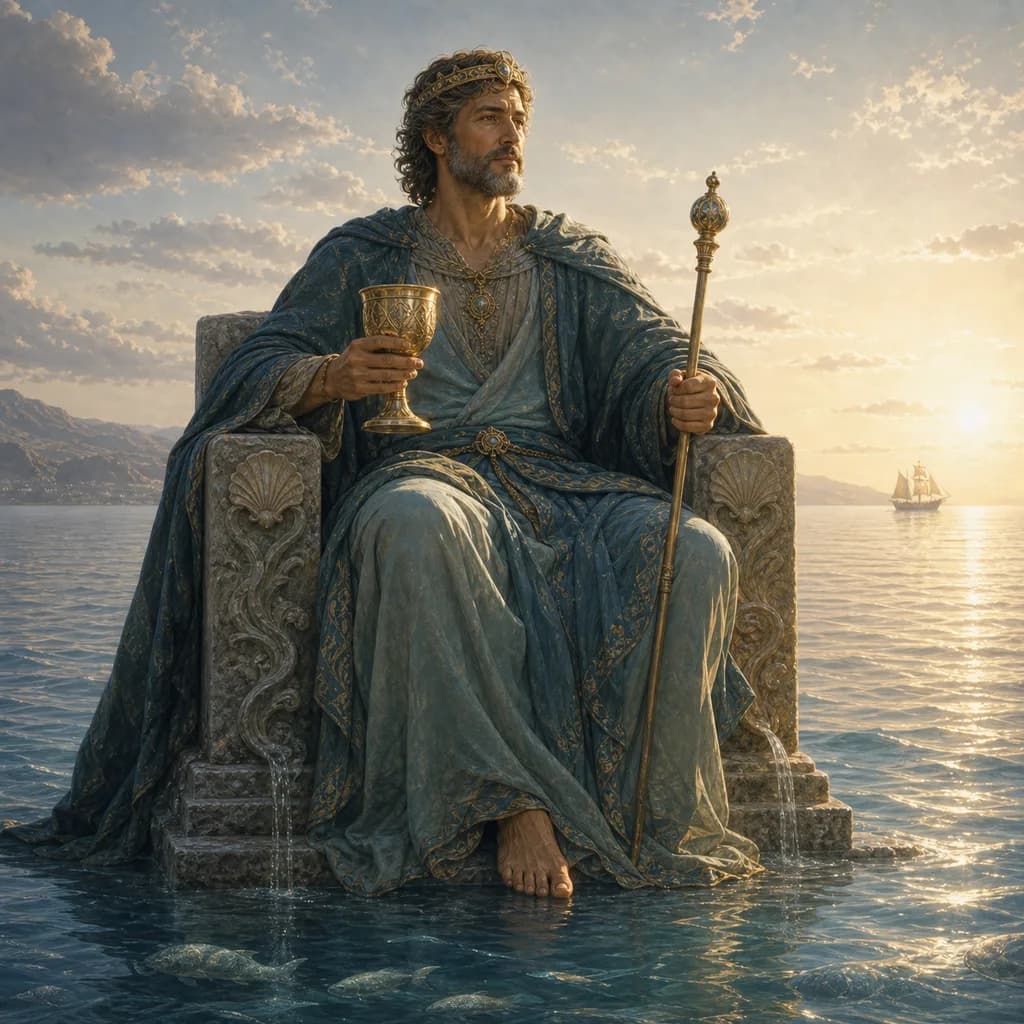
Picture the scene before you interpret it. A king sits on a grey stone throne that appears to float on a rough, choppy sea. He holds a golden cup in his right hand and a short scepter in his left. To one side a fish leaps clear of the water; to the other, a ship rides the swell in the distance. He wears a blue tunic and, around his neck, a fish-shaped amulet.
Most guides describe these objects. Fewer read what they're doing together — which is staging a single argument about feeling under pressure.
The Throne on the Open Sea
This is the detail that decides the whole card, and it's the one people skim. The King's throne is not on land. It sits on a slab in the middle of moving water, and the water is not calm — there are whitecaps. Every other figure in the Cups court has a relationship to a shoreline. The King has none. He is the only one whose seat is entirely surrounded by the element he rules.
The teaching is uncomfortable when you sit with it: his calm is not because the sea is calm. The sea is rough and he is still steady. Mastery here is not the absence of turbulence — it's composure that coexists with it. When clients tell me they "have their emotions handled," I ask whether the sea around them is actually flat, or whether they've just stopped looking down. The King's throne says the second one is allowed, even admirable. The reversed King is what happens when you stop looking down and call that peace.
The Cup and the Scepter
He holds a cup in one hand and a scepter in the other — feeling in the right, authority in the left. The point is that he holds both, neither raised over the other. Compare him to the Queen of Cups, who gazes into her cup completely absorbed; the King looks outward, away from his cup. He has feeling, but he is not lost in it. That outward gaze is the difference between being emotionally present and being emotionally flooded — and it's also, in the shadow reading, the difference between regulation and detachment. The same averted gaze can mean "I'm steady enough to attend to you" or "I'm not really in this cup at all."
The Leaping Fish and the Ship
The fish breaking the surface is the suit's signature — the same creative, intuitive spark that jumps from the Page of Cups' cup. In the King it leaps outside and behind him, in the water, not in his hand. The unconscious is active around this man; he just isn't grasping at it. The distant ship is commerce and direction — the worldly, masculine, goal-oriented current that the King keeps in view without chasing. Together they say: he is aware of both the depths and the destination, and panicked by neither. The fish amulet at his throat is a quiet promise that he hasn't cut himself off from the source — the suit's creativity still touches his body, even if his hands are occupied with governing.
King of Cups Upright Meaning
Upright, the King of Cups is the deck's portrait of emotional adulthood — not the absence of strong feeling, but the capacity to hold it without being run by it.
Core Upright Keywords
- Emotional mastery — Feeling fully, responding rather than reacting
- Compassionate authority — Care that comes with steadiness, not just softness
- Diplomacy — The ability to defuse, mediate, hold the room calm
- Wise counsel — The figure others go to when they're falling apart
- Devotion — Love and loyalty expressed through reliability over display
In-Depth Upright Interpretation
When the King appears upright as a person, he's usually the steady one in the system — the friend who doesn't flinch when you cry, the manager who stays level when the project is on fire, the partner who shows up rather than performs. He tends to read as older or simply more emotionally seasoned, and the surrounding cards will tell you whether he's a real individual, a role you're being asked to play, or a quality entering the situation.
That last one matters more than most guides admit. The King of Cups is one of the strongest advice cards in the deck. Drawn in answer to "how should I handle this," it isn't describing a man at all — it's telling you to become him: feel what you feel, then act from the calm underneath it rather than the spike on top. I give this reading constantly to clients in conflict who want to fire off the angry message. The King says send it tomorrow, from the version of you that has already felt the anger all the way through.
A client of mine in Tokyo, a department head, kept drawing the King of Cups during a stretch when a junior colleague was openly undermining her. She wanted the card to mean "stay nice and let it go." I told her it didn't — the King isn't passive, he's governing. The reading wasn't "suppress your reaction." It was "you can be the calmest person in this room and still draw a firm line; the calm is what makes the line land." She had a direct, unheated conversation that week, and it worked precisely because she wasn't shaking. That's the upright King in practice — composure as leverage, not as avoidance.
The trap to avoid: reading the King as merely "nice." He is kind, but the throne is a throne. There is real authority in this card, and missing it turns a leader into a doormat.
King of Cups Reversed Meaning

First, the question the playbook makes me answer plainly: is reversed King of Cups negative? More often than not, yes — this is one of the court reversals I treat as a genuine caution rather than a soft "blocked energy." But the kind of negative varies a lot, and lumping them together is the common mistake. There are three distinct shapes, and they aren't equally bad.
Core Reversed Keywords
- Emotional repression — Feelings bottled rather than processed
- Moodiness / volatility — The calm cracks into unpredictable weather
- Manipulation — Reading others' emotions to control rather than to care
- Emotional unavailability — Present in body, absent in the relationship
- Coldness — Composure that has hardened into distance
In-Depth Reversed Interpretation
The first and most common reading is repression. The King has stopped riding the waves and started pretending there aren't any. The feeling is still there — it's just been pushed below the line and denied. This is the partner who insists everything's fine through clenched composure, the friend who hasn't actually grieved, the version of you that calls numbness "being mature about it." This reading isn't malicious. It's a man drowning quietly while holding the cup perfectly level. The card is asking for the feeling to be let back up before it comes up sideways.
The second is moody volatility — the dethroned King. Here the sea has won. The control that defined him upright has slipped, and emotion now governs him: he's reactive, sulky, blowing hot and cold, sensitive in a way that destabilises the people around him. In a love reading this is the mixed-signal partner — wonderful one day, withdrawn the next, leaving you unsure which version is real. The instability is the message.
The third, and the one to take most seriously, is manipulation. The King's gift is reading emotional currents. Reversed, that gift can be turned into a weapon — someone who senses exactly where you're soft and presses there, who weaponises calm ("why are you so emotional?") to make you doubt your own reactions, who performs tenderness in words while the behaviour never follows. This is the rarest of the three but the most damaging, and the surrounding cards will usually flag it: the Seven of Swords, The Devil, or The Moon nearby push the reading toward something deliberate rather than merely struggling.
How do I tell them apart in a live reading? I look at the direction of harm. Repression hurts mostly the King himself. Volatility hurts whoever's nearest, but accidentally. Manipulation is aimed. If you're reading this for a person in your life and you can't tell which one you're dealing with, that uncertainty is itself worth sitting with — and it's the same diagnostic the King of Cups as feelings page works through for the specific question of whether someone's quiet means depth or distance.
Is It Emotional Mastery, or Emotional Suppression Wearing the Same Crown?
This is the blind spot in nearly every King of Cups guide I've read, and it's the most useful thing the card can teach you. The competitor articles describe upright mastery and reversed repression as if they sit on opposite sides of a clean line. In real readings they don't. From the outside, the man who has genuinely mastered his feelings and the man who has simply buried them look identical — same calm, same level voice, same averted gaze toward the horizon. The throne on the rough sea is the same image either way. So how do you read which one the card is actually pointing at?
You stop reading the calm and start reading what the calm produces.
Genuine mastery is calm that stays connected. The mastered King is composed and still reachable — his steadiness makes other people feel held, not shut out; his actions track his words; you can bring him your mess and the water has room for it. The Japanese word my teacher used for this, 「包容力」(hōyōryoku), names it better than English does: the capacity to take on another person's emotions without being knocked over by them.
Suppression is calm that isolates. The suppressed King is composed and unreachable — the steadiness becomes a moat, the words run warmer than the behaviour, and getting an honest feeling out of him is like knocking on a sealed door. Crucially, suppression also asks a question about control: a King who uses his composure to make you the emotional one — to keep you off-balance while he stays untouchable — isn't regulating his feelings. He's managing yours. Who's actually being kept in check is the tell.
So the practical move, whether the card describes a person or describes you: don't measure how calm someone is. Measure whether the calm leads to contact or to distance. Steady water still flows toward you. A sealed well only looks peaceful because nothing's moving. Upright King, the water reaches you. Reversed, it stops at the wall.
King of Cups in Love & Relationships
In love, the upright King is one of the more reassuring court cards — a devoted, emotionally available partner who offers steadiness over spectacle. He's the "good husband / good father" archetype the old books point to: loyal, patient, the one who stays calm when you're not. For singles, he can signal either a person of this type approaching, or a nudge to become more emotionally grounded before the right connection can land. The catch is the one the whole card warns about — don't mistake his lack of fireworks for lack of feeling. This King shows love by showing up.
For the deeper version of this question — what it means specifically when you've asked how someone feels about you — the King of Cups as feelings page goes further than I can here, including the crush and ex readings.
Reversed in love is where you slow down. It can mean a partner who has emotionally checked out while staying physically present, someone giving mixed signals, or — at the harder end — emotional manipulation dressed as composure. The single most useful thing I tell clients here: stop weighing how he talks and start weighing whether the warmth turns into action. The reversed King's defining symptom is a gap between word and deed.
King of Cups in Career & Leadership
This is the King's strongest non-romantic territory, and it's underwritten everywhere else. Upright, he's the manager people trust in a crisis, the negotiator who keeps the temperature down, the senior figure whose authority comes from being unrattled. If you draw him about your own work, the advice is to lead with regulated emotion: you don't have to be cold to be in charge, and your steadiness is the thing that lets you hold authority over volatile situations. Caregiving, counselling, mediation, HR, medicine, the arts — the helping and feeling professions cluster around this card.
Reversed in career splits the same three ways as the general reversal. Sometimes it's a boss who has become a moody tyrant, ruling by emotional weather; sometimes it's you losing your composure under pressure and unable to find your footing; sometimes it's a colleague whose niceness is a tactic. Read the neighbours to know which.
King of Cups in Emotional Health & Inner Life
I read this position more often than the old guides suggest, because the King's whole subject is the management of feeling. Upright here is a genuinely healthy sign — emotional regulation, integration, the ability to feel a hard thing without being destabilised by it. It's the card of having done the inner work, or of being ready to.
Reversed in this position is the repression reading turned inward, and it's worth taking seriously. It can point to numbness mistaken for stability, to feelings managed so tightly they've gone underground, sometimes to the escapism (overwork, drink, anything that keeps the cup down) that some traditions attach to this reversal. The card's instruction is gentle but firm: let the water back up. The composure you're proud of may be costing more than it's saving.
King of Cups Card Combinations
King of Cups + The Star
Two quiet cards that get misread as lukewarm. Together they're deep emotional safety — a steady person and a healing, hopeful season. Common when someone is recovering from a turbulent relationship and a calm, trustworthy presence is entering. The King says "I've got you"; The Star says "you're safe to hope again."
King of Cups + The Moon
A flag worth catching. The King is clarity-under-feeling; The Moon is confusion, illusion, things unsaid. Together they often mean a composed surface hiding something murky underneath — the manipulation or emotional-unavailability reading of the King gets stronger here. When a client draws this pairing about a calm, reassuring partner, I slow them right down.
King of Cups + The Lovers
A mature partner meeting a real choice. The Lovers asks for a values-aligned decision; the King supplies the emotional steadiness to make it well rather than impulsively. Often appears around committing to someone — and it's a good omen, because it pairs depth of feeling with the composure to choose deliberately.
King of Cups + Ten of Cups
Domestic fulfilment anchored by a steady provider of feeling. The King is the emotional foundation under the Ten's happy family. One of the warmer combinations in the deck for long-term partnership and home.
King of Cups + Knight of Cups
Two generations of the same suit — maturity meeting romance-in-motion. Often a contrast reading: the steady, proven love versus the sweeping, idealistic one. When both appear about a choice between two people, the King is usually the safer harbour and the Knight the more thrilling unknown.
King of Cups Reversed + Seven of Swords
The manipulation reading, confirmed. Composure used as cover. This pairing pushes the reversed King firmly toward the deliberate end — someone managing your emotions rather than their own. Read it as a caution, not a character flaw to excuse.
Numerology & Astrological Correspondences
The Kings aren't numbered like the pip cards, so there's no single digit to reduce. Their "number" is rank — the court's final, governing stage. Page, Knight, Queen, King maps to a progression of the suit's energy: the Page receives Water, the Knight pursues it, the Queen embodies it, and the King governs it. The King is Cups administered — feeling that has been lived through long enough to be steered rather than merely felt. That's why he reads as the eldest and most settled of the four.
Astrologically the King of Cups carries Water in its governing, outward-facing mode, most often assigned to Pisces, with the broader Cups association spanning all three water signs (Cancer, Scorpio, Pisces). Pisces fits the card's compassion and boundarylessness; the Scorpio undertone explains why the shadow reading can run so dark — the same emotional depth that heals can, turned inward and reversed, manipulate. If you read the courts as people, the King of Cups often describes someone with strong water placements: emotionally fluent, intuitive, and either a profound comfort or a profound puzzle depending on which way the card has fallen.
Frequently Asked Questions
Is the King of Cups a yes or no card?
Upright, it's a yes — but a considered one. The King doesn't leap; he weighs, then commits. So read it as "yes, and it will hold," especially in matters of love, commitment, and anything needing emotional maturity. Reversed, it shifts to no or "not yet," usually because the emotional foundation under the question is currently unstable rather than because the goal is wrong.
What does the King of Cups mean as a person?
A calm, emotionally mature, compassionate figure — often older or simply more seasoned. He's the diplomat, the steady partner, the mentor you bring problems to. He feels deeply but governs it, which makes him reliable rather than dramatic. Reversed, the same person turns moody, withdrawn, or manipulative. Surrounding cards tell you whether he's a real individual, a role you're meant to play, or a quality entering the situation.
What zodiac sign is the King of Cups?
He's a Water card, most often assigned to Pisces, and read more broadly across all three water signs — Cancer, Scorpio, and Pisces. As a person, he frequently describes someone with prominent water-sign energy: emotionally intelligent, intuitive, and comfortable in the depths.
Does the King of Cups mean love?
Often, yes. Upright, he points to devoted, stable, emotionally available love — the partner who shows it by being reliable rather than effusive. It's one of the better court cards to draw in a love reading. The caution is reversed, where the warmth may not match the behaviour; there, watch the gap between what's said and what's done.
What does the King of Cups reversed mean?
Three main things: repressed emotion (feelings bottled and denied), moody volatility (the calm cracking into unpredictable weather), or manipulation (composure used to control rather than care). Repression hurts mostly the person himself; volatility hurts whoever's nearby; manipulation is aimed. The neighbouring cards usually tell you which one you're facing.
How do I know if the King of Cups is mastery or just suppression?
Don't measure how calm the person is — measure what the calm produces. Genuine mastery stays connected: the steadiness makes you feel held, and actions track words. Suppression isolates: the calm becomes a wall, the words run warmer than the behaviour, and you end up the emotional one while he stays untouchable. Steady water flows toward you; a sealed well only looks peaceful because nothing moves.
How is the King of Cups different from the Queen of Cups?
The Queen of Cups gazes into her cup, fully immersed in feeling; the King looks out past his, governing it. The Queen is the depth of emotional intuition; the King is the management of it. In a person, the Queen nurtures from inside the feeling, the King leads from a steady step back. Neither is warmer — they hold the same water differently.
How is the King of Cups different from the King of Swords?
Both rule from a steady head, but they steer different waters. The King of Cups governs feeling — he stays composed because he has felt the wave all the way through. The King of Swords governs thought — he stays composed by reasoning above the wave, sometimes by stepping out of it entirely. One holds you; the other clarifies you. When you need warmth that doesn't flinch, it's Cups; when you need truth without sentiment, it's Swords.
Closing
The King of Cups is the deck's quietest authority, and quiet is exactly what makes him easy to flatter or to fear wrongly. He is not just "the nice, mature one," and his calm is not automatically a virtue or automatically a wall. He's the card that asks you to look under the still surface and check what's actually moving down there.
If you've drawn him, here's the one concrete thing to do before you decide what he means: pick the calm in your reading — your own or someone else's — and ask whether it has led, this week, to one real act of contact or one act of distance. A returned call, a hard conversation had instead of avoided, a feeling named out loud. If the calm produced contact, you've got the upright King, and the steadiness is the gift. If it produced only more distance, you've got the reversed one, and the throne is floating a little too far from shore.
Continue with the Cups court: read the King of Cups as feelings for what it means when you've asked how someone feels about you, or plan a full reading with our love tarot spread guide.