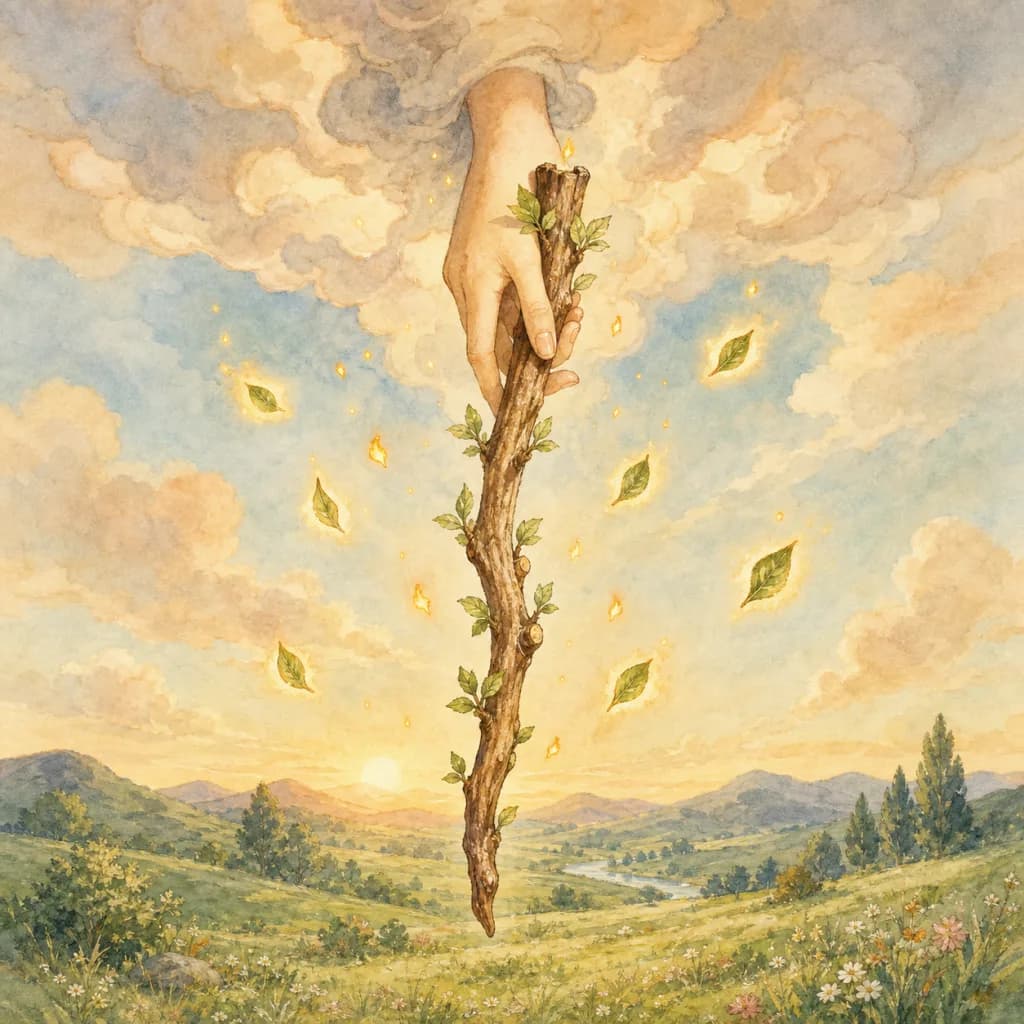
A hand shoves a rough wooden club out of a cloud, and the thing is already sprouting leaves before anyone has touched it. That is the first odd detail people skip past. The Ace of Wands meaning gets flattened into "new beginnings, go for it" so fast that almost nobody stops to ask why the offered branch is shedding little flames before the reading has even started. The card hands you live energy and starts losing it in the same breath.
Most guides will tell you this is the deck's loudest "yes." They are not wrong. They are just describing the firework and ignoring the fuse.
Quick Answer
Upright, the Ace of Wands means a sudden surge of creative energy, inspiration, and the raw drive to begin something — a spark with real heat but no shape yet. Reversed, that drive is blocked, scattered, delayed, or fizzling before it catches. As a Yes/No card it is a strong yes for starting and a firm "not on its own" for finishing, because the spark needs you to act before it drifts off.
Basic Information
| Card Name | Ace of Wands |
| Suit | Wands |
| Arcana | Minor Arcana |
| Element | Fire |
| Astrological Correspondence | The fiery signs — Aries, Leo, Sagittarius |
| Yes / No | Yes (for beginnings) |
| Upright Keywords | inspiration, creative spark, new venture, drive, potential, ignition |
| Reversed Keywords | blocked energy, delay, false start, scattered focus, hesitation, burnout |
Card Imagery & Symbolism
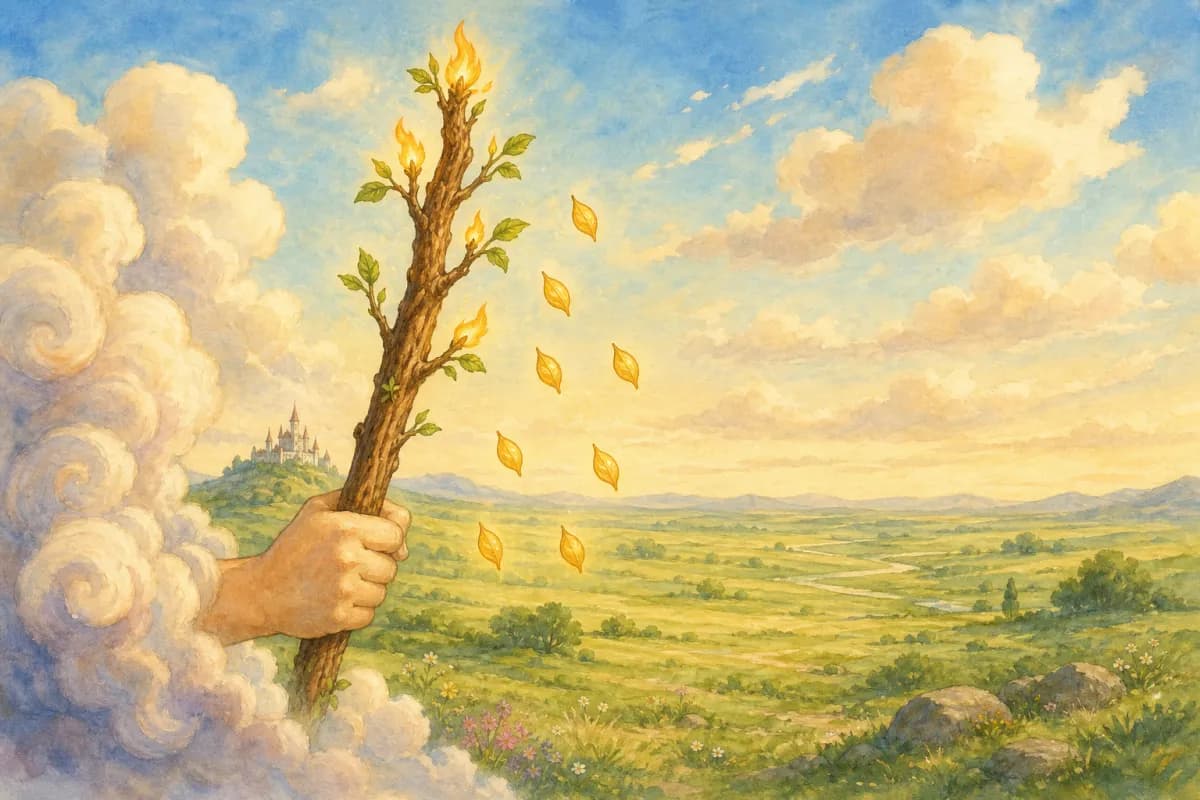
Pull up the Rider-Waite-Smith image and you will see the standard Ace template: a single hand emerging from a cloud, holding the suit's tool over a landscape. Wands gets a living branch instead of a polished staff, which is the first clue that this suit is about growth and raw life rather than finished things. The deeper material is in the parts the popular guides rush past.
The Falling Leaves Are Yods — and They Are Already Leaving
Eight small leaf-shapes float loose around the wand. Pamela Colman Smith drew them as Yods — the Hebrew letter that mystics treated as the seed-point of divine spark, the single drop from which everything else descends. Here is the part that matters and that I have never seen a top-ranking page mention: the Yods are not attached. They are falling away from the wand at the exact instant it sprouts. The card freezes the moment of ignition and the moment of leakage in one frame. Energy is arriving and dissipating simultaneously. That is not a flaw in the image; it is the warning built into the gift. The fire you are handed has a half-life from the second it lands in your palm.
The Hand Grips From Below, Not From Above
Look at how the wand is held. The fingers wrap around the lower third, fist closed, the way you would grab a torch you mean to wave or a tool you mean to swing. Compare that to the Ace of Cups, where the hand cradles the chalice flat-palmed, holding it level so nothing spills. The Wands grip is a working grip. The card is not asking you to receive gently — it is handing you something already built for motion, and a fist that tight does not stay still for long.
The Castle Sits Far Off, on the Left
A small castle perches on a distant hill, usually to the left of the frame. In Smith's visual grammar, left tends to read as the past or the place you came from, and distance reads as "not yet." So the symbol of arrival — the built, settled, completed thing — is deliberately placed where you cannot reach it from where the spark begins. The card shows you the destination precisely so you understand it is a long way from the branch in the cloud. Most readers narrate the castle as "future success." I read it as honest about scale: the ignition and the finished castle are nowhere near each other, and the whole flat plain in between is the part nobody photographs.
Ace of Wands Upright Meaning
Core keywords: inspiration, ignition, creative spark, new venture, drive, raw potential.
Upright, this card is the moment an idea lights up in you before doubt or logistics have arrived to argue with it. It is the project you suddenly cannot stop thinking about in the shower, the urge to email someone you have been meaning to email for a year, the sketch you start at 1 a.m. because it will not let you sleep. The energy is genuine and it is yours. The Ace of Wands does not bring inspiration from elsewhere so much as it reports that your own fire just caught.
What makes it specifically a Wands ace, rather than a generic "good news" card, is the quality of the energy: it is hot, impatient, and oriented toward doing. Where the Ace of Cups opens a feeling and the Ace of Pentacles plants a seed in the ground, the Ace of Wands wants to move. It is the engine turning over. It carries no map.
That last point is the one I lean on hardest in readings. The upright Ace is honest about voltage and silent about direction. It will tell you the fire is real. It will not tell you whether the project is wise, whether the timing holds, or whether you will still care in three weeks. Those are your questions to answer with the rest of the spread. The Ace just confirms you have fuel to spend.
So the upright posture is simple and slightly uncomfortable: act while it is hot. The spark is a perishable asset.
Ace of Wands Reversed Meaning
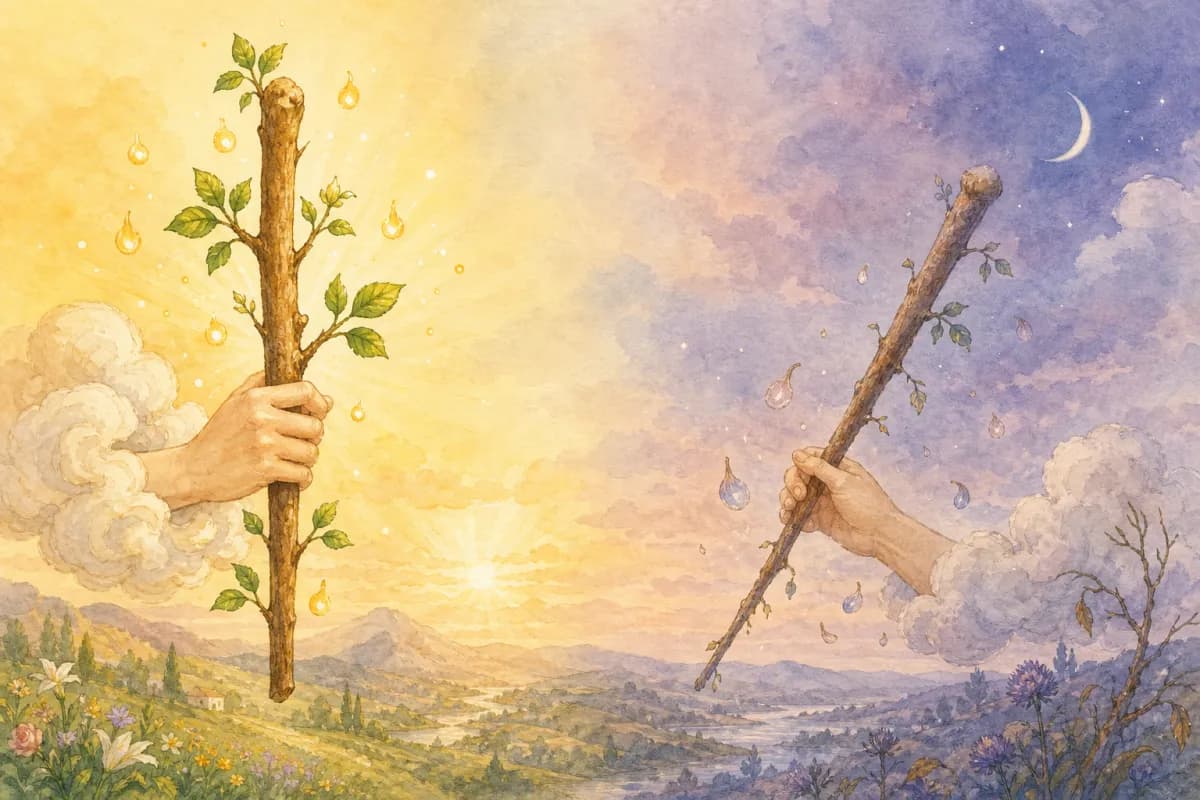
First, plainly: the reversed Ace of Wands is not a disaster card, and I push back when clients treat it as one. It rarely means "no fire ever." Far more often it means the fire is real but something is sitting between it and the world.
There are three flavors worth telling apart. The first is blockage — the inspiration is there, but fear, perfectionism, or someone else's veto is keeping it bottled. You feel the heat and cannot get it out. The second is delay or false start — you launched and it sputtered, or the conditions simply are not ready and pushing harder right now wastes the charge. The third is scatter — and this is where the falling Yods come back. Reversed, those loose leaves read as energy already dispersing: a dozen half-started projects, none finished, the spark split so many ways that no single flame gets enough oxygen to catch.
Telling these apart changes the advice completely. Blockage asks what you are afraid of. Delay asks you to wait without abandoning the idea. Scatter asks you to pick one wand and put the others down. The reversed card does not prescribe; it points at which kind of stuck you are in.
Why Is the Card Already Losing Energy at the Moment It Gives It to You?
This is the question the five top-ranking guides do not ask, and it is the whole reason the Ace of Wands gets misused. They all describe the spark. None of them notice that the card draws the spark mid-escape.
Go back to those falling Yods. A spark that scatters is not a metaphor I am importing — Smith painted it directly into the card. The energy is depicted leaving. Which means the Ace of Wands is not handing you a battery; it is handing you a flare. A flare is brilliant and a flare is on a clock, and the clock started before you noticed the light.
I think of this card as a depreciating asset. The day you receive an inspiration is the day it is worth the most. Every day you "wait until things settle down" or "do more research first" or "wait for the right moment," some of those Yods drift off. Not because the idea was bad, but because raw fire is structurally unstable — it is the nature of the element, not a punishment for your hesitation. The card built the deadline into the picture so you would stop treating inspiration as something that keeps in the fridge.
This reframes the classic advice. Every guide says "the spark needs effort to become a fire." True, but incomplete. The missing half is when. The Ace of Wands is not only telling you to add fuel — it is telling you the window for adding it is open now and closing on its own. The most common Ace of Wands failure I see is not laziness. It is people who fully intend to act, eventually, and let a genuinely good spark depreciate to nothing while they wait to feel ready. The card already drew them the receipt.
Catch it or watch it scatter. That is the choice the image puts in front of you, and there is no third option where the spark waits politely until you are convenient.
Career & Creative Projects
This is the Ace of Wands' home turf. In a work or creative spread it points to a project with genuine heat behind it — a new venture, a role that finally interests you, a creative direction you want to chase. The energy is there and it is the right kind: ambitious, generative, willing to start from nothing.
The practical read is about sequencing. Because this is raw fire, the first move is not the business plan. It is the small, immediate, slightly reckless action that proves the spark is real to you before it cools — the rough draft, the test, the first awkward call. Wands energy is killed faster by over-planning than by under-planning. The Pentacles suit is where you build the structure; the Ace of Wands is where you simply confirm there is something worth building, and you confirm it by moving.
One observation from years of reading professionals in Tokyo: this card shows up constantly for people who already have the idea and are waiting for permission. A designer I read for in Nakameguro had pulled the Ace of Wands three readings running about a side studio she wanted to open. By the third, the card was not telling her something new about whether the idea was good — it was practically the same fire she had let idle for a year. Three identical Aces in a row is not three opportunities. It is one opportunity, depreciating, asking the same question louder.
Personal Energy & Vitality
Stripped of context, the Ace of Wands is a vitality card. It reads as a return of life-force after a flat stretch — the morning you wake up actually wanting to do things again, the end of a dull season. For someone who has been depleted, burned out, or going through the motions, this Ace is the deck noticing the pilot light just relit.
The caution mirrors the symbolism. A relit pilot light is not the same as a furnace running steadily. After a low period, the first surge of energy is real and worth trusting, but it is also fragile, and pouring all of it into one frantic weekend is the fastest way to scatter the Yods and crash back down. The card rewards using the fire to start a sustainable habit, not to sprint. Light the burner; don't try to boil the ocean on day one.
Ace of Wands Card Combinations
- Ace of Wands + The Magician — raw spark meets the one who knows how to channel it. This pairing reads as inspiration you actually have the tools and focus to execute. The Magician supplies the direction the Ace deliberately withholds. A strong launch signal for anything self-driven.
- Ace of Wands + Two of Wands — the natural next beat. The spark from the Ace moves into planning and choice. If you have been sitting on an Ace, the Two arriving is the deck telling you the energy is ready to take a shape and survey the territory. Stop igniting; start aiming.
- Ace of Wands + The Emperor — fire meets structure. Wonderful for a venture that needs discipline to survive, tricky for a free creative impulse that the Emperor's rules might smother. Read the surrounding cards to tell which: is the structure scaffolding or a cage?
- Ace of Wands + Eight of Wands — ignition followed by fast motion. Things move quickly once you commit; messages, travel, momentum all accelerate. This is one of the rare pairings where the "act now" advice is almost literal — the window is short and the speed is the point.
- Ace of Wands reversed + The Sun — a blocked spark sitting next to obvious, available joy. I read this as the fire being present and the querent refusing to claim it; the Sun says the good thing is right there and lit, and the reversed Ace says you are the one holding the valve shut.
Numerology & Astrological Correspondences
As an Ace, this card is the number one of its suit — the seed-point, the source before anything has branched. In the Wands line it is fire in its least processed form, the raw element before it has been aimed (Two), shared (Three), or fought over (Five). It belongs to the cardinal fire of the calendar's start, the Aries impulse to begin for the sake of beginning. Follow the spark up into the court and it matures into the curious, exploring Page of Wands, still untested but already in motion.
In Japanese タロット占い (tarō uranai, tarot divination), I was taught to read this card through 着火 (chakka) — the precise moment of ignition, the instant a flame catches rather than the fire that follows. What I find useful about that framing is that 着火 names an event, not a state. It is the strike of the match, over in a second, and everything after depends on what was nearby to burn. The Ace of Wands is that single instant, and reading it well means asking what you have set next to it before it goes out.
Frequently Asked Questions
Is the Ace of Wands a yes or no card?
It is a strong yes for beginning and a qualified answer for finishing. The card confirms there is energy and the green light to start, but it is silent about the outcome, because an Ace is a beginning rather than a result. Treat it as "yes, go" — not "yes, this will work out on its own."
What does the Ace of Wands mean for a new job or business?
It points to a genuine opportunity with real drive behind it, usually one worth acting on quickly. The card favors the bold first move over the perfect plan. Just remember it speaks to the start of the venture, so pull more cards to read how it develops past the launch.
Is the Ace of Wands reversed always negative?
No, and I would resist reading it that way. It usually means the fire is real but blocked, delayed, or scattered — not gone. The work is to find which of those three is happening, because the fix for fear is different from the fix for bad timing or too many half-finished projects.
What does the Ace of Wands mean in love?
Upright, it is a spark of attraction, passion, or fresh energy in a relationship — high heat, but early and unproven. It tells you the pull can catch, not whether it will last. For the relationship-specific read, see our companion guide on the Ace of Wands as feelings.
What is the difference between the Ace of Wands and the Ace of Cups?
The Ace of Wands is fire — desire, drive, the urge to act and create. The Ace of Cups is water — emotion, tenderness, the heart opening. Wands answers "do you have the energy to begin," and Cups answers "is a feeling opening up." They can arrive together or entirely apart.
What element and zodiac signs go with the Ace of Wands?
It is the element of fire, and it carries the energy of the fire signs — Aries, Leo, and Sagittarius. As a cardinal-fire ace it leans most toward Aries' raw drive to initiate. That fiery quality is why the card reads as impatient and action-oriented rather than reflective.
Why does the Ace of Wands feel urgent?
Because the image itself shows energy already leaving — the small falling leaves are Yods drifting off the wand at the moment it sprouts. The card depicts inspiration as a perishable thing with a built-in clock, so the urgency you feel is the card doing exactly what it was drawn to do.
Closing
The next time this card turns up, don't file it under "good things coming." Find the one idea you have been carrying and not acting on, and do the smallest real version of it today — the rough draft, the first message, the test run — while the fire is still hot enough to catch. The Ace of Wands drew you a flare, not a battery. Light something with it before the leaves finish falling.
Keep reading the suit's arc with the Two of Wands for where the spark goes next, or see how this energy reads in matters of the heart in Ace of Wands as feelings.