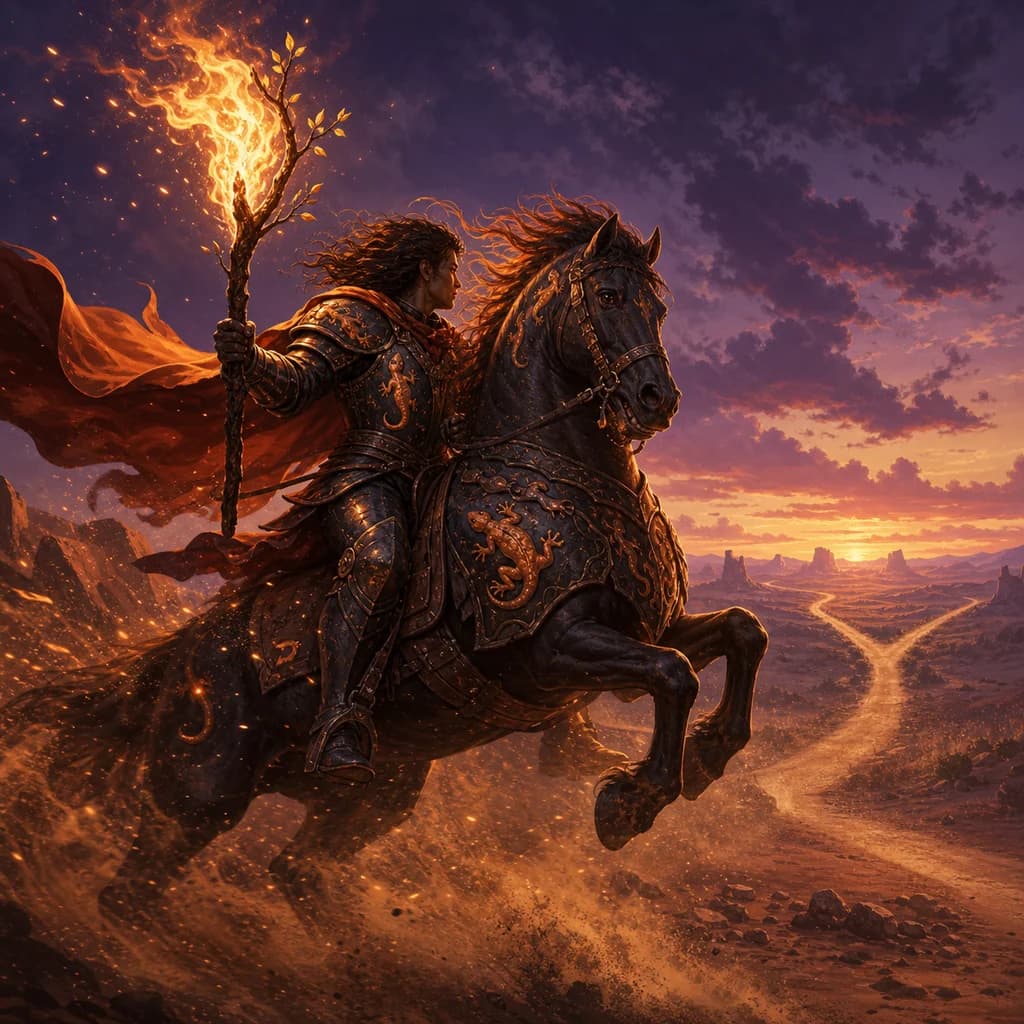
Look at the horse before you look at the rider. It is rearing, front hooves clawing the air, body coiled to spring — and that is the whole card, frozen one half-second before anything actually happens. The Knight of Wands meaning gets summarized everywhere as "action, energy, go for it," which is true and also misses the joke Pamela Colman Smith built into the frame. The horse she painted is rearing in place, still rooted to that dry plain. The Knight is the loudest promise of motion in the deck, and he is standing still.
Most guides read his posture as power. I read it as a question the card refuses to answer for you: all this heat, all this lean-forward intent — is any of it going to land?
Quick Answer
Upright, the Knight of Wands means decisive action, passion, adventure, and the charisma to charge at something you want. It is the card of momentum, travel, and impulsive courage — the energy to begin and to chase. Reversed, that same fire turns to haste, recklessness, frustration, delays, or all flash and no follow-through. As a Yes/No card it is a yes when upright, leaning to no when reversed, because the engine is racing but the wheels may not be touching the road.
Basic Information
| Card Name | Knight of Wands |
| Suit | Wands |
| Arcana | Minor Arcana |
| Element | Fire |
| Astrological Correspondence | Mars; the fiery cusp of late Scorpio into Sagittarius |
| Yes / No | Yes (upright) / leaning No (reversed) |
| Upright Keywords | action, adventure, passion, energy, travel, charisma, impulsiveness |
| Reversed Keywords | recklessness, haste, frustration, delays, scattered drive, no follow-through |
Card Imagery & Symbolism
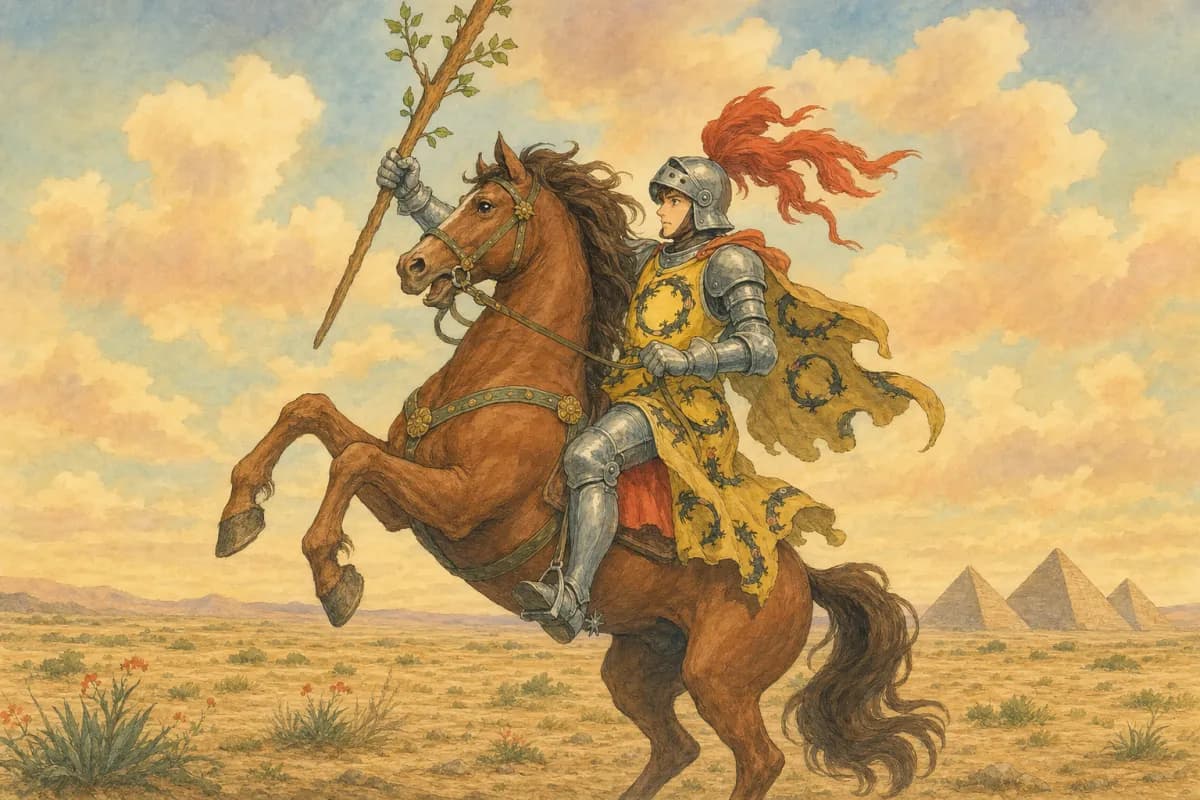
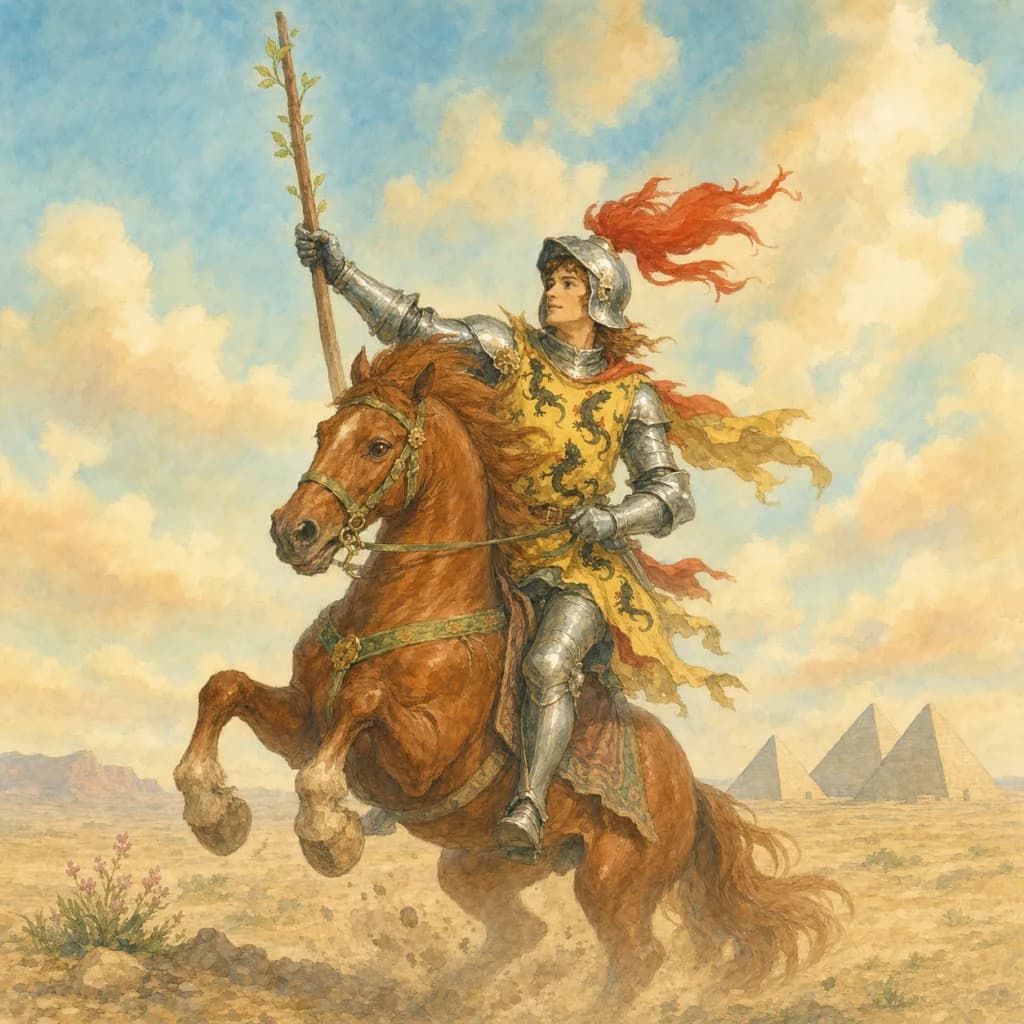
Pull up the Rider-Waite-Smith card and the first thing that hits you is heat — a man in armour on a chestnut horse, plumes streaming, a sprouting wand held aloft against a sky the colour of dust. The background is bare: three small pyramids on a flat, dry plain, no road, no town, nothing to ride toward. The popular guides catalogue the salamanders and stop. The interesting material is in how the figure is held in place.
The Horse Is Rearing, Not Galloping
This is the detail the card lives or dies on, and almost nobody mentions it. The horse is up on its hind legs, neck arched, front legs pawing — all height, no ground covered. A rearing horse is dramatic and it is also stationary. It is the pose of an animal that has been reined in hard at the moment it wanted to bolt, or one that is showing off, or one whose rider has more spur than plan. Smith could have drawn a full gallop, hooves stretched, mane flat with speed. She chose the instant of maximum tension and zero distance covered. The Knight looks like he is moving. Measure the ground he has crossed and the answer is none.
The Salamander Tunic Is Complete Now
The Knight wears a yellow tunic covered in salamanders — the lizard medieval alchemists believed could live in fire, the emblem of the element itself. Here is the part worth catching: on the Page of Wands, the younger figure who admires the spark standing still, those salamanders are drawn with their tails not yet touching their mouths, half-formed. On the Knight they close into full circles, tail to mouth, the ouroboros sealed. The fire in him has matured from a beginner's spark into a self-sustaining loop. He has stopped learning the element and become it. That is his gift and his trap in one motif — the fire feeds itself now, which means it does not need a destination to keep burning.
The Plumed Helmet and the Forward Pitch
Red plumes spill from his helmet like literal flame, and his whole body is pitched forward over the horse's neck, visor up, leaning into a wind that the still horse is not actually generating. The forward lean is the body language of someone already committed in spirit. The raised visor says he is not afraid to be seen charging in. Read together with the rearing horse, the pitch becomes almost poignant: the man's body has left, and the horse underneath him has not. The intent has outrun the locomotion. That gap is the entire reading.
Knight of Wands Upright Meaning
Core keywords: action, passion, adventure, charisma, travel, impulsive courage.
Upright, this is the card of the leap taken before the ledge is measured. Where the Page of Wands is the spark of an idea, the Knight is the body that throws itself at the idea — booking the flight, quitting the job, walking across the room to introduce himself. The energy is hot, confident, and outward. People feel it. The Knight of Wands has charisma in the original sense: he pulls others into his momentum, and a project led by this energy attracts collaborators because the conviction is contagious.
It carries travel and movement very literally. In a spread it often points to a journey, a relocation, a change of scene — sometimes a real plane ticket, sometimes the restlessness that precedes one. Sagittarius lives in this card, the sign of the horizon, of wanting to be somewhere you are not yet.
What I trust most about the upright Knight is its courage. This is reckless courage, the willingness to act while the outcome is unknown and to treat a risk as exciting. When a client is paralyzed by analysis, the upright Knight is the deck telling them the fear of moving has become more expensive than the move. Go.
The caution is baked into the same trait. The Knight does not pause to ask whether the direction is right — only whether it is thrilling. Upright, that is usually a feature. The card is fuel, and fuel is good when you already know where the car is pointed.
Knight of Wands Reversed Meaning
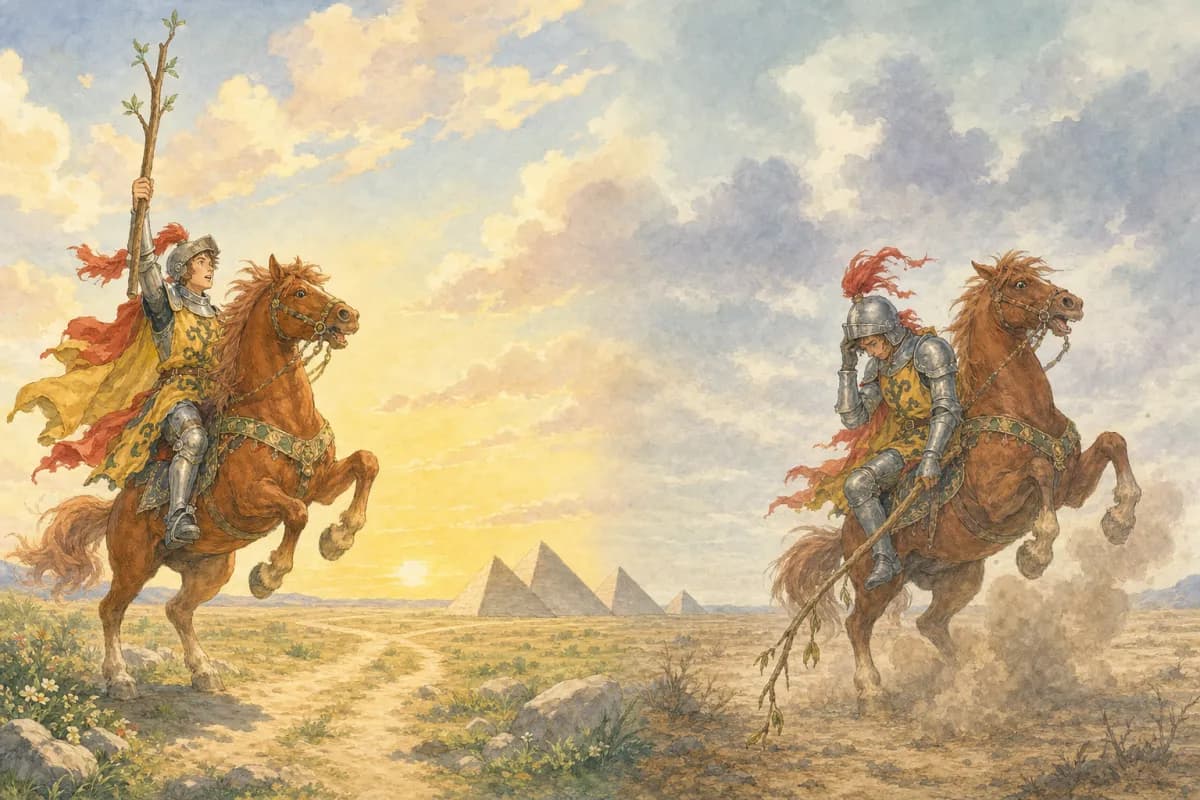
Reversed is not a curse, and I correct clients who treat it as one. The fire does not go out when this card flips. What changes is that the energy loses its aim. Upright fire moves toward something; reversed fire just burns, or sputters, or scorches the people standing nearest.
There are a few ways it shows up. The most common is haste — acting so fast that the action defeats itself, the email sent in anger, the resignation handed in before the next thing was lined up, the launch with no testing. The second is frustration and delay: the Knight wants to charge and something external pins him, so the energy backs up into impatience, snapping at obstacles, drumming fingers. The third, and the one I see most in long readings, is all flash and no follow-through — a stack of started-and-abandoned projects, each one begun at full gallop and dropped the moment a newer fire appeared on the horizon.
That last flavour is where the rearing horse pays off in reverse. Upright, the still horse was a held promise. Reversed, it becomes the honest truth: the man was never going to cover the distance. He mistook the feeling of charging for the act of arriving. Telling these flavours apart changes everything you advise. Haste needs a pause. Frustration needs an outlet that is not the obstacle. No-follow-through needs one wand chosen and the rest set down.
The Knight of Wands is fast — but is he actually going anywhere?
Here is the question most guides skip, because answering it would complicate the clean "take bold action" headline. They describe the speed and never check the odometer.
Go back to the horse. It is rearing. A reared horse is the single most kinetic-looking pose a horse can strike and also one of the least productive — it is energy spent climbing the air while the ground stays put. Smith had every option to show forward travel and chose vertical drama instead. I do not think that was an accident on a card whose suit is about will and direction. The image is a visual pun: maximum apparent motion, zero net displacement.
This is the misread that sinks the Knight of Wands in real readings. People see the card, feel the surge, and assume the surge is progress. The card is more honest than that. It shows you raw drive and stays silent about whether the drive is aimed.
I spent the better part of three years reading this card wrong in exactly this way. Early on I treated every upright Knight of Wands as good news — movement, yes, finally, things are happening. A client in Daikanyama kept drawing it about a business she talked about constantly and had not registered, hired for, or priced. I kept telling her the energy was building. It took me too long to see that the card was not promising she would launch. It was showing me her, on a rearing horse, generating the heat and the conviction of launching while the ground stayed put. The Knight was describing her accurately. I was the one mistaking his posture for his progress.
So when this card turns up, skip the question "is there energy here." There always is. Ask instead whether the energy has a destination attached, or whether it is rearing in place and calling it a journey. Look at the cards around it. A Two of Wands or an Eight of Wands nearby supplies the aim and the launch the Knight lacks on his own. A Seven of Swords or a string of other Wands suggests motion that loops back on itself. The Knight brings the horsepower. He does not bring the map, and he will happily burn a full tank with the handbrake on.
Career & Ambition
This is the Knight's most natural room. In a work spread he is ambition with the safety off — the moment to pitch, to launch, to take the bolder of two roles, to stop refining the deck and send it. He favours the person willing to start ugly over the person waiting to start perfect. For an entrepreneur or a creative, the upright Knight is often a green light with a foot already on the accelerator.
The reversed Knight in career is the warning the upright one withholds. It is job-hopping with no thread running through it, the third startup abandoned at month two, the talent that scatters itself across six things and finishes none. If you keep drawing this card reversed about your work, the deck is not telling you to slow down for its own sake. It is asking what you are running toward, because right now the running has become the point and the arriving never comes.
Travel & Adventure
Few cards are this literal. The Knight of Wands shows up before trips, moves, and leaps into the unfamiliar, and upright it reads as a genuine yes to going — the experience will be worth the disruption, and the part of you that wants to be somewhere new is worth listening to. Sagittarius does not thrive penned in.
Reversed, read the travel as either thwarted or ill-considered: the trip that keeps falling through, the relocation chased to escape a problem at home, the adventure picked for the rush and short on substance. The question to bring to it is simple: where does this trip actually lead, and would you still want to go if the feeling you are fleeing came along for the ride?
Personal Energy
Stripped of context, the Knight is a vitality reading — the return of drive after a flat stretch, the restlessness that means you are ready to do something. Trust the surge. It is real and it is yours.
The single discipline this card asks for is direction. A rearing horse and a galloping one burn the same calories; only one gets you home. Point the energy before you spend it.
Knight of Wands Card Combinations
- Knight of Wands + Two of Wands — the Knight supplies the horsepower the Two supplies the direction. This is the pairing where the rearing horse finally gets pointed at a horizon. If you have been charging in place, the Two arriving is the deck handing you a map. Read it as: the energy is finally aimed.
- Knight of Wands + Eight of Wands — ignition meets actual flight. The Eight is the suit's card of swift, straight-line movement, so next to the Knight it confirms the motion has finally turned real this time. Travel, fast messages, things accelerating. One of the few times "act now" is almost literal.
- Knight of Wands + The Tower — reckless speed colliding with collapse. The impulsive charge meets the structure that cannot hold it. Beautiful for breaking out of something that needed breaking; dangerous if the Knight's haste is what knocked the Tower over. Check whether you are escaping a cage or detonating a foundation.
- Knight of Wands + Four of Wands — the traveler arriving at the celebration, the homecoming. The restless fire finally reaches a place worth stopping at. I read this as the rare moment the Knight's motion resolves into landing somewhere stable, which is exactly what he usually struggles to do.
- Knight of Wands reversed + Seven of Swords — scattered fire and quiet retreat. Energy spent on the wrong target, or commitment slipping out the back door. I read this as a project being abandoned mid-charge while telling itself it is just regrouping.
- Knight of Wands + The Sun — confident momentum meeting open success. The charge actually lands, the adventure pays off, the boldness is rewarded. About as unqualified a green light as the suit gives.
Numerology & Astrological Correspondences
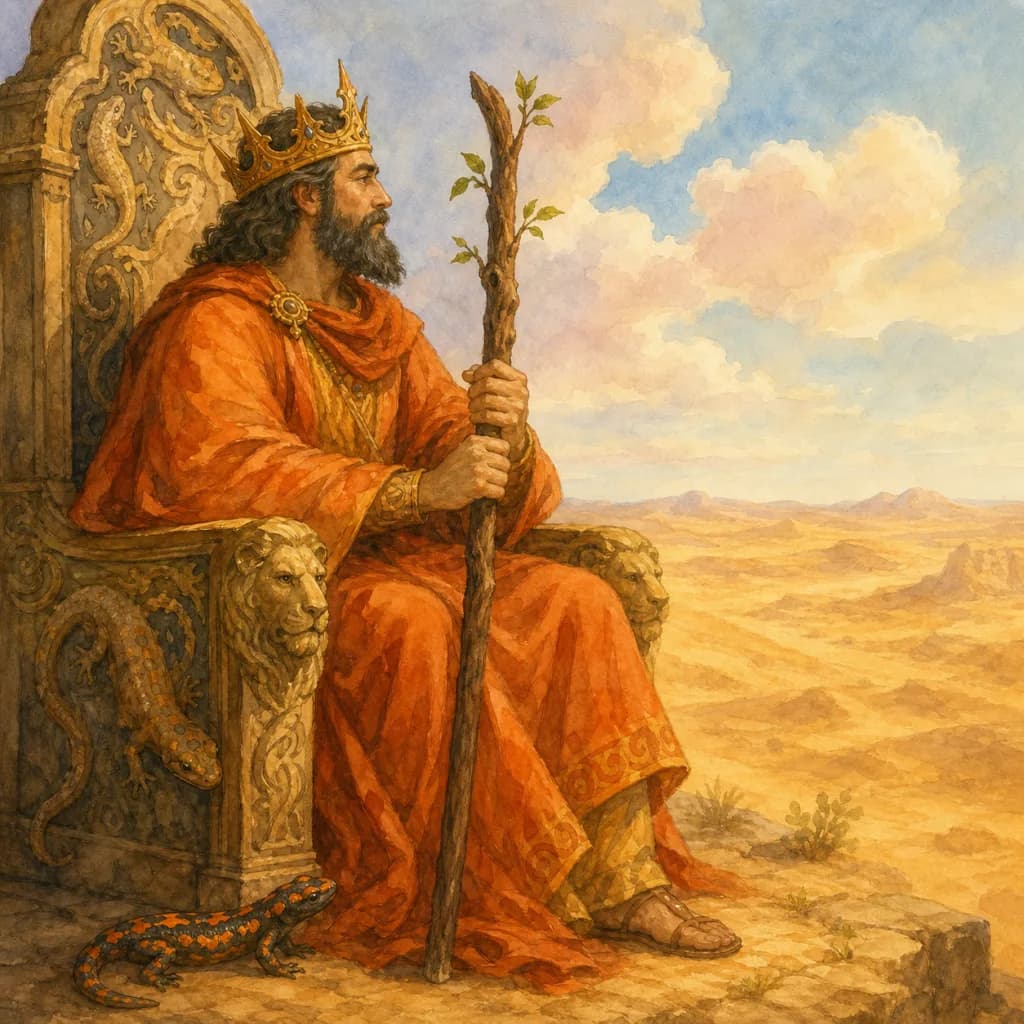
As a court card the Knight sits between the Page's first spark and the same fire matured into the King of Wands and his settled command — the action stage of the suit, fire in its most kinetic and least governed form. Mars rules him, the planet of drive, heat, and the will to charge, and he carries the cusp where Scorpio's intensity tips into Sagittarius's restless horizon. In Japanese タロット占い (tarot uranai, tarot divination), the word my teacher reached for with this card was 猪突猛進 (chototsu-moshin) — "charging straight ahead like a wild boar," admiring and wary at once. It names a courage that is genuine and a forward-rush that forgets to check whether the path leads anywhere. That double edge is the whole Knight.
Frequently Asked Questions
Is the Knight of Wands a yes or no card?
Upright it is a yes — there is energy, courage, and the green light to act. Reversed it leans no, because the same drive turns hasty, scattered, or stalled. A useful refinement: it is a strong "yes, go" and a weak "yes, this will arrive," since the card is better at starting than finishing.
What does the Knight of Wands mean in love?
Upright it points to fast, passionate, exciting energy — a hot pursuit, a charismatic person, a relationship moving at speed. The thrill is real but early, and the chase often runs ahead of the staying. For the full relationship read, see our companion guide on the Knight of Wands as feelings.
Is the Knight of Wands reversed always negative?
No. Most often it means the fire is still burning but has lost its aim — haste, frustration, delay, or too many half-started things. The work is to find which one is happening, because the fix for impatience is different from the fix for scattered focus. It is rarely "no energy at all."
What does the Knight of Wands mean for career?
It is a green light for ambition and bold moves — pitch it, launch it, take the leap. Reversed, watch for job-hopping with no thread, projects abandoned at the first newer idea, and energy spread too thin to finish anything. Pull more cards to see whether the charge has a destination.
Does the Knight of Wands mean travel?
Often, yes, and sometimes literally. It shows up before trips, moves, and leaps into the unfamiliar, and upright the deck is usually saying the journey is worth taking. Reversed can mean travel delayed, derailed, or chased as an escape when no real pull is drawing you on.
What is the difference between the Knight of Wands and the Page of Wands?
The Page is the spark of inspiration — the idea arriving, curiosity, the message not yet acted on. The Knight is the body that throws itself at the idea — the pursuit, the leap, the journey. The Page wonders; the Knight charges. The salamanders on the Page are still half-formed, while the Knight's have closed into full circles.
Why does the Knight of Wands feel so restless?
Because his fire feeds itself and his horse is reared to bolt. The card depicts maximum drive with no destination drawn into the frame — bare plain, no road. That structural mismatch between energy and direction is exactly the restlessness you feel when the card turns up.
Closing
The next time this card rears up in a spread, do not just cheer the energy. Name the destination out loud — one sentence, where is this actually going — before you spend a single unit of the fire it is offering. Then look at the card beside it: that neighbour usually holds the map the Knight forgot to bring. The horsepower is real. Point it at something today, while it is still hot, or you will spend the week rearing in place and calling it a journey.
Trace the suit's arc backward to the spark in the Ace of Wands, or see how all this fire reads in matters of the heart in Knight of Wands as feelings.