A woman stands barefoot in shallow water, wrapped loosely in cloth, blindfolded, with eight swords stuck in the mud around her. Look at her feet. Nobody is holding her. The swords have a wide gap in front of her, the ground is solid behind it, and the wrapping is so slack a single shrug would shake it off. The Eight of Swords is a picture of an unlocked cage, drawn by someone who has clearly already left one.
Most guides will tell you this card means a self-made prison and move on. That much is true, though it stops short of the part that actually helps. The thing nobody at my table in San Francisco wants to say out loud is the next question down: if the trap is mine, who handed me the rope in the first place — and why do I keep retying it?
Quick Answer
Upright, the Eight of Swords means feeling stuck, restricted, and powerless when the real cage is mental — a story you've accepted about what you're "not allowed" to do, when the way out is wider than it looks. Reversed, it usually means the blindfold is coming off and you're starting to move, though it can also show fear gone quiet and underground. On a Yes / No question it leans No, mostly because you're not yet seeing the board clearly.
Basic Information
| Attribute | Details |
|---|---|
| Card Name | Eight of Swords |
| Suit | Swords |
| Arcana | Minor Arcana |
| Element | Air |
| Astrological Correspondence | Jupiter in Gemini (Golden Dawn: "Lord of Shortened Force") |
| Yes / No | No — or "not until you take the blindfold off" |
| Upright Keywords | Restriction, entrapment, powerlessness, self-limiting beliefs, feeling stuck, victim mentality, isolation |
| Reversed Keywords | Release, freedom, new perspective, self-acceptance; or denial, fear driven underground, refusing to leave |
Card Imagery & Symbolism
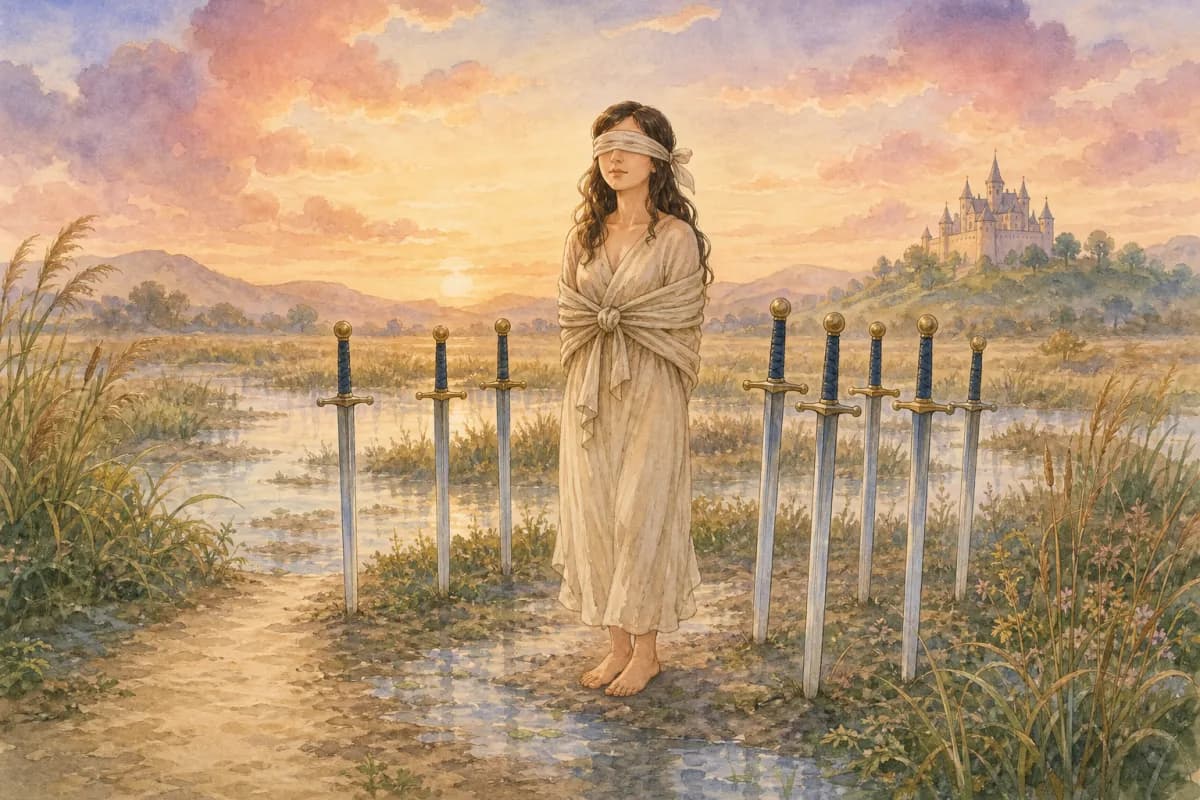
Everyone describes the scene the same way: bound woman, eight swords, blindfold. Fine. The argument the card is actually making lives in three details that get listed and almost never read.
The Swords Make a Fence, Not a Wall
Count the swords and notice where they stand. Five are clustered to her right, a couple behind, and the front is open — there is a clear corridor of unguarded ground directly ahead of her. Pamela Colman Smith, who drew the Rider-Waite-Smith deck, did not arrange a circle by accident; she left a deliberate door. The blades form a fence with a missing section, the kind you'd step through without thinking if you could only see it.
The cruelty of the image is that she's facing slightly away from the gap. The exit is real and the exit is behind her shoulder, which is a fairly exact picture of how being stuck actually works: the options exist, they're just not in the direction you've fixed your attention.
The Bindings Are Tied at the Front
Look at the cloth around her arms. It loops loosely, and on close inspection the knot sits where she could reach it. This is the detail competitors gesture at when they say "self-imposed," but they skip the uncomfortable mechanics of it. You cannot tie a blindfold tightly behind your own head and also wrap your own arms — not in that arrangement. The binding bears the fingerprints of a second person. Someone tied the first knot. What the card shows is the moment long after they've gone, when she's still standing inside a restraint that only her own stillness keeps in place.
The Mud and the Water
She's standing in marshy ground, water pooling at her feet. The Swords are an Air suit — thought, logic, language — and here Air is sunk into water, which in tarot is feeling and intuition. The picture is of someone whose thinking has gotten waterlogged, heavy, unable to lift off. But water is also the one element on the card that knows the way out, because water always finds the low ground and runs. A client of mine in Oakland once said, looking at this card, "my head says stay and my stomach says go" — she'd read the whole image without knowing it. The blindfold blocks the eyes while leaving the gut wide awake.
Eight of Swords Upright Meaning
Core keywords: feeling trapped, restriction, self-limiting beliefs, powerlessness, indecision, isolation, waiting to be rescued.
Upright, the Eight of Swords arrives when you've concluded there is no good move. The job is wrong but quitting is impossible; the relationship is hollow but leaving is unthinkable; the money is tight so of course you can't change anything. Notice the shape of every one of those sentences — a real constraint, followed by a leap to "therefore nothing." The card lives in that leap. The constraint is usually genuine, while the conclusion drawn from it rarely holds up to a second look.
This is a thinking card, and the specific thought it describes is the one that feels like a fact. "I'm not the kind of person who…", "they'd never let me…", "it's too late for…". These don't feel like opinions while you're inside them; they feel like the weather. That's the blindfold doing its job. The world stays perfectly visible; what disappears is every part of it that would contradict the story.
There's often a quiet plea for rescue underneath. The figure waits, hoping someone will notice and untie her. Sometimes someone does. More often the reading I give is both gentle and hard to hear: nobody is coming to take the blindfold off, because nobody else can reach a knot that's behind your own eyes.
The Eight of Swords carries a different despair from the Nine of Swords, which is pure anxiety with no exit drawn at all, and from the finality of the Ten of Swords. The Eight still has the door in the frame. That's the whole reason it's a kinder card than it feels.
Eight of Swords Reversed Meaning
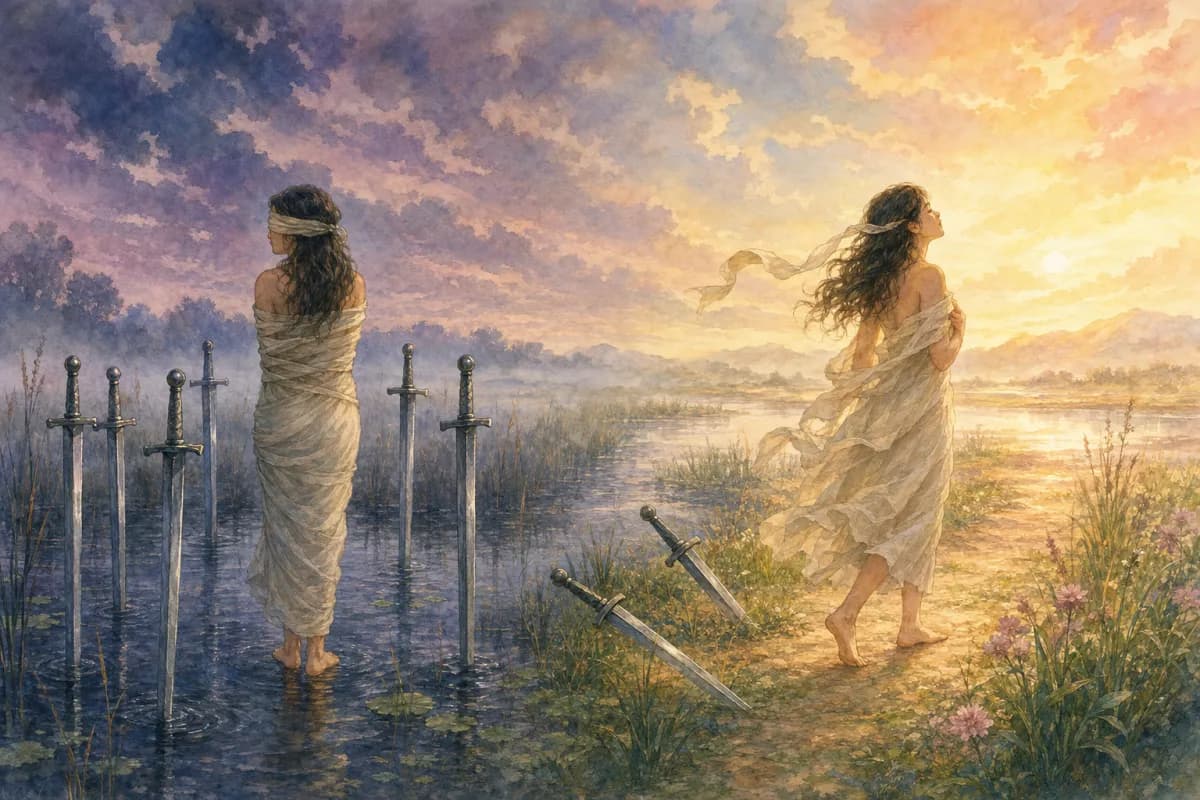
Reversed is usually the better of the two positions, and rarely a negative card here. Most of the time it shows the moment the blindfold slips and light gets in.
Turned over, the swords loosen their hold. You're starting to see that an option you'd ruled out was never actually ruled out, just unexamined. A door you'd treated as locked turns out to have been ajar the whole time. Clients describe it as waking up — the same situation, suddenly with handles on it. This is the card of taking back a power you'd handed to circumstances, a boss, a partner, an old fear.
There's a shadow version, and it's worth naming. Reversed can also show fear that's merely gone underground, still present while out of sight — you've stopped feeling trapped because you've stopped looking at the trap, which is denial wearing the mask of peace. Or it shows someone who can clearly see the open gap and refuses to walk through it, because staying bound has become familiar and the unbound version of life is scarier than the cage. Which reading applies usually comes down to one question: is there movement, or just a quieter kind of stillness?
Who Tied the Blindfold On First — and Why Do You Keep Retying It?
Here's the part the popular guides leave on the table. They'll all tell you the prison is self-made. Almost none of them ask where the blindfold came from, and that origin changes everything about how you take it off.
Look at the image honestly: that knot was tied by someone else. We don't put ourselves in restraints like this from scratch — somebody taught us. A parent who said money is for other kinds of families. A first boss who made it clear people like you don't get the corner office. An ex who narrated, patiently, all the things you're bad at until you could recite them yourself. The original blindfold was a hand-me-down.
The trap of the Eight of Swords is what happens after that person leaves the room. The restraint stays on, and now you're the one maintaining it. Every morning you re-tie a knot somebody else's voice taught your fingers to make, and because the hands are yours, it genuinely feels self-imposed. It is, technically. But "just stop limiting yourself" is useless advice if you don't first notice the limit isn't even in your own voice.
So the work this card actually asks for is attribution. It's a matter of tracing the belief back to its source, which willpower alone never accomplishes. The next time you hit a "therefore nothing," I ask clients to finish the sentence out loud, then ask: whose voice was that? Often the person can name them in under five seconds. The belief doesn't survive being read aloud in the original speaker's accent. Once you hear that the rule was installed rather than discovered, the knot stops feeling like part of your body. That's the moment the blindfold becomes removable. It comes loose when you recognize it was never yours to begin with, and no amount of effort gets you there any faster. The The Devil makes a related point about chains you could lift, but the Eight is subtler: what holds you is an old instruction you forgot to question, with no appetite involved at all.
Mental Health, Anxiety & the Overthinking Loop
This is the card's home territory. The Eight of Swords is what rumination looks like from the inside — a mind so busy mapping every disastrous outcome that it never gets around to the one ordinary action that would end the standoff.
The specific mechanism worth knowing: anxiety keeps you frozen by making every available move look equally terrible, so that staying put feels like the only neutral option. The future looking bleak is rarely the actual hook. It isn't. Standing in the marsh is also a choice with a cost; it just doesn't announce itself as one. When this card appears for someone caught in a spiral, the most useful thing I can offer is permission to make a small wrong move, because a wrong move at least breaks the spell that there's a perfect one waiting to be found.
If you're using this card for self-reflection, try a flat physical step in place of a mental one. The figure can't think her way out — her eyes are covered. She can only feel her foot find dry ground. Pick the smallest action that requires zero certainty: one email, one honest sentence, one walk around the block. The blindfold doesn't come off through insight. It comes off through motion.
Love & Relationships
In a relationship, the Eight of Swords rarely points to the relationship itself being a prison. More often it means you've decided you have no moves left inside it — which is a different, lonelier thing.
What I see most: a person who feels unable to say the true sentence. They've run the conversation a hundred times in their head, predicted every way it goes wrong, and concluded silence is safer. So they stay bound and resentful, waiting for the partner to somehow read the gag and remove it. What the card points at is the unspoken sentence itself. Often the relationship is more flexible than the story about it — the partner would, in fact, want to hear the thing. You just can't see that from behind the blindfold.
For a single person, this card can show someone fenced in by a belief about their own desirability, treating a passing mood as if it were a permanent verdict. If you want to test where you're genuinely stuck versus where you're just facing the wrong way, a structured pull like the love tarot spread guide gives the question a frame your own head keeps blurring. Compare also the Two of Swords, which is the deliberate refusal to choose — where the Eight has talked itself out of believing a choice exists at all.
Career & Work
At work the Eight of Swords is the golden handcuffs card, except the cuffs here are usually forged from your own assumptions, and the salary is incidental.
The classic version: you're in a role that's wrong, and you've assembled an airtight case for why you can't leave. Wrong economy. Too old to switch. The pension. The gap on the CV. Each point may be real on its own, but stacked together they form the blindfold — a wall of reasons whose entire function is to keep you from looking at the one open lane. I'll say what I tell clients in San Francisco who are sure their industry has no other doors: you have researched the reasons to stay in far more detail than you've researched a single alternative. That asymmetry is what the card is pointing to, and the job market has little to do with it.
There's also a workplace version where someone else is genuinely restricting you — a controlling manager, a role with no room to move. The Eight still applies, but the reading shifts. The swords here are partly real fence. The question becomes which blades are actually planted by your employer and which you've added yourself, and you'd be surprised how often it's a fifty-fifty split nobody had separated out.
Eight of Swords Card Combinations
- Eight of Swords + The Moon: a double dose of distorted seeing. The blindfold plus the fog. This pairing warns that the picture you're acting on is largely projection — do not make a permanent decision until the mood passes and the eyes clear.
- Eight of Swords + The Devil: the restraint plus the chain. Often a relationship or habit you keep calling a trap while quietly choosing it. The combination asks honestly whether you want out or just want to complain about being in.
- Eight of Swords + Ten of Swords: the fear, then the feared thing — but the Ten is also rock bottom, where the swords are spent. Together they often say the dreaded ending, once it actually arrives, turns out to be the start of relief.
- Eight of Swords + Ace of Swords: the blindfold meets the blade of clarity. A single sharp realization cuts the whole knot. This is one of the most hopeful pairings in the suit — the truth you've been avoiding is the exact tool for the escape.
- Eight of Swords + The Hanged Man: both are about being stuck, but the Hanged Man is suspended on purpose to gain a view. Together they suggest the stillness might be worth keeping a little longer — look from the new angle before you bolt.
- Eight of Swords + Four of Swords: forced stillness beside chosen rest. The reading: the pause you're treating as imprisonment could be reframed as recovery, if you'd stop fighting it.
Numerology & Astrological Correspondences
Eight in the Swords suit is the number of structures that have hardened — the airy, restless mind has built a system, and systems both organize and confine. Where the suit's earlier cards still felt the cut of each individual thought, by the Eight those thoughts have set into walls. The astrology, Jupiter in Gemini, is telling: Jupiter expands, Gemini thinks, and the two together expand thinking past its useful size, which is precisely overthinking — a mind generously talking itself into a smaller and smaller room.
In Japanese タロット占い (tarotto uranai, tarot divination), I read this card through the idea of 思い込み (omoikomi) — a fixed assumption you've mistaken for fact, a conviction held so long it stopped looking like a belief and started looking like reality. The whole liberation of the Eight of Swords is the small shock of catching an omoikomi in the act and seeing daylight around its edges.
Frequently Asked Questions
Is the Eight of Swords a yes or no card?
It leans No, but with an asterisk. What the card is really saying is that you can't see the answer clearly yet, because a belief is standing in the way. Take the blindfold off, look again, and a no often becomes a "not the way I was trying."
Is the Eight of Swords a bad card?
It feels bad and isn't, mostly. Unlike the harsher Swords cards, it always keeps an exit in the picture. It's a card of being temporarily stuck, with nothing permanently broken, and "stuck" is a condition with a way out by definition.
What does the Eight of Swords mean in a love reading?
Usually that you feel you have no moves left in a relationship — often because there's a true sentence you can't bring yourself to say. The card points at the unspoken thing itself, with doom nowhere in the picture. The relationship is frequently more flexible than the story you've built about it.
What does the Eight of Swords reversed mean?
Most often the blindfold coming off: new perspective, freedom, taking back power you'd handed away. Its shadow side is fear gone quiet through denial, or someone who can see the open door and won't walk through it. Look for whether there's real movement.
Does the Eight of Swords mean I'm trapped?
It means you feel trapped, and feeling trapped is its own state, distinct from actually being trapped. The swords in the image leave a clear gap; the bindings are loose. Real constraints may exist, and even so the card insists the wall is shorter than it looks from behind the blindfold.
How do I get out of the Eight of Swords situation?
Thinking harder won't do it — the figure's eyes are covered, so insight is out of reach for her. Movement is what works. Pick the smallest action that needs no certainty: one honest sentence, one application, one walk. The blindfold loosens through motion, and analysis only keeps you standing still.
What astrological sign is the Eight of Swords?
It's associated with Jupiter in Gemini in the Golden Dawn system. Gemini is the thinking, talking mind; Jupiter expands whatever it touches. Together they describe a mind that has expanded its worrying past anything useful.
Closing
The cruelest and kindest thing about this card is the same thing: the door is already there, slightly behind you, exactly where you stopped looking. You don't have to feel brave or certain or ready. You only have to turn your head and take one step onto ground you can't yet see.
Tonight, finish the sentence "I can't, because…" out loud, and then ask whose voice that was. If you can name them, you've already found the knot.
Related reading: Two of Swords, Nine of Swords, The Moon, and the love tarot spread guide.