Most readers hand you the Two of Swords with the same warning: a hard decision is coming, take off the blindfold, choose. That advice is correct often enough to feel safe, and it still misses what the card is doing. In more than a decade reading the Rider-Waite-Smith deck in Tokyo, I've come to treat the Two of Swords as a truce someone is quietly maintaining. The blindfold isn't always there because you can't see. Sometimes it's there because not-seeing is buying you something, and the reading that actually helps is the one that asks what.
Quick Answer
The Two of Swords means a decision held in suspension: two options, balanced so evenly that choosing feels impossible, so the choice gets put off. Upright, it's the stalemate itself — an impasse maintained by a blindfold that is sometimes missing information, more often deliberate avoidance. Reversed, the balance tips: either the stalemate breaks and a decision surfaces, or the avoidance hardens into denial and information overload. Yes / No: it's a "maybe" leaning "not yet," because the card's whole nature is the choice that hasn't been made.
Basic Information
| Attribute | Details |
|---|---|
| Card Name | Two of Swords |
| Suit | Swords |
| Arcana | Minor Arcana (Pip Card) |
| Element | Air |
| Astrological Correspondence | Moon in Libra (first decan of Libra, Golden Dawn system) |
| Yes / No | Maybe, leaning "not yet" |
| Upright Keywords | Indecision, stalemate, impasse, avoidance, suspended choice, uneasy truce, blocked clarity |
| Reversed Keywords | Stalemate breaking, decision surfacing, deeper denial, information overload, released tension, lifted blindfold |
Card Imagery & Symbolism
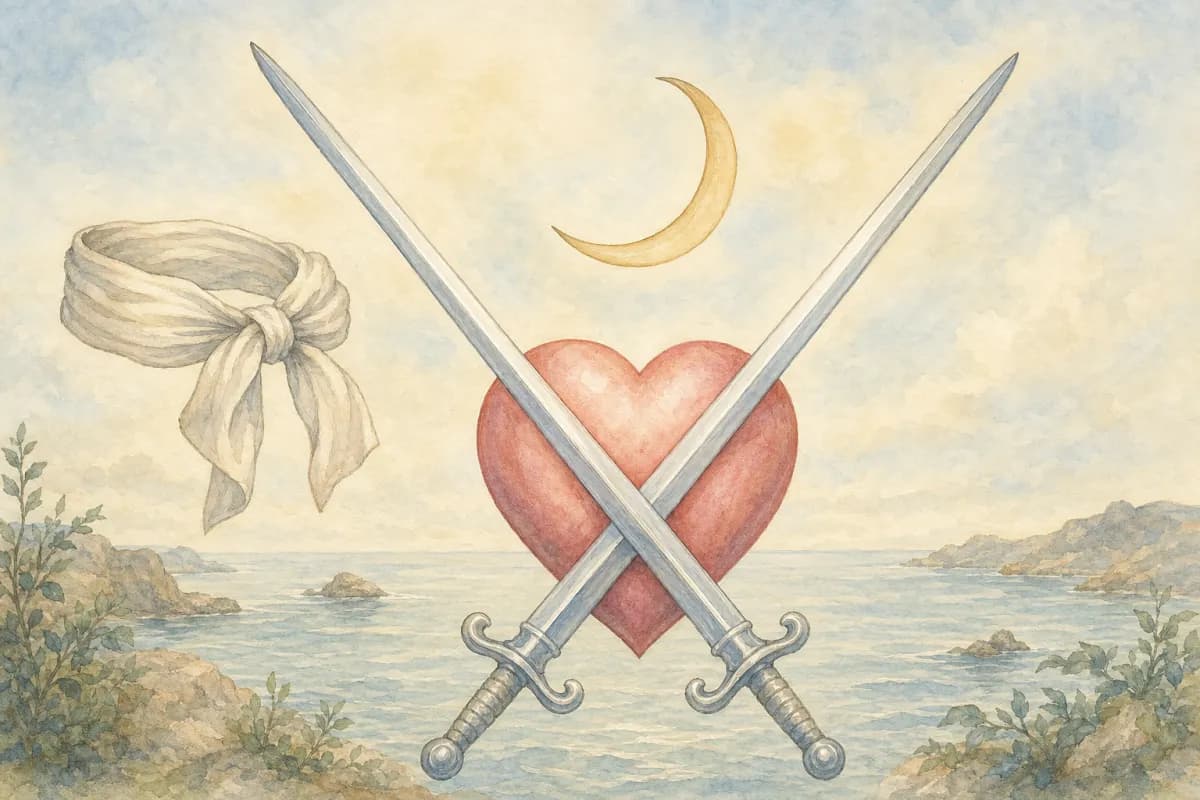
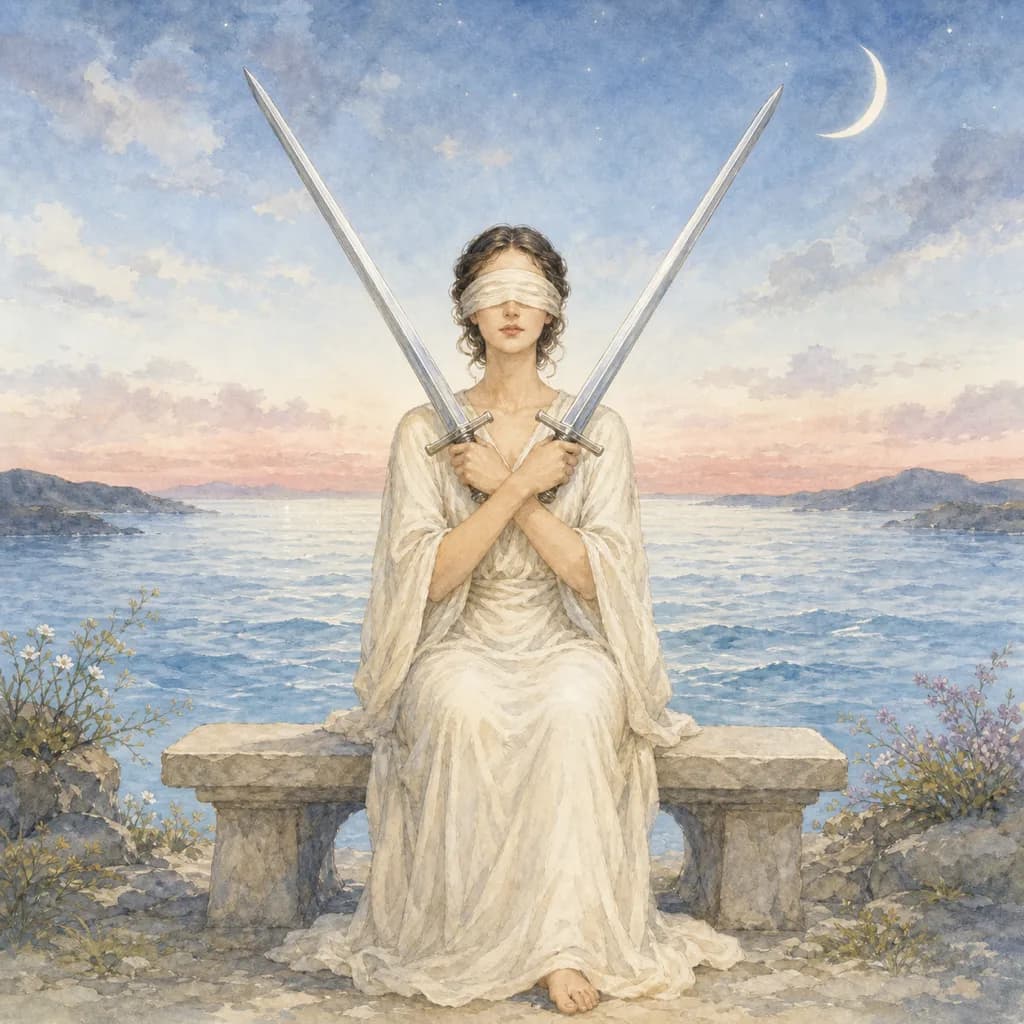
A woman sits on a low stone bench with her back to a choppy bay. She is blindfolded, a sword in each hand crossed over her chest at the same height, her arms forming a stiff X. A crescent moon hangs in the upper right of the sky. The whole image is balanced to the point of strain — two swords the same length, two arms at the same angle, a body held so symmetrically it looks like it took effort to arrange. The picture stages one argument: balance under pressure.
The Blindfold
The blindfold is the detail every reading turns on, and the two standard explanations both undersell it. The first says she can't see — she lacks information. The second says she won't see — the blindfold is self-applied, she's avoiding a truth she already knows. Both are real readings, and I check the surrounding cards to decide which is in play.
Here is what gets skipped. A blindfold is tied on — someone reached behind their own head and knotted it. That makes it an act. When clients tell me they "just don't have enough information to decide," I gently ask whether the information is truly unavailable or whether they've arranged not to go looking. The blindfold protects against having to act on what you'd see, and that protection is the card's real subject.
The Two Swords, Crossed
Two blades of equal length, held at equal height, crossed over the heart. In the suit of the mind and its conflicts, two swords held this way describe two lines of thought at a perfect deadlock, neither winning because they've been weighted to cancel. The crossing matters: the swords guard the heart, the intellect positioned in front of the feelings to keep them from being touched. A genuinely impossible decision is rarely impossible by accident — we keep two options exactly level when choosing would force a loss we're not ready to take. The deadlock does work.
The Water and the Crescent Moon
Behind her, the sea is rough and she has turned her back on it. Water is feeling, and in a Swords card it churns behind while the mind manages from the front. She has positioned herself so she doesn't have to watch it.
The crescent moon is the symbol nearly every guide names and then drops. It's the moon partway through its cycle — neither dark nor full, caught between states, the card's whole condition rendered in the sky. It's also why I never read this as a purely thinking problem. Something is being felt under all that careful balance, and the blindfold is partly there so she doesn't feel it.
Two of Swords Upright Meaning
Upright, the Two of Swords is the deck's portrait of a held position — a person sitting very still inside an unresolved decision.
Core Upright Keywords
- Indecision — Two options weighed so evenly that choosing stalls
- Stalemate — A standoff that holds because moving costs something
- Avoidance — The blindfold deliberately kept on
- Suspended judgment — A matter deliberately left open
- Uneasy truce — Peace maintained by not addressing the thing
In-Depth Upright Interpretation
The freeze is usually held in place on purpose, even when the person holding it would call themselves simply "stuck." The most common version: a decision the client knows they need to make, has the information to make, and keeps not making — because either choice means giving up the other, and not choosing keeps both alive a little longer.
A client came to me last spring with the Two of Swords in the center of her spread. She framed it as a career fork — stable role or riskier offer — and said she "needed more data." The data she was missing turned out to be data she'd already gathered. What she was really weighing was the self who plays it safe against the self who jumps, and she couldn't bear to retire either one. Once she said that aloud, the "impossible" decision took ten minutes.
There is a gentler reading, too. Sometimes the truce is wise — when the situation isn't ripe and acting now would force a premature loss, the right move genuinely is to hold the swords up and wait. The card sometimes means "this pause is legitimate; just be honest that you're choosing it." Tense neighbors push it toward "you're avoiding"; calm ones toward "the wait is earned." Either way, resist reading the card as neutral, as if balance were the goal — the symmetry is strained, held by effort that eventually runs out.
Two of Swords Reversed Meaning
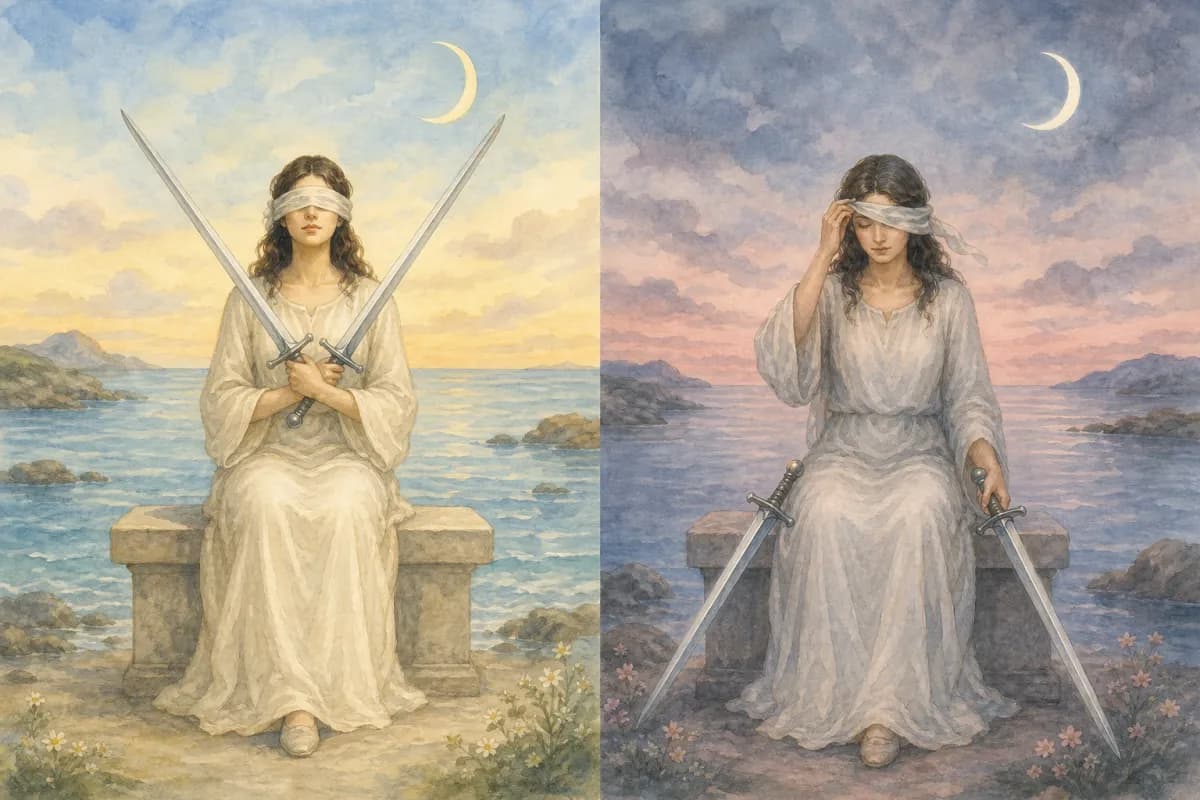
Is the reversed Two of Swords negative? Not reliably. This is one of the reversals I refuse to read as automatically worse, because the upright card is already a stuck position — and inverting "stuck" can mean "unstuck," which is what you've been hoping for. The reversal points two opposite ways, and the work is reading which one.
Core Reversed Keywords
- Stalemate breaking — The deadlock finally giving way
- Decision surfacing — A choice rising into view
- Released tension — The strain of holding both options easing
- Deeper denial — Avoidance dug in past the point of pretending to weigh
- Information overload — Too many voices drowning the inner one
In-Depth Reversed Interpretation
The first reading is the hopeful one: the freeze is thawing. The swords are coming down, the blindfold is loosening, and an avoided decision is finally coming up for air. I see this version most when the cards around it are warming — the truce has run its course and the truth is surfacing on its own, sometimes with relief.
The second reading is the warning: the avoidance has hardened. The querent has stopped pretending to weigh the options — head buried, hoping the question dissolves so no answer is ever required. It often comes with information overload: so many opinions consulted that they drown their own judgment and call the paralysis "doing their research." When clients describe asking ten friends and feeling less clear, this is the card I expect.
A third, quieter reading is the decision made by default. You waited so long that circumstance chose for you — the offer expired, the other person moved on. Life pulled the blindfold off on your behalf, the consequence the upright card warned about.
To tell the three apart, I watch where the energy is moving — toward clarity, into avoidance and noise, or already settled without your input. The card won't tell you; the neighbors and the client's own behavior will.
Is the Two of Swords Telling You to Decide — or Asking What the Stalemate Is Protecting?
This is the blind spot in nearly every Two of Swords guide I've read, and it's the most useful thing the card can teach. Other articles converge on one instruction — take off the blindfold, gather your facts, make the call — as if the stalemate were a failure of nerve. In real readings that lands flat about half the time. A stalemate that has held for weeks is a structure, and structures stand because they hold something up. So before I tell anyone to choose, I ask what the not-choosing protects.
Sometimes it protects a relationship — name the problem and the fragile calm cracks, so the blindfold stays on and everyone keeps pretending. Sometimes it protects an identity: to decide is to retire the other self, the way my client couldn't let go of either the safe version or the bold one. Sometimes it protects hope, because while the choice stays open both futures are still alive in your imagination, and choosing kills one. And sometimes — the one people resist most — it protects you from responsibility. If circumstance decides, you can't be blamed. The blindfold is an alibi.
Once you name what the standoff is keeping safe, the card stops being a scolding and becomes a map. The real decision usually isn't between the two swords at all; it's whether the thing you're protecting is worth the cost. That's why "just decide" fails: it treats a defended position as an empty one. Find what's being defended, and the swords come down on their own.
For the version of this question aimed at romance, the Two of Swords as feelings page works through whose blindfold it really is and what the choice is.
Two of Swords in Decisions & Conflict
This is the card's home territory, more than love or career. Drawn about a choice, the Two of Swords rarely tells you which option is right; it describes the quality of your stuckness, which is "balanced on purpose." The practical move is to break the false symmetry: list the two options and ask honestly whether they're really equal or whether you've been keeping them that way. Most deadlocks dissolve the moment you admit one side is heavier. Don't confuse this deliberate refusal to choose with the Eight of Swords, where you've talked yourself out of believing a choice exists at all — the Two keeps both swords in hand on purpose, while the Eight has convinced itself it's trapped.
Sometimes the deadlock is interpersonal — two factions, each wanting you to pick a side. There, strict neutrality is itself a choice, usually the one that protects your comfort over the relationships. The card's advice is unusually concrete: whoever breaks a stalemate gets to choose the terms, so it might as well be you.
Two of Swords in Love & Relationships
In love, the upright Two of Swords is most often a cold peace — the relationship where nobody's fighting and nobody's resolving anything. Feelings are real and have gone underground because raising them feels heavier than enduring the quiet, both people waiting for the other to take the blindfold off first.
For singles, the card can be the literal "torn between two people" reading the old books love, and occasionally that's exactly it. More often the second option is the safety of choosing no one — keeping the apps open so nobody can disappoint you.
Reversed in love, the better outcome is a stalemate finally breaking: an avoided conversation about to happen, a decision about the relationship surfacing. The harder outcome is detachment hardening — one partner pulling back to avoid the conversation entirely. One caution unique to love: if you've been pressing someone to choose, the reversal can mean they feel cornered and retreat further. Pressure and the Two of Swords are a bad pairing in either orientation.
Two of Swords in Career & Work
At work, the most common Two of Swords reading is a decision you keep deferring: which offer to take, whether to leave, whether to speak up. Upright, you're balanced and stalling, telling yourself you're waiting for clarity that has already arrived. The card grants one honest exception — sometimes you're genuinely waiting on someone else's decision and can't force their timing. The tell is whether the ball is in your court. If it is, the limbo is yours.
Reversed, the career reading I give most is a warning about timing: if part of your work has been suspended too long, the window is closing whether or not you're ready, so move before it's chosen for you. The kinder outcome is movement at last — a sudden burst after months of incubation.
Two of Swords Card Combinations
Two of Swords + The Moon
A flag I always slow down for. The crescent moon on the Two of Swords meets The Moon in full, intensifying the not-seeing. The Moon is confusion (you genuinely can't see); the Two of Swords is avoidance (you won't). Together they describe a stalemate fed by real fog — careful not to use the murk as an excuse to keep the blindfold on.
Two of Swords + The High Priestess
Two cards of held-back knowing. The High Priestess sits between the pillars; the Two of Swords between the swords. Together they usually mean the answer is already available from your intuition and you're keeping it behind a veil — the combination that pushes me toward "you already know."
Two of Swords + The Tower
A stalemate about to be ended by force. The Tower is the lightning strike that resolves what you wouldn't, so the deferred decision gets made by a sudden event. The kindest reading: choose now, before the Tower does.
Two of Swords + Three of Swords
The deferral and the heartbreak it was holding off. The Two of Swords kept the heart guarded; the Three of Swords is what was behind the guard. Together they often describe someone who avoided a painful truth until the avoidance itself caused the wound — the thing you were protecting yourself from arriving anyway, sharper for the delay.
Two of Swords + Ace of Swords
The stalemate cut. The Ace of Swords is the blade of pure clarity that ends deadlock. Following the Two of Swords, it's one of the more encouraging sequences for a stuck querent: the fog lifts, the swords come down, and you see the one thing the choice rested on.
Numerology & Astrological Correspondences
In the suit of Swords, the Ace is raw mental force — a single blade, undivided clarity. The Two is what happens the moment that force splits: one mind, two conflicting conclusions, no third position to break the tie. In this airy, argumentative suit, a two becomes a standoff. The suit will move from this frozen balance into the grief of the Three and the withdrawal of the Four, but at the Two the conflict is still held perfectly, painfully level.
Astrologically the Two of Swords is the Moon in Libra in the Golden Dawn system — the first decan of cardinal-air Libra. Libra's gift is fairness, and its shadow is chronic indecision: the inability to choose for fear of being unfair to the option left behind. The Two of Swords is that shadow rendered as a single, stuck pose, with the card's ruler drawn into the sky as the crescent moon.
In Japanese タロット占い this card is often read through 「保留」(horyū) — to hold a matter in reserve, to leave it pending. I find that word kinder and more accurate than the English "indecision." 保留 carries no failure in it; it's a recognized, almost respectable state of deliberately keeping something open. The Two of Swords often describes a person who has formally put the question on hold — waiting until it feels safe enough to take it off 保留 and choose.
Frequently Asked Questions
Is the Two of Swords a yes or no card?
It's a "maybe," leaning toward "not yet." The card's nature is the decision that hasn't been made, so it resists a clean answer — drawing it usually means the situation isn't ready to resolve. A reversal that's clearly breaking the stalemate open can tip toward "soon."
What does the Two of Swords mean in love?
Most often a cold peace: a relationship where real feelings have gone quiet because addressing them feels too heavy, and both people wait for the other to speak first. For singles, it can mean being torn between two people, though more often it's the pull between connection and the safety of staying uncommitted. The card describes a stalemate, and held breaths don't last.
Is the Two of Swords a good or bad card?
Neither, on its own. It describes a state — a balanced, deferred decision — that's good when the pause is wise and bad when it's avoidance dressed as deliberation. The quality depends on what the stalemate protects. Read the surrounding cards.
What does the Two of Swords mean reversed?
Two opposite things. The hopeful reading is the stalemate breaking — the blindfold loosening, a decision finally surfacing. The harder reading is avoidance hardening into denial, often with information overload. A third possibility: you waited so long the decision was made for you by circumstance.
What is the Two of Swords telling me to do?
Find out why you haven't decided, before you force the decision. Name what the not-deciding is protecting — a relationship's peace, an identity you're not ready to retire, a hope you don't want to kill, or your own freedom from blame. Once that's named, the real choice usually becomes obvious.
What astrological sign is the Two of Swords?
It corresponds to the Moon in Libra — the first decan of Libra in the Golden Dawn system, a cardinal air sign. Libra is the scales and the drive for balance; the Moon is emotion and instinct. Together they produce feeling trying to balance itself and freezing in the attempt. The crescent moon in the image is that ruler made visible.
Why is the figure on the Two of Swords blindfolded?
For one of two reasons, and telling them apart is the reading. Either she can't see — she's missing information — or she won't see, having tied the blindfold on herself to avoid a truth she already knows. Because a blindfold is knotted by hand, the second reading is more common than guides admit: the not-seeing is doing a job.
Closing
The Two of Swords is the deck's most patient card, and that patience is what makes it easy to misread as helplessness. The woman isn't trapped. She arranged the pose and she can unarrange it — the strain in the image is the tell that the balance costs her something.
If you've drawn the Two of Swords, skip the instinct to force a decision today. Do one smaller thing first: write down the two options, and beside them the one thing the not-choosing keeps safe — a relationship, a self-image, a hope, an alibi. Ask whether it's worth the freeze. That one sentence does more than weeks of weighing.
Continue exploring the suit of Swords, or read the Two of Swords as feelings for what this card means when you've asked how someone feels about you. When you're ready for a full reading, our love tarot spread guide walks you through it.