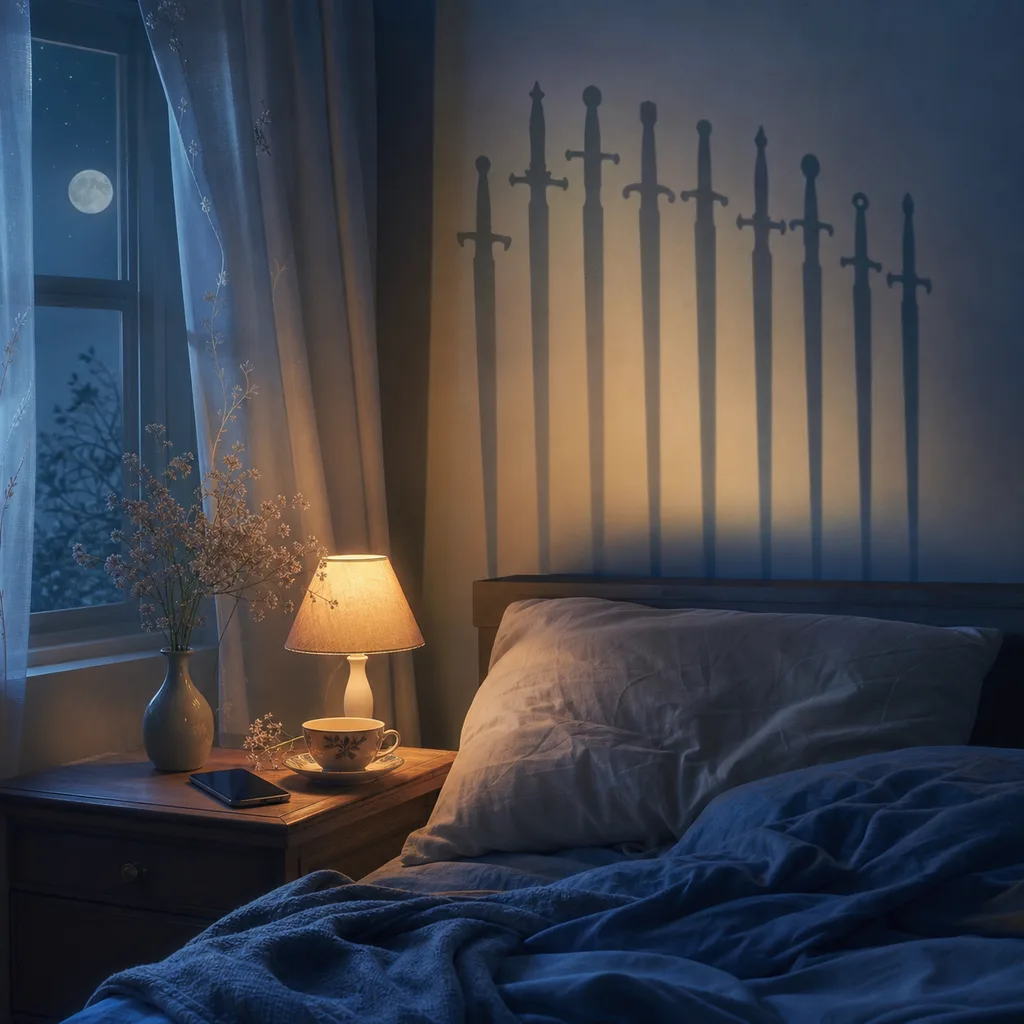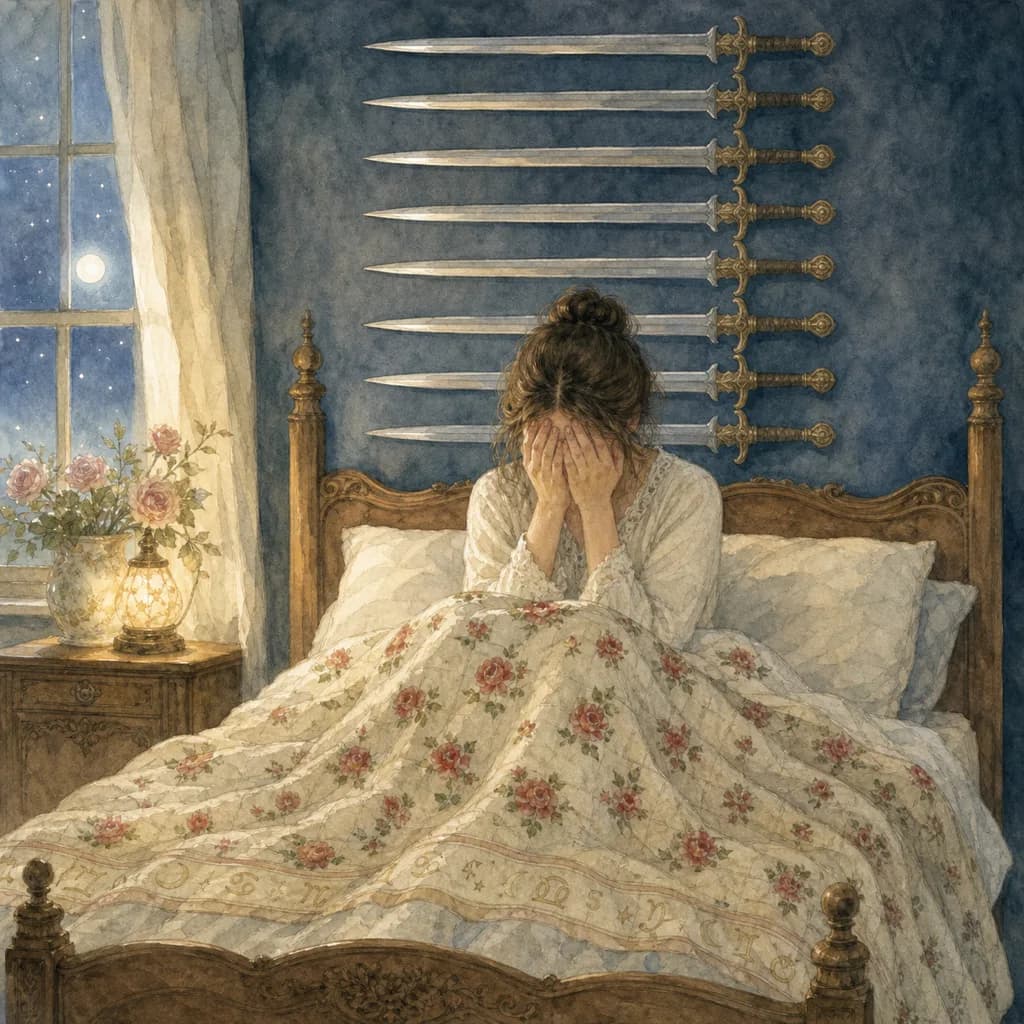
There is one card in the deck that does all its damage with the lights off. The Nine of Swords shows a person sitting bolt upright in bed, face buried in their hands, nine blades lined up on the wall behind them — and not one of those blades is touching anyone. That single detail is the whole card, and most readings rush past it. The suffering is real; the cause is not in the room.
Most guides tell you the Nine of Swords means anxiety and stop there. That is correct and incomplete, because "anxiety" doesn't answer the one thing you actually need at the table: whether the fear is pointing at a real problem you've been avoiding, or whether your mind has built a catastrophe out of nothing. That question runs underneath everything below.
Quick Answer
Upright, the Nine of Swords means anxiety, dread, sleepless overthinking, and guilt — the 3 a.m. spiral where worst-case stories feel like certainties even when, in the world, nothing has actually happened. Reversed, it most often means that anguish is starting to lift, though it can also mean fear driven underground or hardened into self-attack. On a Yes / No it leans No, mostly because fear is currently distorting the question.
Basic Information
| Attribute | Details |
|---|---|
| Card Name | Nine of Swords |
| Suit | Swords |
| Arcana | Minor Arcana |
| Element | Air |
| Astrological Correspondence | Mars in Gemini (Golden Dawn: "Lord of Cruelty") |
| Yes / No | No, or "not while fear is steering" |
| Upright Keywords | Anxiety, worry, dread, nightmares, guilt, rumination, mental anguish |
| Reversed Keywords | Recovery, relief, releasing fear; or suppression, self-criticism, despair |
Card Imagery & Symbolism
A figure sits up in bed, woken in the dark, head in both hands. Behind them, nine swords hang horizontally against a black background. Every popular guide lists the pieces; far fewer read what they argue together — a single claim about where pain comes from.
The Swords That Never Land
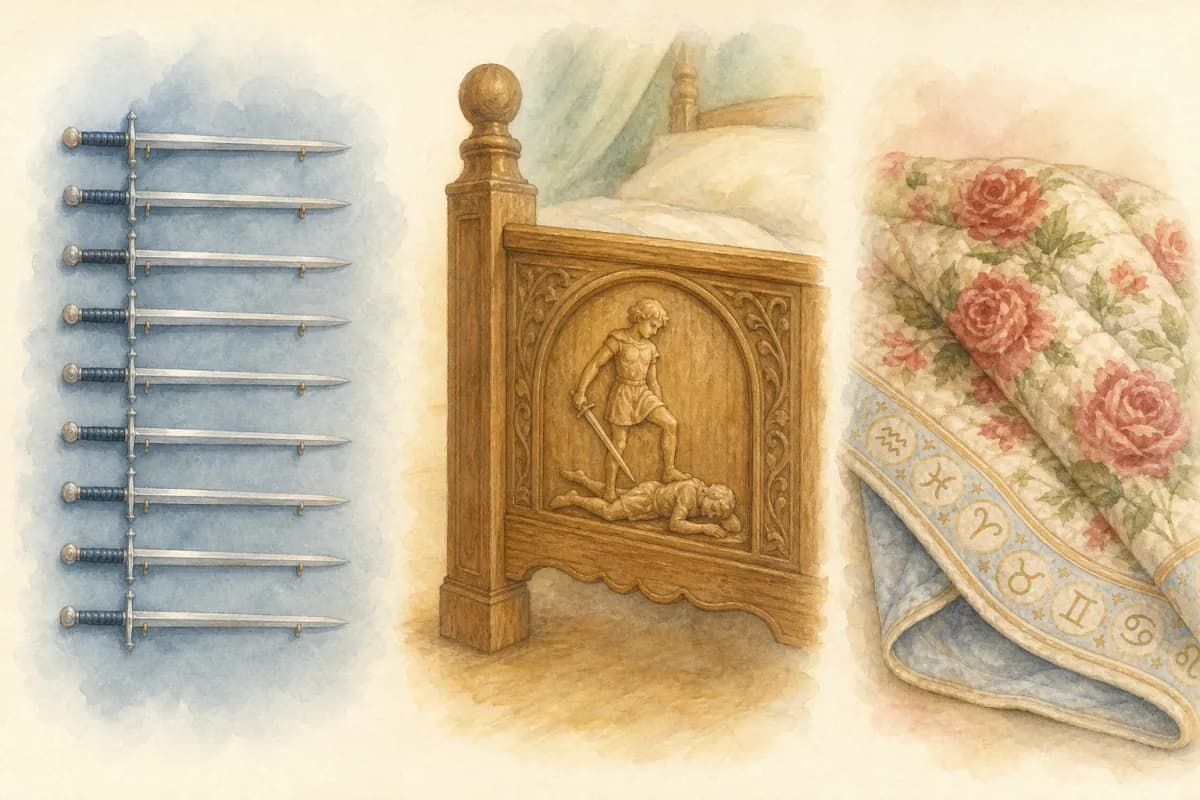
The easiest detail to miss is also the most important: the swords are on the wall. They float in a black field behind the figure, untouched and untouching. Compare the Three of Swords, where blades pierce a heart directly, or the Ten, where they are driven into a back. In the Nine the weapons stay mounted, like trophies or like a memory — the only sword card where the wound is entirely internal, the mind having lined the blades up itself and kept them sharpened.
That is the reading that protects clients most: swords are thoughts, and thoughts are not events. When someone draws this card terrified, the first thing I do is point at the wall — nothing on it has fallen, and the catastrophe in their head has usually happened zero times in the world.
The Carved Panel on the Bed
Here is the symbol every article lists and almost none interprets. The side of the bed frame is carved with a scene of one figure striking down another — the only depicted action on the card; everything else is stillness.
I read that panel as the story the sleeper is telling themselves. The mind has authored a defeat and carved it into the furniture, into the place meant for rest — the fear is in the woodwork. When a worst-case narrative runs so long that it stops feeling like a thought and starts feeling like a fact about who you are, that is the carving: the only fight happening is the one engraved on the bed.
The Roses and the Zodiac on the Quilt
The quilt carries red roses — love, life, vitality — and a band of astrological symbols, the order of the cosmos. Beauty and meaning are literally wrapped around the suffering figure, touching the body, and the figure cannot see them because their hands are over their eyes. That is the card's mercy: the evidence of a workable life is right there in the fabric, but tonight the dread has it all.
Nine of Swords Upright Meaning
Upright, the Nine of Swords is the deck's portrait of the mind turned against its owner — the point where the suit's sharpness folds inward and cuts the person holding it.
Core Upright Keywords
- Anxiety — Fear running ahead of the facts
- Rumination — The same worry looping with no exit
- Guilt and regret — Replaying what you did or failed to do
- Sleeplessness — Worry that owns the small hours
- Dread — Certainty that something terrible is coming
- Mental anguish — Real suffering from an internal source
In-Depth Upright Interpretation
When this card comes up, someone is suffering inside their own head, and the suffering is genuine even though the trigger is often imagined or wildly out of proportion. "Making mountains out of molehills" is the usual phrasing — true, but dismissive. The mountain feels exactly like a mountain to the person climbing it at 3 a.m., and the card asks for honesty about scale while respecting the fear.
The trap the upright Nine sets, and the one I name most at the table, is the self-fulfilling spiral. When you are convinced a thing is going wrong, you start behaving as though it already has — you withdraw, read silence as rejection, send the cold text that creates the distance you feared. The fear writes its own ending. A reading I gave a man here in Tokyo stays with me: certain his manager was about to push him out, he lay awake building the case nightly and had started avoiding the man entirely. Nothing had happened, yet three more weeks of avoidance nearly made it happen — his withdrawal looked exactly like disengagement. The card was not predicting the firing; it was showing him the engine that could cause one.
There is a harder reading most guides skip: sometimes the fear is real signal, a part of you that already knows something the daylight self refuses to look at. The card's job is to make you sort the two, which is what the diagnostic section below takes on.
Nine of Swords Reversed Meaning
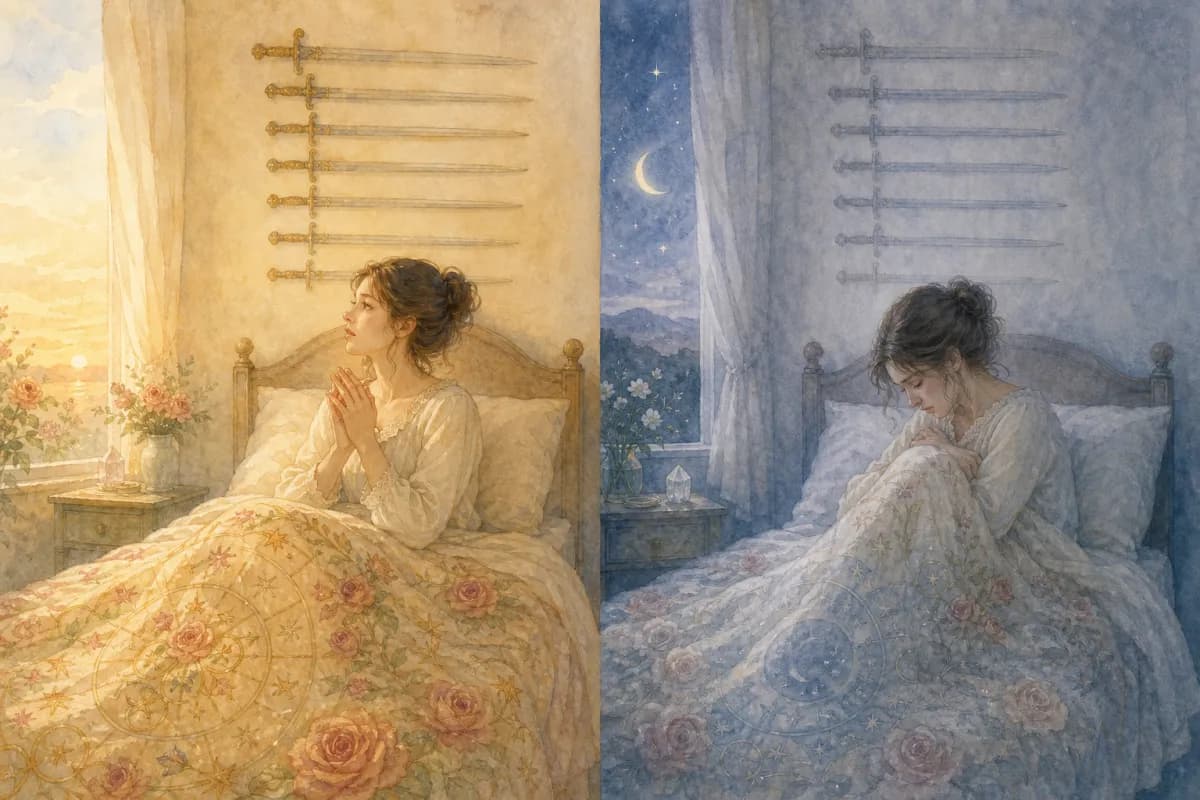
First, plainly: is the reversed Nine of Swords negative? Usually it is the better draw of the two — where so many reversals soften a positive card, this one takes the deck's darkest interior card and turns it toward morning. But there is a real shadow version too, and lumping the two together is the common mistake.
Core Reversed Keywords
- Relief — The worst of the dread loosening
- Recovery — Climbing back out of an anxious or depressive stretch
- Releasing fear — Naming the worry and letting it go
- Suppression — The anxiety pushed underground and left unprocessed
- Self-criticism — The blades turned into a steady internal attack
- Despair — In the harshest readings, the spiral deepening further
In-Depth Reversed Interpretation
The first and most common reading is relief. The swords are coming down off the wall — the nightmare card reversed usually means the nightmare is ending, the catastrophic story losing its grip, sleep returning, a new willingness to talk about what was eating you. After a stretch of upright dread, it is one of the gentlest turns in the deck.
The second reading is suppression, and it wears the same calm face. The anxiety has not been resolved; it has been buried. The person stops acknowledging the fear, which can look like recovery from the outside while pressure builds underneath. Genuine release feels like a thaw; suppression feels like a door shutting softly.
The third reading is the deepening spiral. In a heavy surrounding spread, reversed can deepen the upright dread — harsh self-talk becoming constant, guilt curdling into self-loathing, the fear gone from occasional to ambient. This is where the card asks, sometimes urgently, for outside help: a perspective the spiraling mind cannot reach alone. When clients describe being relentlessly hard on themselves, this is the reversal I see, and it deserves to be taken seriously.
To choose between the three live, I read the surrounding cards and the direction of motion. Bright neighbors and forward movement push it toward relief; stagnant or heavy neighbors, and a person who has gone notably silent, push it toward suppression or the spiral.
Is the Fear Pointing at Something Real, or Manufacturing It?
This is the blind spot in nearly every Nine of Swords guide, and the most useful thing the card can teach. The standard line — "your fear is just catastrophizing" — is half true and quietly dangerous, because it trains you to dismiss all the card's dread as noise. The card hands you a sorting job; here is the diagnostic I use at the table.
Ask what the fear wants you to do. Pure noise has no action attached — it just wants you to keep ruminating in place. Real signal points somewhere specific: make the appointment, have the conversation, ask the direct question. If a doable action appears when you sit with the dread, the fear is probably carrying information; if there is nothing to do but spin, it is probably the carving on the bed.
Ask whether reality has been tested. The signature of this card is conclusions reached entirely in the dark, never checked against daylight. "He's pulling away" — have you asked him? "I'm going to lose the job" — has anyone said so? Most of these blades dissolve the moment you say them out loud to another person, which is why every old guide tells you to reach out: a second person reality-checks the fear the dark amplifies.
Ask who the fear is about. Noise tends to be self-attacking — I'm not enough, I ruined it — looping inward with no off-ramp. Signal tends to be situational — this specific thing is wrong. When the fear is all verdict and no detail, suspect the spiral; when it has edges and locations, listen.
The move is the same either way: stop trying to win the argument inside your head, and run the fear through these questions in daylight. What survives is worth acting on; what evaporates was a sword on the wall all along.
Nine of Swords in Mental Health & Inner Life
This is the card's home position. The Nine of Swords speaks more directly to mental and emotional health than almost any card in the deck — it is the literal picture of insomnia, anxiety, intrusive thought, the depressive 3 a.m. mind. In a health spread I read it first as a state of mind well before any body symptom: stress gone chronic, worry organized into a loop, sometimes the edge of burnout. It describes suffering and prompts toward help; it does not diagnose. The figure cannot see the roses on their own quilt — but someone outside the spiral can. Reversed here is genuinely encouraging, most often signalling the return of sleep and the ability to cope, though I still check whether the person has been supported or has just stopped talking about it.
This is also where the card differs most from The Moon, the deck's other great card of nighttime fear. The Moon is confusion — you cannot see clearly, so it needs orientation. With the Nine you are convinced you see all too clearly, and what you "see" is a catastrophe your own mind drew; this one needs reality-testing.
Nine of Swords in Career & Work
In career readings the Nine of Swords usually means work has become a source of dread — the Sunday-night stomach, the project you lie awake over, the certainty you're about to fail or be found out. The card's core question applies sharpest here: is the stress coming from the job, or from your story about it? External pressure — a toxic manager, an impossible workload, a role that is ending — points at a real problem with a concrete answer: document it, set boundaries, look elsewhere. Internal pressure — impostor dread, a competent person convinced they're failing — puts the work on the thinking, since the spiral cannot audit itself. I have read this card for several high-functioning people whose careers were objectively fine and whose nights were unbearable; for them it was not a warning about the job but about what the worry cost them.
Nine of Swords in Love & Relationships
In love, the Nine of Swords describes the anxiety wrapped around a relationship: fear running far ahead of any evidence — worrying what a short reply means, deciding a quiet week is the beginning of the end, lying awake over a problem nobody has confirmed. At the table I treat the relationship itself as rarely the danger; the danger is the silence around the fear and the self-fulfilling behavior it breeds. The card can also point to guilt, or to dread that is genuine signal — a part of you that already knows the connection is in trouble. For what the Nine means when you've asked how someone feels about you, the Nine of Swords as feelings page goes deeper into the crush, ex, and no-contact readings than I can here.
Nine of Swords Card Combinations
Nine of Swords + The Moon
The two great cards of nighttime fear, and a flag to slow right down. The Moon adds confusion to the Nine's dread — you are frightened and cannot see clearly. Do not trust any conclusion reached here; get to daylight before acting.
Nine of Swords + The Star
The most hopeful pairing the Nine can land in. The Star is healing and the return of hope after a hard stretch, so together they read as the dark night breaking — the anxiety that owned you giving way to recovery. Especially encouraging when the Nine is reversed.
Nine of Swords + Three of Swords
A real wound and the dread around it. The Three of Swords is heartbreak that has actually happened — clean, landed grief — while the Nine is the sleepless anguish surrounding it. This is the pairing where the fear is least likely to be phantom: something real broke, and the aftermath is being replayed at night.
Nine of Swords + Four of Swords
Permission to rest. The Four of Swords is recovery, stillness, deliberate retreat — the antidote the Nine needs. Together they read almost as instruction: the way out of the spiral runs through rest and quiet, once the mind has exhausted itself. When a client draws this pair, the spread is prescribing a pause.
Nine of Swords + Ace of Cups
Dread meeting an opening of the heart. The Ace of Cups is new emotional flow — love, openness, the cup beginning to fill. Beside the Nine it reads as relief arriving through connection: the very thing the anxious mind braces against, letting someone in, dissolves the fear.
Numerology & Astrological Correspondences
By the nine, the suit of Swords has nearly run its full arc. Swords begins with one clear idea cutting through confusion and travels through conflict, stalemate, and grief; by the Eight of Swords you are blindfolded by your own thinking — a trap that still has a door — and by the nine the mind has turned fully inward and started generating its own torment — one step before the Ten releases it. The Nine is the swords' fever pitch: the point where the intellect, the suit's gift, becomes the instrument of its worst wound.
Astrologically the card carries Mars in Gemini, which the Golden Dawn named "Lord of Cruelty" — Mars's aggression aimed through Gemini's restless, verbal mind, the sharp tongue turned against its owner. In Japanese タロット占い I reach for 思い悩む (omoinayamu) — to be tormented by one's own turning thoughts, to suffer inside the head rather than over anything real. It is softer and more inward than "anxiety," carrying no blame — the tone the card deserves.
Frequently Asked Questions
Is the Nine of Swords a yes or no card?
It leans No — but read why. The No is less a verdict on your goal and more a description of your state: fear is currently distorting the question. Reversed softens it toward "the fear is lifting," but it is rarely a clean Yes. Before acting, check whether the answer is genuinely bad or just feels that way at 3 a.m.
What does the Nine of Swords mean in love?
Usually anxiety about the relationship with no real evidence behind it — worrying ahead of the facts, reading silence as rejection, lying awake over an issue no one has confirmed. It can also point to guilt or a secret weighing on someone. The danger is the silence and the self-fulfilling behavior. Say the dread out loud; most blades lose their power once spoken.
Is the Nine of Swords always negative?
No. It depicts real suffering, but the suffering is internal and often out of proportion to reality, which makes it frequently workable. Many readers treat it as a wake-up call: name the fear, test it against the world, reach for support. Reversed especially is often hopeful, marking the end of a dark stretch.
What does the Nine of Swords reversed mean?
Most often relief — the anxiety lifting, sleep returning, recovery underway. Less often it means the fear has been buried while still unhealed (suppression), or in a heavy spread that the spiral is deepening into self-attack. The tell is whether anything is opening up or just going quiet, plus the surrounding cards.
What does the Nine of Swords mean for health?
It points most directly at mental and stress-related health — anxiety, insomnia, rumination, the edge of burnout. Read it as a prompt toward support; it is no diagnosis. Reversed usually signals recovery and the return of the ability to cope, though it can mean a difficulty that has gone quiet without resolving.
What is the timing of the Nine of Swords?
As an Air-suit card, it is often tied to the air-sign seasons — Gemini, Libra, Aquarius — and to the 9th, 18th, or 27th of a month. I treat sword-card timing loosely; the more useful reading is that the card describes a present state of worry, which says little about when an event will land.
I keep drawing the Nine of Swords. What does that mean?
A repeating Nine usually means a fear you have not yet tested against reality or spoken to anyone — the card keeps returning because the loop is still running. Run the specific dread through the daylight questions in this guide, and say it out loud to one trusted person. The card tends to stop repeating once the thought has actually left your head.
Closing
The Nine of Swords is the deck's most honest picture of suffering nobody else can see — real pain from an unreal cause, the mind cutting itself with blades it sharpened in the dark. It is frightening to draw and more workable than it looks, because the wound sits in the one place you have power: inside your own head.
If you've pulled it, do one thing before you decide what it means. Write the fear keeping you up down in daylight, run it through the three questions above, and say it out loud to one person you trust. The swords on that wall have never once fallen on their own. Carry one into the light, where you can finally see whether it was ever a real blade.