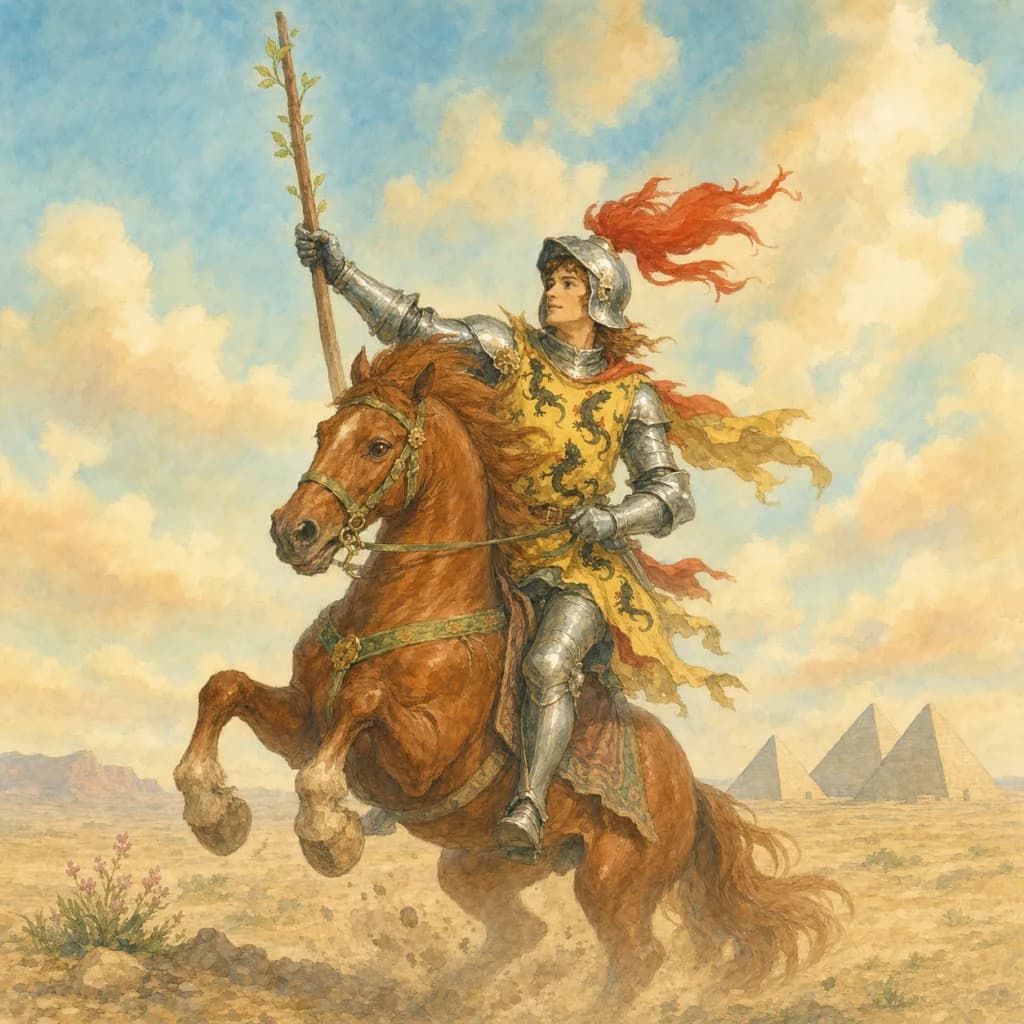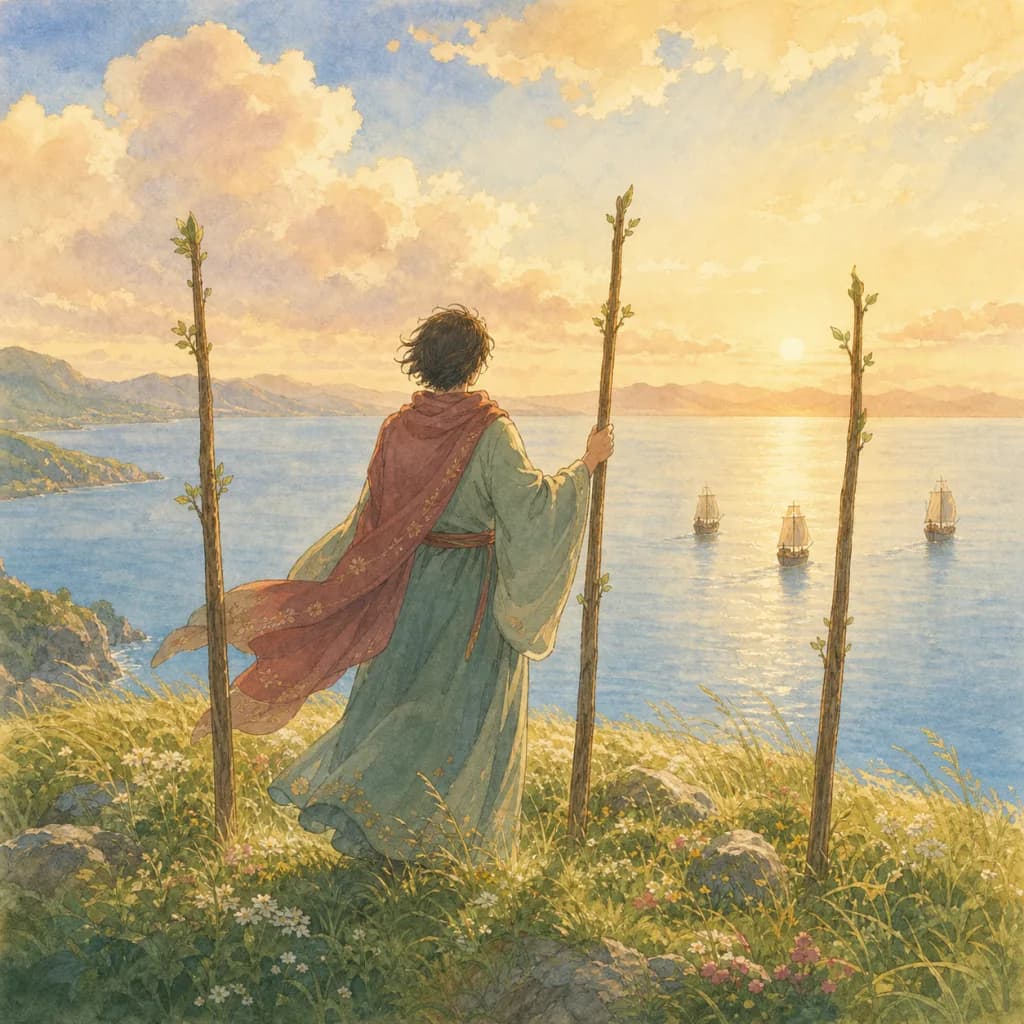
A man stands at the edge of a cliff, his back to us, watching three ships move across the water. Most guides read this as triumph — the visionary surveying his empire-to-come. I read it differently. The ships are already out there. He sent them. Whatever this man is doing on that cliff, it isn't deciding and it isn't sailing — it's waiting, and the Three of Wands tarot card is, above all, a portrait of the particular kind of waiting that comes only after you've already committed.
That gap between "I've launched" and "it's working" is where most readings go quiet. It's where I want to spend our time.
Quick Answer
The Three of Wands means your first move is already made and now you're watching for it to pay off — expansion, foresight, ventures sent out into the world that haven't returned yet. Upright, it's confident anticipation: the plans are in motion, keep your eyes on the horizon. Reversed, it's that anticipation curdling into delay, frustration, or a quiet suspicion you launched too early or planned too small. Yes / No: leans Yes, but a Yes with a wait built into it — the outcome is coming, not arriving today.
Basic Information
| Attribute | Details |
|---|---|
| Card Name | Three of Wands |
| Suit | Wands |
| Arcana | Minor Arcana (Pip Card) |
| Element | Fire |
| Astrological Correspondence | Sun in Aries (second decan of Aries, Golden Dawn system) |
| Yes / No | Yes, with a wait attached |
| Upright Keywords | Expansion, foresight, anticipation, ventures launched, looking ahead, momentum, overseas opportunity |
| Reversed Keywords | Delays, frustration, planning too small, premature launch, blocked progress, impatience |
Card Imagery & Symbolism
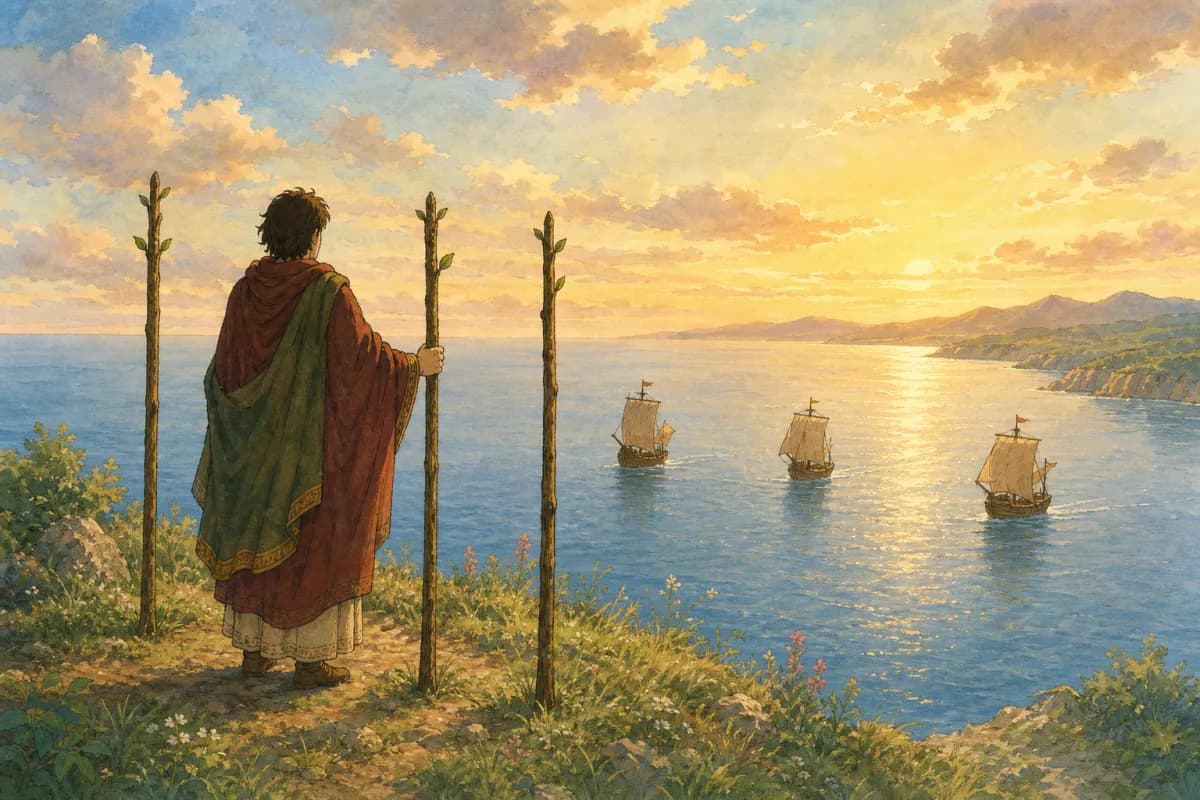
A figure in a long robe stands on high ground, three staves planted around him, one in his right hand. Below stretches water with three small ships on it; in the distance, low mountains. He faces away from us, toward the sea. Compared with the Two of Wands — where the same kind of figure holds a globe and looks restless inside his own walls — this man has clearly left the castle behind. He's outside now, exposed, committed.
The Ships Already on the Water
Here's the detail nearly every guide rushes past: the ships are out there. Not being loaded. Not at anchor. They're mid-voyage, which means the action this card represents happened in the past tense. The man on the cliff isn't planning a venture — he's tracking one he already sent.
This changes the whole emotional weight of the card. The Two of Wands is choosing which direction; the Three is the moment after, when the choosing is done and there's nothing to do but watch the sea. I point this out to clients constantly, because they draw the Three and assume it's asking them to act. Usually it's telling them they already have — and now the harder skill is bearing the interval.
His Turned Back
This is the only card in the Wands suit where the central figure's face is hidden from us. We see the back of his head, the set of his shoulders, nothing of his expression. That hiddenness is doing real work: we can't tell if he's serene or sick with worry. The card refuses to tell us how the wait feels — which is honest, because the wait after a launch feels different to every person inside it.
I read the turned back as the card's central instruction: stop looking inward at your own anxiety and look out at the horizon where the answer is coming from. Watching the doorway beats pacing the room.
The High Vantage Point
He stands above the water, not beside it. Elevation in the Rider-Waite-Smith system is almost always perspective — the Hermit on his peak, the figures who climb. From this height he sees the whole bay, the ships' routes, the weather coming in. The card grants a wide field of view as compensation for the powerlessness of the moment. You can't row the ships home faster, but you can see them coming from a long way off, and that early sight is its own advantage. The card's gift is foresight, not control.
Three of Wands Upright Meaning
Upright, the Three of Wands is the card of the committed wait — the stretch between sending something out and seeing it return.
Core Upright Keywords
- Expansion — Growth that's already underway, not merely contemplated
- Foresight — A clear view of what's coming because of where you stand
- Anticipation — Confident waiting on results in motion
- Momentum — Force that's been set going and is carrying forward
- Overseas reach — Ventures, trade, or connection beyond your immediate ground
In-Depth Upright Interpretation
When the Three of Wands turns up upright, the planning chapter has closed. You've made the move — taken the job, sent the application, launched the product, said the thing — and the card finds you in the aftermath, eyes on the horizon. It's a hopeful card, but its hope has a texture: it's hope you can't rush. The ships will dock when they dock.
The card asks for two things at once that don't sit easily together: confidence and patience. Confidence, because the venture is sound and the broader view supports it. Patience, because seeing the ships doesn't mean you can pull them in. Most people are good at one and bad at the other. The fire energy of the Wands is brilliant at launching and terrible at waiting, which is why this card shows up precisely when someone is about to sabotage a good plan out of impatience.
A client of mine in Tokyo last autumn had quit a stable position to start something of her own and drew the Three of Wands. She wanted me to tell her the business would succeed. What the card actually said was gentler and harder: the ships are out, you did the right thing, and your only job for a while is not to panic and call them back to port. Three months later one came in. She told me the hardest part hadn't been the leap — it had been the silence afterward, which is the Three of Wands almost word for word.
There's an expansion theme here worth naming: this card often points outward, toward bigger arenas — foreign markets, long-distance arrangements, study abroad, scaling beyond your home turf. The horizon in the image is literal as well as symbolic.
Three of Wands Reversed Meaning
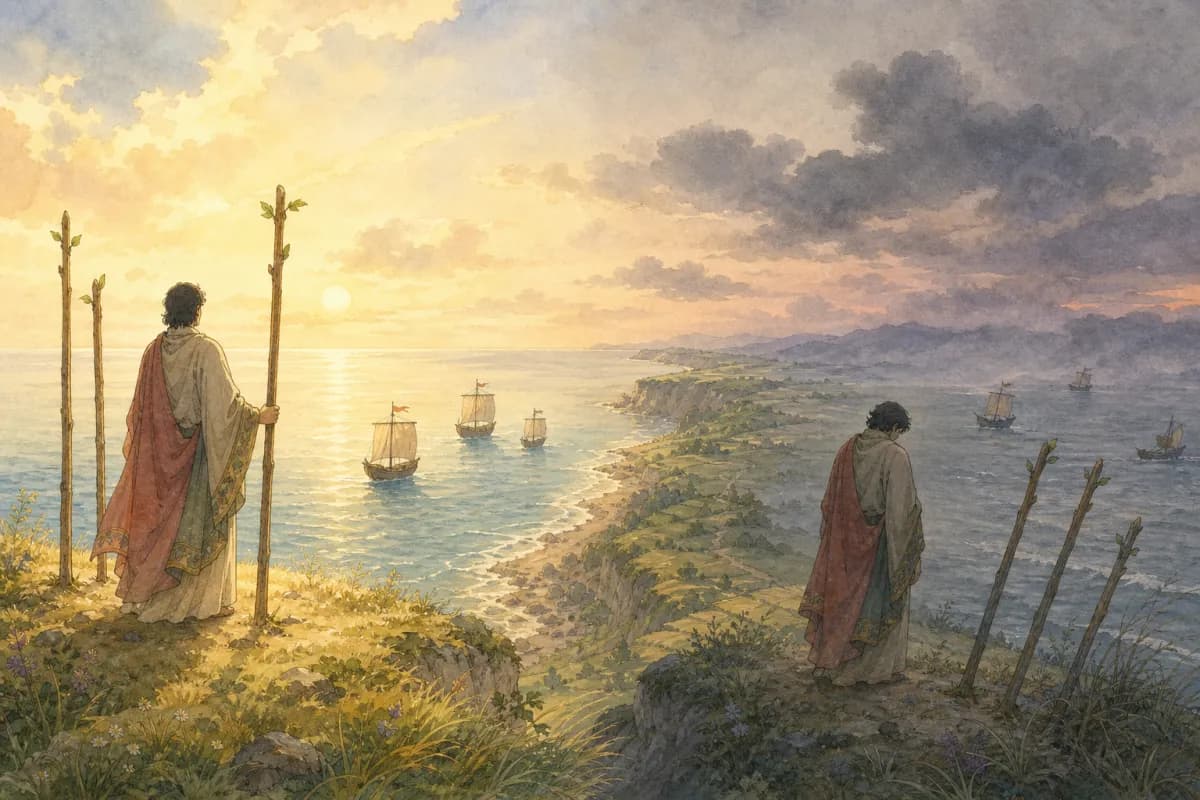
Is the reversed Three of Wands negative? Mostly, yes — more reliably than many reversals. Where the upright card is the wait that pays off, the reversed card is the wait that frays, sours, or reveals a flaw in what you launched. I don't soften this one much.
Core Reversed Keywords
- Delays — Ships held up by weather you didn't account for
- Frustration — The patience of the upright card running out
- Planning too small — A venture launched without enough ambition to clear the horizon
- Premature launch — Sent out before it was seaworthy
- Blocked momentum — Forward motion stalling or reversing
In-Depth Reversed Interpretation
The most common reversed reading is delay and the impatience it breeds. The ships are slow. A response hasn't come, a project is stuck in someone else's queue, the results lag the effort. Nothing has failed, yet the gap between launch and return has stretched longer than you braced for, and the upright confidence is leaking out. You're drumming your fingers on the cliff, tempted to do something rash just to feel like you're moving.
A second reading is that you planned too small. This is the one clients least expect and most need. The venture was real but under-scaled — you aimed for the near shore when the card was pointing you across the whole sea. The ships came back, but the haul was thin because the ambition behind the launch was timid.
A third is the premature launch. You sent the ships before they were ready — moved while the plan still had holes, went public before the thing was built. The reversal is a useful, uncomfortable message: some of what's coming back will need redoing, the cost of having jumped early.
To tell these apart I look at the surrounding cards and at where the querent's energy is going — toward honest patience, toward self-blame, or toward the itch to act for action's sake. The reversed Three rarely means "abandon it." It means what you launched needs a correction, and the correction starts with naming which of these three is true.
What Do You Actually Do While the Ships Are Out?
Almost every Three of Wands guide I've read treats this card as a forward-looking signal — expansion, opportunity, think big, the future is bright. All of that is in the card. But they leave out the question the image is built around, the one my clients ask the second they understand what they've drawn: I've already acted, so what am I supposed to do now, in the waiting?
This is the genuine blind spot. The competitor articles describe the launch and the eventual arrival. They skip the middle — the interval the man on the cliff is physically standing in. And the middle is where this card lives. He's already left the castle, the ships are already on the water, there's no decision left and no way to make the voyage shorter. The whole card is one prolonged in-between.
So what do you do in it? Three things the image teaches. First, keep your eyes on the horizon, not on your own nerves — his turned back tells you to watch the source of the answer. Second, use the elevation: scan widely, notice the second and third opportunities you couldn't see from inside the castle, prepare your harbor for the ships' return. Third — the one people resist — do not call the ships back. The most common way to ruin a Three of Wands situation is to lose nerve mid-voyage and recall what you launched, restarting the wait from zero. The card's hardest instruction is the simplest: you've done your part; let it run.
I'll go further than the safe reading. I don't think the Three of Wands is primarily about expansion at all. Expansion is the Two; the result is the Four. The Three is the discipline of the interval — the unglamorous skill of having committed and not undoing it while you wait. That's the muscle this card asks you to build.
Career & Expansion
This is the Three of Wands' home ground. In a career reading it almost always means a move you've already made is now in its waiting phase — you've applied, pitched, launched, or expanded, and you're watching for the return. It's encouraging: the venture is sound. But it's specifically a card of expansion beyond your current scale, so it rewards thinking bigger than the next step. If you're reading it as "should I stay safe," you've misread it. The man already left the castle.
From years of career spreads: the Three of Wands is the most common card I see right before someone makes the mistake of restarting. Three weeks of silence after a big move, and they want to send a follow-up that undoes their position, or pull out and try another angle. The card is a hand on the shoulder — the ships are slower than your anxiety, not slower than they should be.
For the longer arc of ambition, the Three sits naturally near The Chariot — directed will in motion — and points toward the worldly arrival of The World.
Love & Long-Distance
In love the Three of Wands carries a strong long-distance and "in-between" signal that fits its meaning exactly. For couples, it often shows up around physical distance — one person abroad, a stretch of separation, a relationship maintained across a gap while you wait to close it. The card is reassuring: the ships are coming home. The distance is a phase, not a verdict.
For singles, I read it less as "love is arriving today" and more as "you've already put something into motion" — you reconnected, joined the thing, made yourself available — and now the card asks you to stop refreshing your phone and watch the horizon. The unglamorous truth I tell clients: this card in love is rarely about doing more. It's about not undoing what you started out of impatience.
For a structured way to read where a connection is heading, our love tarot spread guide works well with waiting-phase cards.
Travel & Horizons
Of all 78 cards, the Three of Wands is one of the most literally tied to travel — those ships and that far shore aren't subtle. In a travel reading it's a strong yes, especially for journeys with purpose: relocation, study abroad, a trip that expands your world. It favors the long-haul over the weekend break.
The nuance is timing. Because this is a waiting-phase card, a travel reading often means the trip is planned and the wait is the current reality — visas pending, dates not fixed, the departure still distant. Don't read the delay as a bad omen. The ships in this card are always still on their way.
Three of Wands Card Combinations
Three of Wands + Two of Wands
The before and after of a single decision. The Two of Wands stands inside the castle weighing which way to go; the Three stands outside having gone. Together they describe the whole arc of a commitment — useful mid-deliberation, because the pairing says: you will leave the castle, and then the real work is the wait.
Three of Wands + Eight of Wands
The ships finally pick up speed. The Eight of Wands is rapid motion and messages arriving fast, so following the Three's slow watch it's one of the most encouraging sequences you can draw — the waiting breaks and everything moves at once. When a client is stuck in the Three's silence, this pairing is the answer landing.
Three of Wands + The Emperor
Vision backed by structure. The Emperor is the builder of lasting systems, and beside the Three's horizon-gazing he grounds the expansion in something solid — the entrepreneur whose big venture has real scaffolding under it. A strong career combination for someone scaling a business rather than chasing a whim.
Three of Wands + The World
The ships come home. The World is completion and arrival on a wide scale, so following the Three's wait it's close to a guarantee of return — the venture lands, often bigger than you sent it out. If the Three is the launch and the silence, the World is the dock.
Three of Wands + Five of Wands
Expansion meeting friction. The Five of Wands is scrappy competition and clashing energies, so beside the Three it often means your venture has met rivals — the market is crowded, others launched ships too. Read it as a signal to differentiate; the horizon isn't yours alone.
Numerology & Astrological Correspondences
In the Wands, the Ace is the raw spark, the Two is choosing a direction, and the Three is what happens once that choice has been acted on — the energy has left your hands and entered the world. Three in this fiery suit is where intention becomes external, something with its own momentum you no longer fully control. The suit will move from here into the settled celebration of the Four, but at the Three the outcome is still out on the water.
Astrologically the Three of Wands is the Sun in Aries in the Golden Dawn system — the second decan of cardinal-fire Aries. Aries is the initiator, the one who moves first; the Sun there is that force at full confidence. A fitting match: the card's whole posture is the boldness of having already begun, lit by the certainty that the move was right.
In Japanese タロット占い I often read this card through 「機が熟す」(ki ga juku su) — for the time to ripen, for conditions to come to fruition. The phrase carries no impatience; ripening happens on its own schedule and can't be hurried. The Three of Wands is exactly that state — the work is done, the conditions are set, and now you let the time ripen rather than tearing the fruit off the branch too soon.
Frequently Asked Questions
Is the Three of Wands a yes or no card?
It leans Yes, but it's a Yes with a wait built in. The card says the outcome is on its way, not that it arrives today. For an immediate answer it's less reliable than the Sun or the Ace of Wands; for "will this eventually work out," it's a confident yes as long as you don't lose your nerve.
What does the Three of Wands mean in love?
For couples it often means distance or an in-between phase — long-distance, a separation you're waiting out, a connection held across a gap. The card reassures you the distance is temporary. For singles it usually means you've set something in motion and the task now is patience, not more effort.
What does the Three of Wands mean reversed?
Mostly delay, frustration, and impatience — the wait stretching longer than you braced for. It can also mean you planned too small or launched before you were ready. It rarely means abandon the plan; more often the venture needs a correction, starting with honestly naming what went wrong.
Is the Three of Wands a good card?
Yes, on balance — it's an optimistic card about ventures already in motion and a clear view of what's coming. The catch is that it asks for patience, and people who can't tolerate the waiting phase tend to undo their own good situations. It's good news for anyone willing to sit with an interval.
What is the difference between the Two and Three of Wands?
The Two of Wands is the moment of decision — standing inside the castle, weighing which direction to take, holding the world in your hand without moving yet. The Three is the moment after — you've left, the ships are out, now you watch. The Two plans; the Three waits on what it set in motion.
Does the Three of Wands mean travel?
Strongly, yes — it's one of the most travel-linked cards in the deck, with its ships and far shore. It favors purposeful, long-haul journeys: relocation, study abroad, expansion of your world. If your trip is planned but the dates are still distant, that pending feeling is the card's normal state, not a warning.
What does the figure on the Three of Wands see?
He sees three ships on the water and distant mountains across the bay. Standing on high ground, he takes in the whole scene — the ships' routes, the weather, the far shore. The card grants foresight in exchange for the powerlessness of the moment: you can't speed the voyage, but you see it coming from far off.
Closing
The Three of Wands is the card of what you do after the brave part is over. The leap gets all the attention; the wait gets none, and the wait is where most ventures are quietly lost to the impatience that calls the ships back to port.
If you've drawn the Three of Wands, do one thing: name what you've already launched, and set a date before which you will not interfere with it. Write the date down. Then go prepare your harbor for the ships instead of standing at the rail willing them faster. The voyage is already underway. Your only job is to not undo it.
Continue through the suit with the Two of Wands for the decision before this one, or the Eight of Wands for when the waiting breaks into motion. For a full relationship reading, our love tarot spread guide walks you through it.