Horseshoe Spread Tarot – 7-Card Life Direction
Three cards feels thin. Ten feels like you need to clear an evening for it. The horseshoe spread usually gets chosen out of that gap.
Seven cards go down left to right in the curve of a horseshoe: Past, Present and Near Future for the timeline, then three practical variables — Your Attitude, External Influences, Obstacles — and Final Outcome at the end. If you carry on exactly as you are, where are you most likely to trip? When you want the direction your life is running in as a single picture, this is the layout.
Pro Members OnlyThis premium spread requires Pro membership
Or pick a common question
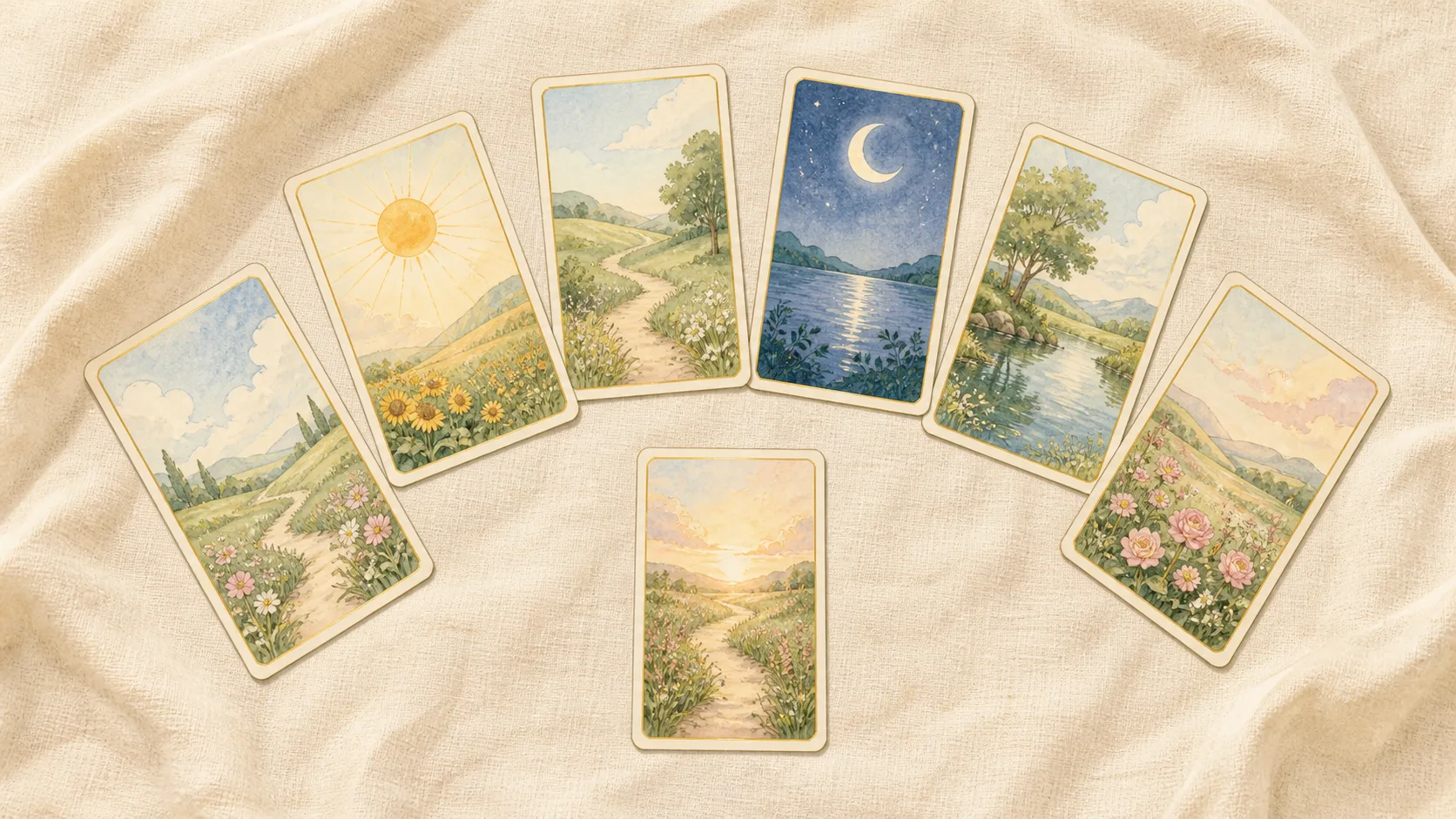
What these 7 cards show
Past
Past situation and influences
Present
Current situation and energy
Near Future
Upcoming developments
Your Attitude
Your own attitude and approach
External Influences
Influences from people and environment around you
Obstacles
Obstacles and challenges to face
Final Outcome
The final result and conclusion
Of the seven, exactly one is something you can rewrite starting this afternoon: Your Attitude, the fourth card. The past won't move and other people won't move on request. So I never read Final Outcome by itself — it goes with card four, every time. In practice those two move together, and a rigid attitude card under a glowing outcome is odd enough that I'd read the pair twice before taking it at face value.
Ask people to guess their External Influences card and they say the boss, or the parents. It's hardly ever either. It's the recruiter who calls every six weeks. It's a LinkedIn post about somebody from your intake making director. The people who write in saying "nobody even knows I'm thinking about this, so outside influence doesn't really apply" are the ones who tend to get the strongest card in that seat. Once you can name what it is, Obstacles — card six — stops being abstract and starts having a shape you can walk around.
What one horseshoe can carry
It's at its best when the topic is single but the moving parts are many. Stay in this job or not. Start the qualification or not. Move cities or not. Slow-burning questions that unfold over months, where you want the timeline and the obstacles in one view.
Decide on one topic before you pull. Load work and love into the same seven cards and they'll alternate between two conversations.
Someone else's feelings won't come through here. There's no seat for "them" anywhere in the seven. Crush, partner, estranged sibling — when a person is the subject, the Relationship spread is the one to use.
A hard binary belongs elsewhere too. The horseshoe traces one road forward, and two roads confuse the reading. For a future per option, use the Crossroads spread. To go down into a single problem far enough to reach what you know versus what you've buried, the Celtic Cross.
Is a bleak Final Outcome the end of the reading?
Two years of thinking about going independent, and still salaried. The timeline ran the way you'd hope: preparation behind him, marking time now, movement in the near future. Sensible so far.
Then Your Attitude came up as caution taken past its useful point — the version of careful that lets things go by. And External Influences turned out to be his own forecast of his family's disapproval rather than any disapproval they had expressed.
Obstacles came up as the shape of his week: where the hours went. Final Outcome was a stalling card — on his current settings, another six months that look a great deal like the last six. That isn't where the reading stops. Because the outcome hangs off card four, the conversation narrows to a single question: where do you take the caution off, once? He took one freelance project alongside the job. Small step, and card four was the only position on the board he could actually touch.
FAQ about this spread
Horseshoe or Celtic Cross?
Horseshoe if you want the visible situation organised, Celtic Cross if you need to get at your own interior. The seven horseshoe positions — time, attitude, environment, obstacles — are concrete enough that first-timers rarely get lost in them. The Celtic Cross keeps seats for the conscious and the subconscious, which makes for a longer walk to an answer and is worth it when the answer is buried.
How far ahead is Near Future?
One to three months as a rough guide, and it stretches. Ask about next week's meeting and you get next week; ask about changing careers and it reaches months out. Naming a window in the question — "by the end of the year" — keeps that position from drifting.
The horseshoe is a luck charm. Does this spread only give good results?
The shape borrows a folk symbol and the cards don't soften because of it. There's a whole position called Obstacles for a reason: it marks where you're most likely to trip, while there's still time to step round it. A horseshoe reading with a difficult card in the sixth position is the version that's actually worth having.
Do I have to lay the cards out in a horseshoe myself?
No. The shuffle and the layout happen on the site, and Tsukishiro Nagi works through what landed in each of the seven positions in order. Nothing is asked of you before that happens — no payment, no registration — and you can repeat it as often as you want. If you own a deck, laying the same seven positions out by hand and comparing is a good exercise.