Hexagram Spread Tarot – 360° View in 7 Cards
"What is it I actually want?" That tends to be the line left over once the pros-and-cons list is finished, and it's the line people bring to the Hexagram spread.
Seven cards sit in the shape of two overlapping triangles: Higher Purpose, Hopes & Possibilities, External Influences, Foundation, Past Lessons, True Self, and Synthesis at the centre. What this star spread does well is light one moment from every angle at once. Putting things in sequence isn't its business.
Pro Members OnlyThis premium spread requires Pro membership
Or pick a common question
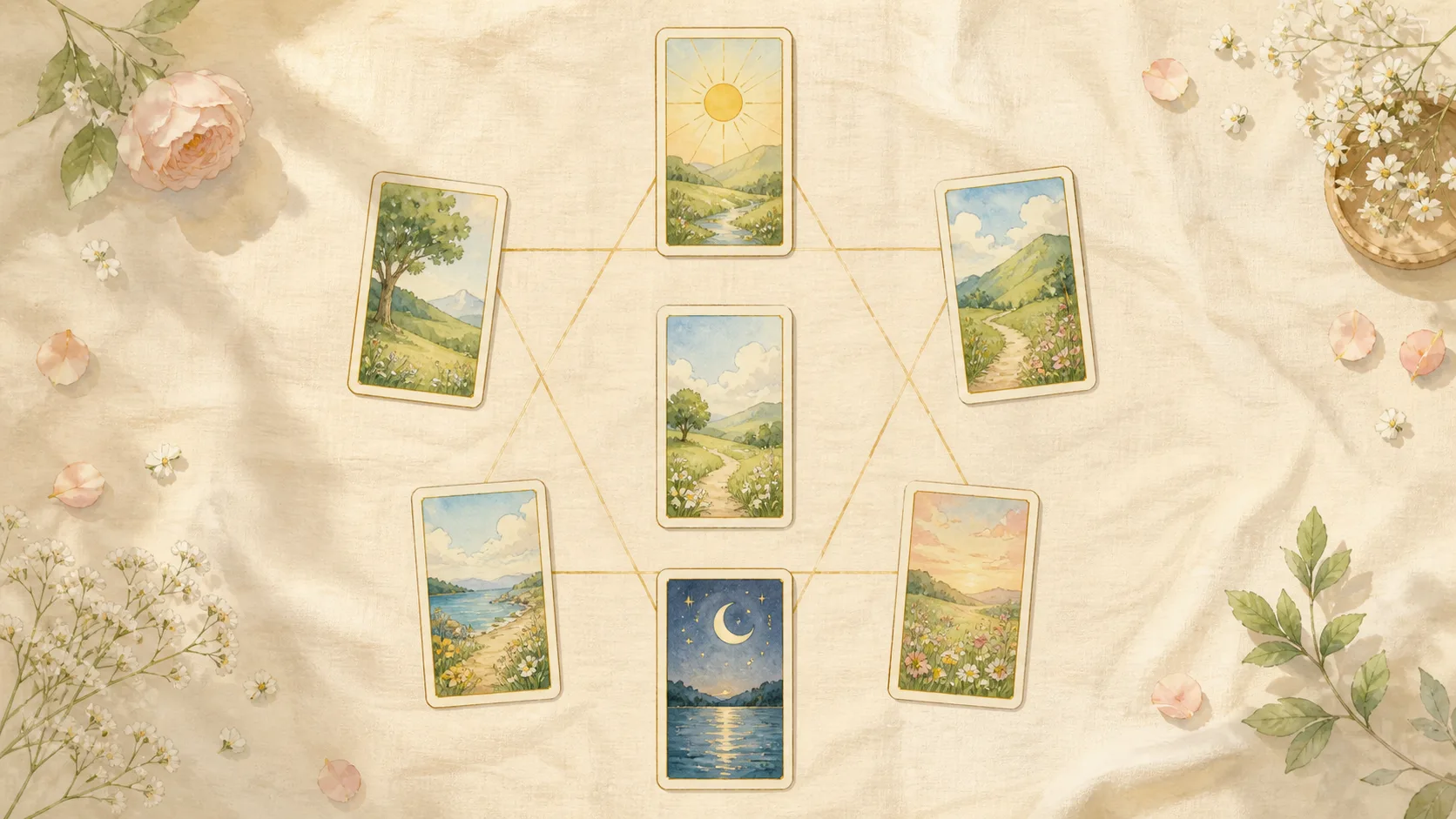
What these 7 cards show
Higher Purpose
The direction you should aim for and your spiritual aspirations
Hopes & Possibilities
What the future may hold and your hopes
External Influences
Influences from people and environment around you
Foundation
The root cause and material basis of the situation
Past Lessons
Past experiences and what you've learned from them
True Self
Your inner voice and deepest desires
Synthesis
The final answer integrating all elements
Start with Higher Purpose and Foundation. In the hexagram those two sit as opposing points of the star, and the distance between them tells you whether the ground under you has caught up with what you're aiming at. A large purpose over a thin foundation is a sequencing problem. It has never once meant give up.
The awkward seat is True Self, the sixth. Someone asked a plain work question, six of the cards duly discussed work, and that one came up as a family card. The first thing back was "I don't think that's related." It took two more exchanges to get there: half the hesitation about a relocation was a parent's diagnosis in March, which had never gone anywhere near the question box. This is the position where the motive you left out sits down anyway.
Ask the hexagram something that has no single answer
It suits questions with no single answer waiting at the end — whether this is how you want to be living, what it is you should be protecting, why something still feels off when nothing in particular has gone wrong. Nothing has split into two clean options, no deadline is forcing the issue, and the shape of the problem stays blurred no matter how long you look at it. Seven simultaneous angles tend to surface the place where you're genuinely caught.
A fair number of people run it as a personal audit: birthdays, the turn of the year, the week after something ends.
It's the wrong tool when the answer is a date or an action. Will I pass next month's exam. Should I say something this weekend. These seven positions sit at a high level of abstraction and will hand you something oblique. For a timeline, take the Horseshoe spread. For a hard binary, the Crossroads spread is faster and lands cleaner.
Someone else's feelings, likewise. The hexagram has no seat for another person — at most they bleed into External Influences, the third card. For a question about a relationship, use the Relationship spread.
What if the two points of the star contradict each other?
Late twenties, pulled on the theme of keeping the job and keeping the creative work going at the same time.
Higher Purpose: the Three of Pentacles, the maker's card. Foundation: the Five of Pentacles, unstable income. Two points of the star in flat opposition. When that happens I don't turn it into a conversation about which one to cut. I go and read External Influences and Past Lessons first.
External Influences said there are already people who value the work. Past Lessons showed a stretch where he had stopped for a while. True Self, the sixth, was the Nine of Swords — fear, and specifically the fear of not being able to keep going. Synthesis pointed at continuing on a smaller scale — the ambition left intact, the output cut back to what a working week can actually carry. He moved to one piece a month, which is the pace he has held since.
FAQ about this spread
Hexagram and horseshoe are both seven cards. What's the difference?
Two different philosophies of arrangement. The horseshoe runs a single line from past to outcome. The hexagram surrounds one point from six directions. If you want to know what happens next, take the horseshoe. If you want to know how you got assembled this way, take the hexagram.
Does the six-pointed star carry religious meaning here?
As a tarot layout it borrows the image of two triangles meeting as a way of picturing opposites integrating, and it has no connection to any religious rite. We don't claim the shape itself holds power. It's a floor plan for assigning seven roles.
Can I just read Synthesis and skip the rest?
Pull that card out on its own and it loses most of its meaning. Synthesis only acquires a direction once the other six are in place, and the same card reads differently depending on how Higher Purpose and Foundation are sitting. Tsukishiro Nagi works through the six in order before entering the centre. When you're in a hurry, skipping ahead is the slower route.
Higher Purpose sounds spiritual. What if I haven't got one?
Then read it as the thing your last few years have kept bending towards, whether you picked it deliberately or not. Nobody arrives with a purpose already written down. That position isn't asking you to produce a calling on the spot; it's asking what you keep returning to. Set it against Past Lessons, card five, and something you recognise usually surfaces. Treat whatever you get as provisional, too — the spread is free, there's no login and no limit on how often you take it, so pull the seven again in a month and see which position has shifted.