A boat slides across grey water. A cloaked figure sits with a child, six swords planted upright in the hull beside them, and someone stands at the back working a pole. Almost every guide reads this scene the same way — transition, moving on, calmer water ahead — and stops there. What that reading skips is a question the picture quietly forces on you: of the three figures in that boat, which one are you? The Six of Swords changes its meaning depending on the answer, and after years of laying it down for clients in London, that is the read I trust most.
This guide covers the upright and reversed meanings plainly, reads the symbolism in detail — including the water depth most people miss — and works through love, career, and the mind. Then it asks the question the card is really posing.
Quick Answer
The Six of Swords means a transition away from something difficult toward steadier ground — a crossing that brings relief but carries grief with it. Upright, it points to moving on, recovery, leaving turbulence behind, and travel both literal and emotional. Reversed, it usually means resistance to a move you know you need, baggage you can't put down, or a crossing that stalls midway. Yes / No: it leans toward a cautious yes — the situation improves, though slowly and at some cost.
Basic Information
| Attribute | Details |
|---|---|
| Card Name | Six of Swords |
| Suit | Swords |
| Arcana | Minor Arcana |
| Element | Air |
| Astrological Correspondence | Mercury in Aquarius |
| Yes / No | Cautious yes (improvement through movement) |
| Upright Keywords | Transition, moving on, recovery, leaving turbulence, travel, calmer waters, gradual healing |
| Reversed Keywords | Resistance to change, stuck in the past, baggage, stalled crossing, return to trouble, forced departure |
Card Imagery & Symbolism
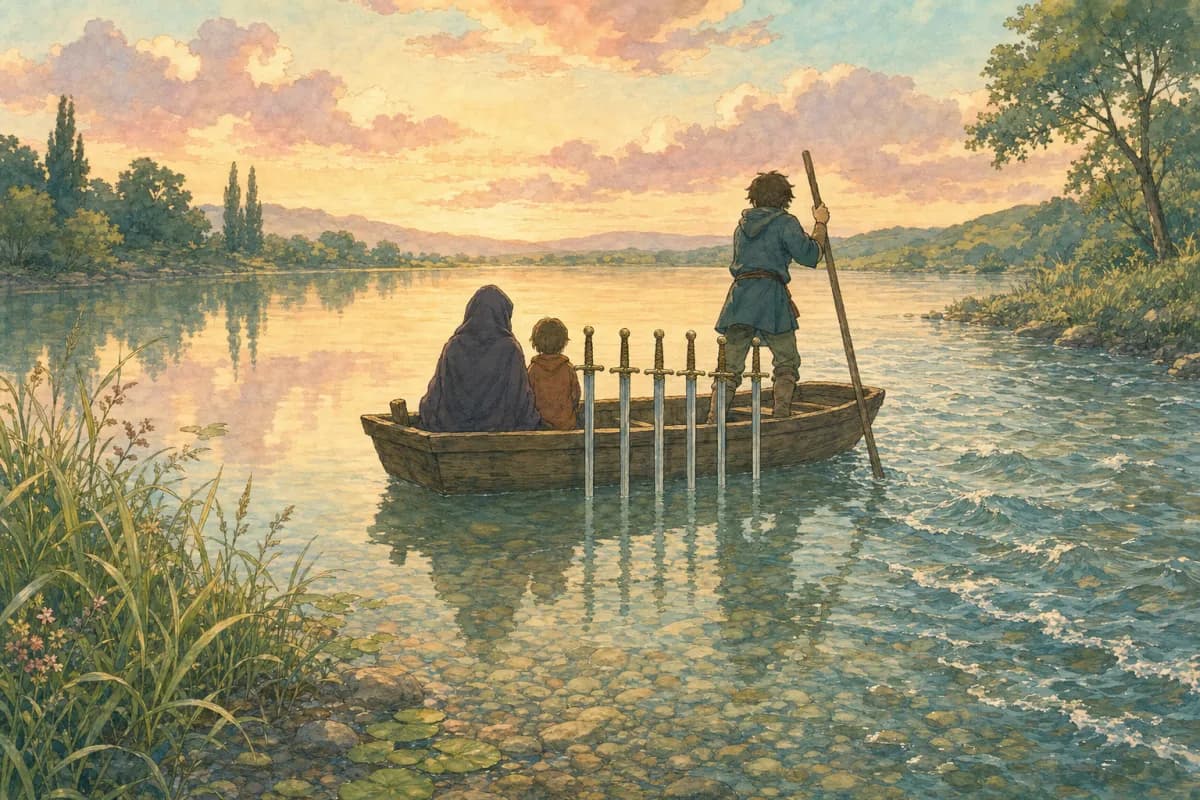
The Rider-Waite-Smith scene is one of the quietest in the deck. A muffled figure and a small child sit low in a flat boat, facing away from us toward a far shore. Six swords stand point-down in the front of the hull. A poler stands at the stern, pushing the craft forward. The water on the right of the boat is choppy; the water ahead lies flat. Most guides list these elements. Fewer notice what the picture is actually telling you about how this crossing is being made.
The Water Is Shallow, Not Deep
Look at the swords. They stand upright, planted through the floor of the boat into water below — which means the water here is shallow enough for blades to reach the bed. This is a wade through a ford rather than an open-sea voyage. That detail rewrites the card's emotional register. The crossing is survivable precisely because the figures never go out of their depth. When a client fears a transition will swallow them whole, I point at the shallows: the Six of Swords is the card that promises the water stays low enough to stand in, even when it's cold.
The Six Swords Are Carried, Not Discarded
This is the symbol people most often get backwards. The swords come with the travelers. Instead of being thrown overboard at the dock, they ride along, planted in the hull like cargo. The wisdom, the scars, the hard lessons of the Swords suit — all of it crosses the water too. The Six of Swords is not a clean break. It is a relocation of everything you've been through to a place where you can finally set it down, but the setting-down happens on the far shore, well after you push off.
The Poler at the Stern
There is a third person here, and competitors tend to collapse them into the scene as scenery. The figure standing at the back is doing the work — steering, pushing, carrying the other two. The passengers sit still; the poler moves them. That split between the one who is carried and the one who carries is the heart of this card, and I'll come back to it as the main question below.
The Bird's-Eye Calm
The far water is glassy, the near water broken. The line between them isn't drawn — there's no marked border where rough becomes smooth. The change is happening underneath the boat, gradually, while the travelers simply keep going. The card's promise of calm is real, but it arrives by degrees, the way Temperance blends two things slowly rather than switching them.
Six of Swords Upright Meaning
Upright, the Six of Swords is the deck's image of a hard departure that turns out to be the right one. After the grief of the Three of Swords and the freeze of the Four of Swords, this is the card where you finally start moving — slowly, heavily, but in the right direction.
Core Upright Keywords
- Transition — Leaving a familiar but painful situation for steadier ground
- Moving on — Emotional and practical progress after a difficult stretch
- Recovery — Healing that happens during the journey itself, all along the crossing
- Travel — Literal trips, relocation, or going somewhere to start over
- Gradual relief — Things easing by degrees rather than all at once
The keyword everyone reaches for is "transition," and it's accurate but flat. What makes this transition specific is its mood. You choose the crossing the way you choose surgery: a heavy, reluctant decision made because staying would cost more. There is grief in it. The cloaked head in the boat is bowed for a reason. You can know a move is right and still mourn what you're leaving, and the Six of Swords is one of the only cards that holds both of those truths in the same hand.
It often shows up as something physical. A house move, a flight, a change of country, leaving a job or a city. One client drew it the week before she moved back to Manchester after a divorce — simply getting away from a flat that had stopped being home. The card was exact: heavy luggage, a quiet train, the water getting calmer somewhere past Birmingham without her noticing the moment it changed.
When it's not literal travel, it's the internal version: moving on from grief, from an identity that no longer fits, from a version of yourself that the last few years wore out. The recovery here is mobile. You heal because you leave, mending on the way across rather than waiting until you've arrived.
Six of Swords Reversed Meaning
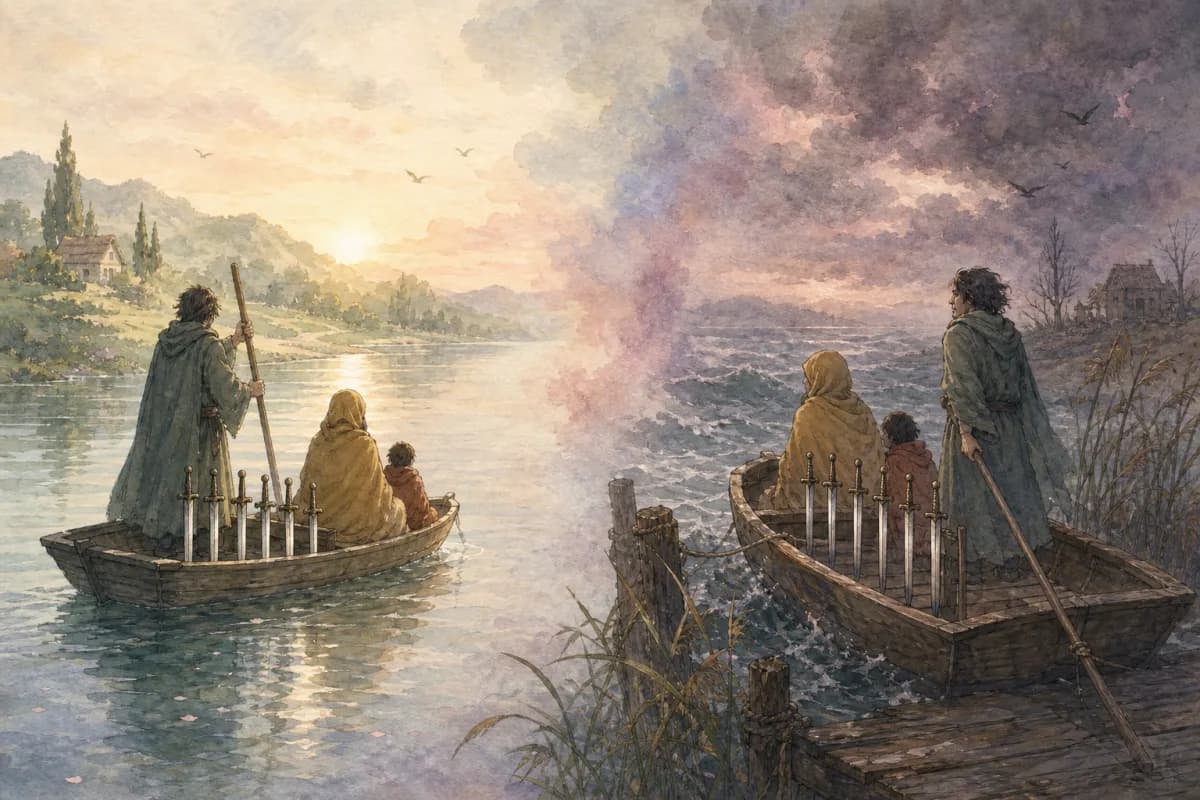
Reversed is not a disaster card. Let me say that plainly, because the upside-down Swords cards get treated as catastrophes and this one really is mild by comparison. The Six reversed is mostly about a crossing that hasn't started, has stalled, or is being made against your will. Think friction, the ordinary drag of a stuck departure.
The most common reversal is resistance. You know the move you need to make — leave the relationship, quit the job, close the chapter — and you keep finding reasons to stay in the rough water. The boat is at the dock and you won't get in. Sometimes that's fear of the unknown shore; sometimes it's the comfort of a familiar pain over an unfamiliar peace.
The second reading is baggage that won't cross. You've made the physical move, but emotionally you're still standing in the old water. The swords haven't traveled with you as wisdom; they've traveled as a weight you keep re-stabbing yourself with. This is the reversal where someone changes everything and feels exactly the same six months later.
The third, and the heaviest, is a forced crossing. Reversed, the Six can mean a departure you didn't choose — eviction, deportation, a relationship ended for you, a goodbye on someone else's schedule. Here the card asks for something harder than acceptance: it asks you to find your footing on a journey you'd never have booked. The shallows are still there, even now. The water still doesn't go over your head.
Are You the Passenger, the Ferryman, or the Cargo?
Here's the question the standard reading never asks. There are three things in that boat — the seated passenger, the poler doing the work, and the six swords riding along — and in any given reading, you are occupying one of those positions. Knowing which one tells you what the card actually wants from you.
If you're the passenger, you're being carried through this transition by something or someone else: time, a partner, a therapist, sheer momentum, a process you started and can now only sit inside. Your job is to let yourself be moved without clutching at the dock, leaving the rowing to others. Passengers who try to grab the pole usually just slow the boat. This is the reading where "allow yourself to be helped" stops being a cliché and becomes the actual instruction.
If you're the ferryman, you are the one doing the carrying — steering someone else's exit, holding a family through a move, being the steady one while a partner falls apart. This is the position competitors miss entirely, and it's the one I see most often in my London readings, usually drawn by the person everyone leans on. The card's warning to you is different: the poler stands the whole way across and never gets to grieve. If you're the ferryman, the question is who is rowing you.
If you're the cargo — if you're the swords — then you're the baggage being moved through someone else's decision. A child in a divorce. An employee relocated by a restructure. The one whose life is being rearranged by a choice that wasn't yours. This is the hardest seat, and the card's honesty about it is part of why I trust it. It never pretends you're driving. It simply tells you the water's shallow and the far shore is calmer, and it asks you to make the crossing yours even though you didn't pick it.
Most people assume they're the passenger. Look again before you decide. The role you're actually in is usually the more useful read.
Love & Relationships
In a relationship, the Six of Swords most often means you're moving out of a rough patch into calmer water together — the fights are quieting, communication is steadying, the two of you are crossing to the other side of something. It's a recovery card for couples rather than a romance-peak card. The warmth here is the warmth of relief, of having survived the storm side by side.
But read the seats. If one partner is always the poler — always the one holding things steady, always carrying the other across every crisis — the card is flagging an imbalance the relief is hiding. A calm crossing where the same person poles every time is a relationship slowly tiring out its ferryman.
For singles, it's the healing journey after heartbreak: the slow boat away from a relationship that hurt, the swords of the old story still aboard but pointing down, no longer aimed at you. You're still healing, and you're moving, which is the part that matters. If the reading is about someone who has gone quiet to recover before they can move at all, that stillness is closer to the Four of Swords as feelings — the depleted rest the crossing heads away from. If you want to look at where the boat is heading, a love tarot spread can show you the far shore.
Career & Transition
On the work front, the Six of Swords is one of the more literal cards in the deck — it genuinely points to relocation, business travel, moving offices, or changing jobs to escape a toxic environment. Things are calming down at work, often because you're leaving the thing that made them turbulent.
The nuance most readings miss is the grief in a good career move. People expect to feel triumphant when they leave a bad job and instead feel hollow on the first morning of the new one. The Six of Swords predicts exactly that. You can be right to go and still mourn the desk, the routine, the people you crossed the water without. That feeling is the bowed head in the boat rather than a sign you made a mistake, and it passes as the water flattens.
Mental Health
This is where the card earns its keep. The Six of Swords is the picture of healing-in-motion — the stretch after a depressive episode, a loss, or a long anxiety where you're still far from better yet finally no longer underwater. The work is simply to keep the boat moving while you carry what you carry, long before you feel fixed.
What I tell clients drawing it for the mind: notice that the swords are upright and quiet. Earlier in the suit they were cutting; here they ride along, neutralized by distance and motion. Whatever cut you is still aboard, but it's pointing at the floor now. That's what recovery looks like in this deck — not the absence of the swords, but the day they stop being aimed at your chest. If the swords still feel aimed, the card has likely turned reversed, and the honest move is to find a hand at the stern: support, structure, someone to pole while you rest.
Six of Swords Card Combinations
- Six of Swords + The Moon — A crossing made in fog. You're moving on, but you can't see the far shore clearly and your read on the situation may be distorted by fear or illusion. Move slowly; don't make the destination decision while the water's still murky.
- Six of Swords + Three of Swords — The grief and the departure in sequence. This is leaving the source of a heartbreak — often a literal exit from a relationship that broke you. The boat is pointed away from the thing that hurt.
- Six of Swords + Death — A transition that's also an ending, with no return ticket. The old life doesn't get rebuilt on the far shore; something is genuinely over, and the crossing is one-way. Heavy, but often a relief.
- Six of Swords + Four of Swords — Rest, then movement. You recovered enough to finally get in the boat. A reassuring pairing: the strength to make the crossing came from the pause that preceded it.
- Six of Swords + Ace of Swords — A clean decision finally cuts you loose. The crossing begins because a moment of clarity gave you the truth you needed to push off from shore.
Numerology & Astrological Correspondences
Six in the Swords suit is the suit's recovery beat. Where the Five left the field strewn with conflict and humiliation, the Six is the morning after — the moment you gather what's left and start walking out. Sixes across the tarot carry this quality of repair and rebalancing after a low point, and in the suit of the mind, that repair takes the shape of distance: you mend by getting away.
The Mercury-in-Aquarius correspondence fits the boat exactly. Mercury is the messenger, the mover, the one who carries you between places; Aquarius gives the crossing its cool, slightly detached air — the mind choosing the rational route out rather than the dramatic one. I often frame this card around the act of setting out itself, the moment of departure rather than the arrival. There is a gentle sorrow in any leave-taking, the ache of pushing off from a shore you knew, and that's the precise emotional weather of the Six of Swords: you are honoring the act of leaving more than celebrating any destination.
Frequently Asked Questions
Is the Six of Swords a yes or no card?
It leans toward a cautious yes. The situation improves and you move toward steadier ground, but the change is gradual and carries some grief, so it's rarely a triumphant yes. Think "yes, and it'll be better than now — give it time to cross."
Is the Six of Swords a good card?
On balance, yes. It promises relief, recovery, and movement away from what's hurting you, which is genuinely hopeful. The catch is that the relief is bittersweet and slow — you reach calmer water, but you grieve what you left to get there.
What does the Six of Swords mean in love?
In a relationship it usually means you're moving past a rough patch into calmer water together, with communication and stability returning. For singles it's the healing journey after heartbreak — slowly moving on while still carrying the ache. Watch for one partner always doing the steering, which signals an imbalance.
What does the Six of Swords reversed mean?
Three main things: resistance to a move you know you need, emotional baggage you've carried into the new situation without resolving, or a departure forced on you against your will. It's friction rather than catastrophe — the crossing has stalled, hasn't started, or wasn't your choice.
Does the Six of Swords mean travel?
Often, yes — it's one of the more literal cards for relocation, trips, flights, or moving country. But the "travel" is just as often emotional: moving on from grief, an identity, or a chapter of life. Surrounding cards tell you whether to pack a bag or do inner work.
Why is the Six of Swords sad if it's about moving on?
Because the move is usually chosen reluctantly, made because staying would cost more. You can know a transition is right and still mourn what you're leaving. The bowed figure in the boat holds both at once: relief and grief crossing the same water.
What does the Six of Swords mean for the future?
As a future card it signals an approaching transition into calmer circumstances — a change is coming that moves you away from current turbulence. Expect it to be gradual rather than sudden, and to ask something of you on the way: patience, and the willingness to leave something behind.
Closing
The Six of Swords is the deck's most honest picture of leaving. It never pretends the departure is happy or the destination is dazzling. What it promises is quieter and more useful — that the water gets calmer the longer you keep going, and that it never goes over your head.
If you've drawn it this week, do one concrete thing: name which figure you are. Write down whether you're the passenger being carried, the ferryman carrying everyone else, or the cargo being moved by a decision that wasn't yours. The role you're actually in is the one that tells you your next move — whether to sit still and let the boat work, or to ask, finally, who is rowing you.
Continue across the Swords suit: read the Three of Swords for the heartbreak this card carries you away from, or the Four of Swords for the rest that comes before the crossing. To see where your boat is heading in love, try the love tarot spread guide.