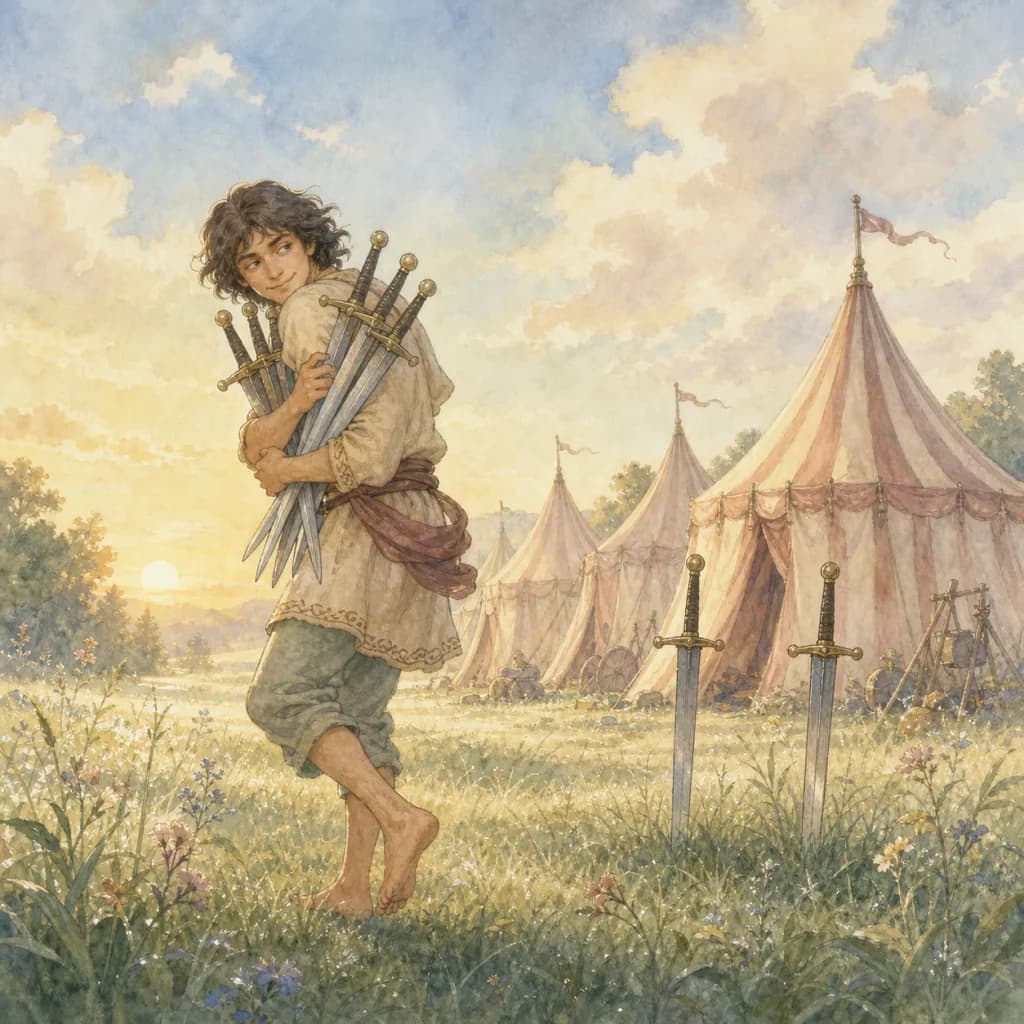
Count the swords on the ground in the Five of Swords. There are five in the scene, and the smirking man has gathered only three. Two are still lying in the grass, and he is not going back for them. Almost every guide reads this card as a hollow victory — you won the argument, you lost the relationship — and that's true as far as it goes. But the part the smirk hides is the two blades he walked past. The Five of Swords is a card about winning, and equally about what you leave behind to do it.
This guide reads the symbolism closely — including those abandoned swords — gives the upright and reversed meanings without the usual moralising, and answers the questions clients actually ask.
Quick Answer
The Five of Swords means conflict won at a cost — a victory that turns hollow, or a defeat you're walking away from with your dignity bruised. Upright, it points to arguments, tension, win-at-all-costs behaviour, and the aftermath where nobody really feels like a winner. Reversed, it usually means a conflict winding down, an attempt at reconciliation, or the harder version where the fight you tried to leave keeps following you. Yes / No: it leans No — even a "yes" here arrives with damage attached.
Basic Information
| Attribute | Details |
|---|---|
| Card Name | Five of Swords |
| Suit | Swords |
| Arcana | Minor Arcana |
| Element | Air |
| Astrological Correspondence | Venus in Aquarius |
| Yes / No | No (or a yes with strings attached) |
| Upright Keywords | Conflict, defeat, hollow victory, hostility, tension, win-at-all-costs, betrayal, walking away |
| Reversed Keywords | Reconciliation, releasing conflict, making amends, lingering resentment, open wounds, moving on |
Card Imagery & Symbolism
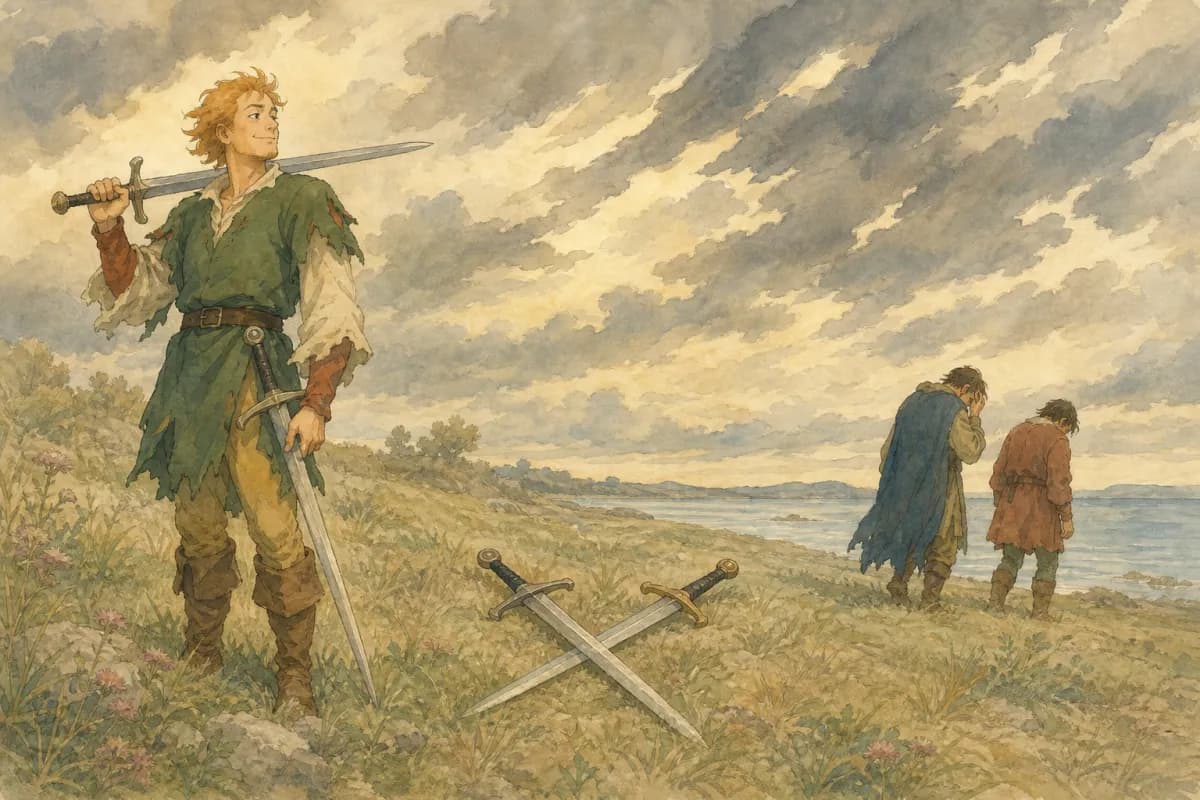
The Rider-Waite-Smith scene is one of the loneliest in the deck even though three people are in it. A man in the foreground holds two swords and rests a third on his shoulder, looking back with a small, satisfied curl of the mouth. Two figures walk away toward the water, heads bowed, one with a hand half-raised to the face. Two more swords lie abandoned on the ground. Above, the sky is torn with wind-driven clouds. Most guides stop at "the victor and the defeated." The card is built out of smaller cruelties than that.
The Smirk Before the Sword
People call this man the winner, but look at his face before his hands. The defining detail is the expression rather than the count of blades he holds. There's no triumph in it, just a private smugness, the look of someone enjoying the other person's loss more than any gain of their own. The card's first warning is about a feeling, and only secondarily an outcome. When a client kept "winning" every disagreement with her sister and couldn't understand why she felt worse each time, this was the detail we sat with: the satisfaction was in the defeat itself, a hunger that never gets fed.
The Two Figures Walking Toward Water
The defeated pair don't walk off the edge of the card — they walk toward the water. In the Swords suit, where everything is air and intellect, water is the one thing the men here are leaving behind: feeling. They're walking back toward their emotions, toward grief, toward the part of conflict the winner refuses to touch. The composition quietly suggests who's healthier — the losers are heading somewhere the smirking man can't follow. That water is where the very next card picks up: the Six of Swords is the boat that carries them across it, the morning-after recovery that follows this fight.
The Two Swords Left in the Grass
This is the detail nearly every competitor skips, and it's the whole card. He picked up three swords and left two. He could carry all five — they're right there — but he doesn't bother, because he already has what he wanted: to win, not to collect. Those two blades in the grass are the cost he's decided not to pick back up — the relationship, the trust, the version of himself that didn't need to humiliate anyone. The Five of Swords lays the price of winning in the grass and lets you choose whether to look. The same image of swords abandoned on the ground returns in the Seven of Swords, where the shortcut leaves a similar cost behind.
The Torn Sky
The clouds are the giveaway that this isn't peace, it's a ceasefire. Calm would show a clearing sky; instead the air is still shredded by wind. The fight stopped because someone won while the underlying problem stayed exactly where it was — and the weather knows it.
Five of Swords Upright Meaning
Upright, the Five of Swords is the deck's most honest card about conflict, because it refuses to make winning feel good.
Core Upright Keywords
- Conflict and tension — Arguments, disagreements, an atmosphere you can cut
- Hollow victory — Winning the point and losing the thing that mattered
- Win-at-all-costs — Being right made more important than being kind, or fair
- Defeat and walking away — The other side of the card: losing, and leaving
- Hostility — Aggression, intimidation, scoring off other people
In-Depth Upright Interpretation
The upright Five of Swords usually arrives in the middle of, or just after, a conflict — and the first thing I do is ask which figure the querent is. The card is drawn from the winner's point of view, but that composition choice says nothing about which role is yours. You might be the man with the swords; you might be one of the two walking away. The reading changes completely depending on the answer, and most people know the moment you ask.
If you're the winner, the card is a mirror, and not a flattering one. It asks what the victory cost and whether the smugness is worth it. The classic reading — being right at the expense of the relationship — lives here, as does the colder version: manipulation, intimidation, getting your way by making the other person small. Winning on the facts can still leave you empty, and the proof is that you feel no better.
If you're one of the defeated, the card is gentler than it looks. Yes, you lost this one, but you're the figure walking toward the water, away from the person who needed to beat you. Sometimes the healthiest move is to be the one who leaves — to decline the rematch and stop feeding a fight against someone who needs to win more than they need you.
There's a third placement that trips people up: the bystander, standing in the wreckage of other people's conflict — a family feud, a friend group splitting into camps, office politics you got dragged into. The card asks whether you've been recruited into someone else's war.
Five of Swords Reversed Meaning
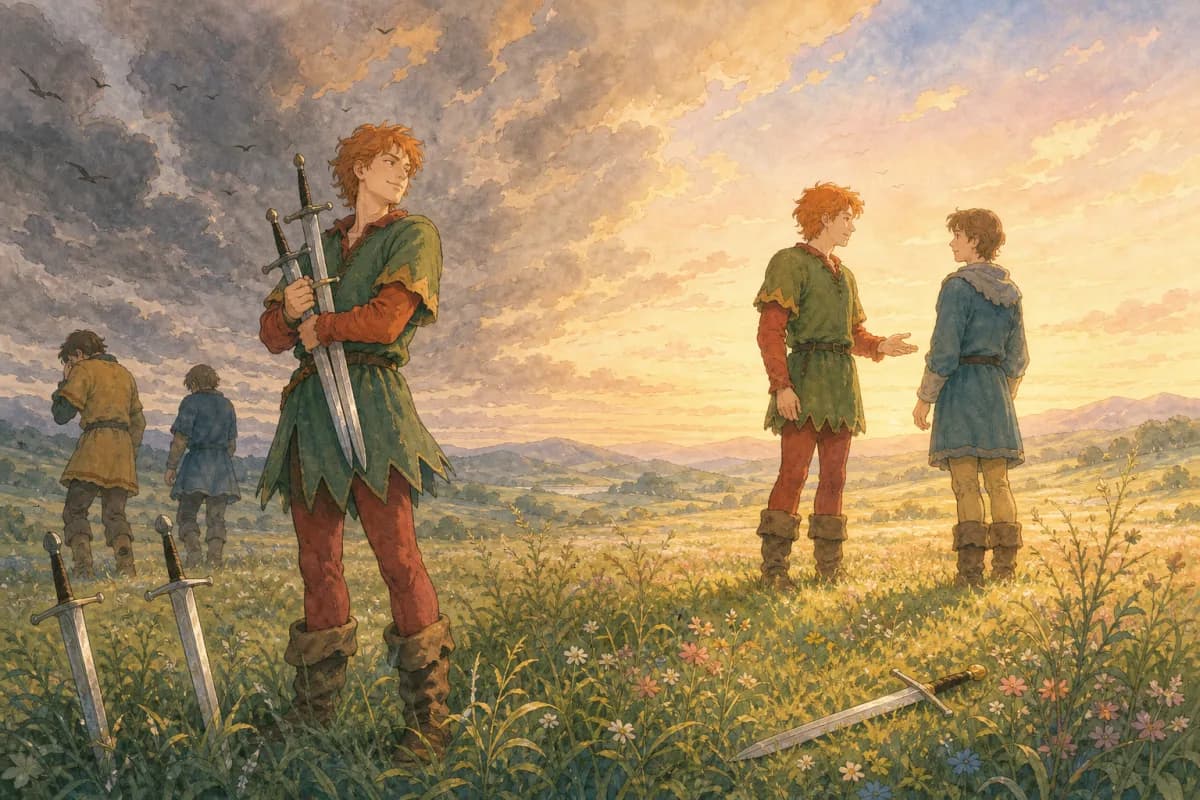
First, plainly: is reversed Five of Swords negative? Mostly no — this is one of the rare Swords reversals I'm relieved to see. The most common reading is the conflict releasing its grip: the fight ending, the desire to make amends, the willingness to put the swords down. The negative version exists, but it's the minority case.
Core Reversed Keywords
- Reconciliation — Moving past the conflict, repairing what's repairable
- Releasing conflict — Choosing to stop fighting, even without resolution
- Making amends — Apology, accountability, owning your part
- Lingering resentment — The fight you "ended" still echoing
- Open wounds — Damage that hasn't healed yet, even after the ceasefire
In-Depth Reversed Interpretation
The most common reading is the thaw. The reversal turns the card's energy toward repair. People locked in a standoff start wanting it over more than they want to win, and that shift is everything. Someone reaches out. Someone says the hard sentence. The reversed Five of Swords is frequently the first real apology in a long fight.
The second reading is release without reconciliation. Sometimes there's no repairing it, and the reversal is about letting go anyway — walking away for your own sake. You stop replaying the argument, stop drafting the perfect comeback, stop carrying the swords at all. This is rarely warm forgiveness; it's putting down something heavy because your arms are tired.
The third, and the one to watch, is the fight that won't stay dead. Here the reversal sours: you tried to walk away, but the resentment follows you, the other person won't let it end, or you keep relitigating it at 3 a.m. The conflict has gone underground without going away. The work is figuring out why you can't set it down, since neither winning nor leaving has ended it.
How do I tell these apart in a live reading? I look at where the emotional charge is. The thaw feels lighter; the release feels tired but clean; the lingering version still has heat in it. Soft cards nearby push toward repair, while The Devil or the Three of Swords beside it warns the wound is open.
What Are You Leaving in the Grass to Win This?
This is the question almost no Five of Swords guide asks, and the one the image is built to make you ask. Everyone covers the hollow victory; far fewer point at the two abandoned swords and ask the practical version: before you win this, what exactly are you deciding not to pick back up?
Run the math before the fight, while you can still change course. Every conflict has an exit cost — what you'll have spent by the time you've "won." Sometimes it's small and worth it: you correct a stranger, never see them again. Sometimes the two swords in the grass are your relationship with your mother, your standing on a team, a friend who will be polite forever and never warm again. The card never tells you to stop fighting; it asks you to count those swords before deciding the win is worth it.
A manager in his forties came in furious about a colleague who'd taken credit for his work; he wanted to expose him in front of their director. We drew the Five of Swords, and instead of "pick your battles," I asked what the two swords on the ground would be if he won this one. He named them: the director's read of him as someone who litigates in public, and a working relationship he'd need for two more years. He still raised the issue, but privately. He won the point and kept both swords — the card used well.
Five of Swords in Career & Conflict
This is the card's home turf. Upright in a work reading, the Five of Swords is office politics with the gloves off — credit stolen, meetings that become ambushes, a colleague who has to win every exchange, a culture where being right is a blood sport. The thing I watch for is the win-at-all-costs read pointed at the querent. It's easy to cast yourself as the wronged party; it's more useful to ask whether you've become the smirking man, the one colleagues have started managing around rather than working with.
Sometimes you have to lose on purpose. Some fights you could win would mark you as someone not worth fighting near, and the strongest career move this card recommends is conceding a small battle to stay someone people want in the room. Reversed at work, it's usually the team repairing after a blow-up, or you deciding a conflict isn't worth your peace.
Five of Swords in Love & Relationships
In love, the upright Five of Swords is the argument where winning ruins the evening. Couples who keep score draw this one — every disagreement has to resolve into someone being right, and the "winner" goes to bed alone in spirit even while sharing the bed. The detail I always raise: in a relationship there is no winning an argument against your partner, because your partner's defeat is also yours — you live with the loser. A victor with nobody left to celebrate with is what a relationship looks like after one person wins too many fights.
For singles, upright can flag a recent falling-out still casting a shadow, or a combative pattern worth examining. Reversed leans toward reconciliation, the apology that lets a couple move on, or the cleaner ending where two people stop fighting and let each other go. To read how a specific connection feels right now, the love tarot spread guide lays out spreads that get underneath the conflict.
Five of Swords in Mental Health & Self-Respect
This is the domain most guides skip, and where I do some of my most useful readings. The Five of Swords speaks directly to self-respect — both its loss and its defence. The smirking man has traded his for the cheap fuel of someone else's defeat; the figures walking away are protecting theirs by leaving. The card asks where your sense of worth comes from, and whether it depends on other people losing.
For mental health more broadly, upright can describe a mind at war with itself — the inner critic that wins every argument against you, the rumination replaying a conflict you've already lost. There's a version where all three figures are you: the part that attacks, the part defeated, the part standing in the wreckage. The swords in the grass become the self-compassion you keep choosing not to pick up.
Reversed, it can mark the moment you stop fighting yourself — the inner ceasefire, extending yourself the grace you'd give a friend. If the conflict is with another person and it's eroding you, walking away is sometimes the most self-respecting move available.
Five of Swords Card Combinations
Five of Swords + Justice
The fairness reckoning. The Five of Swords is a win that may not have been fair; Justice asks whether it was earned. Together they often mean the truth is about to come out — and if you won by underhanded means, this is where it catches up with you.
Five of Swords + The Tower
A conflict that detonates. The Five is tension and scheming; The Tower is the explosion that ends it badly for everyone. I read this as a warning that a simmering fight is about to blow up — no one walks away from it clean.
Five of Swords + Three of Swords
Conflict that cuts to grief. The Five is the fight; the Three of Swords is the heartbreak underneath it. Together they describe an argument that wasn't really about the argument — the wound was already there, and the fight pressed on it.
Five of Swords + Ten of Swords
The whole arc of a losing fight. The Five is the battle in progress; the Ten of Swords is the final defeat. When these land together, the message is often: this fight is already lost, stop spending swords on it. The kinder reading is that rock bottom is where it ends.
Five of Swords + The Devil
The fight you can't stop having. The Devil is compulsion; the Five is conflict. Together they describe a toxic dynamic you keep returning to — the argument you've had a hundred times, the person you can't stop trying to beat. The work is recognising the loop.
Five of Swords + Two of Swords
Ceasefire before or after the war. The Two of Swords is the standoff, the refusal to engage; the Five is what happens when the truce breaks. Order matters: Two-then-Five is avoidance erupting into conflict; Five-then-Two, an uneasy stalemate after the damage.
Numerology & Astrological Correspondences
In the tarot, every five is its suit's crisis — and you can read that crisis straight off this image. Five swords have been thrown into play, three claimed and two abandoned, three people scattered across a field where there should be a clean resolution. In Swords, the suit of mind and conflict, the crisis is interpersonal: one mind set against another. That scattered, unresolved energy is why the sky won't clear.
Astrologically the Five of Swords carries Venus in Aquarius — Venus, the planet of connection and value, placed in the most detached, principle-driven sign of the zodiac. It's a precise signature: warmth subordinated to winning the point, love filtered through a need to be right in the abstract. Aquarius will defend the principle even when it costs the person.
There's an old battlefield warning I often read this card through: tighten the cords of your helmet right after the victory. The moment you win is the most dangerous one, because that's when you drop your guard and the real cost arrives. It fits the smirk exactly — he thinks the fight is over, and he's the one who has lost the most without noticing.
Frequently Asked Questions
What does the Five of Swords mean?
It means conflict that comes at a cost — winning an argument while losing something that mattered, or losing one and walking away wounded. Upright, it's tension, hostility, and the hollow feeling of a victory that didn't satisfy. Reversed, it usually points to reconciliation or finally releasing a fight, though sometimes to resentment that won't quit.
Is the Five of Swords a yes or no card?
It leans No. Even when it points to a "win," that win arrives with damage attached, so it rarely supports a clean yes. Reversed softens it slightly — if the question is about resolving a conflict or moving on, the reversed card can tilt toward a tired yes.
What does the Five of Swords mean in love?
Upright, it's the relationship where someone needs to win every argument, and the winning is quietly corroding the bond. It can also flag hostility, betrayal, or a recent falling-out. Reversed is usually more hopeful — reconciliation, an overdue apology, or a clean ending where two people stop fighting and let each other go.
Are you the winner or the loser in the Five of Swords?
That's the question to ask, and the card doesn't answer it — it's drawn from the winner's point of view, but you might be either figure. If you're the man with the swords, it questions the cost of your victory. If you're one walking away, it offers the dignity of refusing a fight you can't win. Sometimes you're the bystander caught in someone else's conflict.
What does the Five of Swords reversed mean?
Most often, a conflict winding down — reconciliation, amends, the willingness to put the swords down. Sometimes it's release without repair: letting go of a fight for your own peace. At its hardest, it's resentment that won't die, a conflict that went underground instead of ending. The surrounding cards tell you which.
Is the Five of Swords a bad card?
It's a difficult card more than a bad one. Upright it describes real conflict and its costs — uncomfortable but honest. Its gift is the warning: it shows you the price of winning before you pay it, which gives you the chance to choose differently. Reversed, it's often genuinely hopeful.
What is the spiritual meaning of the Five of Swords?
Spiritually, it's a lesson about ego and the hunger to be right. It asks where your sense of worth comes from and whether it depends on others losing. The deeper teaching: some victories impoverish you, and the mature move is sometimes to decline the win and keep your peace.
Closing
The Five of Swords refuses to let winning feel clean. It hands you a victory and makes you look at what's lying in the grass behind you — the relationships, the self-respect, the version of yourself that didn't need to beat anyone. Won well, it teaches discipline; won badly, it leaves you smirking in a field with nobody left to celebrate with.
If you've drawn it, here's the move before your next conflict: name the two swords you'd leave in the grass to win it. If they're worth losing, fight cleanly. If naming them makes the win feel hollow before you've started, you already have your answer.
Continue exploring the Swords suit: read the Two of Swords for the standoff before the fight, the Three of Swords for the heartbreak underneath the conflict, or work through a connection with the love tarot spread guide.