There is a hand holding a cup out of a cloud, and the man under the tree will not look at it. That single refusal is the Four of Cups. Most guides race past it to the keyword list — apathy, discontent, missed opportunity — and miss what the picture is actually doing. The card is not about the cup. It is about the looking away.
I have come to think of the Four of Cups as the deck's most misunderstood "low" card, because the low it describes is so specific. It is not grief. It is not depression in the clinical sense. It is the particular flatness of someone who has been offered enough good things that they have stopped trusting good things to be real. Once you can see that, the card reads completely differently.
Quick Answer
The Four of Cups means emotional withdrawal, apathy, and discontent — a person turned inward, often missing the opportunity or affection being offered right in front of them rather than actively rejecting it. Upright, it signals contemplation that has curdled into disengagement; reversed, it usually means that fog is lifting and openness is returning. It belongs to the suit of Cups (water, emotions), is numbered 4, and carries the astrological signature of the Moon in Cancer.
Basic Information
| Attribute | Details |
|---|---|
| Card Name | Four of Cups |
| Number | 4 |
| Arcana | Minor Arcana |
| Suit | Cups |
| Element | Water |
| Astrological Correspondence | Moon in Cancer (third decan) |
| Thoth Title | Lord of Blended Pleasure |
| Yes / No | Leans No (upright); leans Yes (reversed) |
| Upright Keywords | Apathy, discontent, withdrawal, contemplation, missed opportunity, emotional saturation |
| Reversed Keywords | Re-engagement, renewed openness, leaving a rut — or deeper avoidance |
Card Imagery & Symbolism

A young man sits under a tree, arms crossed, legs crossed, head down. Three cups stand on the grass in front of him. A fourth cup is held out by a hand emerging from a cloud — and he isn't looking at it. Every guide describes this scene. Far fewer ask why each piece is drawn the way it is.
The Crossed Arms Are a Door, Not a Wall
Beginners read the crossed arms as defensiveness, and there's something to that. But look closer: he isn't recoiling, and he isn't pushing the cup away with his hands. The arms are crossed inward, the posture of someone self-soothing, not self-defending. This is the body language of withdrawal, not rejection. The distinction matters in a reading, because rejection is aimed at something and withdrawal is aimed at nothing. He hasn't decided the cup is bad. He has stopped evaluating cups at all.
The Fourth Cup Comes From a Cloud
The offered cup emerges from the same kind of disembodied hand that delivers the Ace in every suit — the hand of the divine, of grace, of the unearned gift. That's the quiet cruelty of this card. The thing being offered isn't a mediocre option he's right to decline. It's an Ace-grade gift, heaven-sent, and he can't lift his head to see it. The card is not warning you against a bad opportunity. It is warning you that you've gone numb enough to miss a real one.
The Three Cups Already on the Ground
The three cups at his feet are what he already has — and the card's deepest point lives here. He isn't empty-handed. He's surrounded by what would have thrilled the figure two cards earlier, in the Three of Cups, where friends raised their cups in celebration. The revelry ended. Now the same cups sit on the grass, unremarkable, taken for granted. The Four of Cups is what abundance feels like once you've stopped tasting it.
The Tree and the Mountain
He sits under a tree, often shown on raised ground. The tree is shelter; the elevation is isolation. He has climbed somewhere quiet to be alone with his discontent — which is the detail that ties the Four of Cups to the Hermit's chosen solitude and, just as importantly, separates it. The Hermit withdraws to find something. The Four of Cups figure has withdrawn and then stopped looking. The retreat lost its purpose somewhere along the way.
Four of Cups Upright Meaning
Upright, the Four of Cups is the card of emotional saturation. Not too little has happened — too much has, and the person has hit the wall where nothing new registers.
Core Upright Keywords
- Apathy — A flat, "I can't bring myself to care" mood
- Discontent — Restlessness without a clear object
- Withdrawal — Pulling inward, away from offers and people
- Contemplation — Introspection that has gone past useful into stuck
- Missed opportunity — Failing to see what's being offered now
- Emotional saturation — Overwhelm wearing the mask of indifference
In-Depth Upright Interpretation
The reading I give most often for upright Four of Cups is some version of: you are not seeing what's in front of you, and the reason isn't that it isn't there. The reason is that something in you has closed the shutter.
That something is usually one of two things. The first is plain boredom — life has flattened into routine, the relationship has gone comfortable to the point of invisible, the job pays but no longer means. The second is subtler and more important: protection. People go numb after being disappointed too many times. You stop expecting good things, so you stop noticing them, because noticing them and being wrong again costs more than staying flat. The crossed arms guard against hope, not against harm.
Here is where I disagree with how the card usually gets taught. The standard reading frames the figure as ungrateful — "look up, count your blessings, stop taking things for granted." That scolding tone misses the mechanism. He's not refusing the cup out of entitlement. He's refusing it because his capacity to receive has temporarily gone offline. Telling a saturated person to be grateful is like telling a flooded field to absorb more rain. The work isn't gratitude. The work is drainage.
A subtler upright reading worth watching for: sometimes the Four of Cups is correct to decline. The offered cup is genuine, but not every genuine offer is yours. Occasionally the card describes someone in healthy re-evaluation, sorting what to let in — a "not now, maybe later" that is wisdom, not avoidance. The way to tell the difference is whether the withdrawal has an end the person can name. Re-evaluation has a horizon. Apathy doesn't.
Four of Cups Reversed Meaning
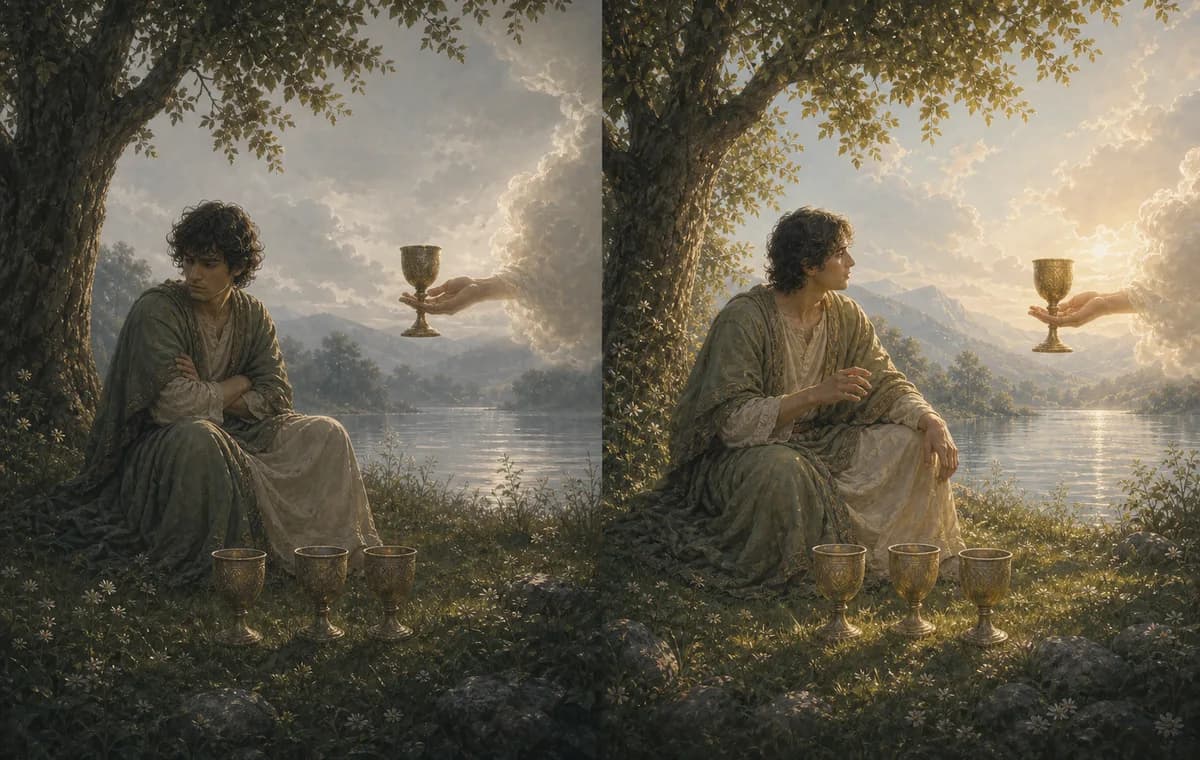
Let me answer the question first, because it shapes everything: is reversed Four of Cups negative? No. More than most reversals, this one tilts upward. When you flip a card whose whole posture is "head down, not looking," turning it over lifts the head. Reversed Four of Cups is, in its most common form, the card waking up.
Core Reversed Keywords
- Re-engagement — Coming back online, noticing the world again
- Renewed openness — A willingness to receive what's offered
- Leaving the rut — The fog lifting, energy returning
- Acceptance — Finally reaching for the cup
- Deeper avoidance — The minority reading: burying feeling rather than facing it
In-Depth Reversed Interpretation
The first and most common reading is the thaw. The discontent that defined the upright card is dissolving. Color comes back into things. The person who couldn't be bothered last month is suddenly answering messages, taking the meeting, reaching for the cup they'd been ignoring. Clients often draw reversed Four of Cups at the exact moment they've quietly decided to re-enter their own life — before they've told anyone, sometimes before they've fully told themselves.
The second reading is the wake-up call. Same upward energy, sharper edge: opportunities are knocking and you are about to miss them if you don't shake yourself out of it. This version of reversed Four of Cups has urgency the upright lacks. The fog is liftable — but only if you move.
The third reading is the one most guides bury, and it's real. Occasionally the reversal doesn't heal the withdrawal; it deepens it. The person doubles down on distraction — work, scrolling, casual flings, anything that keeps them from sitting still with what they feel. The tell is direction. Healing-reversal turns toward life; avoidance-reversal turns further away. I won't pretend both readings are equally likely — three times out of four it's the thaw. But check the surrounding cards before you promise someone the fog is lifting, because the fourth time it isn't.
The Three Life Areas Where the Four of Cups Hits Hardest
This card doesn't spread evenly across love, career, and health. It concentrates. The three places it lands hardest are emotional life, work that has lost its meaning, and the relationship with one's own gratitude.
Love & Relationships
In love, the Four of Cups is the card of the rut, not the rupture. In an established relationship it usually means complacency has set in — the affection is still being offered, but it's stopped landing. One partner has gone quietly inattentive, and the other is starting to feel like the cloud-hand holding out a cup nobody's looking at. The love is generally intact underneath; what's missing is attention.
For singles, it's cooler. The Four of Cups often describes someone not in an emotionally available season — lukewarm, comparing options in their head, or guarding against the disappointment that dating has handed them before. If you want the full love-and-desire breakdown — what this card says when you ask "how does he feel about me" — I wrote that out separately in Four of Cups as feelings, where the central question is whether the apathy is aimed at you or at everything. This page is the broad meaning; that one is the relationship microscope.
One opinion I'll plant a flag on: when the Four of Cups shows up in a love reading, the worst move is to read it as a verdict on the relationship's worth. It is almost always a verdict on someone's capacity in that season, which is a temporary thing.
Career & Work
In career readings the Four of Cups is disengagement. The job that once meant something now feels like beige. You're going through the motions, declining the stretch project, ignoring the recruiter email, not because anything is wrong on paper but because the meaning has drained out. The card here is asking a real question: is this a sign to leave, or a sign you've stopped looking at what's actually available where you are? Both are possible. The Four of Cups, unlike the Eight of Cups, doesn't tell you to walk — it tells you you've stopped seeing. What you do with clearer sight is the next card's job.
Gratitude & the Inner World
The third area is the one other cards rarely own: your relationship with what you already have. The three cups on the ground are real, full, and ignored. This is the card of the person with a good life they cannot feel. In spiritual or self-work readings, the Four of Cups names the specific numbness of taking abundance for granted — not as a moral failing, but as a depletion. The reversal of this isn't forced positivity. It's the slow return of the ability to taste your own life again.
Should You Push Past the Four of Cups, or Sit in It?
Here's the angle almost no guide handles well, and the one I get asked about most. Every article tells you the Four of Cups means "look up and seize the opportunity." But anyone who has actually sat in this card's mood knows that being told to cheer up and reach for the cup is useless at best and shaming at worst. So which is it — do you push past the Four of Cups, or do you let yourself sit in it?
The honest answer is that the card contains both instructions, and reading it well means knowing which one the moment calls for.
Sit in it when the withdrawal is doing work. Sometimes the flatness is the nervous system's way of forcing rest after a saturated, over-stimulated stretch. The cups are being declined because you genuinely have nothing left to receive them with. Pushing here just deepens the depletion. Emotional rest is not laziness; it's re-entry preparation. A field that's been flooded needs to drain before it can take more water, and no amount of willpower drains it faster.
Push past it when the withdrawal has overstayed. The same posture that protects you at week one calcifies into a habit by week ten. Past a certain point the numbness stops being rest and becomes a place you've moved into. The diagnostic I use: has anything at all moved your energy lately — a song, a friend, a small want? If genuinely nothing has, you may be in the depletion that needs rest. But if small things still spark and you're declining the big offered cup anyway, that's not rest. That's avoidance, and the card is asking you to lift your head.
The Four of Cups, in other words, is not a single instruction. It's a question about whether you're recovering or hiding. Most people know the answer the second they're asked it honestly — they've just been avoiding the question, which is the most Four-of-Cups thing a person can do.
Four of Cups Card Combinations
Four of Cups + Ace of Cups
The cruelest and clearest combination — because the offered cloud-cup is an Ace of Cups, made literal. A genuine new emotional beginning is being held out, and the Four of Cups names the risk: you're too checked out to take it. When these appear together, the reading is rarely "no opportunity." It's "the opportunity is here and you're not looking." A nudge, not a warning.
Four of Cups + The Moon
Two cards of fog. The Moon clouds your perception; the Four of Cups clouds your willingness to engage. Together they describe a season where you genuinely cannot tell whether your discontent is information or illusion. The advice I give for this pairing: make no decisions about what to decline until the fog clears. You can't trust a "no" issued from inside the Moon.
Four of Cups + The Sun
The thaw made vivid. The Sun is everything the Four of Cups can't feel — warmth, visibility, the simple pleasure of being alive in the open. As a combination it almost always reads as the apathy ending. The cup gets lifted; the head comes up into the light. One of the more hopeful pairings this card produces.
Four of Cups + Eight of Cups
Sequential, and important. The Four of Cups is sitting with the cups, unmoved. The Eight of Cups is finally standing up and walking away from them. Together they trace the arc of someone moving from passive discontent into active departure — the moment the rut becomes a decision to leave. Common in readings where a client has stopped pretending the situation will improve on its own.
Four of Cups + The Lovers
A choice being avoided. The Lovers asks for a values-aligned decision; the Four of Cups describes someone too withdrawn to make it. This pairing often shows up when a person is being asked to choose — a partner, a path, a commitment — and has gone numb precisely to avoid the weight of choosing. The card combination's message is gentle but firm: the choice doesn't disappear because you stopped looking at it.
Four of Cups + Death
Less common, and quietly hopeful. Death is closure that makes room; the Four of Cups is the apathy that often precedes it. Together they suggest a chapter that has genuinely ended emotionally, even if it hasn't ended in fact — the numbness being the first honest signal that something is over. Not a tragedy. A completion you've been feeling before you could name it.
Numerology & Astrological Correspondences
The Number 4
Four is where motion stops. The Ace pours, the Two joins, the Three celebrates — the Four is the first Cups card that sits still, emotional water gone stagnant for lack of anywhere to flow. Paired with the watery, flowing suit of Cups, it creates a productive tension: emotion that has stopped flowing and started seeking ground. This is the card where emotional water seeks roots rather than expansion, settles rather than streams. Some of the card's flatness is just this: feeling at rest, sometimes too much at rest, occasionally stagnant. Four also carries the resonance of the square — in astrology, the friction angle, the tension that demands effort to resolve. The Four of Cups holds exactly that internal square: the pull to open against the pull to withdraw.
Astrological Correspondence: Moon in Cancer
The Four of Cups is assigned to the Moon in Cancer — specifically the third decan of Cancer, where the Moon rules both the sign and the decan. This is the Moon at maximum strength, in its own home, and it explains the card's emotional depth and its moodiness in equal measure. The Moon governs tides, cycles, the waxing and waning of feeling, and in Cancer — the sign of home, comfort, and emotional safety — it produces a card that runs deep and changes quickly. The flatness of the Four of Cups isn't shallow boredom. It's lunar: the low point of an emotional tide that will turn. In the Thoth tradition the card is titled the Lord of Blended Pleasure, which captures the bittersweet quality precisely — pleasure that has gone mixed, dulled, no longer pure.
In Japanese タロット占い the Four of Cups (カップの4) is frequently read through 「無気力」(mukiryoku) — a listlessness, an absence of drive, the depleted state of having no energy to reach for even the things you'd normally want. I find that frames the card more honestly than the English "apathy," which sounds like a choice. Mukiryoku isn't a decision. It's an emptiness in the tank — and Japanese readers tend to treat it with less judgment as a result, which is closer to how the card actually behaves.
Frequently Asked Questions
Is the Four of Cups a yes or no card?
Upright, it leans No — not a hard refusal, but a "not while you're this checked out." The card's whole posture is disengagement, which rarely supports a confident yes. Reversed tilts toward Yes, as openness returns and you start reaching for what's offered. Overall it behaves more like a "wait and watch" card than a clean verdict.
What does the Four of Cups mean in love?
In an established relationship, usually a rut — complacency and inattention rather than a real ending, with the love still intact underneath. For singles, it points to someone in an emotionally unavailable or lukewarm season. For the full relationship reading, see Four of Cups as feelings. Read it as "checked out," not "doesn't care."
Does the Four of Cups mean missed opportunity?
Often, yes — that's the cloud-hand cup nobody's looking at. But the card isn't fortune-telling a loss; it's describing a state of attention. The opportunity is present. Whether it's missed depends on whether the person lifts their head. That's why reversed (the head coming up) so often reads as the opportunity finally being taken.
Is the reversed Four of Cups positive?
Mostly. Three times out of four it signals the thaw — apathy lifting, re-engagement, renewed openness. The exception is when the reversal deepens avoidance instead of healing it. Tell them apart by direction: is the person turning toward life or further away from it? If toward, the reversal is the good one.
What zodiac sign is the Four of Cups?
Cancer — specifically the third decan (20–29 degrees), ruled by the Moon in its own home sign. The element is water. This combination of Moon and Cancer is what gives the card its emotional depth, its moodiness, and its tidal quality: the flatness is the low point of a feeling that will turn.
How is the Four of Cups different from the Five of Cups?
The Five of Cups is grief — eyes fixed on what's been spilled, mourning something specific, still very much feeling, just in pain. The Four of Cups is the opposite problem: not too much feeling but too little, numbness rather than sorrow. Five is "I'm hurting over what I lost." Four is "I can't seem to feel anything about what I have."
Why do I keep drawing the Four of Cups?
Usually because the question you're asking is one you've gone numb to rather than resolved. A repeating Four of Cups is the deck pointing at the cup you keep not looking at. Ask yourself honestly: am I resting, or am I hiding? The card tends to stop repeating once you've answered that — not before.
Closing
The Four of Cups is the card of the unseen gift. Not the absent gift — the unseen one, held out and ignored, three more sitting full on the grass while the one person who could enjoy them sits with his head down.
If you've drawn it, don't reach for the easy fix of forcing gratitude. Do one quieter thing first: name whether your flatness is rest or refuge. Sit somewhere for ten minutes and ask what, if anything, still moves you. If something does, lift your head — the cup is genuinely there. If nothing does, let yourself drain a while longer without calling it failure. The hand from the cloud isn't going anywhere. It's waiting for you to look up.
Continue with Four of Cups as feelings for what this card says about how someone feels about you, or read Death for the closure the Four of Cups numbness so often precedes.