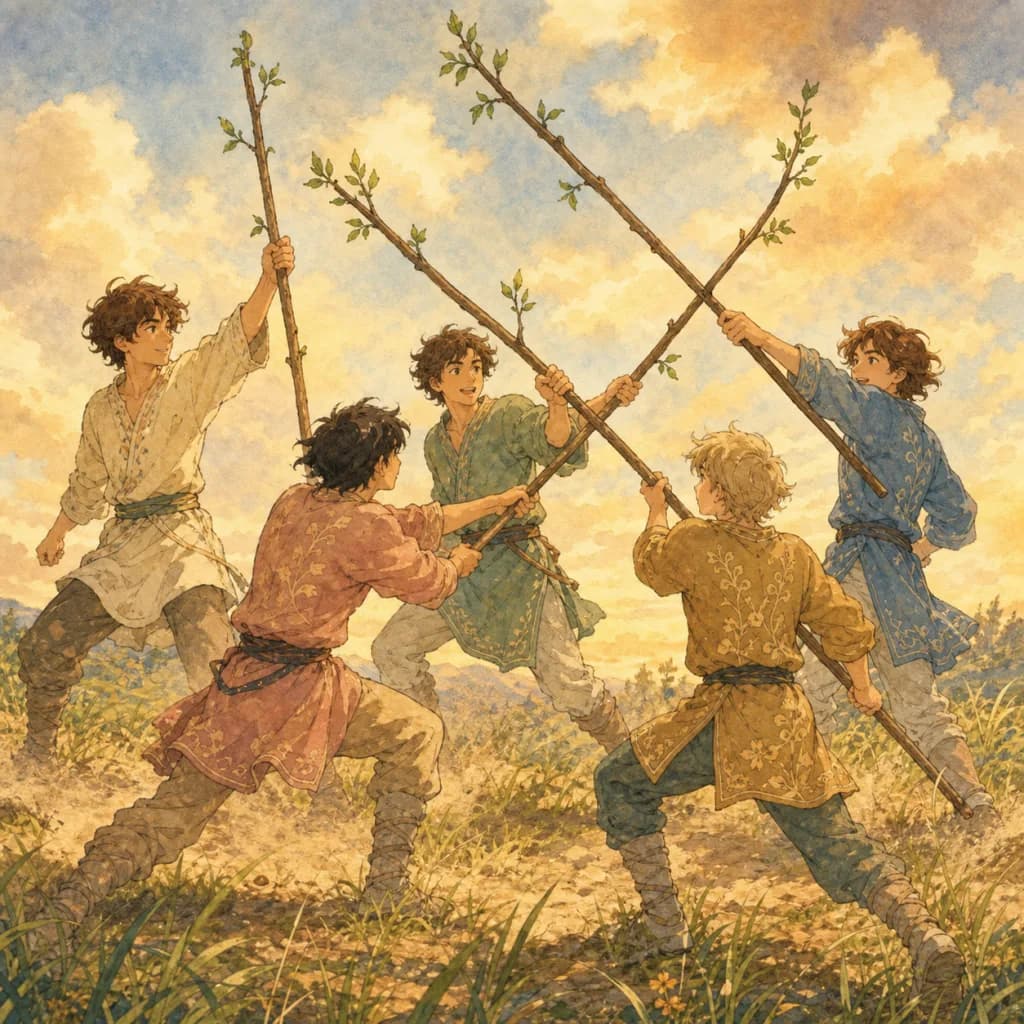
Count the figures in the Five of Wands and then ask a harder question: who is on whose side? You can't tell. Five people, five raised staves, no two of them clearly allied, no goal anyone is fighting toward. That blank is the real Five of Wands meaning. Most readers see a brawl and reach for "conflict." What I see, after years of laying this card down in Chicago, is five separate solos performed in one cramped room — and the noise is what happens when nobody agreed on the song.
Quick Answer
The Five of Wands means scattered competition and friction — people clashing because they're all pushing at once with no shared plan, even though they aren't really enemies. Upright: rivalry, disagreement, chaotic energy, the scramble of too many voices. Reversed: the conflict either cools into resolution or goes quiet and underground, turning into avoidance or passive tension. Yes / No: a wavering maybe — usually no until the players sort out who actually wants what.
Basic Information
| Attribute | Details |
|---|---|
| Card Name | Five of Wands |
| Suit | Wands |
| Arcana | Minor Arcana (Pip Card) |
| Element | Fire |
| Astrological Correspondence | Saturn in Leo (first decan of Leo, Golden Dawn system) |
| Yes / No | Maybe / lean No until the field clears |
| Upright Keywords | Competition, friction, rivalry, scattered effort, disagreement, sparring, chaotic energy, clashing egos |
| Reversed Keywords | Resolution, conflict avoidance, internal tension, passive aggression, exhaustion, ducking the fight |
Card Imagery & Symbolism

Five young men stand on rough ground, each gripping a long wooden staff, and they appear to be swinging at one another. Look again. No staff actually connects with anyone. The poses are mid-motion, almost theatrical, and every figure wears a different patterned tunic. Nothing in the scene is breaking, falling, or bleeding. The chaos is loud but harmless — which is precisely the trap, because being harmless still leaves you going nowhere.
Five Staves, No Two Pointing the Same Way
Most guides count the wands and call it a day. Trace their angles instead. Each staff tilts on its own axis — one up, one across, one diagonal — and they cross without meeting in any single point. There is no center to this fight. Compare that to the Two or Three of Wands, where the staves stand parallel, planted, aimed at a horizon. Here the geometry has come apart. The picture is telling you the disagreement has no shared coordinate, no common direction everyone is at least facing. This goes deeper than people simply disagreeing. That visual detail is the whole card, and almost nobody mentions it.
Different Tunics, and What They Quietly Confess
The clothing is usually read as "diverse backgrounds, different beliefs." True, but follow it further. Each figure is dressed for a different occasion entirely — one for labor, one for leisure, one almost for court. These people didn't arrive for the same event. They wandered into the same patch of ground carrying separate agendas and started swinging out of reflex. The friction is logistical more than ideological. Five private missions colliding in one space.
The Bare, Uneven Ground
The earth under their feet is rough and undefined — no path, no markers, no playing field with lines. I find this the most honest symbol in the card. A real contest has a pitch, rules, a referee. This ground has none. So the "competition" everyone keeps naming is competition without a structure to make it mean anything. Nobody can win because there's no agreed game. The wands swing, the dust rises, and at the end of it the ground looks exactly the same.
Five of Wands Upright Meaning
Core keywords: competition, friction, scattered effort, clashing voices, sparring, disorder.
Upright, you've walked into a situation where everyone has energy and nobody has alignment. A project where five people each defend their own version of the plan. A group chat where every reply is a counter-reply. A field crowded with capable rivals who all want the same prize and keep tripping over each other reaching for it. The defining feature is the absence of a center, with no real hostility behind it. People are engaged, opinionated, awake. That part is good. Fire is moving. But it's moving in five directions, and the result feels like effort that produces only heat.
This is where I push back on the standard advice. Every site tells you to "step back and listen." Listening helps, but it falls short of a cure here, because the Five of Wands rarely fails for lack of listening. It fails for lack of a shared target. You can listen perfectly to four people who each want something different and still end up exactly nowhere. The card's actual instruction is to find — or name — the one thing all this energy could point at. Once there's a common horizon, the same five staves stop crossing and start pulling together.
One thing worth holding onto: friction in this card is a sign of life. A team that draws the Five of Wands is a team that still cares enough to argue. Apathy looks like an empty card. A crowded one means people still show up. The real problem is that they're fighting in place.
Five of Wands Reversed Meaning

Reversed is not automatically negative — and this is one of the few Wands cards where the reversal can genuinely go either way.
The favorable read: the noise dies down. A drawn-out rivalry resolves, a clashing team finally sorts out roles, an exhausting argument burns itself out and people go back to building. After the upright scramble, the reversed card can feel like the moment the room goes quiet and you can finally hear yourself think. Tension that was external moves inward in a useful way, asking you to settle a debate you've been having with yourself.
The harder read: the conflict didn't resolve, it went underground. The staves stopped swinging in the open and started moving behind closed doors. Passive aggression instead of an honest clash. People competing while insisting they aren't. A meeting where everyone smiles and nothing gets decided, because the real disagreement is happening in side messages afterward. Where the upright Five at least stays loud and honest, this version of the reversed Five turns quiet and dishonest — and that's worse, because you can't redirect energy you're not allowed to name.
Reversed can also mean you personally are dodging a fight that needs to happen. You feel the friction, you'd rather it vanished, so you swallow your position and call it keeping the peace. The card asks whether you're avoiding a conflict or actually resolving one. From the outside the two can look identical, yet they feel completely different to live through.
Is the Conflict in the Five of Wands Actually a Lack of Shared Goal?
Here's the angle the other guides keep circling but never land on. They frame this card as a competition card — winners, losers, rivals, ego. But there is no winner anywhere in the Five of Wands, and there can't be, because nobody is playing the same game. The rivalry is really five uncoordinated individuals each running a private campaign in shared space.
That reframe changes the diagnosis completely. Treat the problem as competition and the obvious fix is to compete harder or compete more fairly — which, when the real issue is missing alignment, just multiplies the noise. The cure is upstream of the fight: somebody has to ask "what are we all actually trying to do here?" — and get a real answer. The moment a genuine common goal appears, the Five of Wands stops being a brawl and becomes a brainstorm, the most productive room in the building. The friction was never the disease. The lack of a shared horizon was.
I tell clients to treat this card as a question to sit with rather than a verdict to accept. The question worth asking is "what would it look like if all five of these forces were rowing the same boat?" — and you'll notice that question has nothing to do with who's winning. Sometimes the honest answer is that they can't be — and then the reading is about which fights to leave entirely. Walking away from a contest that has no prize costs you nothing, since there was never a prize to lose.
Career & Teamwork
In work readings, the Five of Wands is the meeting that runs ninety minutes and decides nothing. Five smart people, five strong opinions, no one chairing. It also shows up for a competitive field — a hiring round, a pitch, a crowded market where everyone has roughly the same skill and you have to make noise just to register.
My specific observation from Chicago client work: this card lands most often for teams that have too many capable people and no agreed leader, rather than for people who lack talent. A startup I read for kept drawing the Five of Wands through an entire product cycle. Every founder was excellent. That was the problem — five excellent people each steering. The card resolved the week they finally named one person to make the final call. The talent never changed. The geometry did.
Practically: if you draw this for a project, don't add more effort. Subtract ambiguity. Decide who owns the decision, then let the rest argue inside that frame, where the friction sharpens the work rather than scattering it.
Love & Relationships
In a partnership, the Five of Wands is the argument that only pretends to be about the dishes. Two people clashing repeatedly over small things usually means a bigger unnamed question is going unaddressed, and the small fights are stand-ins for it. The card points you to the question under the question.
For singles, the older reading is "multiple suitors competing for your attention," and sometimes that's exactly it — a season where several people are interested at once and you're enjoying the heat. But I read it more often as internal: competing wants inside one person. You want closeness and you want freedom; you want to be chosen and you want to stay free to choose. That's its own Five of Wands, five impulses swinging at each other in one chest. For a wider look at how relationship friction reads across a layout, the love tarot spread guide gives you positions to separate the noise from the signal.
A small thing I've noticed: couples who fight openly and draw this card tend to be doing better than couples who draw the reversed version and report "no problems at all."
Personal Growth
On the inner level, the Five of Wands is the day every part of you wants something different and none of them will yield. Discipline versus rest. Ambition versus peace. The voice that says push and the voice that says stop. It feels like dysfunction, though it really signals that you're alive to several real values at once, which is more than most people can say.
The growth move here has nothing to do with silencing the loudest voice or forcing a truce. It's to notice you've been letting these forces fight unsupervised, with no shared aim, and to ask them the same question you'd ask the team: what are we all trying to build? The conflict between your drives is only destructive while it's leaderless. Sit in the chair. Let them make their cases. Then decide. The Strength card is the natural next step here — it gentles the inner noise toward one direction instead of crushing it.
Five of Wands Card Combinations
Five of Wands + The Emperor — the missing chair, filled. The Emperor is structure, authority, the person who makes the call. Together they read as a chaotic group finally getting a leader, or your own scattered drives submitting to a plan. The single best resolution this card can pair with.
Five of Wands + Six of Wands — the brawl, then the victory parade. This sequence tells a story: the messy contest sorts itself out and someone (often you) emerges recognized. When these two come up together, the friction is worth pushing through; it has an exit.
Five of Wands + Four of Wands — competition followed by celebration and homecoming. A team that argued its way to something good and is now toasting it. The fight was the kind that builds rather than breaks.
Five of Wands + The Tower — low-grade friction you ignored is about to stop being low-grade. Unaddressed conflict collecting until the structure cracks. Read this as a warning to name the real disagreement now, while it's still just noise.
Five of Wands + Seven of Wands — the crowd thins to one. The scattered clash narrows into you standing your ground against the remaining challengers. The fight became real, with a real position to defend.
Numerology & Astrological Correspondences
Fives in tarot are the number of disturbance — the point where a closed situation gets shaken loose and forced into motion. You can read it straight off this card's image: five figures, five staves, all in the air at once, none of them coordinated. In the Wands suit that disruption shows up as fire suddenly given five outlets and no single channel. The astrological signature is Saturn in Leo: Saturn's discipline and limitation pressing against Leo's need to shine and be seen. Five egos all wanting the spotlight, all meeting resistance. That tension is the card in one phrase.
I often frame this card through the idea of mutual sharpening — the way two whetstones polish each other through honest rivalry. The Five of Wands is that kind of sharpening waiting to happen. Right now the stones are just grinding randomly. Aim them, and the same friction that was wearing everyone down starts producing an edge.
Frequently Asked Questions
Is the Five of Wands a positive or negative card?
Neither, cleanly. It's friction — and friction is only negative when it's pointless. Drawn for a stale situation it can be a wake-up; drawn for an already chaotic one it confirms the scramble. The card is energy looking for direction, and whether that reads as good depends entirely on whether you give it one.
Does the Five of Wands mean a real fight or argument?
Usually it's an argument, a clash of opinions, or competition rather than a serious confrontation. Nobody in the imagery is getting hurt. Think spirited disagreement, jockeying, friction between strong personalities. It rarely rises to a relationship-ending rupture or open warfare; for that level of damage, you'd look to other cards.
What does the Five of Wands mean in a yes or no reading?
It leans toward "not yet." The card describes a situation where things aren't settled and too many forces are pulling against each other. A clear yes or no is hard to deliver into that much noise. Treat it as "resolve the conflict first, then ask again."
Is the Five of Wands reversed better or worse than upright?
It depends on which way the reversal tips. At its best it means the conflict is resolving and the air is clearing. At its worst it means the conflict went underground into passive aggression and avoidance, which is harder to fix than open clashing. Read the surrounding cards to tell which version you've got.
What does the Five of Wands mean for love?
In a couple, recurring small fights that point to a bigger unspoken issue. For singles, either several people competing for your attention or competing desires inside yourself. The card asks you to find the real question under the surface arguments rather than keep re-fighting the surface ones.
How is the Five of Wands different from the Five of Swords?
The Five of Swords has a winner who walks away while others leave defeated — conflict with a victor and real cost. The Five of Wands has no winner at all, because nobody is playing the same game. Wands friction is messy and harmless; Swords conflict is sharp and leaves a mark.
What should I do when I draw the Five of Wands?
Stop adding effort and look for the missing shared goal. Ask what everyone — or every part of you — is actually trying to achieve, and whether there's a common version of it. If there is, name it and the chaos organizes. If there isn't, the wisest move may be to walk out of a contest that has no prize.
Closing
The Five of Wands isn't asking you to win. There's nothing here to win. It's asking you to notice that all this energy is real and worth keeping — it just has no shared direction yet. The next time this card lands, don't fight harder and don't flee. Say the words out loud to the room or to yourself: "What are we all trying to do here?" Then wait for an honest answer. That single question turns a brawl into a workshop faster than any amount of stepping back.
Continue through the suit with the Four of Wands and Six of Wands, or read friction in a layout with the love tarot spread guide.