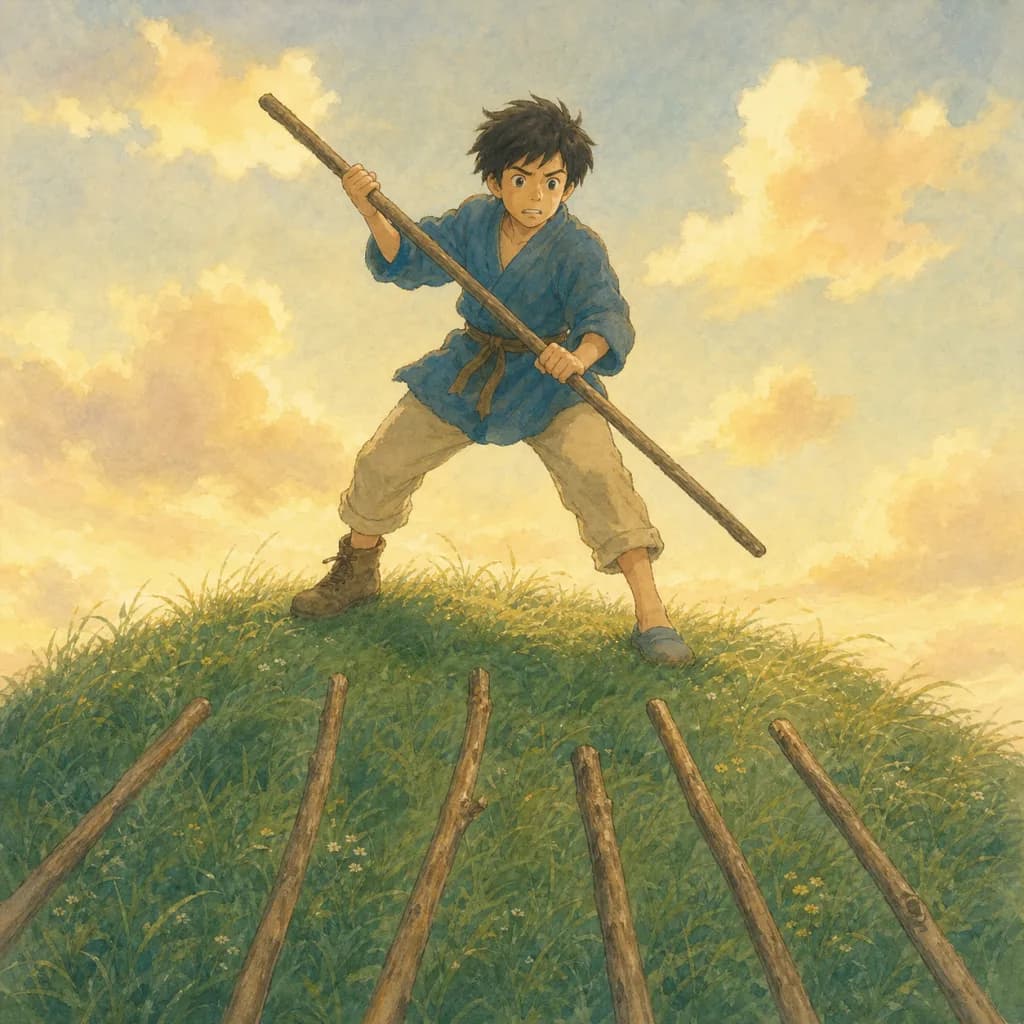
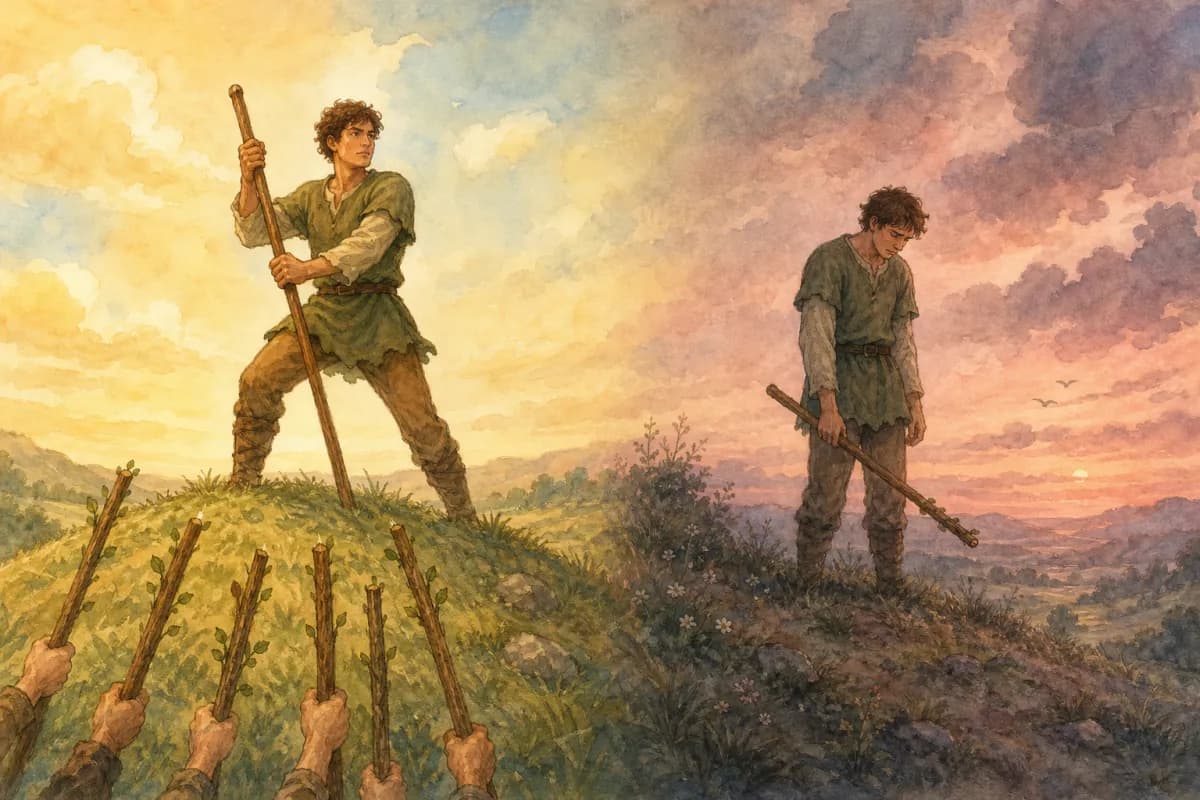
A man stands on a green hilltop, swinging a staff at six wands that rise from below the frame. Here's the part the picture hides: he can't see how many there are. The wands come up from off the edge of the image, beyond his sightline, and his face has the slightly wild look of someone reacting faster than he's thinking. The Seven of Wands is usually called the card of standing your ground, and that holds. The more honest version of its question is whether you've checked what you're defending against before swinging.
Quick Answer
The Seven of Wands means defending a position you've already won — holding your ground against challengers, criticism, or competition that arrives precisely because you succeeded. Upright: courage, conviction, standing firm, refusing to back down. Reversed: overwhelm, self-doubt, exhaustion, or backing off a fight you no longer have the energy for. Yes / No: a qualified yes — you can hold the position if you're willing to fight for it.
Basic Information
| Attribute | Details |
|---|---|
| Card Name | Seven of Wands |
| Suit | Wands |
| Arcana | Minor Arcana (Pip Card) |
| Element | Fire |
| Astrological Correspondence | Mars in Leo (first decan of Leo, Golden Dawn system) |
| Yes / No | Yes — if you're willing to defend it |
| Upright Keywords | Defense, conviction, standing your ground, perseverance, courage, holding the high ground, opposition, tenacity |
| Reversed Keywords | Overwhelm, self-doubt, exhaustion, burnout, backing down, surrender, defensiveness, fighting the wrong battle |
Card Imagery & Symbolism
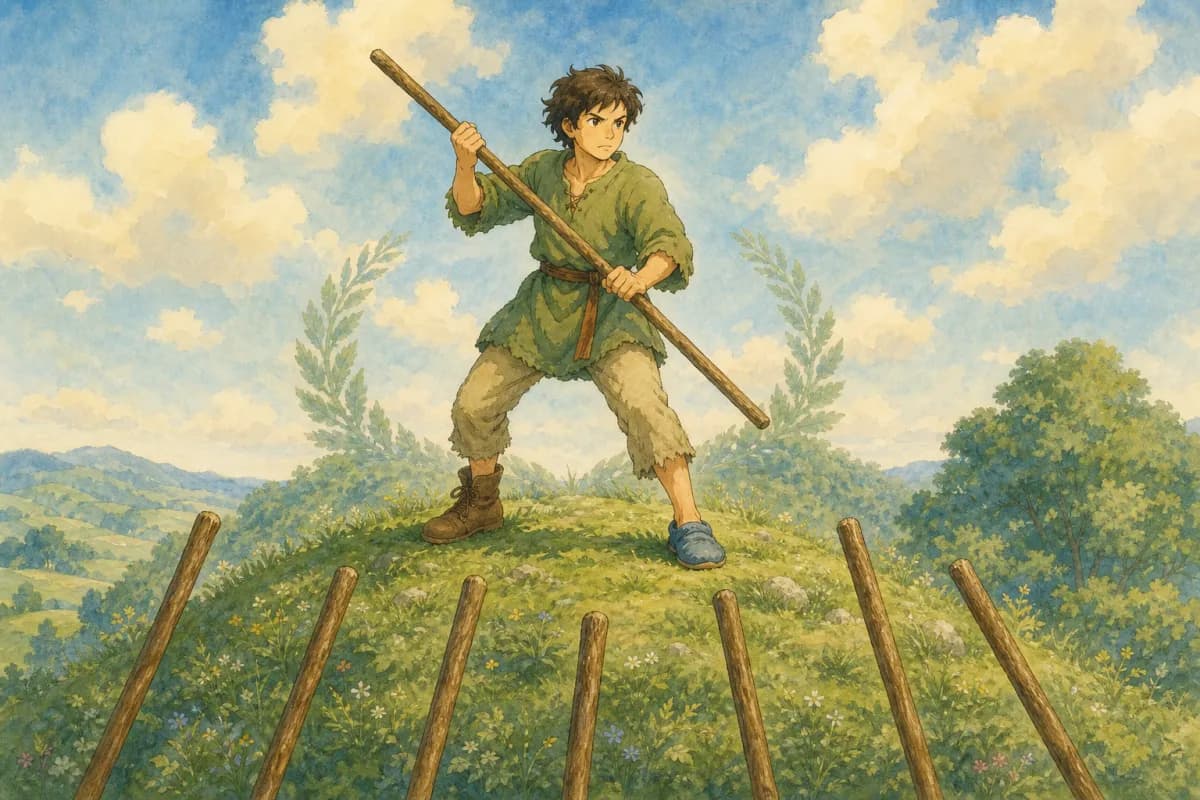
A single figure on a rise, planted feet apart, holding one wand braced across his body while six more push up from below the edge of the card. The sky is plain. No army stands behind him, no clear face on any opponent. Almost everything about the image is built to make him look outnumbered, and to keep you from knowing by how much.
The Wands That Rise from Off the Frame
Every guide notes the six wands coming up at him. Far fewer notice where they come from: outside the picture, below the bottom edge, from a place the man cannot fully see. He's looking down at staves whose owners are out of view. He has no count and no faces.
That single detail reframes the whole card. He isn't fighting an enemy he's assessed; he's fighting one he's assumed. The high ground gives him position and takes away information — you can be perfectly placed to defend and still have no idea what against.
The Two Different Shoes
This is the symbol the card is famous for: one foot in a boot, one in a soft shoe. The standard reading — caught off guard, dressed for something other than a fight — holds.
What gets left off is the implication. Mismatched shoes mean the attack interrupted him mid-something; he was in an ordinary day and grabbed whatever was nearest. The Seven of Wands belongs to the person who looked up from their work to find the work itself under threat, which is why the response is so often reflexive. This is no prepared sentry.
The High Ground He's Standing On
The hill gets read as advantage, and it is one. The detail worth holding onto is that the hill is the same thing he won in the card before. In the Rider-Waite sequence the Seven follows the Six of Wands, the victory parade — the public win, the crowd, the laurel. The hill is that laurel turned to terrain.
So the position he's defending isn't abstract territory. It's last chapter's success, now a thing other people want to take or pull down. The card sits at the hinge where winning becomes the reason you're attacked. That's the part that stings in real readings: the trouble is a sign you got somewhere worth contesting, which is the opposite of failure.
Seven of Wands Upright Meaning
Upright, the Seven of Wands is the card of holding a hard-won position against the pushback success invites.
Core Upright Keywords
- Defense — Protecting something you already have
- Conviction — Standing by a belief under pressure to drop it
- Perseverance — Staying in the fight past the point it stops being fun
- Courage — Acting against opposition without backup
- Holding the high ground — Keeping a position others want to take
Something you built, won, or believe is being challenged, and the card says the position is yours to keep if you'll stand for it. The struggle to win a thing belongs to the Five of Wands, the scrum where everyone's still fighting for the prize. The Seven comes after the prize is yours, when the fight turns from offense to defense. The climbing is over; now you hold.
The challenge can be loud or quiet. Sometimes it's open competition — a rival for the promotion, someone gunning for your spot. More often, for the people I read for, it's criticism: the choice everyone now has an opinion about, the boundary people keep testing to see if you mean it. The instruction is steady in all of these. Your only job is to stay on the hill, and you owe the people below it nothing in the way of persuasion.
A client who had left a stable corporate job in the Loop to go freelance drew this card eight months in — exactly when the income had started working and her parents had started asking, weekly, whether she was being irresponsible. That timing is the Seven of Wands in one sentence. The attacks arrived once she'd succeeded enough that people wanted a vote on it.
Upright, surrounding cards tell you how heavy the fight is, but rarely change the verdict: the ground is defensible. Plant your feet.
Seven of Wands Reversed Meaning
Is the reversed Seven of Wands a bad card? It's a tired one more than a bad one. The reversal rarely means you lose the position. It means you've run low on the energy or certainty it takes to keep holding it, and the card is asking whether the holding is still worth what it costs.
Core Reversed Keywords
- Overwhelm — More pressure than you can keep absorbing
- Self-doubt — Losing your conviction about why you're fighting
- Exhaustion — Defending past the point of depletion
- Backing down — Giving up ground, sometimes wisely, sometimes from fatigue
- Defensiveness — Fighting reflexively when nothing is attacking
The most common reversed reading is depletion. You've been holding the line so long you've forgotten what you're holding it for, and the criticism that used to bounce off now lands. This is the burnout face of the card — the freelancer who's stopped defending her choice and started wondering if her parents were right, only because she's too tired to argue anymore.
The second reading is the wisdom of stepping back. Reversed isn't always collapse. Sometimes it's the moment you realize this particular hill wasn't worth dying on, and you climb down on purpose. Letting go of a fight you've outgrown counts as its own kind of win.
The third reading is the one to watch: defensiveness with no real attack. Reversed, the Seven can show someone swinging at shadows — reading challenge into neutral comments, defending a position no one is contesting. The fight has become a habit. The shoes are still mismatched, but no one is coming up the hill.
To tell depletion from wisdom, I listen for relief. When a client describes stepping back and sounds lighter, it's the wise version. When they sound defeated, it's burnout, and the work is recovery.
Is This Hill Worth Defending — or Are You Just Swinging Because You Can't See What's Coming?
Every competitor page tells you to stand your ground. None stop to ask the prior question, and the prior question is the whole game: do you actually know what you're standing against?
Go back to the image. The man holds the high ground, which means he can see far — and yet the thing he's fighting comes from below his own feet, out of frame, uncounted. He has the worst possible intelligence on his own enemy. He doesn't know if there are six challengers or one persistent one waving six sticks, a real threat or a nuisance. He's swinging on the assumption that being attacked means he must defend, and that assumption does more work in this card than his courage.
This is the blind spot the meaning pages skip, and the most useful thing the card offers. Defense feels like strength, so we rarely audit it. But reflexive defense is just obedience to whoever decided to attack you — they pick the hill, the timing, the terms, and you react. The mismatched shoes are the tell: he didn't choose this fight, and he's spending hard-won high ground on a battle he never assessed.
So before you plant your feet, the card asks two things. First: how many of them are there, really? The criticism that feels like a mob is frequently one loud voice you've let echo. Second: is the hill worth it? You won this ground for a reason. If that reason still holds, defend it without apology — this card backs the worthy fight. But if you're defending only because it's yours and someone's pushing, you may be burning your best energy on terrain you don't want.
The strongest people I read for can tell a hill that's theirs from one handed to them by an attacker's choice of where to swing. Never coming down is no measure of strength on its own.
Seven of Wands in Career & Boundaries
At work this is the card of the contested position, in both senses: the literal job, title, or project someone's angling for, and the stance colleagues keep pressing on. Both ask the same thing — hold, without needing the room to agree.
The career version most people miss is that the Seven of Wands often shows up for the competent, the people already doing well. When you're good enough to be visible, you become a target for envy and for the colleague who wants your spot. It's frequently a backhanded compliment from the deck: you're being challenged because you're worth challenging.
On boundaries, this is one of the clearest cards in the deck, and the most exhausting to live. A boundary gets defended every time someone tests it, never settled with a single declaration. The observation I give clients: a boundary you defend on pure reflex — without checking whether the person's even still pushing — turns you into the man swinging at an empty hillside. Defend the line, but look down occasionally to confirm someone's there.
Seven of Wands in Love & Relationships
In a relationship reading, the Seven of Wands points to a bond being challenged from outside or one you're having to actively protect. Disapproving family, an ex circling back, an unsupportive friend group, distance and pressure — the card says the relationship is worth fighting for and will require you to fight.
For singles, it can mean genuine competition for someone's attention, or defending your own standards against pressure to lower them. I lean on the second more than most readers do, because in Chicago I see a lot of clients defending their right to be selective against family and friends who call them too picky. The card, for them, is about holding a personal standard while everyone insists they should settle.
The trap the card warns about in love is the same as everywhere else: defensiveness that's outlived its cause. Couples who survived a real external threat sometimes keep fighting as if it's still there, bracing against a disapproval that long since softened. If you've drawn this about a relationship that already feels secure, the question is whether real protection is still needed or you've gotten stuck in the posture of it.
Seven of Wands in Mental Resilience
This is where the card does its quietest, most important work. The Seven of Wands is what conviction costs over time — the daily, unglamorous act of not folding under constant pressure.
The thing I want clients to hear is that resilience here coexists with doubt. The man's face looks strained, a long way from serene. Resilience in this card is defending while afraid and uncertain, the only kind there is. The Seven of Wands honors the white-knuckle version of courage — the one that keeps refusing to come down without ever feeling brave.
But the card also marks the line where resilience curdles into self-harm, the reversal living inside the upright. Standing firm can quietly slide into refusing to ever rest, and defending a value can decay into defending an ego. Even the most defensible position needs someone who checks whether the siege is real or remembered. Resilience includes knowing when to sit down.
Seven of Wands Card Combinations
Seven of Wands + Strength
The defended position made sustainable. Where the Seven alone is white-knuckle and reactive, Strength brings the calm, patient force that lets you hold ground without burning out. Together they describe someone defending a boundary or belief from a centered place — the hill held with composure, a strong pairing when the question is endurance.
Seven of Wands + The Emperor
Defense backed by real authority. The Emperor is structure, legitimacy, the right to hold the position you're holding. Together they say your ground is yours by right, defensible from established power. Often a workplace reading: standing firm on a position you're genuinely qualified to occupy.
Seven of Wands + The Chariot
Two cards of forceful will, and a warning. The Chariot drives forward; the Seven digs in to hold. Together they can mean unstoppable determination — or two kinds of aggression with no off switch, all push and defense and no pause to ask whether the fight is worth it. Watch for motion and defense as pure habit.
Seven of Wands + Three of Wands
The contrast that diagnoses the card. The Three of Wands is the wide view, the figure on the cliff watching the horizon. The Seven is the opposite stance — down in it, swinging, no perspective at all. Together they ask you to climb to the Three's vantage and count the ships before you keep fighting the Seven's battle.
Seven of Wands + Ace of Wands
Defending the new flame. The Ace of Wands is a fresh spark — a new project, passion, or beginning — and the Seven beside it means that spark is already drawing opposition. Often it's the early-stage venture critics want to talk you out of before it's had a chance. The advice: protect the young fire from people who'd put it out for sport.
Seven of Wands + The Tower
Defending what's already cracking. The Tower is sudden, structural collapse. Beside the Seven, it raises an uncomfortable question — are you defending a position about to fall regardless? Sometimes this pair says the hill isn't worth the fight because it's coming down anyway. Step off before it takes you with it.
Numerology & Astrological Correspondences
Across the Wands suit, the number seven lands after the open conflict of the Five and the public victory of the Six — the point where you've gained something and now have to keep it. Sevens in tarot sit at the edge of completion, where the easy momentum runs out and what's left is the test of whether you'll hold what you've made. The Seven of Wands is that test rendered as a single figure refusing to come down off a hill.
Astrologically the card is Mars in Leo in the Golden Dawn system — the first decan of fixed-fire Leo, titled the Lord of Valour. Mars is the fighter; Leo is the proud, fixed sign that hates being challenged on its own ground. The combination is the card's energy exactly: combative defense of a position held with pride. The shadow is in the word "fixed" — Leo doesn't yield easily, which is why this card slides so readily into stubbornness, defending territory long after the defending stopped making sense.
I often read this card through plain stubborn pride — the kind that makes a person refuse to back down even when backing down would be easier. That pride is what keeps the man on the hill. At its best it reads as backbone; at its worst it becomes fighting purely so as not to lose face. The card asks you to know which one holds your feet to the ground.
Frequently Asked Questions
Is the Seven of Wands a yes or no card?
It's a qualified yes. The card says the position is yours to keep and the outcome can go your way — but only if you're willing to defend it actively. This yes happens on the strength of your effort and resolve, never on its own.
What does the Seven of Wands mean in a love reading?
It points to a relationship that's worth protecting and is being challenged — by outside disapproval, competition, or pressure. For couples it says fight for the bond. For singles it can mean real competition for someone, or defending your own standards against people who think you're too selective. Watch for defending against a threat that's already gone.
Is the Seven of Wands a positive or negative card?
Upright it's broadly positive, in a demanding way — you're being challenged because you have something worth challenging, and the card backs you to hold it. The difficulty signals success drawing attention rather than any kind of failure. The caution is only about defending on reflex rather than from genuine conviction.
Why does the man in the Seven of Wands wear two different shoes?
The mismatched shoes signal he was caught off guard — the attack interrupted him mid-task, and he grabbed whatever was nearest. It's why the card's energy is reactive rather than prepared. He didn't choose this fight or this timing; it found him in the middle of an ordinary day.
What's the difference between the Five of Wands and the Seven of Wands?
The Five of Wands is the fight to win something — open competition where everyone's still scrambling for the prize. The Seven of Wands is the fight to keep something you've already won. Five is offense and chaos; Seven is defense from a held position.
What does the Seven of Wands reversed mean?
Usually exhaustion or self-doubt — you've defended so long you're depleted, or you've lost the conviction that made the fight feel worth it. It can also mean wisely stepping back from a hill that wasn't worth holding, or, in its trickier form, defensiveness against an attack that isn't happening. Read for relief versus defeat to tell them apart.
Does the Seven of Wands mean someone is against me?
Often it does point to opposition or criticism, yes — but the card's deeper lesson is to check how real and how large that opposition actually is. The image shows a man fighting an enemy he can't fully see. Before you brace for a mob, count the actual challengers; it's frequently fewer than it feels.
Closing
The Seven of Wands gets reduced to "stand your ground," advice that's accurate as far as it goes and stops too early. The card's real intelligence is in the gap between the high ground he holds and the enemy he can't see.
If you've drawn this card, do one concrete thing before you keep fighting: write down exactly who is challenging you and what they actually want. Most of the time the mob shrinks to a person or two, and you'll know in a sentence whether this is a hill worth your feet — or one you can finally step down from.
Trace the suit's arc through the Three of Wands for the wide-view perspective this card lacks, or the Four of Wands for the celebration that comes before the defense. When you're ready for a full reading, our love tarot spread guide walks you through it.