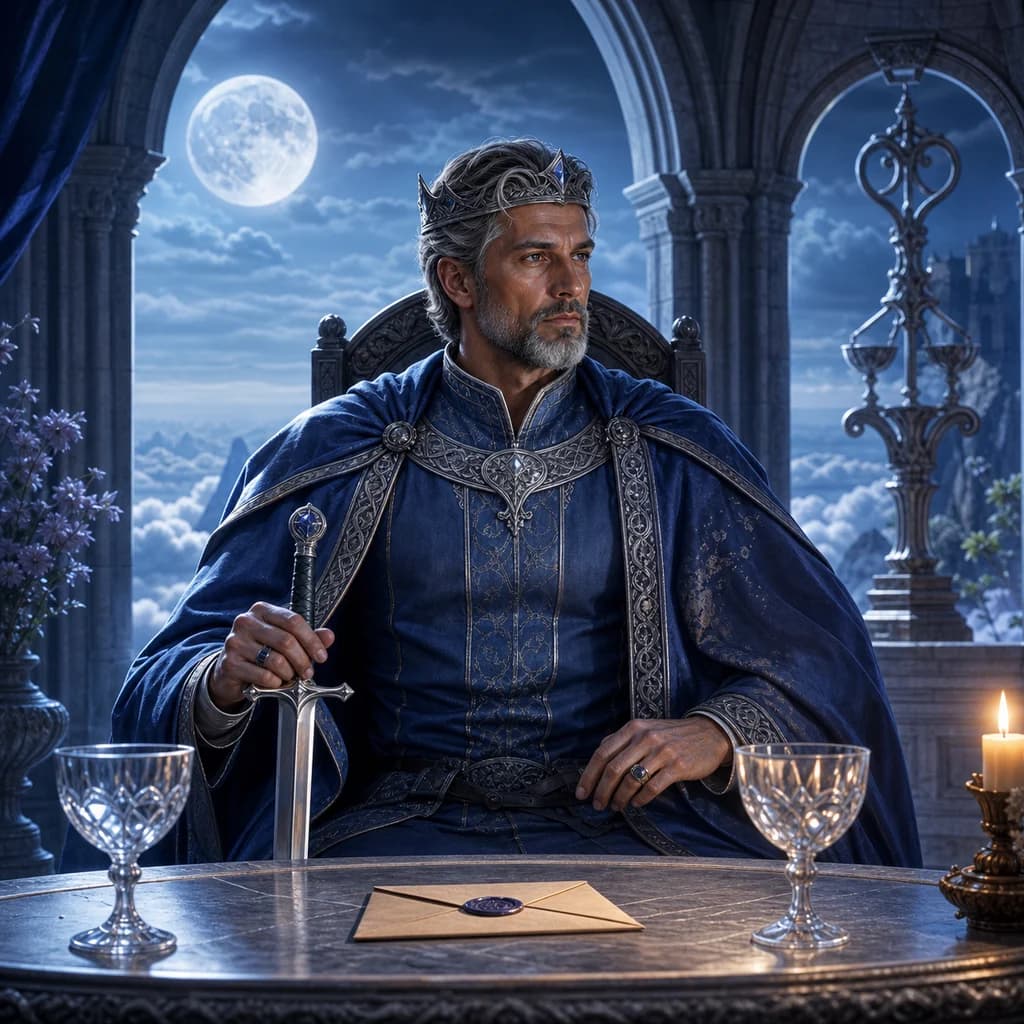
Set a King of Swords face-up next to almost any other court card and it looks like the adult in the room — sword raised, spine straight, nothing trembling. That's exactly why it gets read lazily. The King of Swords tarot card meaning is usually handed over as a compliment: smart, fair, in charge, end of story. After fourteen years reading the Rider-Waite-Smith deck in Tokyo, the cases that stay with me are the ones where that compliment was wrong by a hair — where the same upright sword that means "tell the truth" had quietly tipped into "win the argument." This guide is built around that difference, because it's where the card does its real work.
Quick Answer
The King of Swords is a Minor Arcana court card in the suit of Swords, tied to the element of Air and to mind, logic, communication, and judgment. Upright, it means intellectual authority used well: clear thinking, honesty, impartial decisions, the discipline to lead with the head when feeling would mislead. As a person, he's the mature advisor, the judge, the strategist others trust to stay level. Reversed, that intellect curdles — manipulation, coldness, harsh judgment, abuse of power, or at the milder end scattered thinking and indecision. The card's real question isn't whether you're smart enough; it's whether your clarity is serving the truth or just serving you.
The Symbolism: A Throne That Faces Forward
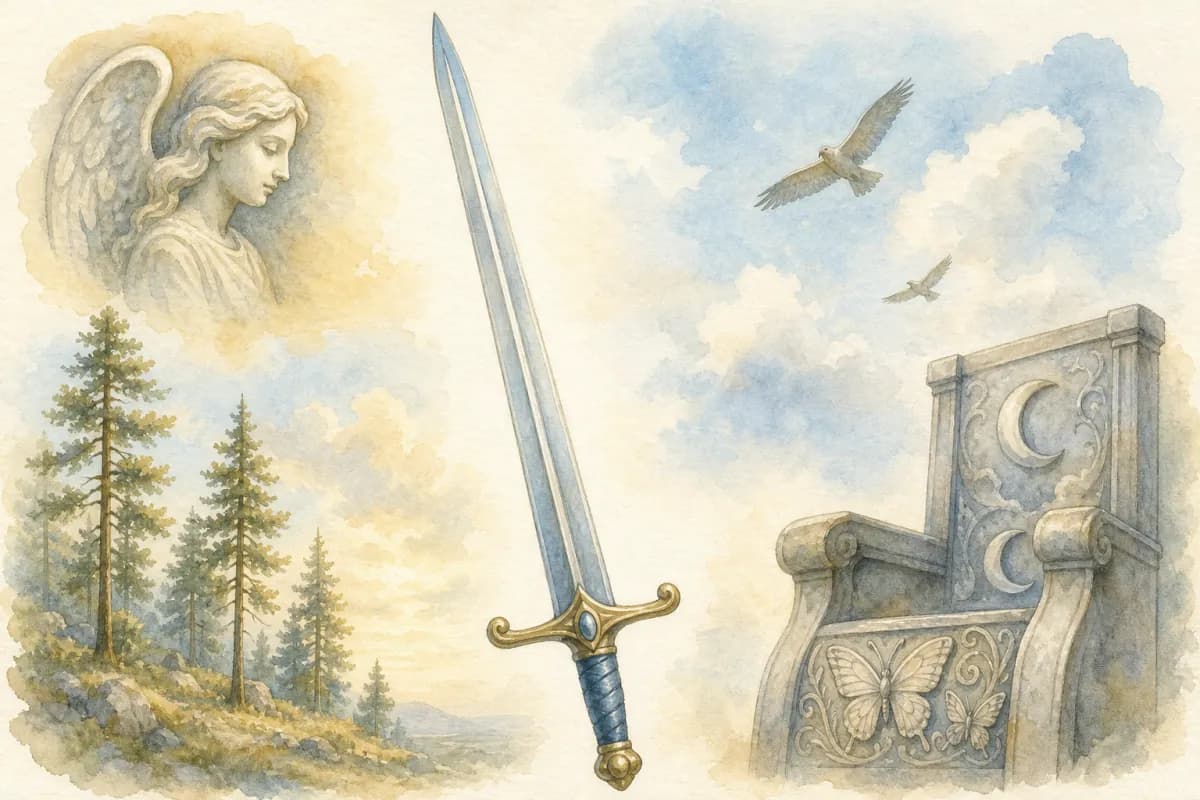
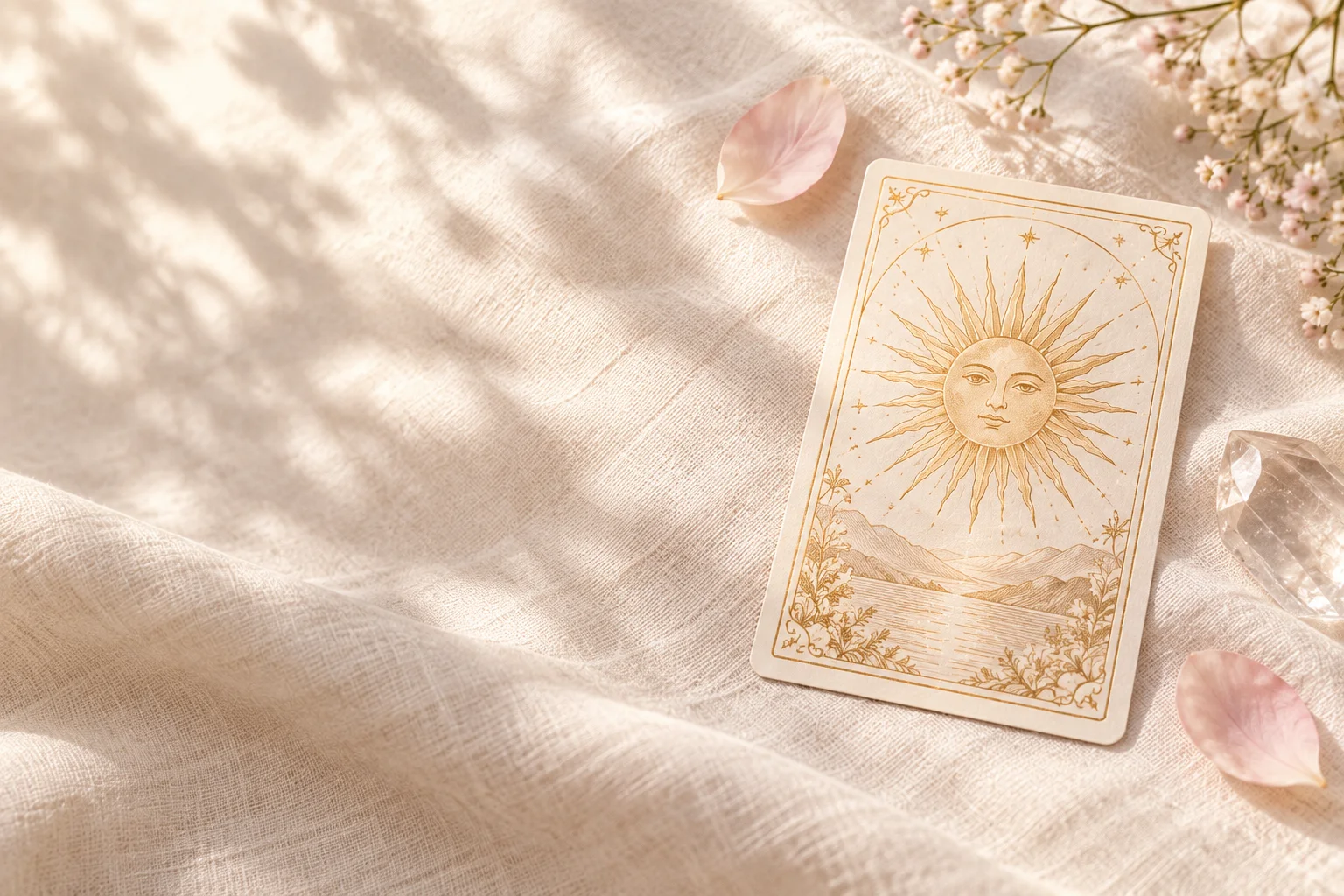
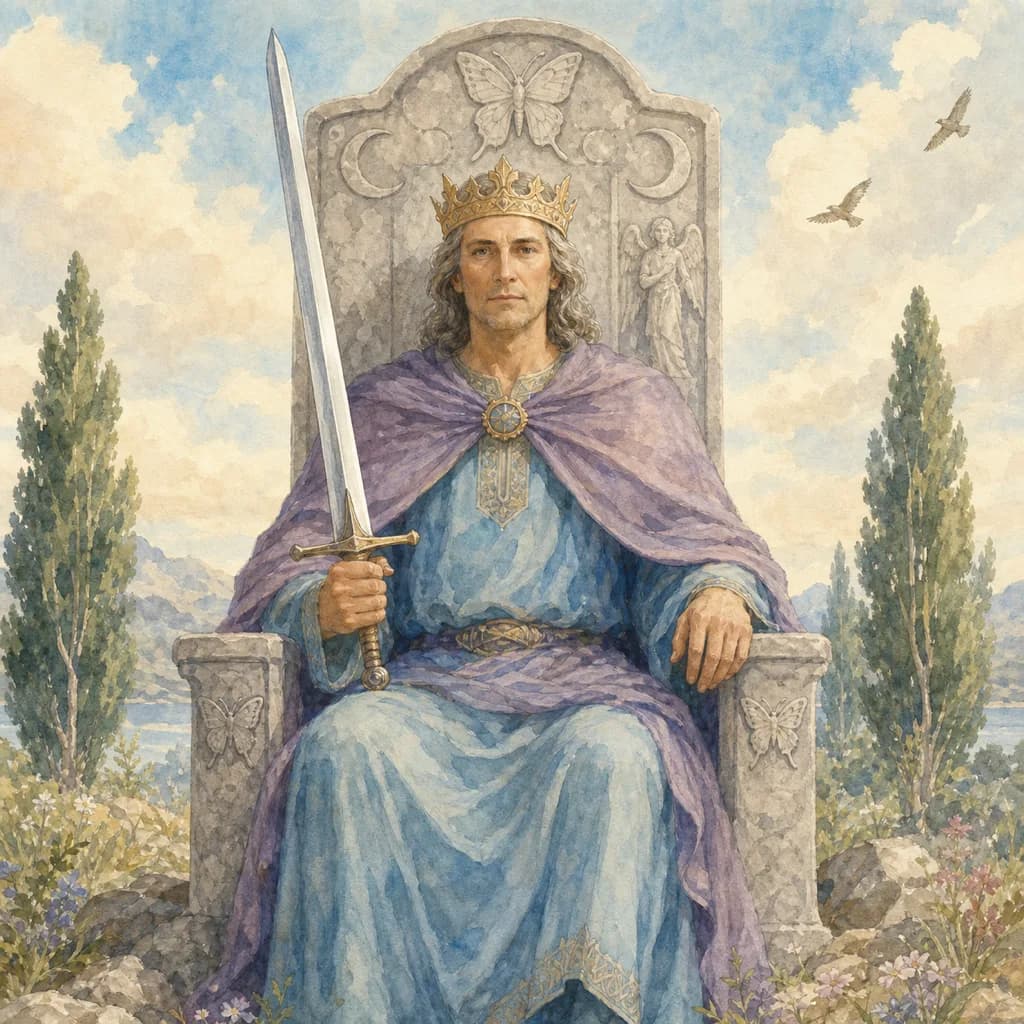
Picture the card before you label it. A king sits on a stone throne, robed in blue beneath a deep purple cape, holding a long double-edged sword upright in his right hand. Behind him the sky has cleared — the gales that whipped through the rest of the Swords court have dropped, the trees stand without bending, two birds cross a settled sky. Carved into the throne are butterflies, a pair of crescent moons, and, near his left ear, a small angel.
Most guides list these and move on. What they rarely point out is how this King sits relative to the rest of his suit, and that's where the meaning lives.
The Sword Held Upright — and Slightly Tilted
The detail people quote is that the blade is double-edged, so it "cuts both ways" — every clean judgment this card makes can also wound. But look closer at the hand. He holds the sword in his right hand, the conscious, deliberate side, and the blade leans very slightly left, toward the intuitive. He is logic that has agreed to keep one ear open. The angel carved by his left ear rhymes with it: reason that still listens. When the card reverses, this tilt is the first thing to break — the blade goes rigid and vertical, certainty with the listening switched off.
The Cleared Sky
This is the symbol I'd argue decides the card. In the Ace through Ten of Swords, wind and storm are everywhere — the suit is mental turbulence made visible. The King is the only Swords figure who sits in stilled air. The storm hasn't been avoided; it's been thought through and out the other side. That's the gift of the upright King: not a man who never doubts, but one who has already done the doubting and arrived somewhere he can defend. The shadow version skips the storm entirely — looks calm because he never let the hard questions in, not because he answered them.
Butterflies and Crescent Moons
The butterflies are transformation; the crescents are intuition and the cycles of feeling. Their placement matters — they're carved into the throne, under him, load-bearing. The reading I give clients: this King's authority rests on having transformed and on having felt, even though neither shows on his face now. He earned the steadiness. A King who has the surface without that foundation is the reversed card waiting to happen — composure with nothing carved into the seat.
King of Swords Upright Meaning
Upright, the King of Swords is the deck's image of the disciplined mind in full authority — thought that has matured into judgment, and judgment expressed with enough integrity that people listen.
Core Upright Keywords
- Mental clarity — Seeing a situation as it is, not as feeling wishes it were
- Intellectual authority — Power that comes from knowing, not from volume
- Truth and integrity — Saying the accurate thing even when it costs
- Impartial judgment — Weighing without bias, ruling without favoritism
- Discipline and structure — The self-command to act on the head over the heart
When the King turns up as a person, he's the cool, even-tempered figure people consult when the stakes are high — the lawyer, the surgeon, the senior advisor who doesn't flinch when the room does. He reads as mature, often older, and his respect has to be earned rather than charmed. The surrounding cards tell you whether he's a literal individual, a role you're being asked to step into, or a quality the reading is calling for.
That last possibility is the one I lean on most, because the King of Swords is one of the deck's great advice cards. Drawn in answer to "what should I do here," it rarely means "wait for a clever man to fix this." It means: think this through cleanly, strip the feeling off the facts, and decide from the part of you that isn't panicking. I gave that reading to a client last spring who was about to sign a contract out of fear of disappointing someone. The King wasn't calling the deal good — it was telling her to read it as a stranger would, without the guilt in the margins, and the moment she did, the answer was an obvious no.
There's a failure mode in reading this card too generously, though, and it's the mirror of reading the King of Cups as merely "nice." The King of Cups risk is mistaking a wall for warmth. The King of Swords risk is mistaking coldness for wisdom. Just because a position sounds rational and is delivered without a tremor does not make it correct — and the upright King, at his best, knows that about himself. The genuine article holds strong opinions and still updates them. That tilt in the blade is the whole point.
King of Swords Reversed Meaning
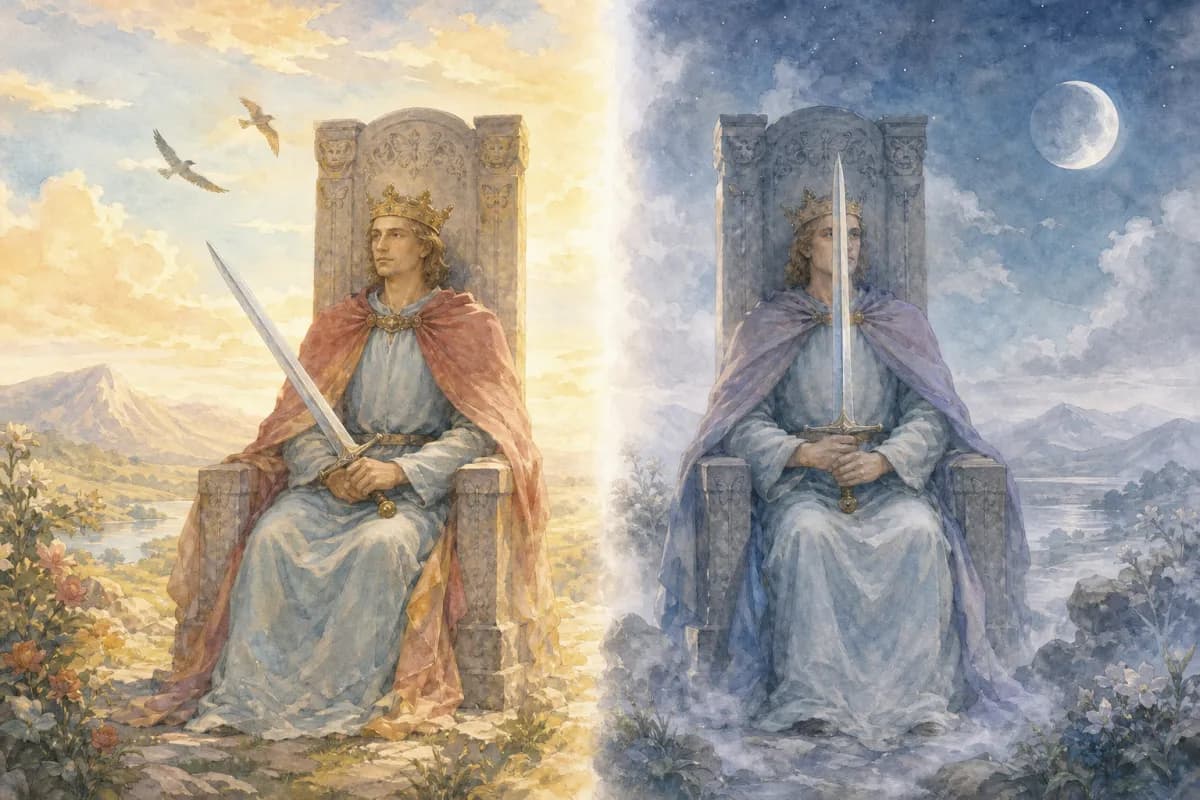
Is the reversed King of Swords negative? More often than not, yes — I treat it as a real caution rather than a soft "blocked energy," because the thing that goes wrong here tends to hurt people. But "negative" splits into distinct shapes, and confusing a scattered mind with a cruel one is the most common reading error I see.
Core Reversed Keywords
- Manipulation — Intellect turned into a tool for control
- Coldness / contempt — Detachment hardened into looking down
- Harsh judgment — Criticism that wounds more than it clarifies
- Abuse of authority — Power used to dominate rather than to serve
- Scattered thinking — At the milder end, indecision and mental fog
Reading the Three Shapes
The first and least sinister is the clouded mind. Here the King's clarity has simply deserted you. Thoughts scatter, decisions stall, you can't tell which opportunity is real. This is the reversal as confusion, not malice — the storm of the lower Swords cards has crept back into the throne room. It asks you to slow down and gather facts before you commit to anything, because right now your judgment isn't trustworthy and some part of you knows it.
The second is the tyrant. The sharp intellect that was admirable upright now serves only itself — cold, controlling, cutting. This is the boss who rules by intimidation, the partner who keeps everyone at arm's length, the person who deploys big words and faster logic to make sure no one can challenge him. He may well be brilliant. Brilliance is exactly what makes him hard to argue with.
The third, and the one to watch most carefully, is the weaponized truth. Subtler than the tyrant and more corrosive. It's the person who is technically right and uses it to wound — who hands you an accurate, devastating observation and calls it honesty, who wins every disagreement and never notices the relationship bleeding out underneath. The Seven of Swords or The Devil nearby pushes toward deliberate manipulation; the Five of Swords pushes it toward winning-at-all-costs. I separate the three by where the harm lands: the clouded mind hurts the King himself, the tyrant hurts whoever's nearest, and the weaponized truth is aimed — fired with a smile and a footnote.
Is This Clear Thinking, or Is Being Right Just Another Weapon?
Here is the blind spot in nearly every King of Swords guide, and the most useful thing the card can teach. Competitors describe upright "logic and truth" and reversed "manipulation and coldness" as if a clean line runs between them. In real readings the line is almost invisible, because both wear the same expression: calm, articulate, certain, impossible to fluster. The sword looks identical whether it's cutting toward the truth or cutting toward a win. So how do you tell which King you're actually holding?
You stop grading the logic and start watching what the logic is for.
Clear thinking is in service of getting it right. The healthy King will follow an argument to a conclusion he doesn't like, change his mind when the facts change, and treat being wrong as information rather than a wound. His clarity has an exit — a point at which new evidence moves him. When he tells you a hard truth, there's room left in the conversation; the truth is offered, not detonated.
Being-right-as-a-weapon is in service of winning, or of staying untouchable. This King's logic has no exit. Notice that he never loses an argument, never concedes a point, never says "you've changed my mind." Every exchange ends with him correct and you somehow smaller. The tell isn't the volume — he's usually quiet — it's that his accuracy always, conveniently, leaves him on top. When the sword only ever cuts away from himself, you're looking at the reversed card no matter which way it landed on the table.
The same person can be both King within a single afternoon, so the practical move — whether the card describes someone else or you — is to ask of any cool, reasonable position: could new information move this, and does the person holding it ever let it cost them anything? Clear thinking can afford to be wrong. A weapon cannot.
This is the meaning-page counterpart to a question the King of Swords as feelings page works through from the other direction: how the same calm tone can deliver a yes or a no in love. Same composure, two opposite contents.
King of Swords in Career & Authority
This is the King's home ground, and the place the card is least ambiguous. Upright, he's the figure whose authority is built on competence — the manager people trust in a crisis because his head stays cold while theirs overheat, the negotiator who wins by preparation, the mentor who is hard on you in a way that makes you sharper. Law, medicine, finance, engineering, research, strategy, anywhere clear judgment under pressure is the job: the King clusters there. Drawn about your own work, he's usually advice — lead with the facts, hold your standards, let your competence rather than your charm do the talking.
Reversed in career, read the three shapes: a superior turned cold tyrant ruling by fear; the weaponized-truth colleague who's always technically correct and somehow always advancing while morale rots; or you — scattered, indecisive, or so attached to being right that you've stopped being effective. The neighbouring cards say which.
King of Swords in Love & Relationships
Love is where this King is most easily misjudged, because his suit is the one least fluent in feeling. Upright, he loves through respect, honesty, and reliability rather than romance — the partner who tells you the truth, keeps his word, and engages your mind. The connection here is built on being understood rather than swept away. The standing caution: don't mistake his lack of flourish for a lack of depth. He shows care by being fair and being honest, which can feel cool to someone who reads love only in heat.
Reversed in love is where I slow clients down. It can mean a partner who keeps you at arm's length, who turns every disagreement into a case he wins, who uses cutting honesty as a substitute for tenderness — or, more sympathetically, someone so defended the warmth never gets out. The single most useful question: does his truth-telling leave room for you, or does it always end with you in the wrong?
King of Swords in Conflict & Decisions
I read this position more than the older guides suggest, because conflict and decision-making are the King's actual specialty. Upright, he's the steadying instruction in a tangled situation: detach enough to see it clearly, separate the facts from the fear, and rule. He's the card I want to draw when someone is paralyzed. Reversed here warns the opposite — your judgment is currently compromised, by fog or by ego, and a decision made now will carry that flaw. Wait for the sky to clear before you swing the sword.
King of Swords Card Combinations
King of Swords + Justice
Two cards of the upright sword, doubled — judgment with the full weight of cause-and-effect behind it. Legal matters, contracts, a decision that must be both clear-headed and fair. When both appear, the reading turns unusually literal about truth and consequence: tell it straight, and accept what follows.
King of Swords + Queen of Swords
The two adults of the suit, side by side. Often a partnership or a pair of advisors — clear minds in alignment. As a contrast reading, the King governs from principle and the Queen from hard-won experience; together they're formidable counsel and a relationship with no room for self-deception.
King of Swords + Three of Swords
The hard truth that hurts. The King's clarity meets heartbreak — sometimes a painful fact delivered honestly, sometimes a decision made with the head that the heart will grieve. Whether it reads as cruelty or as necessary surgery depends on whether the King is upright (clean cut) or reversed (cut to wound).
King of Swords + Knight of Cups
Cold logic meeting warm romance, a near-opposite pairing. Frequently a contrast between two people or two impulses: the considered, principled choice versus the sweeping emotional one. Neither is the villain; the cards are asking you to notice you're pulled by both.
King of Swords Reversed + Five of Swords
Winning at all costs, confirmed. The weaponized-truth reading, locked in. This pairing is the person who treats every interaction as a contest and the relationship as collateral. Read it as a caution, not a personality quirk to forgive.
King of Swords + The Moon
Clarity against fog — a productive tension. The King wants facts; The Moon trades in illusion, projection, and things unsaid. Together they often mean a situation where logic alone won't crack it: the King's instruction is to keep thinking, but to stop pretending the unknowns aren't there.
Numerology & Astrological Correspondences
The court cards aren't numbered like the pips, so there's no digit to reduce. The King's "number" is rank — the suit's final, governing stage. Across the Swords court the progression runs from the Page receiving the idea, to the Knight charging after it, to the Queen who has lived inside the thinking, to the King who governs it from a settled place. The King is Air administered: thought that has been tested enough to be steered rather than merely had. That's why he reads as the eldest and most authoritative of the four, and why his shadow is so specifically about authority gone wrong.
Astrologically, the King carries Air in its outward, governing mode, most often associated with the air signs — Gemini, Libra, and Aquarius, with Aquarius frequently named for the card itself. The Libran note explains his pull toward fairness and balanced judgment; the Aquarian note explains the cool detachment that reads as either visionary clarity or emotional distance depending on which way the card falls. Read as a person, he often describes someone with strong air placements: articulate, principled, quick to see the structure of a problem, and — at his best or worst — slow to be moved by feeling.
Frequently Asked Questions
What does the King of Swords mean?
It's a Minor Arcana court card in the suit of Swords, tied to Air, intellect, and authority. Upright it means clear thinking, honesty, impartial judgment, and disciplined leadership — using the head over the heart, well. Reversed it means that intellect misused: manipulation, coldness, harsh judgment, or abuse of power, with scattered thinking and indecision at the milder end.
What does the King of Swords mean as a person?
A mature, cool-headed, intelligent figure — often the advisor, judge, strategist, or authority others consult under pressure. He's honest, disciplined, and earns respect rather than charming for it; he leads with logic and isn't easily rattled. Reversed, the same person turns cold, controlling, or manipulative. Surrounding cards tell you whether he's a literal individual, a role you're meant to play, or a quality the reading is calling for.
Is the King of Swords a yes or no card?
Upright, it leans yes — but a reasoned, conditional yes, the kind that depends on the facts holding up rather than on hope. It favors decisions made with a clear head: legal matters, contracts, anything needing impartial judgment. Reversed, it leans no, or "not until your thinking clears," because the judgment behind the question is currently compromised.
What zodiac sign is the King of Swords?
He's an Air card, associated with the air signs — Gemini, Libra, and Aquarius — with Aquarius most often named for the King specifically. As a person, he frequently describes someone with strong air-sign energy: articulate, rational, principled, and more comfortable in the realm of ideas than of feeling.
What does the King of Swords reversed mean?
Three main shapes: scattered thinking and indecision (the mildest, where his clarity has simply deserted you); cold tyranny (intellect and authority used to control and intimidate); and weaponized truth (being technically right and using it to wound or to win). The first hurts mostly himself, the second hurts whoever's nearest, and the third is aimed. The neighbouring cards usually reveal which one you're facing.
How do I know if the King of Swords is wise or just cold?
Don't grade the logic — watch what it's for. Wisdom can afford to be wrong: the healthy King changes his mind when the facts change and leaves room in the conversation when he hands you a hard truth. Coldness cannot: he never loses an argument, never concedes, and his accuracy always conveniently leaves him on top. Clear thinking serves getting it right; a weapon serves winning.
How is the King of Swords different from the King of Cups?
They're the two composed, mature men of the deck and they look alike from the outside, but the stillness is made of different things. The King of Swords is calm because he's thought it through — his composure is a conclusion. The King of Cups is calm because he's holding feeling steady — his composure is a container. When the Swords King goes quiet he's drafting a clear sentence; when the Cups King goes quiet he's managing something too big to say. One explains; the other absorbs.
Closing
The King of Swords is the easiest court card to praise and the easiest to misread, because clarity and contempt borrow the same calm face. He isn't simply "the smart one," and his cool delivery is neither automatically wisdom nor automatically a weapon.
So before you decide what he means, take the most reasonable-sounding position in your reading — yours or someone else's — and ask one thing: could new information move it, and has the person holding it ever let being right cost them anything this week? If yes, you've got the upright King, and the clarity is a gift worth trusting. If the position can't bend and never costs its owner a thing, you've got the reversed one — and that sword isn't pointing at the truth anymore. It's pointing at whoever's across the table.
Continue with the Swords court: read the King of Swords as feelings for what this card means when you've asked how someone feels about you, or compare composed court cards with the King of Cups tarot card meaning.