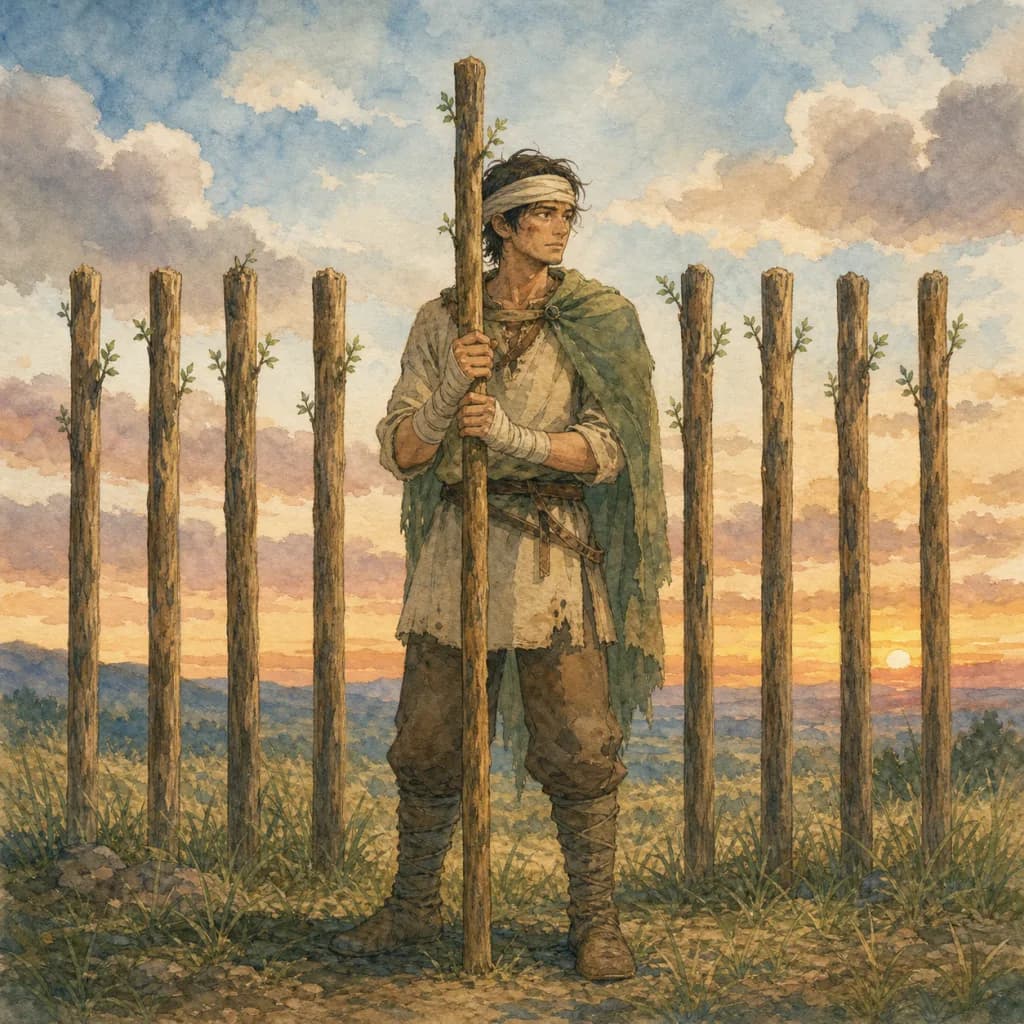
A man stands at the front of eight planted staves, gripping a ninth, and the first thing your eye goes to is the bandage wrapped around his head. He is watching the gap to his left, jaw set, weight shifted onto the staff like it is the only thing holding him up. Nobody is attacking. The Nine of Wands meaning gets summarized as "you're tired but almost there, keep going" so reliably that almost no guide stops on the detail that decides everything: the wound is already healed over, and the fence behind him is already finished. He built his defenses some time ago. Now he is guarding them out of a posture his body learned and never put down.
Most guides describe a soldier mid-battle. Look again. The battle is over. What you are watching is the part nobody photographs — the man who cannot tell that it ended.
Quick Answer
Upright, the Nine of Wands means resilience under fatigue: you have weathered a long run of difficulty, you are bruised but still on your feet, and one more test stands between you and the finish. It asks for persistence and clean boundaries. Reversed, that same guardedness curdles into exhaustion, paranoia, or stubborn defensiveness — bracing against threats that have passed, refusing help, or burning out from never lowering your guard. As a Yes/No card it leans toward a cautious yes: you can make it, but only if you keep going without barricading yourself away from everyone.
Basic Information
| Card Name | Nine of Wands |
| Suit | Wands |
| Arcana | Minor Arcana |
| Element | Fire |
| Astrological Correspondence | Moon in Sagittarius |
| Yes / No | Cautious yes (you can endure, but stay open) |
| Upright Keywords | resilience, persistence, last stand, boundaries, guardedness, courage under fatigue |
| Reversed Keywords | exhaustion, paranoia, defensiveness, giving up, overwhelm, refusing help |
Card Imagery & Symbolism

Pull up the Rider-Waite-Smith image and the scene reads as wary at a glance: one figure, nine wands, a defensive stance. Pamela Colman Smith packed three details into it that most popular guides walk straight past, and each one changes how you read the card.
The Bandage Is an Old Wound, Not a Fresh One
The cloth wrapped around the man's head is the detail everyone names and nobody finishes. They call him "battered" and move on. Look at the bandage. It is clean, settled, dressed — the wound under it has been treated and is well past bleeding. Someone got hurt here at some point in the past, healed, and kept the dressing on. The card shows you a scar that the figure is still defending as though the blow could land again any second. That gap between when the wound happened and how he is still standing guard over it is, to me, the entire psychological engine of this card.
The Eight Wands Behind Him Are a Fence Already Built
Eight staves stand upright in a row behind the figure. The older guides love to call them enemies looming over him. Read them instead as a wall he has already raised. Eight wands planted firmly, evenly spaced, is a finished palisade. The work of defending is done. The boundary exists. He is standing in front of his own completed fence, holding a ninth wand as if the fence were not enough, as if it could all be breached the moment he relaxes. The structure says safe. His posture says besieged. That disagreement is the message.
The Lone Wand and the Half-Turned Body
He grips the ninth wand close, two-handed, body angled away from the wands and toward the open space on his left. His head is turned over his shoulder, scanning. This is the posture of someone who has decided the danger comes from a direction he cannot see — so he never fully faces forward, never fully rests. The half-turn is the tell. People at ease face the way they are going; this figure stays permanently fixed on his flank, checking the ground beside him. He has organized his whole stance around an attack that may not be coming.
Nine of Wands Upright Meaning
Core keywords: resilience, persistence, the last stand, boundaries, courage under fatigue.
Upright, the Nine of Wands is the card of being almost through. You have come a long way and it has cost you. The card finds you with the finish line in sight and your reserves nearly spent, and it says the obvious encouraging thing first: do not quit here. Everything you have already survived is proof you can take one more round. This is the deck's clearest portrait of grit: the worn, stubborn kind that keeps a person upright long after the fresh energy of the Ace has drained away.
The honest part of the upright reading is that the last test will still be hard. What the card promises is that you have what it takes to meet it. The strength here is earned, scarred, slightly suspicious of good news. That is appropriate. Someone who has been knocked down repeatedly and gotten up each time has a right to be wary.
Boundaries are the other half. The Nine of Wands is the strongest boundary card in the Minor Arcana, and upright it asks you to hold your line: protect your energy, say no to the people who drain it, defend the thing you have been building. You have already done the hard work of putting up the fence. The upright instruction is to trust it and keep watch a little longer.
There is one caution folded inside the upright meaning, and it is the bridge to everything below. Guardedness that kept you alive can outlive its usefulness. Hold the line, but check that there is still something on the other side of it worth holding off.
Nine of Wands Reversed Meaning
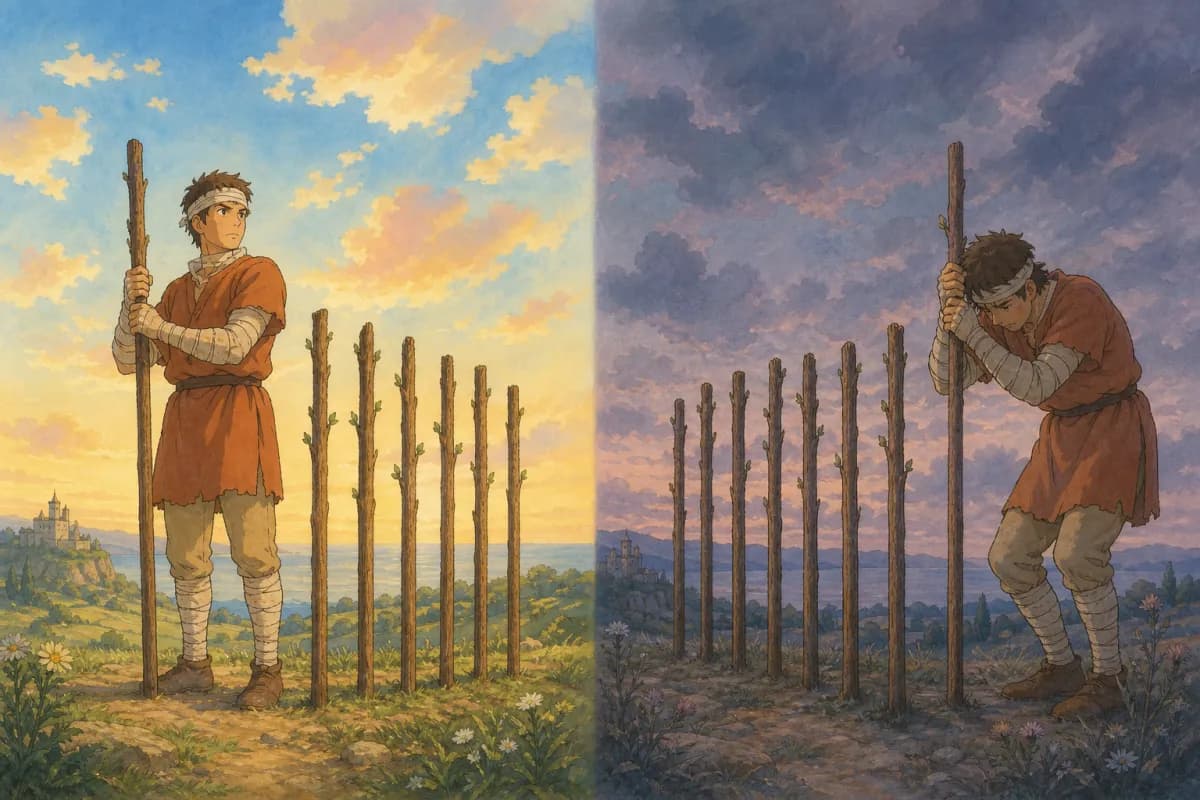
First, plainly: the reversed Nine of Wands is not a catastrophe card, and I correct clients who treat it as one. It is more like the upright card with the volume turned past where it helps. The resilience is still there. It has just stopped serving you.
Three readings are worth telling apart. The first is burnout — you have held the line so long that the holding itself is what is breaking you. The fight may genuinely be over, but your body never got the message, and the exhaustion of permanent vigilance has become the real problem. The second is paranoia and over-defensiveness — you are bracing against threats that have already passed or never existed, treating ordinary people as siege engines, reading help as an attack. This is the bandage and the half-turn taken to their unhealthy extreme. The third is giving up — the opposite failure, where you finally drop the wand one step short of the finish — you could go on, but you cannot face one more test.
Telling these apart changes the advice entirely. Burnout asks you to rest and stop pushing. Paranoia asks you to test whether the danger is current or remembered. Surrender asks you to find the small reserve that gets you across the last stretch. The card reversed hands you no verdict. It points at which kind of stuck you are in.
The thread running through all three is the refusal of help. Reversed, this figure will not let anyone past the fence — not the people trying to relieve him, not the ones who would gladly stand watch so he could sleep. The card asks a quiet question here. Who have you locked out by defending a perimeter that no longer needs defending?
Is the Nine of Wands Guarding a Real Threat, or Bracing Out of Old Habit?
This is the question the top-ranking guides do not ask, and it is the one that decides what the card is actually telling you to do this week. Every popular page reads the figure as a soldier facing one more enemy. None of them check whether there is an enemy.
Go back to the three details. The bandage covers a wound that healed long ago. The fence behind him already stands, finished. His body is half-turned toward a threat he cannot see, his back to the open ground ahead. Put those together and the card shows you someone braced against an attack that already happened — running the defense program long after the war ended.
So the real question the Nine of Wands puts to you is a diagnostic one. Is the thing you are guarding against actually in the room? Or are you defending the spot where you once got hurt, against the memory of getting hurt there?
These are not the same situation and they do not take the same advice. If the threat is real and present — the deadline is genuinely looming, the person genuinely is trying to take what you built — then the card is straightforwardly on your side. Hold the line. Keep watch. You have one more round in you. The wariness is accurate.
But if the bandage has healed and the fence is finished and you are still scanning the treeline out of a habit your nervous system learned during a danger that has passed, then "keep pushing, set firmer boundaries" is the worst possible advice. It tells you to reinforce a wall against an empty field. It mistakes a trauma response for a strategy.
Here is the test I give clients. Name the specific threat. Out loud, in present tense, concretely: who or what is going to breach the fence this week, and how. If you can name it and it holds up, the upright reading applies and you should defend. If you reach for the answer and what comes back is "I don't know, but I can't relax," that is the bandage talking — old habit dressed up as danger. That is the moment the card is asking you to do the genuinely hard thing — harder than fighting — which is to put the ninth wand down and find out whether the field is actually empty.
I will say plainly where I land, because a balanced non-answer would not help you. In the majority of Nine of Wands readings I have done, the threat the querent is braced against is not in the room. The card shows up far more often for over-defending than for under-defending. That is its real warning, and almost nobody writes it.
Career & Long Projects
The Nine of Wands is at home in a work spread, and it shows up at a very particular point: the grind near the end. You are deep into something — a project, a degree, a build-out, a long campaign — and running on fumes with the finish in sight. The card says you are closer than your exhaustion is letting you believe, and the distance you have already covered is the evidence that you can cover the last bit too.
The trap at work is the defensive crouch. People who pull this card in a career reading often have stopped collaborating without noticing — guarding their turf, refusing to delegate, treating colleagues as competition for resources that are not actually scarce. The fence that protected your project early can wall off the help that would get it finished. Look hard at the people you are holding at arm's length. Often they are reinforcements wearing the face your fatigue painted on them.
A pattern from years of reading professionals in Tokyo: this card lands constantly for people one promotion or one launch away from the thing they wanted, who have started sabotaging it through sheer defensive exhaustion. A founder I read for in Ebisu had pulled the Nine of Wands twice in a month while raising a final round. The deal itself was fine. She was so braced for it to collapse — because two earlier ones had — that she was reading every ordinary investor question as an ambush and nearly talked herself out of a clean offer. The earlier collapses were the bandage. She was guarding a fresh, willing room as though it were the two that had walked out on her.
Love & Relationships
In a love reading the Nine of Wands carries the same wariness, and it splits cleanly by situation. For couples, it often marks a relationship that has been through a rough stretch and is still standing — bruised and tired, yet very much alive. The card encourages you to see the last hard part through, now that the worst already sits behind you. There is loyalty in it, the kind that has been tested.
For singles and for anyone carrying a past relationship into the present, the card gets sharper. This is the person guarding their heart behind a finished fence because the last wound taught them to. The bandage is the old breakup. The vigilance is the wall they built afterward. So the question returns in a romantic key: the new person usually has nothing to do with the one who hurt you, yet the perimeter treats them as the same intruder. The Nine of Wands in love is frequently a card about letting someone past a perimeter that no longer needs to be there.
Personal Energy & Boundaries
Stripped of context, this is a card about your reserves and the walls you have built around them. It reads as someone running low on energy who has been holding firm so long they have forgotten what rest feels like. The boundaries are real and often necessary. The card's harder challenge is to notice when the act of protection has become the very thing draining the energy it was meant to guard.
The practical read is to audit the fence. Some of those eight wands are genuinely load-bearing and should stay. Some are walls you put up during a hard season that ended, and they are now just things you maintain at a cost. Hold on to the boundaries that still protect something real. Let the ones that only guard a memory come down. Resting still counts as keeping watch — it is what keeps the guard worth anything for the moment you actually need it.
Nine of Wands Card Combinations
- Nine of Wands + Eight of Wands — the rush right before the wall. The Eight is fast motion and things finally moving; the Nine catching it suggests you are weathering the draining sprint of a project in full flight. Brace for the speed without seizing up. The end is close and arriving quickly.
- Nine of Wands + Ten of Wands — the warning combination. You are exhausted from guarding (Nine) and about to pick up an even heavier load (Ten). This pairing says: before you take on more, ask what you can put down. Otherwise the last stand becomes a permanent burden you carry alone.
- Nine of Wands + The Tower — the threat is real this time. When the Tower sits beside the Nine, the wariness is accurate; something genuinely is about to shake. Here the defensive posture is justified — hold what you can, and let the parts that must fall, fall.
- Nine of Wands + Four of Swords — the rest you keep refusing. The Four of Swords is explicit recovery, and beside the over-guarding Nine it is the deck almost begging you to lower the wand and sleep. If both turn up, the message is plain: the fight is over, so put it down.
- Nine of Wands + Strength — two kinds of resilience side by side. Strength is the quiet, open courage that needs no wall, set against the Nine's braced, scarred version of the same nerve. Together they ask you to trade some of the defensive grit for the calmer power that does not need to keep its fists up.
- Nine of Wands reversed + The Sun — safety you cannot let yourself feel. The Sun floods the field with bright, all-clear daylight, and there you are, still scanning the treeline out of habit. This is the clearest "the threat is not in the room" pairing in the deck.
Numerology & Astrological Correspondences
As a nine, this card arrives one step before the suit completes at ten: the fire of Wands has been through every prior stage and shows up weathered, tested, nearly done. It carries Moon in Sagittarius — the Moon's instinct and emotional memory laid over Sagittarius' restless, freedom-seeking fire, which is exactly why the card feels like an old emotional wound bracing inside a body that wants to keep moving. There is a useful word for the figure's stance: digging your heels in and refusing to be moved, the act of standing your ground against pressure. It names a posture, a way of holding the body, with no promise about how things turn out. That held ground earns its admiration only as long as there is something real to hold against; the moment the field empties, the same stance becomes pure fatigue.
Frequently Asked Questions
What does the Nine of Wands mean in a tarot reading?
It means resilience under fatigue. You have been through a long, hard run, you are bruised but still standing, and one final test sits between you and the finish. The card asks you to persist and to hold your boundaries — while checking that the thing you are guarding against is still actually there.
Is the Nine of Wands a yes or no card?
It is a cautious yes. The card says you can endure and come through, but the yes is conditional on not barricading yourself away or quitting at the last step. Treat it as a conditional "yes, if you keep going and stay open to help" — never an unconditional green light.
Is the Nine of Wands reversed always negative?
No. Reversed it usually means the resilience has overshot into burnout, paranoia, or stubborn refusal of help — or, less often, giving up just before the finish. The work is to identify which one is happening, because rest, reality-testing, and one last push are completely different responses.
What does the Nine of Wands mean in love?
For couples it often marks a relationship that has survived a rough patch and is worth seeing through the last hard stretch. For singles it points to a guarded heart defending against an old wound. The honest work is to check the new person on their own evidence, since the fear usually belongs to whoever caused the last wound, not to them.
What does the Nine of Wands say about boundaries?
It is the strongest boundary card in the Minor Arcana. Upright, it tells you to protect your energy and hold your line. The deeper instruction is to audit the line, holding on to whichever boundaries still protect something real and letting the leftover ones that only guard a memory come down.
Why does the figure in the Nine of Wands look injured?
Because he is carrying an old wound, shown by the bandage around his head. The key detail most readings miss is that the wound has healed; he stays braced over a scar that stopped bleeding long ago. That gap between the past hurt and the present vigilance is the heart of the card's meaning.
What is the astrological correspondence of the Nine of Wands?
Moon in Sagittarius. The Moon brings emotional memory and instinct, while Sagittarius adds restless fire, which is why the card reads as an old emotional wound bracing inside a body that still wants to move forward.
Closing
The next time this card turns up, do not just file it under "keep pushing." Name the threat out loud, in present tense, concretely. If you can name it and it holds, defend your line — you have one more round in you. If what comes back is only "I can't relax, but I don't know why," that is the bandage talking, and the brave move is to set the ninth wand down and walk into the field to see whether anyone is actually there.
Follow the suit's arc into the final weight of Ten of Wands, or step back to the fast motion that runs you up to this wall in Eight of Wands.