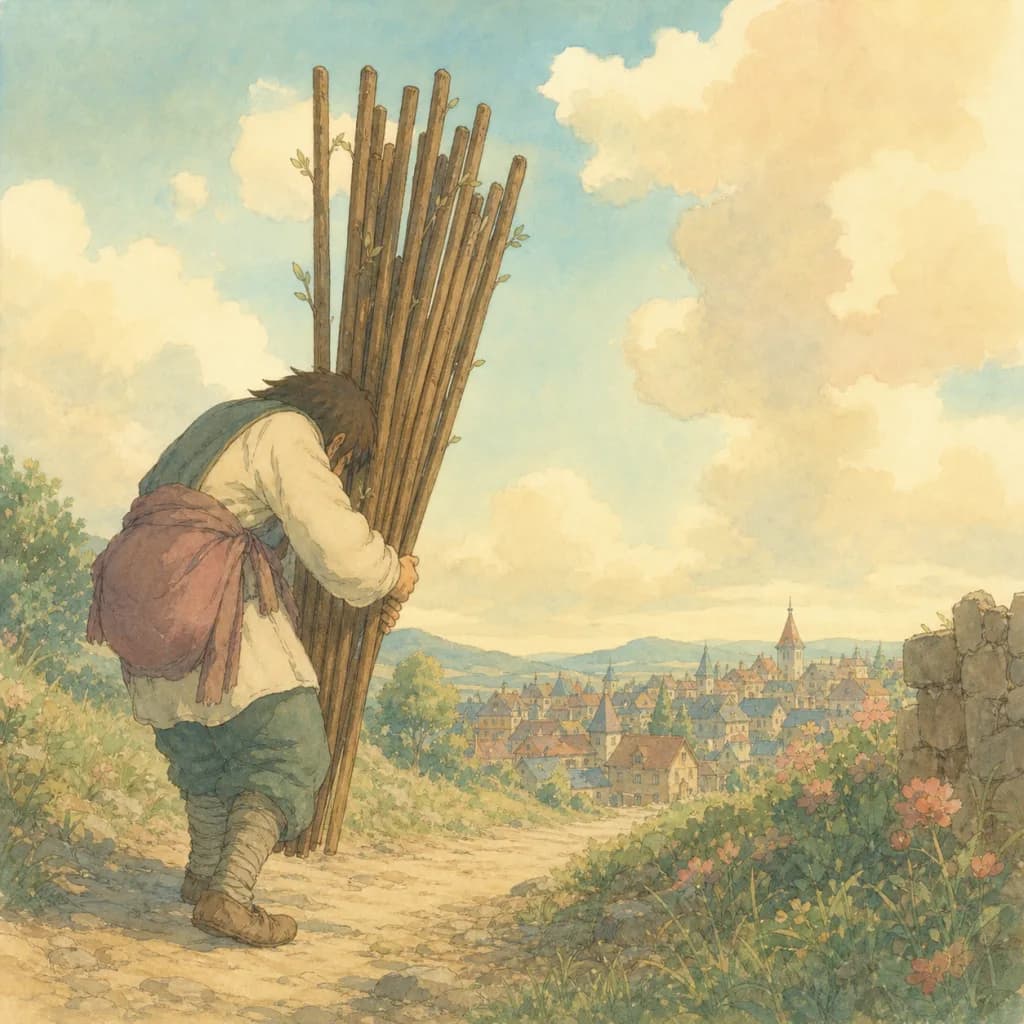
A man walks the last stretch toward a town, ten heavy staffs gathered in his arms and pressed against his chest. His back is bent almost double. The town is close — you can see the rooftops — and he is nearly home. That is the scene every guide describes, and it is correct as far as it goes. The detail they skip past is where his face is pointing: straight into the bundle. The Ten of Wands meaning is usually flattened to "you have too much on your plate." That reading holds, and it still misses the quieter cruelty in the picture: the load is held in the one position that stops him from seeing the very place he is trying to reach.
This is the card of carrying it all when you no longer remember which parts were yours to carry.
Quick Answer
Upright, the Ten of Wands means burden, overload, and responsibility that has piled up faster than you have put anything down — hard work near its finish, carried at real cost. Reversed, it points to burnout, collapse, or the moment you finally delegate, release, or set down what was never yours to hold. As a Yes/No card it leans No, or "yes, but only if you are willing to keep paying this much for it."
Basic Information
| Card Name | Ten of Wands |
| Suit | Wands |
| Arcana | Minor Arcana |
| Element | Fire |
| Astrological Correspondence | Saturn in Sagittarius |
| Yes / No | No (or yes at a heavy cost) |
| Upright Keywords | burden, responsibility, overload, duty, hard work near completion, carrying it all |
| Reversed Keywords | burnout, delegation, release, collapse, letting go of what is not yours |
Card Imagery & Symbolism
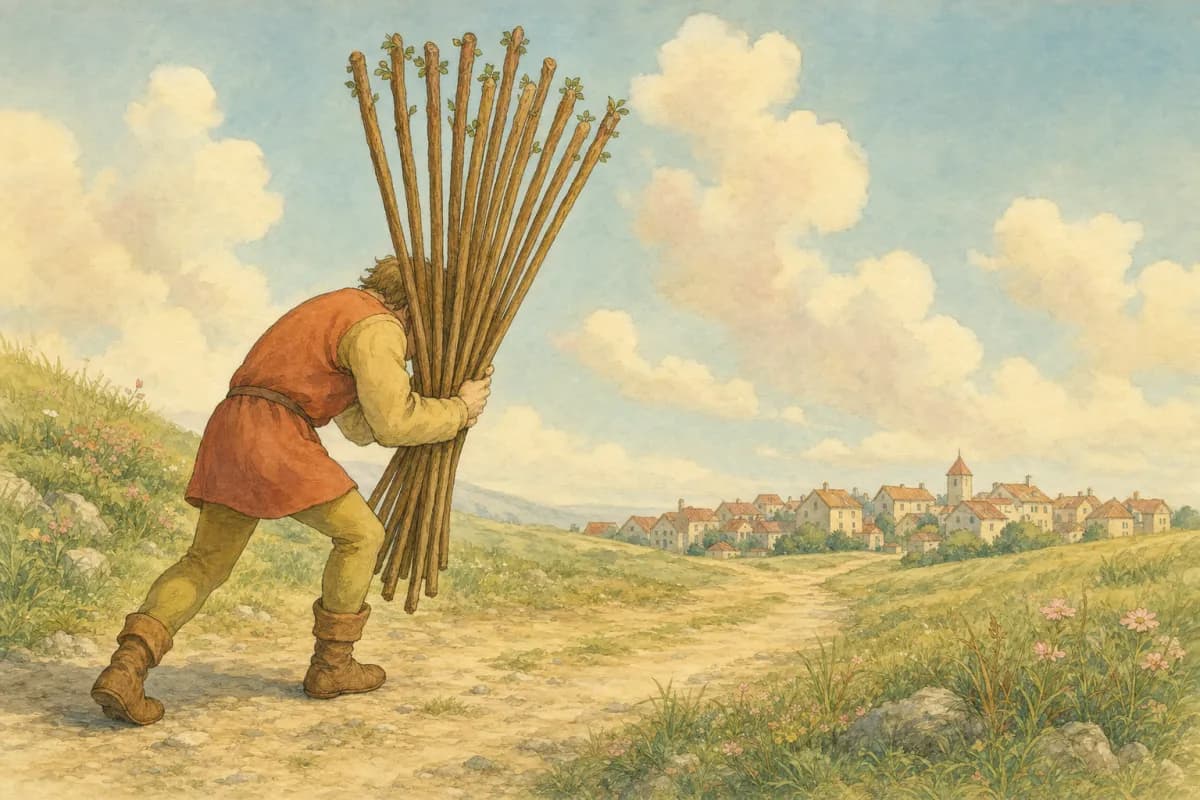
Pull up the Rider-Waite-Smith image and you get a deceptively simple scene: one figure, ten wands, a town on the horizon. No demons, no swords, no falling towers. The drama of this card is entirely in the body language, which is exactly why the careless reading misses it. Pamela Colman Smith hid the whole argument in posture and sightline.
The Wands Are Clutched to the Chest, Not Carried on the Back
Look at how he holds them. The ten staffs are bundled together and hugged against the front of his body, arms wrapped around the whole armful. This is the least efficient way a person can carry ten long poles. A woodcutter would balance them across one shoulder or sling them behind him, keeping his arms free and his eyes clear. Smith chose the awkward arrangement deliberately. Held to the chest, the wands cover his torso, weigh down his arms, and rise up in front of his face. The posture reads like an embrace. The grip says something the keywords leave out: on some level he is holding on.
The Body Is Bent Forward, Folding Around the Weight
His spine curves over the bundle until his head is nearly level with the tops of the wands. Compare this to the Nine of Wands, where the wounded figure still stands upright and watchful. By the Ten, the standing is over. The forward fold is the shape of someone who has stopped looking up because looking up costs energy he no longer has. There is a specific exhaustion in that curve. It comes from the slow compression of weight that has been there long enough to reshape the body around it. Months of wear leave their own kind of mark, the kind that settles in gradually and stops feeling like an injury at all.
The Town Sits Close Ahead — and He Cannot See It
The rooftops are right there, a short walk away. This is the detail that turns the card from sad to almost unbearable once you notice it. Relief is close. Safety, rest, the place to set everything down — all of it is within reach. The wands rise in front of his eyes, though, and his head is bowed into them, so the destination he is breaking his back to reach is the one thing he cannot actually see. He is close to home and walking partly blind. Most guides mention the town as "the goal is near." Few notice that the card has arranged the load so the goal stays hidden from the one person who needs it most.
Ten of Wands Upright Meaning
Core keywords: burden, overload, responsibility, duty, hard work near completion, carrying it all.
Upright, this card is the feeling of being saddled. It accumulates into a steady load, gathering one obligation at a time until the pile is enormous. It is the inbox that refills as fast as you clear it, the family everyone expects you to hold together, the role at work where your reward for competence is more work. The Ten of Wands describes a situation that probably began as something you wanted. The project was a good idea. The promotion was real. The relationship was worth tending. Then one reasonable thing got added, and another, and you never put anything down, and now the sum of all those sensible yeses is bending your back.
What makes it a Wands ten specifically — a card with real bite to it, sharper than generic stress — is the source of the weight: it is the fire suit. Wands are drive, ambition, projects, will. So the weight here is self-generated: it is the accumulated mass of your own initiatives and commitments — the things you started, the responsibilities you accepted because you cared. The burden has fuel in it. That is precisely why it is so hard to put down.
The card is honest about the upside. Tens close a cycle, and the town is near. You are almost there. If the question is "should I push through the last stretch," the Ten often answers yes — the finish line is real and close. It attaches a bill to that yes. You can finish, and you can finish carrying all of it, and you will arrive emptied out, and you may not even register the arrival because you have been staring at the load for so long.
The harder upright question is whether all of it actually needs to come with you. Your ability to carry it is rarely in doubt — you clearly can, and that capability is exactly the trap.
Ten of Wands Reversed Meaning
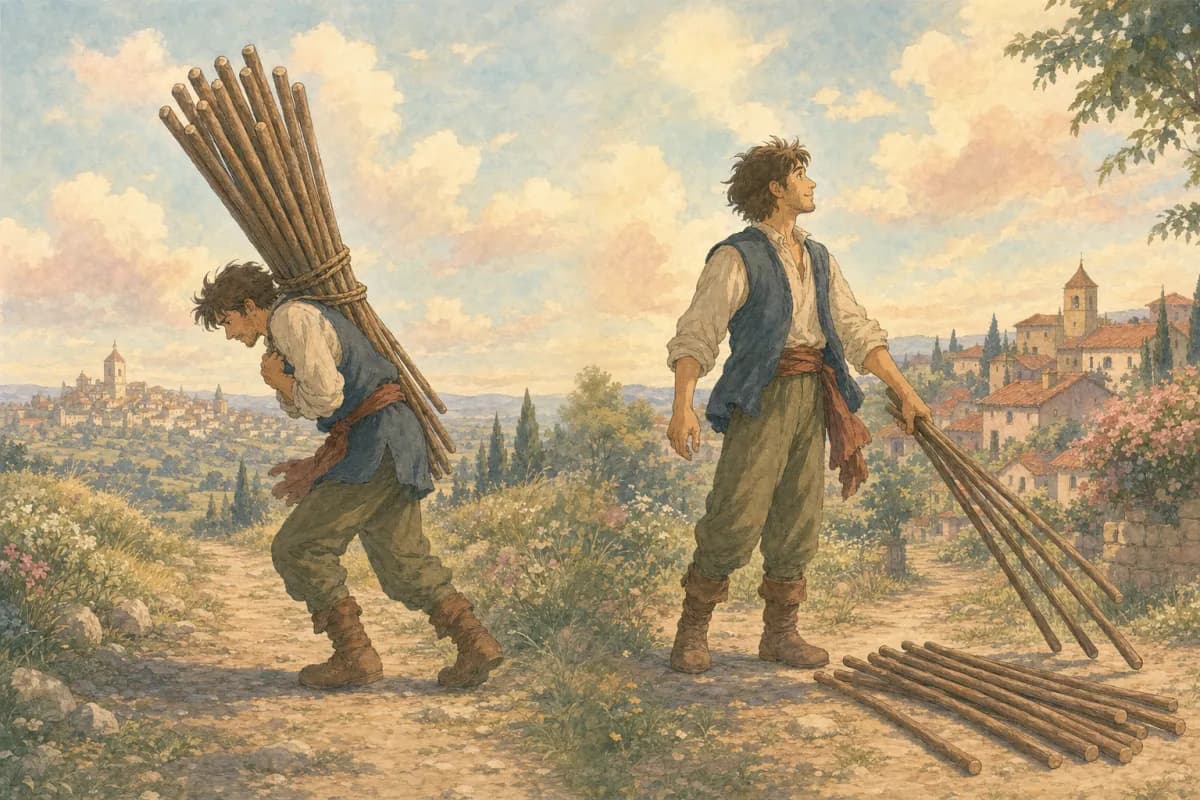
First, plainly: in many readings the reversed Ten of Wands is the more welcome card to draw. It is the card finally moving.
Reversed, the bundle tips, and there are two very different ways it can fall.
The first is release — the good version. You delegate. You say no. You go through the armful and discover that three of these wands were handed to you by other people and you have simply never given them back. This is the reversal as relief: the weight coming off, the spine straightening, the realization that "I have to do everything myself" was only ever a story you told yourself. When the reversed Ten shows up next to supportive cards, I read it as permission to let go.
The second is collapse — the burnout version. Here the wands drop because the body simply gives out under them. This is the all-nighter that turns into illness, the caretaker who breaks, the resentment that finally boils over. Here the release happens to you, on the body's schedule. The difference between these two reversals comes down almost entirely to timing: whether you choose to put things down before your body chooses for you.
There is a third, subtler reversed reading I see often — the person carrying the load in secret. Upright, the burden is at least visible; everyone can see the bent back. Reversed can mean you have started hiding it, insisting you are fine, refusing every offer of help. The weight stays exactly the same. You have simply added the extra labor of pretending it is not there.
Why are the wands carried in the one way that hides where the carrier is going?
This is the question most guides skip, and it is the heart of what the card is actually warning about. They all note the heavy bundle. They mention, in passing, that he "cannot see past his wands," and then they move straight on to delegation advice. That single visual fact — load held high against the face, blocking the line of sight to the town — is the whole lesson, drawn deliberately.
Go back to the posture. He could carry these wands a dozen easier ways that would leave his eyes free. Smith drew the one arrangement that puts the burden directly between him and his destination. Read that as a sentence: the way you are carrying this is blocking your view of why you are carrying it. The town — the reason, the rest, the point of the whole journey — is hidden by the very load he took on to get there.
I have come to read this card as a warning about a specific failure mode, and it is the one that hits the most responsible, conscientious people I read for. You take on the load for a reason — to provide, to finish, to not let anyone down. The load grows. And at some point the carrying becomes the whole world. You stop being able to see the reason because the reason is behind the wands. People in this state will tell you, with total sincerity, that they are doing all of this "for the family" or "for the future" while no longer having any contact with the family or any image of the future. The carrying has eaten its own purpose.
This is what makes the Ten of Wands more than a stress card. Stress says "this is heavy." The Ten of Wands says "this is heavy and you can no longer see what it is for." Those are different problems with different cures. Heaviness eases with rest. Lost sight of the point only returns when you lift your head — when you set the bundle down long enough to look at the town and ask whether you are still walking toward it, or just walking.
A client once described her job to me for ten minutes — every duty, every deadline, who depended on her for what. I asked her what she was working toward. She went quiet, and then she laughed, a little frightened, because she genuinely could not answer. She had drawn the Ten of Wands. She was three streets from the town and had forgotten the town existed. That is the card. It describes a particular kind of lostness: you have stopped being able to see the point, because the point is on the other side of everything you are holding.
So when this card turns up, the useful move is to stop, lower the bundle, and look up. Pushing harder toward a finish you can no longer see only deepens the problem. The town is closer than the weight is letting you believe.
Career & Workload
This is the Ten of Wands' home ground, and the reading is direct. In a work spread it points to professional overwhelm — too many projects, too many people relying on you, the steady habit of saying yes to the next thing before the current things are done.
There is a particular pattern to notice. This card haunts capable people. Because you can handle it, you get handed it; because you handle it, you get handed more. Competence becomes its own punishment. The reward for being the reliable one is an ever-growing armful of wands, and nobody upstream is counting them because you have never complained.
The practical move here is to audit the bundle — you are already working hard enough. Go wand by wand and ask which of these are actually your job, which got quietly delegated to you because you would not say no, and which could go back. The Ten reversed in a career context is often the deck telling you the delegation is overdue and safe to do.
Personal Energy & Burnout
Stripped of context, the Ten of Wands is a vitality card pointing the wrong way. It reads as energy running on fumes — the fire of the Wands suit nearly spent on hauling. For someone going through the motions, exhausted, dragging through each day on obligation while the want that once fueled it has gone quiet, this card is the deck naming it out loud.
The warning is in the forward fold of the figure's spine: weight carried long enough starts to feel like your permanent shape. People in a Ten of Wands season often cannot remember that they used to stand upright. The danger lies in mistaking the bent back for who you are now. A posture held for months starts to feel permanent, even though it began as a temporary response to a temporary load.
The kind reading treats this as a load you happen to be under, something separate from who you are. Loads can be set down. Ten heavy things would tire anyone, so the exhaustion is simply proof of how much you have been holding.
Ten of Wands Card Combinations
- Ten of Wands + Nine of Wands — the full exhaustion arc in two cards. The Nine is the wounded figure still standing guard; the Ten is what happens when that vigilance turns into a load you can no longer put down. Together they read as someone who has been defending and carrying for far too long. The advice is the same in stereo: the threat has likely passed already, while your body keeps standing guard out of pure habit.
- Ten of Wands + The Devil — a burden you are choosing to keep. The Devil's loose chains and the Ten's clutched bundle rhyme: both show someone who could let go and does not. This pairing asks the hard question about whether the overload is truly imposed on you or whether you are holding on because the load has become your identity or your excuse.
- Ten of Wands + The Sun — the town, made explicit. The Sun is the relief and clarity waiting on the far side of the bundle. I read this combination as one of the most hopeful pairings the Ten can land in: the thing you cannot see past your wands is good, close, and worth lifting your head for. Set something down and look.
- Ten of Wands + Eight of Wands — fast motion meeting a body that cannot keep up. The Eight wants everything to move quickly; the Ten is already overloaded. This is the recipe for a crash — too much arriving too fast onto shoulders that are full. Slow the intake before the bundle drops on its own.
- Ten of Wands + Four of Wands — the rest you keep postponing. The Four is celebration, home, the laid-down load and the open arms. Next to the Ten it reads as a direct invitation: the homecoming is available right now, and you are walking past it because you will not stop carrying. Permission to arrive.
- Ten of Wands + Strength — endurance pushed past its healthy limit. Strength is gentle, sustainable power. The Ten is that same power spent until it strains. This pairing often means the very quality that makes you strong — your capacity to bear things — has tipped into hurting you. Real strength here may be the strength to say no.
Numerology & Astrological Correspondences
As a ten, this card closes the Wands suit — the full cycle of fire run all the way to its end, every spark from the Ace now grown into a weight. Tens are completion, and the Ten of Wands is completion at its most costly: you finished, and look what finishing took. Its astrological signature is Saturn in Sagittarius, which is almost too apt — Saturn the planet of duty, limits, and burden, sitting in the sign of the seeker who wants the far horizon. The card is exactly that tension: the long-distance dreamer weighed down by obligation, the fire of Sagittarius pressed flat under Saturn's load. There is a useful word for the human gesture at the center of it — to gather everything into your own arms and hold it alone, the way a person shoulders far too much and quietly refuses to let anyone share the weight. That single gesture is this card's whole posture.
Frequently Asked Questions
What does the Ten of Wands mean in a tarot reading?
It means burden and overload — responsibility that has accumulated until it weighs you down, often work or duty you took on for good reasons and never set back down. The figure carries ten heavy staffs toward a town that is close but hidden by the load. Its central question is whether all of it is actually yours to carry.
Is the Ten of Wands a positive or negative card?
It is mostly a hard card that still carries real hope. The weight is real and the strain is real, and the town is near — the cycle is close to complete. The most useful reading treats it as a prompt to set down whatever was never yours, so you reach the finish line lighter and still standing.
What does the Ten of Wands mean in love?
In a relationship it usually means the partnership has come to feel like a chore, a standing obligation that drains more than it gives back. One person may be carrying the whole weight — the planning, the emotional labor, the effort — while the other takes a back seat. It signals resentment building under the surface and a need to redistribute the load before it breaks.
What does the Ten of Wands reversed mean?
Two things, depending on the surrounding cards. The hopeful version is release: you delegate, say no, and set down what is not yours. The harder version is collapse or burnout — the load dropping because your body or mind gives out. It can also mean carrying a burden in secret and refusing all offers of help.
Is the Ten of Wands a yes or no card?
It leans toward no, or toward "yes, but at a cost you should count first." Because the card is about overload, it rarely encourages taking on more. If the question is whether to push through something already underway, it can be a tired yes — the end is near — with a warning attached that you will pay for it.
What is the difference between the Nine and Ten of Wands?
The Nine of Wands is the wounded defender still standing, braced and watchful after a long fight. The Ten of Wands is what comes after the standing stops — the burden carried, the back bent, the figure now hauling a load. Think of the Nine as vigilance and the Ten as weight. See the Nine of Wands for the card just before this one in the suit's arc.
How do I act on the Ten of Wands?
Lower the bundle and look up. Go through what you are carrying and name which parts are genuinely yours and which got handed to you. Delegate, decline, or release at least one thing. Even if you keep it all, change how you hold it so the load stops blocking your view of why you started.
Closing
The next time this card turns up, read it as an invitation to lighten the load. Treat it as a cue to ease the grind toward a finish you can barely see. Pick one wand out of the armful — one task, one obligation, one thing you have been holding because no one else would — and put it down today. Then lift your head. The town you are walking toward is closer than the weight has been letting you believe.
Trace the suit's exhaustion arc backward with the Nine of Wands, or step into the relief on the far side of the load with the Four of Wands.