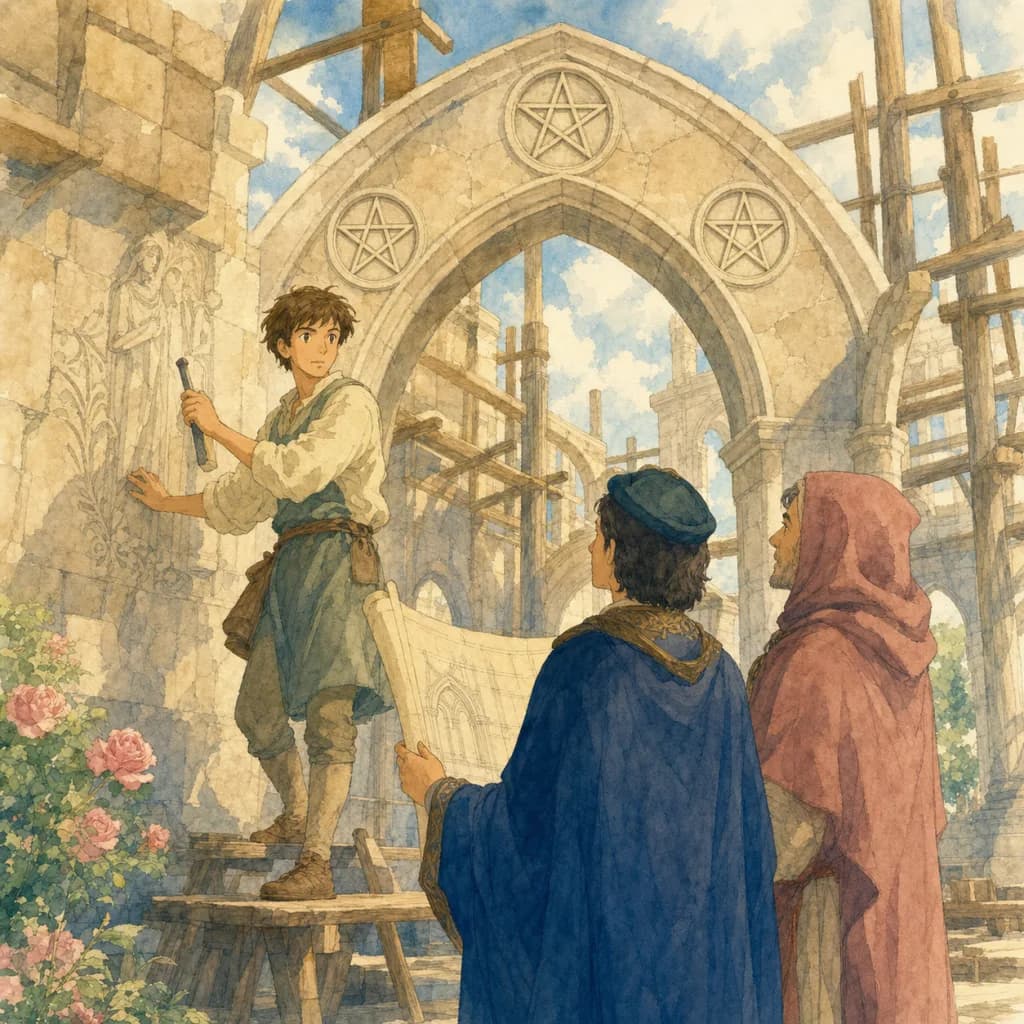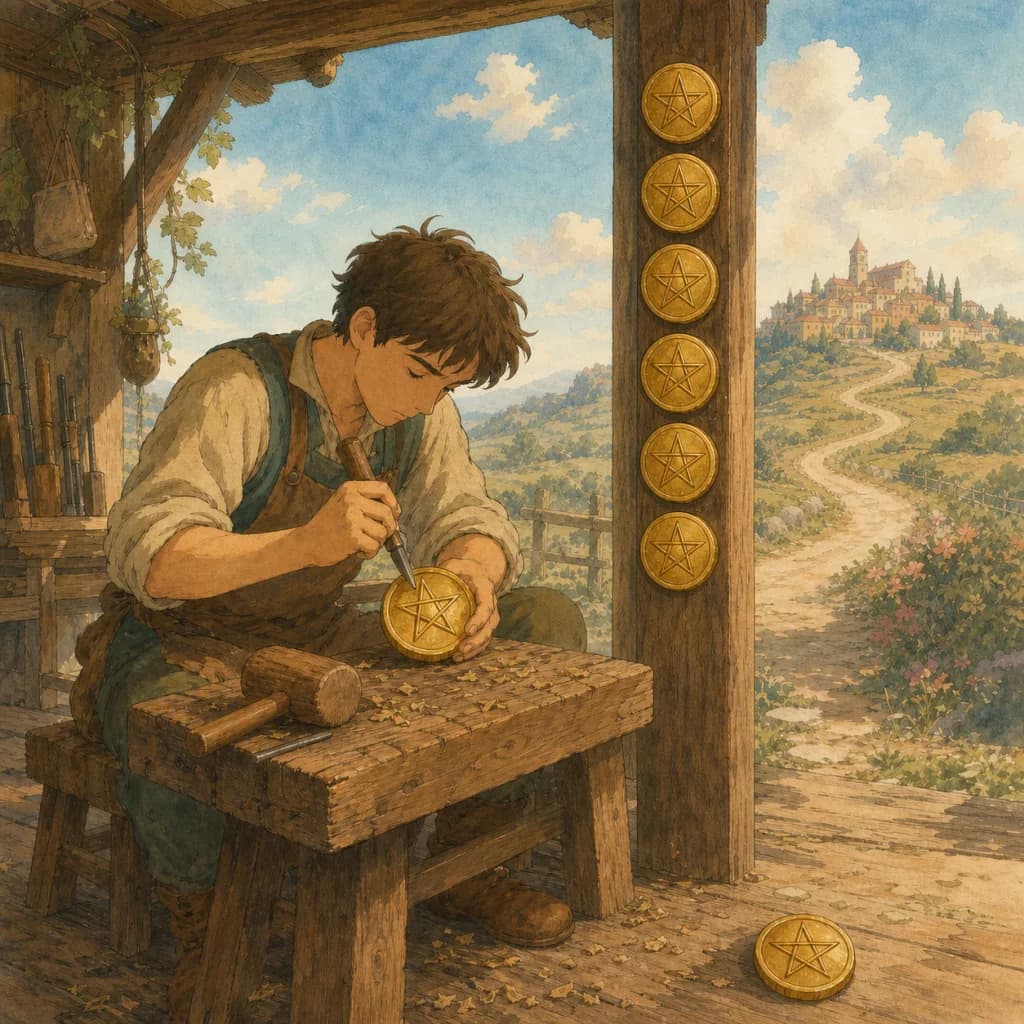
A craftsman sits at his bench with his head down, chiselling a star into a coin. Six finished pieces already hang on the post beside him. One more is clamped in his hands, half-done. His eyes have left the six already. They skip past the town on the hill behind him too, where people are eating dinner and talking to each other. His whole gaze has narrowed to the single coin in front of him, and the Eight of Pentacles meaning lives in that narrowed gaze more than in any keyword list.
Most guides will tell you this card is about hard work and skill, and they are right. Here is the quieter detail almost everyone walks past: the town is painted deliberately out of reach, and the man chose that.
Quick Answer
Upright, the Eight of Pentacles means diligence, apprenticeship, and the slow building of mastery through focused, repeated effort — you are putting in the hours and the work is shaping you. Reversed, it points to perfectionism, joyless repetition, cutting corners, or working without your heart in it — the motion continues but the growth has stopped. As a Yes/No card it is a yes, on the condition that you are willing to keep showing up.
Basic Information
| Card Name | Eight of Pentacles |
| Suit | Pentacles |
| Arcana | Minor Arcana |
| Element | Earth |
| Astrological Correspondence | Sun in Virgo |
| Yes / No | Yes (with sustained effort) |
| Upright Keywords | diligence, mastery, apprenticeship, skill development, focus, craftsmanship |
| Reversed Keywords | perfectionism, uninspired repetition, cutting corners, work without heart |
Card Imagery & Symbolism
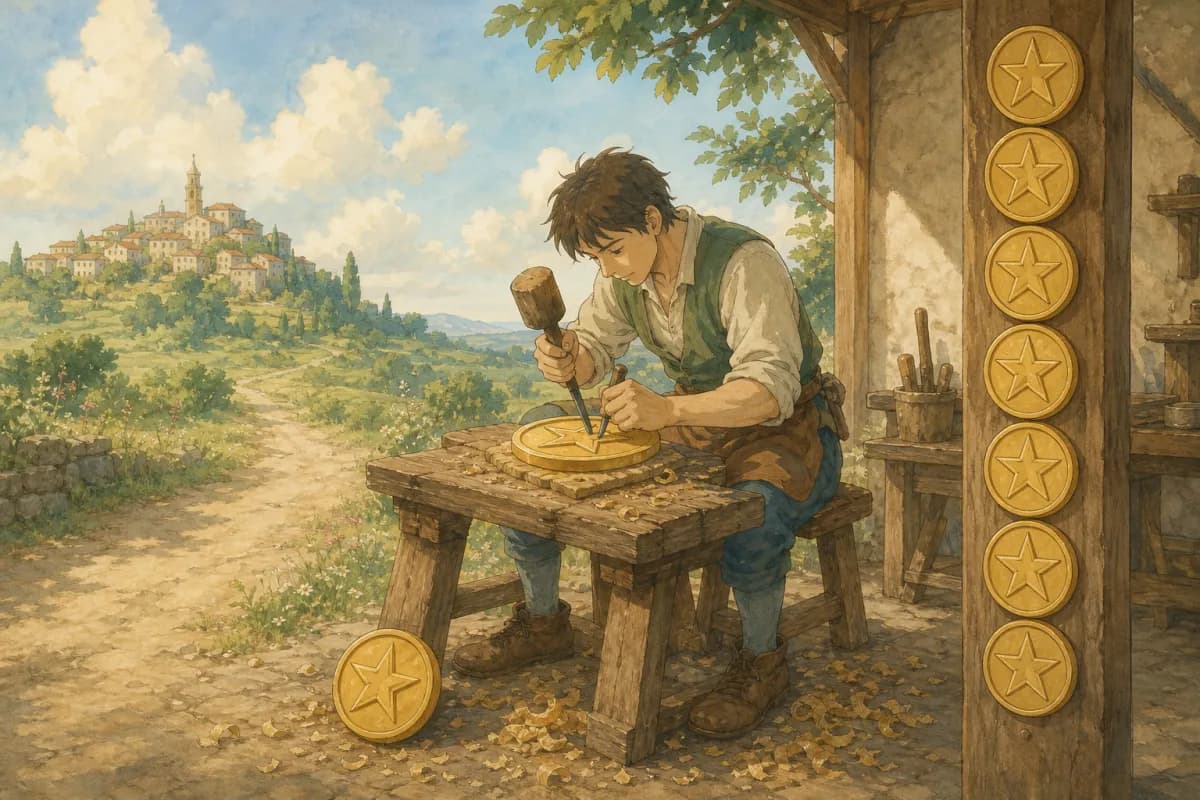
Pull up the Rider-Waite-Smith image and the scene reads as plain at first glance: a man working. Pamela Colman Smith hid the real meaning in the staging — what he keeps close, what he finished, and what he turned his back on.
Six Hung Up, One in Progress, and the Eighth Unaccounted For
He has carved six coins and mounted them on the post, neatly, one above the other. A seventh is in his hands. Count carefully and the eighth is below his bench, sometimes propped against the floor, easy to miss. Here is the detail almost every guide skips: the finished work is displayed but set aside. He gives the six no second glance and no extra polish. They are done, and done things get hung up and left so the hands stay free for the next one.
That arrangement is the whole psychology of mastery in one image. The coin in his hands holds all his attention; the finished six have already faded from it. The moment the seventh is done it will join the others on the post and stop mattering too. The Eight of Pentacles is a card about a person who has learned to find the work itself more interesting than the proof of the work.
The Town Set Far Behind Him, on Purpose
A small town sits in the distance, often to the upper left, separated from the workbench by a clear stretch of empty road. Most Pentacles cards keep community and home close at hand; here they have been pushed to the far edge of the frame. The craftsman has physically removed himself from where the warmth and the conversation are.
I read that distance as a chosen cost, not a sad accident. To go deep on a skill you give something up, usually social, usually pleasant. The road to the town is not blocked — he could walk it any evening. He is choosing the bench tonight, and the card is honest that this choice has a price tag.
Head Down, Fully Absorbed
His posture is the loudest symbol and the one people narrate as simply "concentration." Look closer at what kind of concentration. His shoulders are rounded over the work, eyes down, body folded toward the single object in his hands. He has forgotten he is being watched at all; the absorption has swallowed any thought of an audience.
That state has a name in flow research, and Smith drew it three decades before anyone studied it. Performing competence for an audience is easy enough. What the card honours is the rarer thing — being so lost in the doing that the audience disappears. That is what builds a craftsman.
Eight of Pentacles Upright Meaning
Core keywords: diligence, apprenticeship, mastery, skill development, focus, craftsmanship.
Upright, this card lands when you are in the middle of building something real through repetition. The new job where you are still learning the systems. The instrument you practise daily. The body of work that gets better by one coin at a time. The Eight of Pentacles confirms you are on the apprentice's road, and it approves of the road.
What it specifically rewards is the willingness to be a beginner again. Sun in Virgo is the energy here — careful, exacting, devoted to getting the small things right because the small things are the craft. Picture the flashy Pentacles cards where wealth has already arrived, then set them aside. This is the unglamorous one, where you are still earning the wealth by becoming worth it.
The card also carries a promise about direction. Effort applied with focus compounds. Each repetition deposits something into a skill you cannot see growing day to day, only across months. When this card appears about a project that feels slow, it is usually telling you the slowness is the process doing its job.
One honest caveat I give every client who draws this upright: the card says nothing about whether the right thing is being practised. It blesses the diligence and stays silent on the destination. A person can be magnificently dedicated to a skill that leads nowhere they want to go. The card tells you the engine is running well. You still have to check the map yourself.
Eight of Pentacles Reversed Meaning
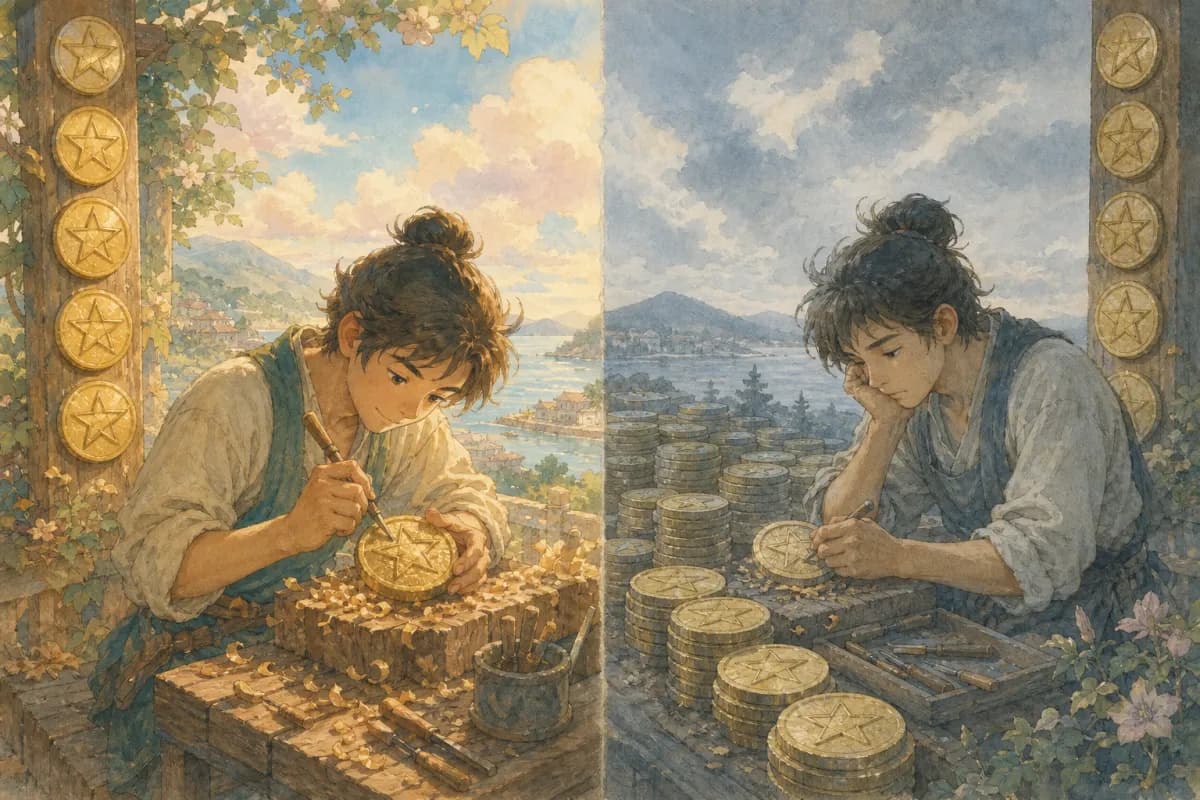
Reversed, this card rarely means failure, and I push back when clients read it that way. Far more often the form of the work has survived while the soul of it quietly left. The hands keep moving even after the learning has gone still.
There are a few shapes this takes. The most common is uninspired repetition — you are doing the same task for the hundredth time and it is no longer teaching you anything, just filling hours. The second is perfectionism, the Virgo energy soured: fussing over a detail nobody will notice while the larger work stalls, polishing a single coin forever because finishing means being judged. The third is cutting corners, the opposite failure, where you have stopped caring enough to do it properly and the work shows it.
The fourth is the saddest and the one I see most in Tokyo readings: work without heart. The skill is genuinely there. The person is competent, even admired. And they feel nothing doing it. The bench has quietly turned into a hiding place, somewhere to disappear while the growth it once offered dries up.
Telling these apart changes everything about the advice. Perfectionism needs you to ship the coin and move on. Cutting corners needs you to slow down and care again. Uninspired repetition and heartless work both ask a harder question, which is whether this is still the right bench at all.
Mastery versus grinding: when does repetition stop teaching you anything?
This is the question that decides whether the card is encouraging you or warning you. Everyone agrees repetition builds mastery. What gets left out is that the same repetition, past a certain point, stops building anything at all — and the Eight of Pentacles draws the exact moment that distinction starts to matter.
Go back to the six coins hung on the post. Look at them as a sequence in time. The first coin he ever carved taught him an enormous amount. The second, slightly less. By the sixth, his hands knew the motion so well he could do it half-asleep. Here is the trap the image sets: the action looks identical from coin one to coin sixty. Same chisel, same star, same bent posture. From the outside, the apprentice who is leveling up and the worker who plateaued years ago and kept going out of habit look exactly alike.
Repetition teaches you only while you are still reaching slightly past what you can comfortably do. The instant the task drops fully inside your competence, the chisel turns into a treadmill. The coins keep coming; the carver behind them stops improving. This is the line between mastery and grinding, and it is invisible from the bench. The motion never changes — and learning, which is the only thing that does change, happens in silence.
So how do you actually tell which side you are on? I ask clients three questions. First: when did this task last surprise you, force a small adjustment, make you think? If the honest answer is months ago, the teaching has likely stopped. Second: are you finishing coins and hanging them up, or finishing the same coin over and over because you are afraid to call it done? Finishing and moving on is craft. Reworking the same piece out of fear is perfectionism wearing craft's clothes. Third, and this is the one people dodge: if no one would ever see the result, would you still want to do it well? A yes means the heart is still in it. A flinch means you may be grinding.
The craftsman in the card is on the right side of the line, and the proof is subtle. He is on coin seven, and he is still leaning in. The day he stops leaning in — the day the seventh coin feels exactly like the sixth and he carves it anyway, blank — is the day the upright card quietly flips reversed, even sitting right side up on the table. Grinding is not the absence of skill. It is the presence of skill with the learning drained out.
What do you do when you realise you have crossed that line? Quitting is only one option, and rarely the first. Sometimes you raise the difficulty — take a harder commission, add a constraint, teach the skill to someone else so you have to understand it again. Sometimes you do walk to the town on the hill for a while. What the card asks for is simple: keep the labour alive.
Career & Skill Development
This is the Eight of Pentacles' home ground. In a work spread it points to a season of building competence — a new role, a certification, a craft you are deliberately leveling up. The card favours the long apprenticeship and the slow accumulation of skill, and it is patient in a way much of the rest of the deck rarely manages.
The practical read is about staying teachable. In most careers the danger arrives the moment effort calcifies into routine and you mistake seniority for growth. Too little effort is seldom what derails an experienced person. When this card turns up for someone established, I read it as a nudge to find the edge of your skill again. A senior person drawing the Eight of Pentacles is being asked whether they are still an apprentice to anything.
For someone early in their path, the message is simpler and kinder. The clumsiness you feel is supposed to be there. You are carving your first coins. They are allowed to be rough.
Love & Relationships
For a card that has so little to say about romance directly, the Eight of Pentacles earns its place in a love spread. It shows up when a relationship is in its working phase — past the spark, into the part where you build something through showing up daily. Cooking the meals, having the boring logistics conversations, learning each other's actual rhythms once the fantasy version has worn off.
Read upright, it is a good sign for durability. Someone is putting genuine, attentive effort in — the unglamorous kind that holds a relationship together long after it stops photographing well.
Reversed in love carries the warning I find most worth naming. A relationship can be maintained the way the burned-out craftsman carves coins: technically, dutifully, hands moving with the heart elsewhere. If this card reverses around a partnership, the question to ask is whether the work still means anything to the person doing it. The chores getting done tells you very little on its own.
Eight of Pentacles Card Combinations
- Eight of Pentacles + Three of Pentacles — the apprentice and the collaboration. The Eight is solitary skill-building; the Three brings other people into the workshop. Together they read as a craft maturing into something you do with and for others — mentorship, a team, recognition from peers who can actually judge the work.
- Eight of Pentacles + The Hermit — deep, deliberate withdrawal into mastery. Both cards turn away from the town on the hill. This pairing blesses a real season of going inward to study something properly, but watch the dose: two cards of isolation can tip from focused into hidden.
- Eight of Pentacles + Ten of Pentacles — the apprentice's road and its destination in one spread. The hours at the bench compounding into lasting wealth, legacy, something you can pass down. When these appear together, the slow work is pointed at a genuinely long horizon. Keep going.
- Eight of Pentacles + The Devil — this is the grinding warning made explicit. The Devil's loosened chains plus uninspired repetition reads as work that has become a cage you could leave but do not. Especially in a career spread: the job you have outgrown but keep doing because it is familiar.
- Eight of Pentacles + Knight of Pentacles — pure, methodical persistence. Both cards move at the patient pace of the tortoise. Wonderful for finishing a long project, but together they can describe someone so committed to the steady grind that they have stopped asking whether the destination still fits.
- Eight of Pentacles + Seven of Pentacles — heads-down craft meeting the lift of the head to assess. The Eight is the bent-over, absorbed carving; the Seven is the moment the worker leans on the hoe and asks whether the harvest is worth the labour. Together they pace the suit: keep going, but pause periodically to judge what the effort is actually producing.
- Eight of Pentacles + Nine of Pentacles — the apprentice's bench and the garden it eventually builds. The Eight is the diligent hours; the Nine is the earned, self-made comfort those hours compound into — the same craft, years later, walking its own grounds. Drawn together, the slow work is pointed at a real reward.
- Eight of Pentacles + The Star — labour with renewed faith behind it. The Star pours hope back into work that may have started to feel mechanical. A lovely pairing after a burned-out stretch: the heart returning to the bench.
Numerology & Astrological Correspondences
In numerology, eight carries the energy of cycles of effort and consequence — sustained work that has begun to produce results, the midpoint where what you have practised starts to show. Under Sun in Virgo, that energy turns exacting and devoted, the temperament that finds genuine satisfaction in doing a small thing precisely. In Japanese タロット占い (tarō uranai, tarot divination), I often reach for the word 精進 (shōjin) for this card — a kind of diligent, almost devotional persistence at one's craft, the steady refining of a skill treated as a path in its own right, valuable for the practice itself. The Eight of Pentacles is shōjin drawn at a workbench.
Frequently Asked Questions
Is the Eight of Pentacles a yes or no card?
It is a yes, with a string attached. The card says yes to anything that rewards sustained effort and skill-building, but the yes depends on you actually putting in the hours. Reversed, it leans toward no — usually a sign you need to sharpen the skill before the answer becomes yes.
What does the Eight of Pentacles mean in a career reading?
It points to a phase of building competence — learning a role, earning a skill, leveling up through repetition. For someone early on, it validates the apprenticeship. For someone established, it quietly asks whether they are still growing or just running on routine.
Is the Eight of Pentacles reversed always negative?
No, and I resist reading it that way. Far more often it means the work has gone joyless or perfectionist, with failure nowhere in the picture. Sometimes reversed it even points to intentional self-improvement done in private. Your job is to find which version is showing up before deciding what to fix.
What does the Eight of Pentacles mean in love?
It describes the working phase of a relationship — daily effort, attentiveness, building something past the initial spark. Upright it signals genuine devotion. Reversed it warns that a partnership may be maintained out of duty with the heart gone elsewhere.
What is the difference between the Eight of Pentacles and the Three of Pentacles?
Both are craft cards. The Three of Pentacles is collaborative — building with others, earning recognition. The Eight is solitary — the private hours of skill-building before anyone is watching. The Eight usually comes first in the arc; the Three is where the skill meets the world.
Does the Eight of Pentacles mean I should keep going or stop?
Usually keep going, as long as the work is still teaching you something. The card turns from encouragement to warning at the exact point repetition stops growing you. Ask whether the task has surprised you recently. If it has, stay at the bench. If it has not in a long time, the card may be asking you to raise the difficulty or change benches.
What zodiac sign and element is the Eight of Pentacles?
It is an Earth card associated with Sun in Virgo. That gives it Virgo's exacting, detail-loving, devoted-to-the-craft temperament — which is why the card reads as patient, precise, and quietly tireless, with none of the drama some cards carry.
Closing
Next time this card turns up, push past the easy "work hard" reading. Look at the one task you have been repeating on autopilot and ask, honestly, when it last taught you something. If the answer is recent, lean back into it tonight the way the craftsman leans into coin seven. If the answer is months ago, that is your signal to raise the difficulty, find a harder version, or finally walk to the town on the hill for a while.
Follow the Pentacles arc forward to the Ten of Pentacles to see where the craft eventually leads, or step back to the collaborative Three of Pentacles where skill first meets other people.