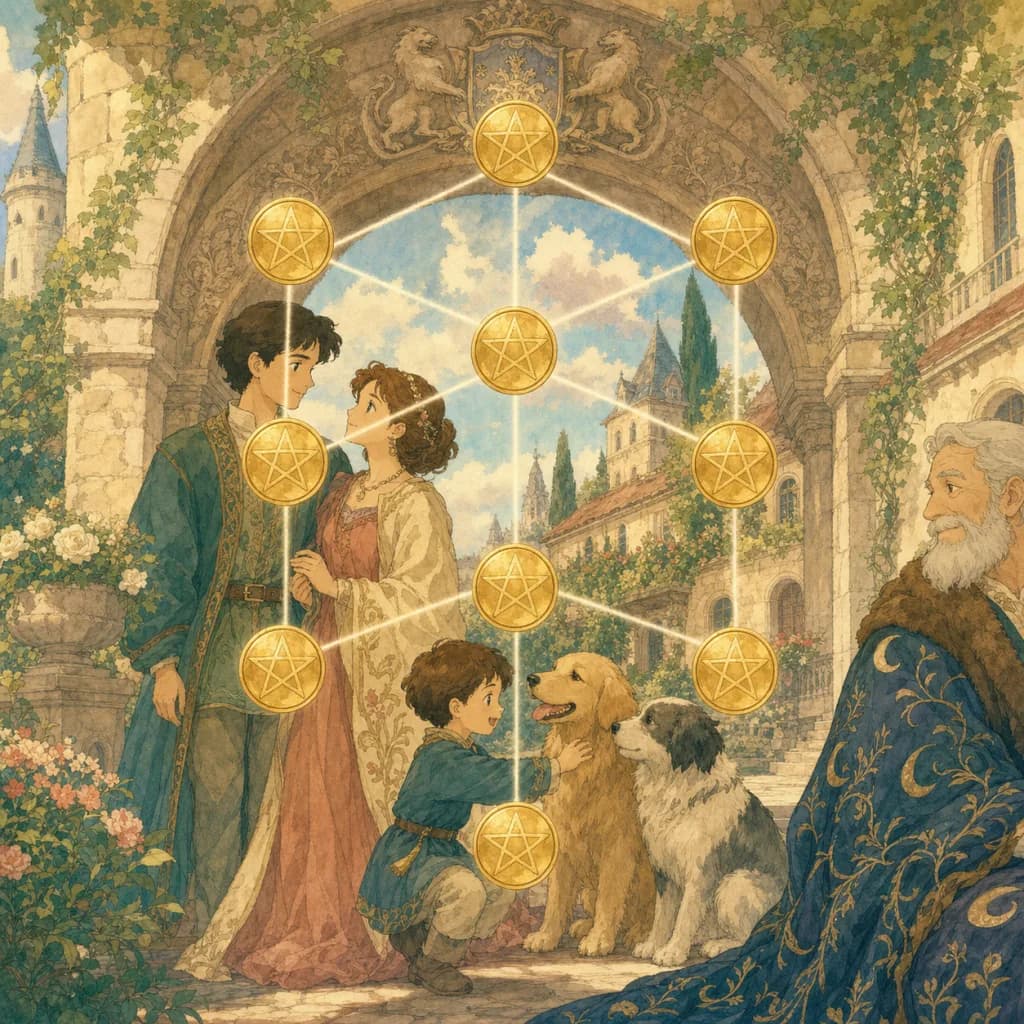
Three generations stand under a stone archway. A young couple talks, a child reaches for one of the dogs, and ten gold coins hang in the air over the whole scene like a chart of something bigger than this one family. It looks like the happiest card in the deck, and most guides treat it that way. Then you notice the old man. He is seated off to the right, at the very edge of the frame, half of his robe already outside the picture, watching the family he built without quite being inside it. The Ten of Pentacles is the card of legacy, and almost nobody asks why its founder is sitting where he is.
Most guides describe the wealth in detail and stop there. The man's seat is where the real story sits.
Quick Answer
Upright, the Ten of Pentacles means lasting wealth, family, inheritance, and the kind of security that outlives the person who built it — success that has hardened into a foundation other people can stand on. Reversed, it points to family disputes, money that arrives and leaves quickly, broken traditions, or a stable life that feels hollow when you stop to ask whether it is the one you actually wanted. As a Yes/No card it is a clear yes, especially for anything to do with home, long-term money, and commitment.
Basic Information
| Card Name | Ten of Pentacles |
| Suit | Pentacles |
| Arcana | Minor Arcana |
| Element | Earth |
| Astrological Correspondence | Mercury in Virgo |
| Yes / No | Yes |
| Upright Keywords | legacy, family, lasting wealth, inheritance, long-term security, belonging |
| Reversed Keywords | family disputes, fleeting success, broken traditions, financial instability |
Card Imagery & Symbolism
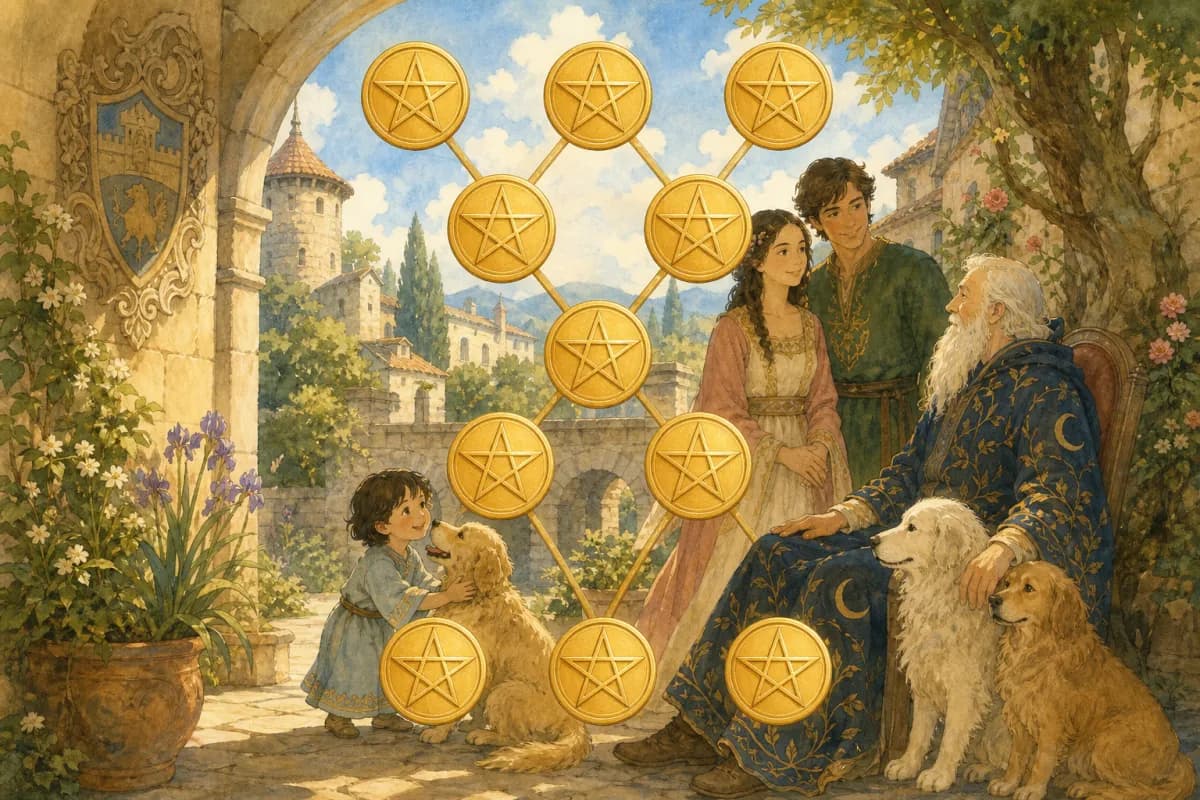
Pull up the Rider-Waite-Smith image and the first impression is abundance — a wealthy courtyard, robes, a settled family, coins everywhere. Pamela Colman Smith filled this card more densely than almost any other in the deck, and the meaning lives in how the figures are arranged across the scene.
Three Generations Under One Archway
The card holds an old man, a young couple, and a child — three living generations in a single frame. That is the rarest composition in the whole deck. Most cards show one person, sometimes two. Here the suit of Earth, the suit of slow accumulation, finally shows what all that patience was for: a whole line of people, three generations deep. The archway behind them is heavy and built, decorated with a family coat of arms — a settled, enclosed space where the Aces give you open landscapes. This family has arrived and stayed. They have a doorway with their own name carved over it.
The detail most guides skip: the couple are turned toward each other, the child toward the dog, and not one of them is looking at the old man. The legacy is functioning. The founder is already slightly invisible inside it.
The Old Man at the Edge, and His Two Dogs
The patriarch sits on the far right, partly outside the frame, dressed in a robe patterned with vines and crescent moons — a richer garment than anyone else wears. Two dogs press against him, and one of them he is touching. In Smith's visual grammar, dogs are loyalty and the domesticated, protected world. They press toward the old man while the young couple goes unattended by them. The animals acknowledge only him, while the people in the scene give their attention to each other.
I will come back to that seat, because it is the whole argument of this card.
Ten Coins in the Shape of the Tree of Life
Look closely at how the ten pentacles sit. They are arranged across the picture in the pattern of the Kabbalistic Tree of Life — the same map of the ten sephirot that runs from the divine source down to the material world. It is the only Minor Arcana card where the suit's symbols form a complete esoteric diagram laid over an ordinary domestic scene. Read that way, the coins become a structure that connects the highest thing to the most everyday thing, which is exactly what a healthy legacy does: it carries something down through generations of completely ordinary afternoons in a courtyard.
Ten of Pentacles Upright Meaning
Core keywords: legacy, family, lasting wealth, inheritance, long-term security, belonging.
Upright, this card is the moment success stops being yours alone and becomes something larger that holds you. It is the house that is finally paid off, the business that will run after you retire, the family that gathers without needing to be summoned. Picture the Nine of Pentacles — one woman enjoying her garden alone — and then move a generation forward. The Ten is that same wealth shared, rooted, and aimed squarely at the future.
The Pentacles suit has spent ten cards building toward this. The Ace was a single coin offered in a garden. The Ten is what that coin became when nobody spent it on the first impulse. So the upright card carries a particular flavor of security: the quiet of money that has been here long enough to stop feeling like a thrill. That quiet is the point. Lasting wealth is supposed to feel a little boring.
In a reading the Ten of Pentacles answers questions about permanence. Will this hold. Will this last past me. Can I build something here that does not evaporate. The card says yes, and it means the durable kind of yes — the foundation, not the firework.
It also speaks plainly to inheritance, in both the literal and the wider sense. Sometimes that is money or property passing down. The harder inheritance shows up just as often: a family name, a way of doing things, an expectation, a trade. The card asks you to notice what you are receiving from those who came before, and what you are about to hand on.
Ten of Pentacles Reversed Meaning
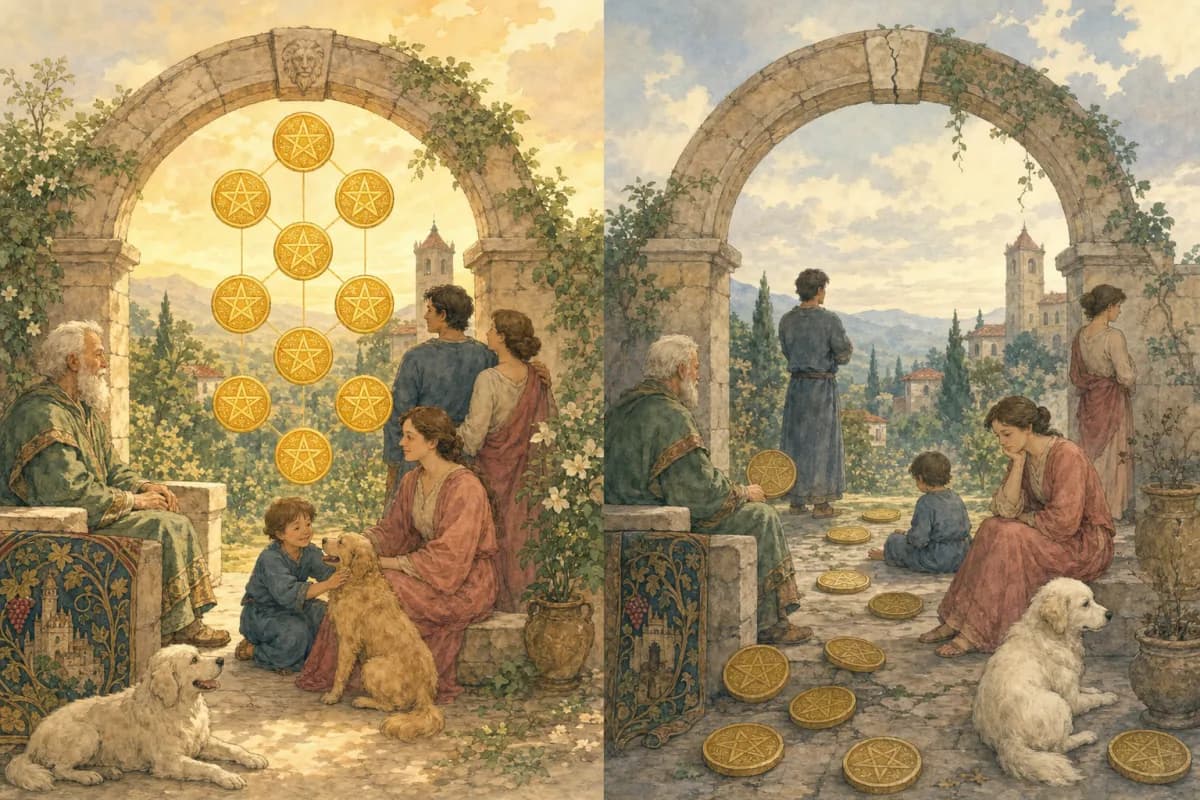
Some readers treat the reversed Ten of Pentacles as a catastrophe. In practice it usually means the foundation has developed a crack, and the crack tends to run through the family before it ever touches the bank account.
The most common reversed reading is the family dispute — the inheritance that splits siblings, the business that should have united a family and instead divided it, the holiday table where the money is fine and the people are not speaking. The gold stays intact while the relationships it was meant to protect quietly come apart.
A second flavor is fleeting success: money that arrives and runs straight back out, a win that does not take root, the lifestyle that looks settled from outside and is one bad month from collapse. Reversed, the Tree of Life pattern stops connecting top to bottom. The coins scatter into a pile of separate windfalls that never settle into a structure.
There is a third reading I lean on more than the textbooks do. Sometimes the reversed Ten is a person standing inside a completely successful life and feeling nothing in it. The security is real, the family is real, and somewhere along the way they built a legacy that answers everyone's question except their own. The card turned over asks the uncomfortable thing: is this stable life the one you chose, or the one you inherited and never questioned?
Tell these apart by what the rest of the spread is doing. Cups nearby usually point to the family rift. Reversed or fast-moving suits point to the money that will not stay. The Hermit, the Moon, or the court cards looking inward point to the quiet life that fits everyone but the querent.
Why the patriarch sits at the edge of his own legacy, not the center.
Every guide I read while researching this card describes the old man as the satisfied owner of the scene. He built the wealth, he sits among his family, he is content. That reading captures his mood accurately enough. It misreads his seat.
Look again at where Smith put him. He sits pushed to the far right, well clear of the courtyard's middle, his robe spilling past the border, one foot practically out of the picture. The composition's center belongs to the young couple and the coins. The man who made all of it possible is being painted on his way out of the frame.
This is deliberate, and it is the truest thing the card says about legacy. A legacy worthy of the name is the one thing you build that does not need you in the center anymore. The founder's success is measured by how far toward the edge he can sit while the thing keeps running. Picture the alternative: an old man dead center, hand on every decision, the family arranged around him like courtiers. That describes someone who never managed to let go, and the moment he died the whole arrangement would collapse. Smith drew a structure so sound that its maker has already drifted to a figure in the corner the children do not look at.
For three years early in my practice I read this card backwards. A woman came to me in Tokyo, in her sixties, asking about handing her small ceramics studio to her daughter, and she drew the Ten of Pentacles. I told her, the way the books do, that it meant she was at the center of a thriving family enterprise. She looked genuinely sad, and I did not understand why until much later. She was the man on the right, watching from the margin of her own studio. The card was telling her the studio had finally grown strong enough to survive her stepping to the edge of it — and that the stepping-back was itself the achievement. She had heard the card correctly before I talked her out of it.
So when this card appears about anything you have built — a company, a family, a body of work — ask whether it could run without you in the picture. That is the question the patriarch's seat is posing. The patriarch at the edge is the one figure in the card who has finished his job, and his seat at the margin is the proof.
Career & Money
This is one of the strongest career and finance cards in the deck, and its specialty is the long horizon. A raise or a new job belongs to smaller cards. The Ten works on the scale of decades. It is the pension that will actually be there, the business that becomes an institution, the partnership solid enough to outlast the people who signed it. When clients ask whether something will provide for them across whole decades, this is the card I want to see.
It frequently points to working within a family — a family business, a firm you join because your parent built it, money that moves down through the generations of a single family. That can be a gift and a weight at once, and the surrounding cards tell you which. The Ten gives stability. Whether that stability feels like freedom is a separate question the card leaves open.
For money specifically, it favors the structural move: the will, the trust, the long investment, the property you hold for decades. Its rewards go to patience that has already been spent — the groundwork you laid years ago finally paying out.
Family & Home
Of all seventy-eight cards, this is the one most about home in the deepest sense — home as a lineage, the feeling of belonging to people across time. Upright in a reading about family, it is genuinely warm: roots, continuity, a place you are held. It can mark marriages that join two histories, the decision to put down roots somewhere for good, or the quiet relief of a family that simply works.
The card also treats belonging as a basic human need. Some querents draw it when they are searching for exactly this and do not have it — when the question underneath the question is "where do I actually belong." The Ten answers by pointing at the archway. The thing you are looking for is built and durable and possible. The work is finding or making your way under it.
Ten of Pentacles Card Combinations
- Ten of Pentacles + The Hierophant — tradition reinforced twice over. This pairing reads as marriage, family institutions, or formally taking on a role passed down to you. It is one of the strongest "this becomes official and lasting" signals in the deck — a wedding, a family business made legal, an inheritance properly settled.
- Ten of Pentacles + The Tower — a foundation you assumed was permanent gets shaken. Read it as a sudden disruption to family or finances: an unexpected inheritance dispute, a house sold under pressure, a legacy that does not survive contact with reality. The Tower asks which parts of the structure were actually load-bearing.
- Ten of Pentacles + Five of Pentacles — security and its loss placed side by side. Often this is one family member shut out of the warmth the others share, or the fear of losing the stability you finally built. It can also mark the moment a once-secure family falls on hard times.
- Ten of Pentacles + Three of Pentacles — the long arc of building, from collaboration to completion. Read together they describe a project or enterprise that started as teamwork and matured into something lasting. A good omen for anything you are constructing to outlive the current phase.
- Ten of Pentacles + The Moon — surface stability hiding something unspoken. The family looks settled, the money is fine, and underneath runs a current nobody names: a secret about an inheritance, a tension at the table, a doubt about whether this life is truly yours. It is the quiet, hollow-life reading of the card showing up as a pairing.
- Ten of Pentacles + Ace of Pentacles — the full circle of the suit in one spread. The seed and the harvest together, the first coin and the lasting fortune. Read it as a new financial beginning that genuinely has the potential to grow into a lasting legacy, the kind of seed that takes root for good.
- The World + Ten of Pentacles — the long arc realized in concrete form. The World's sense of a whole cycle completed lands in the most material way possible: a legacy not just imagined but actually built, settled, and able to stand on its own. One of the deck's most affirming "you finished what you set out to build" pairings.
- Ten of Pentacles + Six of Pentacles — generosity maturing into structure. The shared-resources first move of the Six — giving from a position of having — is what eventually hardens into the generational stability of the Ten. Read together, they trace how an open hand today becomes a lasting foundation that holds other people up for decades.
Numerology & Astrological Correspondences
As a Ten, this card shows the suit of Earth having reached everything it set out to build, the full harvest of nine earlier cards of effort. Its correspondence is Mercury in Virgo: Mercury the messenger and inheritor of knowledge, Virgo the sign of careful, practical, generation-spanning craft, which is why the Ten reads as wealth that has been organized and maintained over a long time. In Japanese タロット占い (tarot uranai, tarot divination) I was taught to read this card through 家庭円満 (katei enman, household harmony) — a phrase that points at a home that holds together. What I find useful is that the term measures legacy by the warmth between people, the same test the reversed card applies when it asks whether the family is actually thriving.
Frequently Asked Questions
Is the Ten of Pentacles a yes or no card?
It is a clear yes, and one of the more reliable ones in the deck. It is strongest for questions about long-term security, family, home, marriage, and money that needs to last. The only caution is around emotional fulfillment — it says yes to stability and stays silent on whether that stability will feel exciting.
What does the Ten of Pentacles mean in a love reading?
Upright, it points to a relationship built for the long term: commitment, shared finances, family, putting down roots together. It is one of the deck's strongest cards for marriage and lasting partnership. For the emotional, feelings-focused read of this card, see our companion guide on the Ten of Pentacles as feelings.
Is the Ten of Pentacles about money or family?
Both, and the card's whole point is that it refuses to separate them. The wealth in the image exists to support the family, and the family is what gives the wealth meaning. When it appears, read the money and the relationships as one connected system.
What does the Ten of Pentacles reversed mean?
Most often a family dispute over money or inheritance, success that does not last, or a stable life that secretly feels empty. Total ruin is uncommon. The work is identifying which crack you are looking at — the people, the money, or the quiet doubt underneath both.
Does the Ten of Pentacles mean inheritance?
It can, quite literally — money, property, or a business passing down a generation. The non-material inheritance is just as common: a family name, a tradition, an expectation, a trade you are receiving or about to pass on. The card asks what is being handed across generations in both directions.
What is the difference between the Nine and Ten of Pentacles?
The Nine of Pentacles is solitary, self-made wealth — one person enjoying a garden they earned alone. The Ten takes that same wealth and roots it across a family and a future. The Nine is independence; the Ten is belonging. Moving from one to the other tracks a shift in the question you are answering: from building something for yourself to building something that will outlast you.
Why is the old man sitting at the edge of the card?
Because Smith drew legacy as something that no longer needs its founder in the center. The patriarch is pushed to the frame's edge to show a structure sound enough to keep running on its own. His position at the margin works as visual proof that what he built has grown bigger than him, a healthy sign that the legacy stands on its own.
Closing
The next time this card appears, look at the one thing you have built that matters most — a relationship, a career, a family, a craft — and ask the patriarch's question. Could it run without you holding the center? If the honest answer is no, the Ten of Pentacles is pointing you toward your next task: building the structure that survives your stepping back. Make one decision this week that moves you a single seat toward the edge.
Keep tracing the suit's arc with the Ace of Pentacles for where the legacy begins, or read how this card lands in matters of the heart in Ten of Pentacles as feelings.